In This Article
An all-terrain fat tire e-bike is an electric bicycle with oversized 4-inch (about 10 cm) tires, a motor and battery sized for hills and loose ground, and usually a suspension fork. The wide tires float over sand, snow and gravel while the motor flattens the climbs, so one bike can cover trail, road and winter.
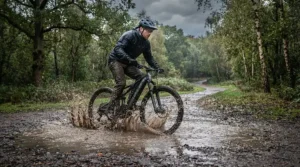
Fat bikes started life as a snow-and-sand curiosity (the fatbike entry on Wikipedia sketches that origin story). Add a motor and the category suddenly makes sense. Pedalling 35 kg of rubber and aluminum through slush on leg power alone? Brave. Doing it with 80 Nm of assist? Practical.
It’s early November, which in much of Canada means leaf season has quietly turned into “is that ice?” season. That’s when a versatile fat tire e-bike Canada riders can use year-round earns its keep. It shrugs off gravel concession roads in October, groomed snow in January and soft shoulders in April.
Below you’ll find seven real models, from budget to premium. Each is broken down by what the spec sheet means on an actual ride, what published reviewers say, and where it falls short. Then comes the stuff listings skip: tire-pressure presets, suspension logic, long-term costs and Canadian power rules. That last one matters because several bikes in this multi-surface fat tire e-bike review carry motor ratings above the 500 W limit most provinces use. Every one gets flagged.
Quick Comparison: The 7 Best All-Terrain Fat Tire E-Bike Models at a Glance
Prices below are ranges in Canadian dollars at the time of research. They shift constantly, so check current pricing before you commit.
| Model | Motor / Torque | Battery | Suspension | Price range (CAD) | Best For |
|---|---|---|---|---|---|
| Hiboy P6 | 750W (1,000W peak) / 80 Nm | 48V 13Ah | Front fork | C$1,000–C$1,500 | Budget starters |
| Lectric XPeak 2.0 | 750W (1,310W peak) / 85 Nm | 720 Wh or 960 Wh | 80 mm front fork | C$1,900–C$3,000 | Value hunters |
| Aventon Aventure 3 | 750W (1,188W peak) / 80 Nm | 733 Wh | 80 mm fork + seatpost | C$2,700–C$3,300 | Daily all-rounders |
| Velotric Nomad 2X | 750W (1,400W peak) / 105 Nm | 802 Wh | 120 mm air fork + rear shock | C$3,300–C$3,600 | Comfort and cargo |
| Biktrix Juggernaut Lite Plus 2 | 750W / 80 Nm | 960 Wh | Front fork | C$3,400–C$3,800 | Prairie distances |
| Surface 604 Boar Explorer | 500W (750W peak) / 80 Nm | 672 Wh or 960 Wh | Rigid (optional suspension fork) | C$3,000–C$3,500 | Rule-conscious riders |
| Eunorau Specter-S 3.0 | 1,000W mid-drive / 160 Nm | 48V 17.5Ah (+ optional 2nd pack) | Full suspension, 140 mm fork | C$3,800–C$4,200 | Steep off-road riding |
Read across the rows and the torque column tells a quieter story than the wattage column. Hiboy P6, Aventon Aventure 3 and Biktrix Juggernaut Lite Plus 2 all sit near 80 Nm, so what really separates them is battery size, sensor type and build quality rather than the “750W” badge. Velotric Nomad 2X and Eunorau Specter-S 3.0 play in a different league for hill torque. Lectric XPeak 2.0 delivers the biggest spec-per-dollar jump, and Surface 604 Boar Explorer is the only one rated at 500 W continuous, which matters a great deal in the regulations section later.
💬 Just one click — help others make better buying decisions too!😊
Multi-Surface Fat Tire E-Bike Review: The 7 Best Models for Canadian Riders
Everything in this section is built from manufacturer specifications and published third-party reviews. It is not hands-on testing. Where reviewer opinion is cited, it’s aggregated sentiment, and where the evidence was thin, I’ve said so. Availability on amazon.ca varies by listing and seller, so check the current listing and who services the bike.
1. Hiboy P6 — lowest-cost ticket into fat-tire riding
The Hiboy P6 is the budget doorway into the category: a 26 × 4-inch bike with a 750W rear hub motor (1,000W peak), a 48V 13Ah removable battery and a front suspension fork.
Best Buy Canada’s listing cites 80 Nm of torque, a 120 kg payload and a claimed 80–100 km in pedal assist (40–50 km on throttle alone). In plain terms, that’s enough shove for most suburban hills and a pack that carries a commuter through several days of short trips, as long as you actually pedal. Throttle-only riding roughly halves the distance. One published review put the weight near 65 lb (29.5 kg), several kilograms lighter than the premium bikes below.
Based on the spec comparison, the P6 suits gravel paths, snow-packed streets and the odd hill better than technical singletrack. I couldn’t find a torque sensor on the spec sheet, and that’s where pricier rivals feel more natural, so expect a slightly more on/off assist character. Reviewers consistently praise the value and climbing ability. The independent review pool I could verify is thinner than for the big U.S. brands, though, and brake specs have differed between listings (an early review noted mechanical discs, while current Canadian marketing mentions hydraulic). Confirm which version you’re ordering.
Pros:
- ✅ Lowest entry price in this lineup
- ✅ Removable battery for indoor charging
- ✅ Lighter than most rivals here
Cons:
- ❌ No torque sensor listed on spec sheet
- ❌ Brake spec varies between listings
Expect roughly the C$1,000–C$1,500 range at the time of research. Verdict: the cheapest sensible way to try the category, provided you budget for a good helmet and check the brakes.
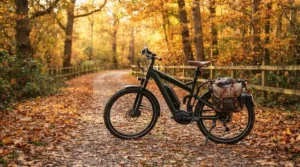
2. Lectric XPeak 2.0 — torque sensing at a bargain-bin philosophy
The Lectric XPeak 2.0 earned its reputation by putting upmarket parts on a modest price tag: a 750W Stealth M24 hub motor (1,310W peak) with 85 Nm of torque, a torque sensor, an RST Renegade fork with up to 80 mm of travel and hydraulic disc brakes.
The torque sensor is the headline upgrade over the first-generation bike. It reads how hard you’re pressing the pedals and meters assist to match, which feels more like cycling and less like a light switch on loose climbs. Buyers choose between a 720 Wh (about 97 km claimed) and a 960 Wh (about 129 km claimed) battery. Reviewers who tested it found the range met or beat the claim in good conditions. The bike is UL 2849 and 2271 certified.
The trade-off is mass. Lectric lists 64.5 lb without the 10.5 lb battery, and a published scale test of the full bike landed around 81–84 lb (37–38 kg). Testers also flagged tight pedal clearance on rough ground and tires that feel sluggish and puncture-prone. Opinions split on climbing: one tester found the motor underpowered on the steepest grades, while another found steep inclines manageable.
Pros:
- ✅ Torque sensor at a value price
- ✅ Two battery sizes to match your range
- ✅ Adjustable fork and hydraulic brakes
Cons:
- ❌ Heavy and bulky to lift or rack
- ❌ Stock tires draw puncture complaints
Pricing in Canada lands in roughly the C$1,900–C$3,000 range, depending on battery size, frame style and retailer. Verdict: the best spec-per-dollar play here, if you can live with the weight.
3. Aventon Aventure 3 — the smartest all-rounder
The Aventon Aventure 3 takes the fat-tire formula and refines it: a 750W hub motor (1,188W peak) with 80 Nm, a torque sensor, 26 × 4-inch tires, an 80 mm lockable fork and a suspension seatpost, plus Tektro hydraulic brakes. Fenders, a rear rack (59 lb limit) and integrated lights come standard.
Its 733 Wh pack is smaller than the 800–960 Wh batteries on pricier bikes. Even so, independent testers reached close to the advertised 65-mile (about 105 km) range. One owner-style report cited roughly 50–55 miles (80–89 km) in regular riding. That suggests the torque sensor meters power efficiently. Aventon’s app adds a motor lock and lets you tune assist. Its speed class can be unlocked to 45 km/h, so in Canada keep it set to 32 km/h unless you’re strictly off-road.
Reviewers praise range accuracy, suspension comfort and braking, and Aventon’s own blog notes an OutdoorGearLab Editors’ Choice for all-terrain and sand riding. Treat that one as brand-reported. The most consistent complaint is weight at about 77–78 lb (roughly 35 kg), which makes stairs a chore.
Pros:
- ✅ Torque sensor plus fork and seatpost suspension
- ✅ Rack, fenders and lights included
- ✅ Independent range tests near the claim
Cons:
- ❌ Around 35 kg to carry or rack
- ❌ Smaller battery than premium rivals
Expect about C$2,700–C$3,300 at the time of research. Verdict: if I had to pick one bike for a rider who wants no drama, this is the spec-sheet frontrunner.
4. Velotric Nomad 2X — full-suspension comfort with a truck-bed payload
The Velotric Nomad 2X is the plush one. It pairs a 750W hub motor (1,400W peak) delivering 105 Nm with a 120 mm adjustable air fork and an 80 mm rear shock. A 48V 16.7Ah (802 Wh) battery with an IPX7 rating and a 560 lb (about 254 kg) payload round out the package.
Full suspension changes the character of a fat bike. Instead of relying on tire pressure alone to absorb hits, you get two tunable shocks that keep the wheels planted over frost heaves, roots and rutted gravel. Velotric’s SensorSwap lets riders pick between torque and cadence assist. The 2-year warranty reportedly covers electrical components too, which is rare at this price.
The headline range of 75 miles (about 121 km) assumes light assist. One hands-on review put realistic mixed riding closer to 40–55 miles (64–89 km), which is still excellent but worth knowing upfront. At roughly 80 lb (36 kg), the Nomad 2X isn’t something you casually carry up a porch. Reviewers praise comfort and power in equal measure.
Pros:
- ✅ Full air suspension, front and rear
- ✅ Very high payload and towing rating
- ✅ Warranty reportedly includes electrical parts
Cons:
- ❌ Real-world range well under the claim
- ❌ Roughly 36 kg of bike
Expect around C$3,300–C$3,600 in Canada. Verdict: premium money for premium comfort. It’s the best fit for riders hauling gear or battered by rough roads.
5. Biktrix Juggernaut Lite Plus 2 — Saskatoon-built range for prairie distances
The Biktrix Juggernaut Lite Plus 2 comes from a Saskatoon company founded in 2014 and purpose-built, by its own account, for hard Prairie and northern terrain. The spec sheet lists a 750W rear hub motor with 80 Nm, a 48V 20Ah (960 Wh) battery, a cadence sensor and an estimated 100 km of range. Max load is 300 lb (about 136 kg).
What does that mean on a long, wind-flattened road? The big pack is the point. A 960 Wh battery gives you a real buffer for headwinds, cold-weather range loss and the 25 km commute that turns into 40 km because you took the scenic gravel. The cadence sensor is less nuanced than a torque sensor, so assist feels more like a steady push than a mirror of your effort. The reward is simplicity.
Biktrix’s own review page shows thousands of ratings with a strongly positive skew. It’s brand-hosted, so I weigh it accordingly. One retailer round-up notes limited physical showrooms, which matters if you want a test ride before buying.
Pros:
- ✅ Big 960 Wh pack for long distances
- ✅ Canadian company with local support
- ✅ Configurable build options
Cons:
- ❌ Cadence sensor, not torque sensing
- ❌ Few physical showrooms
Plan on roughly C$3,400–C$3,800. Verdict: a strong pick for rural riders who value service in their own time zone over cutting-edge sensors.
6. Surface 604 Boar Explorer — the one built around the 500 W rule
The Surface 604 Boar Explorer is a Vancouver-designed trail machine and the only bike here rated at 500 W continuous. Its geared hub motor peaks at 750 W and delivers 80 Nm, with a dropout-mounted torque sensor and a motor-assisted top speed of 32 km/h. Those numbers line up neatly with how most provinces define a bicycle.
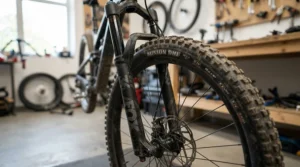
The tires are the star: Maxxis Colossus 27.5 × 4.5-inch rubber, among the fattest in this group. Pair them with a Shimano Alivio 9-speed, Tektro Auriga hydraulic brakes and a 672 Wh or 960 Wh battery, and you get a bike that one reviewer called one of the more capable-feeling hub-driven fat bikes. At about 50 lb (23 kg) in testing, it’s also far livelier than the 35 kg-plus competition.
The catch is the stock rigid fork. Reviewers note you can tame vibration by lowering tire pressure, and Surface 604 offers an optional inverted suspension fork. Another review found it heavier than expected, with a throttle weaker than top pedal assist. Some Canadian retailer listings show it as unavailable at times.
Pros:
- ✅ 500 W continuous rating fits provincial rules
- ✅ Torque sensor and enormous 4.5-inch tires
- ✅ Light by fat-bike standards
Cons:
- ❌ Rigid fork unless you upgrade
- ❌ Stock can be patchy at retailers
Expect roughly C$3,000–C$3,500 depending on battery and fork. Verdict: the sensible choice if staying on the right side of the law matters as much as trail grip.
7. Eunorau Specter-S 3.0 — 1,000 W mid-drive power for steep, serious terrain
The Eunorau Specter-S 3.0 is the one you buy when “hill” means “wall.” Its Bafang M620 mid-drive motor makes 1,000W and 160 Nm of torque, paired with torque-sensing assist, a throttle, a 48V 17.5Ah battery and an optional second 15Ah pack for up to 80 miles (about 129 km) on the dual-battery setup.
A mid-drive sends power through the bike’s own gears, which multiplies torque on climbs in a way a rear hub can’t. Add a 140 mm inverted fork, a DNM rear shock and four-piston hydraulic brakes, and you have a proper electric mountain bike on fat tires. It’s also heavy, with retailer listings citing roughly 40 kg.
Independent coverage mostly covers earlier Specter-S generations, whose reviewers were impressed by the motor and its climbing ability. Treat the 3.0 findings as likely but not guaranteed. There’s one big caveat for Canadians: at 1,000 W this is far beyond the 500 W definition, so think private land, off-road use and local rules, not a bike-lane commuter.
Pros:
- ✅ Mid-drive with 160 Nm of climbing torque
- ✅ Full suspension and 4-piston brakes
- ✅ Dual-battery option for long days
Cons:
- ❌ About 40 kg and premium priced
- ❌ Well above Canada’s 500 W bicycle limit
Expect around C$3,800–C$4,200. Verdict: unmatched hill power, but only for riders who understand where they can legally use it.
How the Seven Stack Up on Weight, Tires and Range Reality
| Model | Approx. weight | Tires | Claimed range | What to know |
|---|---|---|---|---|
| Hiboy P6 | ~29.5 kg (65 lb) | 26 × 4.0 | 80–100 km (pedal assist) | Brake spec varies by listing |
| Lectric XPeak 2.0 | ~37–38 kg tested | 26 × 4.0 | ~97 km / ~129 km | Heavy; tires draw complaints |
| Aventon Aventure 3 | ~35 kg | 26 × 4.0 | ~105 km | Tests came close to claim |
| Velotric Nomad 2X | ~36 kg | 26 × 4.0 | ~121 km | Reviewer saw ~64–89 km real |
| Biktrix Juggernaut Lite Plus 2 | Not confirmed | Fat tires | ~100 km (est.) | Cadence sensor, 960 Wh pack |
| Surface 604 Boar Explorer | ~23 kg tested | 27.5 × 4.5 | Up to ~105 km (large pack) | 500 W continuous rating |
| Eunorau Specter-S 3.0 | ~40 kg listed | 26 × 4.0 | ~129 km (dual battery) | Mid-drive, off-road class |
Two patterns jump out. First, claimed range runs ahead of reality for almost everyone, which is why the Aventon Aventure 3 looks so good: its independent tests stayed closest to the brochure. Second, the Surface 604 Boar Explorer is a genuine outlier on weight, and anyone who stores a bike in a basement will feel that gap every winter.
Your First 30 Days: Setup, Tire Pressure and Maintenance
Fat tire bikes forgive a lot, but they do demand a little ritual in the first month. Check the bolts on the stem, handlebar, pedals and axle nuts before the first ride, because shipping vibration loosens things. Squeeze each brake lever hard in the driveway. Hydraulic brakes need a few dozen stops to bed in, so avoid long, steep descents on day one.
Tire pressure is your biggest free upgrade. Starting points compiled from several retailer guides, converted to metric:
- ✅ Pavement: about 125–170 kPa (18–25 PSI), lower for comfort and higher for range
- ✅ Gravel and hardpack: about 85–125 kPa (12–18 PSI)
- ✅ Packed snow or wet sand: about 35–70 kPa (5–10 PSI)
- ✅ Soft sand or loose snow: lower still, stopping if the rim feels close to the ground
Save these as phone notes and carry a compact pump if your route changes surfaces mid-ride. On air forks, a common starting point is around 20–30 % sag, then adjust with the brand’s pressure chart. Lock the fork out for smooth climbs.
Maintenance is wonderfully dull. Every week, check tire pressure and wipe the chain. Every month, re-check bolt torque, lube the chain and inspect brake pads. After salty roads, rinse the drivetrain and dry it. In winter, bring the battery inside to charge at room temperature, since lithium cells dislike freezing.
Real-World Scenarios: Matching the Right Bike to Your Life
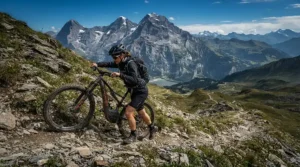
Specs only matter once they meet a real life. Here are three profiles with budget, environment and frequency spelled out.
The mixed-surface commuter. You ride 8 km each way, five days a week, on a gravel rail trail and a stretch of arterial road, with about C$3,000 to spend. You need lights, fenders and a rack because it’s a daily bike. The Aventon Aventure 3 is the logical pick: those accessories are included, the torque sensor keeps assist smooth in stop-and-go, and independent range tests suggest a charge will stretch across several commutes.
The rural long-hauler. Your commute or errands run 20+ km each way on gravel, and winter wind is a fact of life. With a budget near C$3,500, the Biktrix Juggernaut Lite Plus 2 gives you a 960 Wh pack and a Canadian service relationship, a combination that matters when the nearest bike shop is an hour away.
The weekend trail-and-bush rider. You want steep climbs, rough forest roads and long weekends, with C$4,000 or more to spend. The Eunorau Specter-S 3.0 offers the torque and suspension for that terrain, and the Velotric Nomad 2X is the more civilized alternative if comfort and payload matter more than raw grunt. If you’re testing the waters on a tight budget, the Hiboy P6 or Lectric XPeak 2.0 let you try the category without much financial risk.
✨ Ready to Check Current Prices?
🔍 Take your all-terrain fat tire e-bike search to the next level with these carefully selected models. Click on any highlighted bike name to check current pricing and availability. A little research now means more confident rides all season! 🚴♂️
How to Choose an All-Terrain Fat Tire E-Bike
Choose by matching three things: your terrain, the legal power rating where you ride, and how far you need to go between charges. Everything else is detail. Here are seven steps to work through.
- Map your surfaces. If you’re mostly on pavement with occasional gravel, prioritize weight and a lockable fork. If sand and snow dominate, prioritize tire width and low-pressure capability.
- Check the legal power rating. Most provinces cap bicycle-class e-bikes at 500 W continuous and 32 km/h assisted. CBC’s coverage of Prince Edward Island’s updated power-assisted bike rules shows how a bike beyond that ceiling can be treated as a low-speed motorcycle.
- Look at torque, not just watts. A 750W badge tells you little. Torque in newton-metres and the sensor type (torque versus cadence) shape how the bike actually climbs and feels.
- Size the battery honestly. A cautious planning figure for mixed riding is 10–15 Wh per kilometre. An 802 Wh pack should therefore land in the neighbourhood of 55–80 km, less in the cold.
- Pick your suspension level. Rigid is light and simple, a front fork suits most riders, and full suspension earns its weight on rough, rooty or rutted ground.
- Respect the scale. Weigh the bike against your stairs, trunk rack and storage. Thirty-five kilograms is a lot at the bottom of a flight of steps.
- Check service and warranty. Local support, battery warranty terms and certification such as UL 2849 and UL 2271 matter more than a small spec edge.
Off-Road vs On-Road Handling: What Changes With Fat Tires
Off-road vs on-road handling is where an all-terrain fat tire e-bike reveals its personality. On pavement, 4-inch tires bring extra rolling resistance and weight. At 125–170 kPa (18–25 PSI) the steering feels planted but slower, and low pressure can feel vague in hard cornering. One reviewer summed up the logic: on smooth roads fat tires add weight and drag, while on washboard gravel, sand and snow they shine.
Off-road, the story flips. Drop pressure and the tire spreads into a long contact patch that floats over sand and clings to packed snow. Braking on loose surfaces becomes far more predictable, since the tire deforms around obstacles instead of skipping off them. Weight matters here too. A bike like the Surface 604 Boar Explorer, at about 23 kg, flicks through switchbacks, while the roughly 36 kg Velotric Nomad 2X asks you to plan your lines and let its suspension do the work.
The takeaway is practical. You don’t choose between road and trail. You choose a tire pressure for each, and the bike has to be able to cope with both. Sorting that out before you buy keeps you from paying for performance you won’t use.
Suspension Fork Options: Rigid, Spring, Air or Full Suspension
Suspension fork options on fat-tire e-bikes fall into four camps, and each suits a different rider.
Rigid forks, like the stock fork on the Surface 604 Boar Explorer, keep weight and maintenance low. The big 4.5-inch tires carry most of the cushioning, and reviewers say lowering pressure keeps it comfortable. Surface 604 also sells an optional inverted suspension fork for riders who change their minds.
Spring (coil) forks are the budget standard. The Hiboy P6 and Lectric XPeak 2.0 use them, with the XPeak’s RST Renegade offering adjustable damping and up to 80 mm of travel. They’re simple and sturdy, though they can’t be tuned as finely as air.
Air forks let you set pressure by rider weight, a real advantage if you carry cargo or vary your load. The Velotric Nomad 2X runs a 120 mm adjustable air fork, and the Aventon Aventure 3 pairs its 80 mm fork with a suspension seatpost for a double dose of comfort.
Full suspension adds a rear shock. The Eunorau Specter-S 3.0 combines a 140 mm inverted fork with a DNM rear shock for steep, rough terrain, at the cost of weight and service points.
A warning for tinkerers: aftermarket forks for 26 × 4-inch bikes exist, but fit is fussy. Aventon’s own spec sheet lists a 135 mm front and 190 mm rear spacing, numbers worth checking before you buy anything. As a rule, 80 mm of travel handles commutes and gravel, while 100–140 mm suits roots, rocks and speed.
Versatile Fat Tire E-Bike Canada: Winter, Mud and Everything Between
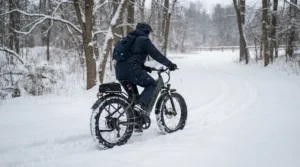
A versatile fat tire e-bike Canada riders can depend on has to handle four seasons that rarely behave. Autumn means wet leaves and gravel. Winter brings packed snow, slush and the occasional glare-ice surprise. Spring brings mud and salt-stained pavement. Summer brings sand, lakeside trails and the long-weekend loop.
Cold is the main variable. Lithium-ion batteries lose usable capacity as temperatures drop, so a large pack gives you margin. That’s why a 960 Wh battery on the Biktrix Juggernaut Lite Plus 2 or Surface 604 Boar Explorer feels like cheap insurance for winter. Charge indoors, store the battery at room temperature, and ride at lower assist levels to stretch range. If your commute includes ice, studded fat tires exist as an aftermarket option.
Salt is the quiet enemy. Rinse the drivetrain after salty rides and keep cables and fork stanchions clean. Canada-based support also matters more than usual, since a cracked fork in January shouldn’t mean waiting weeks on a cross-border shipment. Brands like Biktrix (Saskatoon) and Surface 604 (Vancouver) have long histories in the Canadian market, while larger international brands typically sell direct or through retailers, so confirm your warranty path.
All-Terrain E-Bike for Trails and Roads: Where Fat Tires Fit
An all-terrain e-bike for trails and roads sounds like a compromise, and it is, though a very good one when picked carefully. Fat tires give you float and grip off-road. At higher pressures they roll acceptably on pavement. The motor smooths over the weight penalty.
Here’s how the formula compares to the alternatives you might also be considering.
| Factor | All-terrain fat tire e-bike | Standard hybrid e-bike | E-mountain bike (narrower tires) |
|---|---|---|---|
| Snow and sand | Excellent | Poor | Limited |
| Pavement efficiency | Fair | Excellent | Good |
| Comfort on rough roads | Very good | Fair | Good |
| Weight | Heavy | Moderate | Moderate to heavy |
| Best For | Year-round riders (Aventon Aventure 3) | Paved commuters | Technical trails (Eunorau Specter-S 3.0 crosses over) |
The table says what you’d expect: fat tires win on soft surfaces and lose on pure road efficiency. If your week is 90 % pavement, a hybrid is the better buy. If winter, gravel or sand fill your calendar, the fat tire earns its extra kilograms. Trail access adds another wrinkle, since rules vary by province and park, so confirm where your bike class is allowed before heading out.
Common Mistakes When Buying an All-Terrain Fat Tire E-Bike
Most regrets come from the same handful of errors.
- Buying on wattage. Torque, sensor type and battery size matter more than a headline motor rating.
- Ignoring weight. The difference between 23 kg and 36 kg is invisible on a spec sheet and very visible at a doorstep.
- Trusting range claims. The Velotric Nomad 2X‘s headline of 75 miles shrinks to roughly 40–55 miles in a reviewer’s mixed riding. Plan with the lower number.
- Skipping the legal check. A 1,000 W bike like the Eunorau Specter-S 3.0 is a different legal animal from a 500 W rig.
- Overlooking service. The cheapest bike becomes expensive when a failed part means a month without it.
- Running the wrong pressure. Beach-soft tires on pavement drain your battery and feel vague. Rock-hard tires in snow skate.
Long-Term Cost and Maintenance: The Real Price of a Fat Tire E-Bike
Sticker price is only the entry fee. Over five seasons, a bike in the C$3,400 range works out to roughly C$680 a season before consumables. Energy is the smallest line item: a full charge of a 750–960 Wh pack costs a dime or two at typical Canadian electricity rates. The bigger costs are tires, brake pads, chains and, eventually, the battery. A replacement pack is usually the single largest maintenance expense and can run well into the hundreds of dollars, so check the brand’s current price and warranty.
| Tier | Models | Price range (CAD) | Value verdict |
|---|---|---|---|
| Budget | Hiboy P6, Lectric XPeak 2.0 (smaller battery) | C$1,000–C$2,000 | Highest spec per dollar, fewer refinements |
| Mid-range | Aventon Aventure 3, Surface 604 Boar Explorer | C$2,700–C$3,500 | Balanced build, sensors and service |
| Premium | Velotric Nomad 2X, Biktrix Juggernaut Lite Plus 2, Eunorau Specter-S 3.0 | C$3,300–C$4,200 | Comfort, range or climbing power you can feel |
The table points to a simple conclusion. Budget bikes win on the cost-per-season math. Premium bikes win when you ride daily, push the battery or need the support network. A middle-tier bike like the Aventon Aventure 3 is often the sweet spot for riders who want refinement without paying for features they won’t use.
Safety and Regulations: What Canadian Riders Need to Know
Here is the part many listings skip. Federally, a power-assisted bicycle has been defined as a pedalled vehicle with a motor rated at 500 W or less that stops assisting at 32 km/h on level ground. Transport Canada stepped back from regulating such bikes in 2021, leaving the details to provinces. Provincial rules still centre on the same 500 W and 32 km/h numbers, plus helmet and minimum-age requirements that vary by province.
Québec’s official e-bike page (in French) states the same ceiling for public roads: a motor of 500 W or less with assist that cuts out at 32 km/h. Prince Edward Island’s government guidance adds a 120 kg bike-weight limit, and warns that modifying a bike to exceed 32 km/h can push it into moped or limited-speed motorcycle territory.
Here’s what that means for this lineup. Only the Surface 604 Boar Explorer is rated at 500 W continuous. The others are marketed at 750 W to 1,000 W. Retailers and manufacturers often cite peak or nominal figures, and rules refer to continuous output, so the exact status of each bike can be a grey area. For road use, check your province’s rules, and treat the higher-powered bikes as best suited to private land and off-road use. Also confirm any municipal bylaws about trails.
On safety, look for third-party certification such as UL 2849 for the bike system and UL 2271 for the battery, charge on a hard surface away from exits, and never leave a battery charging unattended overnight.
FAQ: All-Terrain Fat Tire E-Bike Questions
❓ How much should I budget for a good all-terrain fat tire e-bike in Canada?
❓ Can a fat tire e-bike handle Canadian winters?
❓ Is a fat tire e-bike comfortable for daily road commuting?
❓ How far will a fat tire e-bike really go on one charge?
❓ Can I buy a fat tire e-bike on Amazon.ca?
Conclusion: Which All-Terrain Fat Tire E-Bike Should You Buy?
The honest answer is that it depends on your terrain, your budget and how far you ride. On the spec-and-review evidence, here’s how this multi-surface fat tire e-bike review shakes out. The Aventon Aventure 3 is the best all-rounder. The Lectric XPeak 2.0 is the value champion if you can live with the weight. The Hiboy P6 is the cheapest sensible entry. The Velotric Nomad 2X wins on comfort and payload. The Biktrix Juggernaut Lite Plus 2 is a long-range Canadian-built option. The Surface 604 Boar Explorer is the one built around the 500 W rule. The Eunorau Specter-S 3.0 is the king of steep, off-road power.
Whichever you choose, set your tire pressures, respect the legal limits and keep the battery warm. Before you ride a park trail, read Parks Canada’s e-bike bulletin for how bikes are defined there. A little preparation turns an all-terrain fat tire e-bike from a heavy toy into the most versatile bike in your garage.
Recommended for You
- E-Bike For Extreme Cold And -20°C Riding: 7 Tough Picks 2026
- E-Bike Rated For Sub-Zero Temperatures: 7 Best Picks 2026
- Cold-Weather E-Bike Under $2500 CAD: 7 Proven Picks (2026)
Disclaimer: This article contains affiliate links. As an Amazon Associate, I earn from qualifying purchases. If you purchase products through these links, we may earn a small commission at no additional cost to you.
✨ Found this helpful? Share it with your friends! 💬🤗
