

In This Article
An all-season e-bike for Canadian winters is a pedal-assist electric bicycle built to keep working below zero: wide or studded tires for snow and ice, a sealed, removable battery you can warm indoors, hydraulic brakes, fender mounts and a motor within your province’s legal limits. It is meant to replace the car or bus in January, not just July.
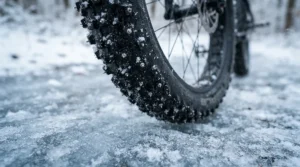
Here’s the thing the glossy summer ads skip: most e-bikes are fair-weather friends. Drop the temperature to minus fifteen, add a crust of plowed-over slush and a brine of road salt, and a skinny-tired commuter becomes an expensive coat rack. A bike built for Canadian conditions behaves differently. It floats over snow on tires four inches wide, shrugs off splash, and keeps its battery out of the cold until the last possible moment.
This guide compares seven real models, from budget step-throughs to a premium Bosch-powered cargo fat bike, and explains what each spec means once the mercury drops. It rests on spec sheets, retailer listings and published reviews, not on my own test rides, so read the analysis as informed reasoning rather than hands-on testing. Tire choice matters most. Fatbikes were developed for snow and sand and can run pressures as low as about 5 psi (roughly 35 kPa) for grip and float.
One practical warning before we start. Brands often sell near-identical models with different motor ratings, and stock on amazon.ca changes constantly. Confirm the exact model, motor rating and certification on the listing before you buy.
Quick Comparison: 7 Winter-Ready E-Bikes at a Glance
Here is the whole field on one screen. Prices are ranges at the time of research and will move.
| Model | Tires | Rated motor | Battery | Price range (CAD) | Best For |
|---|---|---|---|---|---|
| Hiboy EX6 Step-Thru | 20″ × 4.0″ | 500W (750W peak) | 48V 14.5Ah | C$1,000–C$1,800 | Short city commutes |
| Heybike Ranger 2.0 | 20″ × 4.0″ | 750W nominal (as listed) | 48V 12.5Ah | C$1,000–C$1,500 | Tight storage, folding |
| Hiboy P6 | 26″ × 4.0″ | 500W–750W (listings vary) | 48V 11.6–13Ah | C$1,200–C$1,900 | Budget gravel and city mix |
| Eunorau Fat-AWD 3.0 | 26″ × 4.0″ | 2 × 500W | 48V 15Ah | C$2,200–C$2,500 | Deep, unplowed snow |
| Taubik Tour | 26″ × 4.0″ | 500W (about 1,000W peak) | 48V 15Ah | C$2,000–C$2,800 | Certified, legal daily riding |
| Himiway D5 2.0 | 26″ × 4.0″ | 750W nominal (as listed) | 48V 15Ah | C$2,500–C$3,000 | Rough paths and trails |
| Tern Orox S12 | 27.5″ × 4″ | Bosch Performance CX mid-drive | 725Wh | C$8,500–C$10,000 | Cargo and long winter trips |
Read the table through two filters. If road legality matters most, the Hiboy EX6 Step-Thru and Taubik Tour are the cleanest fits, because their rated motors sit at 500W. The Heybike Ranger 2.0 and Himiway D5 2.0 list 750W nominal motors, above the cap most provinces use. If deep snow is your daily reality, the Eunorau Fat-AWD 3.0 and its two driven wheels stand out. The Tern Orox S12 is the only bike here built to haul serious loads in the cold.
💬 Just one click — help others make better buying decisions too!😊
Top 7 Picks: The Best All-Season E-Bike for Canadian Winters, Analyzed
Each pick below gets the same treatment: what the spec means in practice, who it suits, what published reviews report, and where the catch is. Watch the motor ratings in particular. Most provinces cap legal power-assisted bicycles at 500W and 32 km/h, so a “750W” label is a reason to check, not a reason to cheer.
1. Hiboy EX6 Step-Thru — easy mounting in bulky winter gear
Step-through frames sound like a comfort feature. In January they are a safety feature, because swinging a leg over a top tube in a parka and ski boots is how people tip over. The Hiboy EX6 Step-Thru gets that right.
It pairs a 500W rated rear hub motor (750W peak) with a 48V 14.5Ah battery, roughly 700Wh. The rated figure sits at the provincial ceiling, while the peak number only matters for short bursts up a driveway ramp. The 20″ × 4.0″ tires keep the bike low and stable. Hiboy’s Canadian page claims up to 120 km of range, but treat that as a gentle-assist, mild-weather figure, since cold typically trims 10–30 percent.
Based on the spec comparison, this is a short-hop commuter: 10–15 km each way, no brutal hills. The small wheels transmit frozen ruts more than a 26-inch bike would, and the IPX4 rating covers splashes, not pressure-washing.
Published reviews, including one from Momentum Magazine, describe smooth, dependable power from the 500W motor. In the sources I found, summer impressions outnumber deep-winter durability reports, so hunt for recent owner notes from cold climates.
Pros:
- ✅ Step-through frame for easy winter mounting
- ✅ 500W rated motor fits provincial limits
- ✅ Roughly 700Wh battery for a budget bike
Cons:
- ❌ IPX4 rating handles splashes only
- ❌ Front-only suspension on small wheels
Expect roughly C$1,000–C$1,800 depending on retailer and timing. For a legally sensible step-through, that is strong city-winter value.

2. Heybike Ranger 2.0 — folds to fit a condo storage closet
Storage is the unglamorous reason people quit riding in winter. A folding fat-tire bike answers it.
The Heybike Ranger 2.0 runs 20″ × 4.0″ tires, a 48V 12.5Ah (600Wh) battery, a Shimano 7-speed drivetrain and front suspension. It weighs about 33 kg (72 lb) and carries up to roughly 150 kg (330 lb). The 750W nominal motor (1,400W peak) is the catch. That exceeds the 500W cap most provinces apply, so verify whether the Canadian-market version is limited before riding on public roads.
On paper, this is the apartment-dweller’s pick: it folds for stairwells, car trunks and closets. At 600Wh, the smallest battery here, expect winter range to shrink fast, so keep rides short or carry the charger.
Reviewer sentiment is positive but based on small samples. One retailer listing shows about 4.2 out of 5 from roughly 60 ratings, and the newer Ranger S refresh scores around 4.6 across about 45 ratings at Best Buy in the U.S.
Pros:
- ✅ Folds for closets, trunks and stairwells
- ✅ UL 2849 certification listed on retailer pages
- ✅ Lighter than most fat bikes at about 33 kg
Cons:
- ❌ Listed 750W motor exceeds typical provincial cap
- ❌ Smallest battery in this lineup
Expect around C$1,000–C$1,500. It is good value for tight spaces, provided you confirm the motor rating.
3. Hiboy P6 — 26-inch fat tires without the premium price
Wheel diameter is the quiet hero of winter comfort. A 26-inch wheel rolls over frozen ruts and curb lips that a 20-inch wheel attacks the hard way.
The Hiboy P6 combines 26″ × 4.0″ tires with a hydraulic front fork and a removable 48V battery listed from 11.6Ah to 13Ah (roughly 560–620Wh), depending on the market. Retailer pages disagree on the motor, too. Hiboy’s Canadian page lists 500W with a 750W top end, while Best Buy Canada’s listing describes 750W with a 1,000W maximum. That mismatch matters, because the first figure fits provincial rules and the second does not.
Based on the spec comparison, it is the budget pick for rougher routes such as gravel paths and unplowed side streets. Confirm the motor and battery of the exact variant before ordering.
A Mountain Weekly reviewer found the P6 made commuting enjoyable, handled unpaved weekend detours, and singled out the puncture-resistant tires. The brand’s own page also shows high owner ratings, though a manufacturer’s page is hardly neutral ground.
Pros:
- ✅ 26-inch wheels roll over ruts easily
- ✅ Hydraulic fork smooths frozen washboard
- ✅ Removable battery charges indoors
Cons:
- ❌ Listings disagree on motor rating
- ❌ Battery capacity varies by variant
Typically around C$1,200–C$1,900. It is good value if you verify what you are actually buying.
4. Eunorau Fat-AWD 3.0 — two motors for unplowed snow
Single-motor fat bikes drive one wheel. When that wheel spins on glare ice, the bike mostly just whirs. Two driven wheels change the maths.
The Eunorau Fat-AWD 3.0 puts a 500W hub motor in each wheel (up to 110 Nm), with a 48V 15Ah main battery (about 720Wh), 26″ × 4.0″ Kenda tires, hydraulic disc brakes and torque-sensing pedal assist. An optional second 15Ah battery stretches the claimed range from about 65 km to about 130 km.
Deep, unplowed snow is where all-wheel drive earns its keep. The catch is legal: each motor is 500W, but the combined 1,000W exceeds the cap most provinces apply, so check how your province would classify it. At roughly 36–37 kg (79–82 lb), it also needs a ground-level storage spot.
At one U.S. reseller, owners gave it about 4.0 out of 5 across roughly 50 reviews, which reads as solid rather than spectacular. Reviewers of the earlier AWD generation praised the off-road fun but found range hard to pin down.
Pros:
- ✅ Two driven wheels grip loose snow
- ✅ Optional second battery doubles claimed range
- ✅ Torque-sensing assist feels natural
Cons:
- ❌ Combined motor power exceeds typical provincial cap
- ❌ Heavy at around 36 kg
Around C$2,200–C$2,500. It is best for rural or private-land riders who value traction above road legality.
5. Taubik Tour — Canadian-designed and UL 2849 certified
Safety certification is the least glamorous line on a spec sheet. It is also the one you’ll appreciate when the battery charges in your hallway all winter.
The Taubik Tour pairs a 500W Bafang geared hub motor (80 Nm, peaking near 1,000W) with a removable 48V 15Ah battery built from Samsung 21700 cells (about 720Wh). It rolls on 26″ × 4.0″ Kenda tires, tops out at 32 km/h and claims up to 100 km of range. One retailer lists the step-through at roughly 35 kg (77 lb).
One Canadian retailer’s research singled it out as the only UL 2849 full-system certified bike in its fat-bike shortlist, which matters for anyone charging indoors. The 2026 Tour S variant adds selectable torque or cadence sensing. By the spec comparison, this is the most “ride it legally and charge it calmly” option on the list.
Independent reviews are thinner than for the Hiboy P6 or Himiway D5 2.0. Most detail comes from Canadian dealers, so weigh the praise accordingly and ask for winter-owner feedback.
Pros:
- ✅ UL 2849 full-system certification
- ✅ 500W motor fits provincial limits
- ✅ Samsung cells in a removable battery
Cons:
- ❌ Heavy at roughly 35 kg
- ❌ Thin independent review coverage
Expect about C$2,000–C$2,800. You are paying for peace of mind, and in this case it is a fair trade.

6. Himiway D5 2.0 — full suspension and Maxxis rubber
Full suspension on a fat bike sounds like overkill until you meet a frozen, rutted bike path at 25 km/h.
The Himiway D5 2.0 uses a 750W rear hub motor (90 Nm) and a 48V 15Ah Samsung/LG battery (about 720Wh) certified to UL 2271. It adds Maxxis Minion 26″ × 4.0″ tires, Tektro hydraulic discs with 180 mm rotors, a Shimano 8-speed drivetrain and a 180 kg (400 lb) payload rating. Fork and rear suspension soak up the rough stuff, so the tires are not doing all the cushioning. One dealer listing includes a rear rack and fender kit, so confirm what ships on your listing.
That makes it the most trail-capable bike here short of the Tern, and name-brand tires are a rare premium touch at this price. But the listed 750W motor sits above the 500W cap most provinces use. Listings put weight anywhere from roughly 36 to 42 kg.
One published review scored its electronics and battery highly, though a 6-foot-tall tester found the stock seatpost too short. Check the seatpost against your height.
Pros:
- ✅ Full suspension tames frozen ruts
- ✅ Maxxis Minion tires grip confidently
- ✅ UL 2271-certified battery pack
Cons:
- ❌ Listed 750W exceeds typical provincial cap
- ❌ Heavy to lift or carry
Expect roughly C$2,500–C$3,000. It is excellent value for rough-path riders once the motor question is settled.
7. Tern Orox S12 — premium Bosch power for hauling in the cold
If the other six are winter tools, this one is a winter vehicle. It is a longtail cargo bike on fat tires, built to carry kids, groceries or camping gear through serious cold.
The Tern Orox S12 uses a Bosch Performance Line CX mid-drive (85 Nm, up to 340 percent assist) and a 725Wh battery, with a dual-battery option for long range. The 27.5″ × 4″ tires are stud-compatible per the REI listing, and BikeRadar highlights an insulated battery cover that helps in the cold. The bike weighs about 33 kg (73 lb) without the battery and handles a 172 kg (380 lb) total load.
A mid-drive works through the gears, so it climbs more naturally than a hub motor and keeps weight low and central. REI lists the bike as UL 2849 certified. For a family replacing a second car, the spec comparison makes the price easier to rationalize. For a solo commuter, it is more bike than you need.
Electric Bike Report described the Bosch motor as among the smoothest and most natural it has tested, while flagging the price as out of reach for many buyers.
Pros:
- ✅ Bosch mid-drive feels natural on climbs
- ✅ Insulated battery cover and stud-compatible tires
- ✅ Dual-battery option for long range
Cons:
- ❌ Premium price tag
- ❌ Large, heavy cargo frame
Around C$8,500–C$10,000. It is worth it only if you will use the cargo capacity.
Top 7 Side by Side: Strengths, Watch-Outs and Review Signals
| Model | Winter strength | Watch-out | Review signal | Price range (CAD) | Best For |
|---|---|---|---|---|---|
| Hiboy EX6 Step-Thru | Easy mounting | Small wheels, IPX4 | Positive magazine review | C$1,000–C$1,800 | Short urban hops |
| Heybike Ranger 2.0 | Folds away | 750W listed | About 4.2–4.6 on small samples | C$1,000–C$1,500 | Tight storage |
| Hiboy P6 | 26″ wheels | Conflicting listings | Positive review, own-site ratings | C$1,200–C$1,900 | Budget mixed routes |
| Eunorau Fat-AWD 3.0 | All-wheel drive | Combined 1,000W | About 4.0 across about 50 | C$2,200–C$2,500 | Unplowed snow |
| Taubik Tour | UL 2849 system | Thin independent reviews | Mostly dealer feedback | C$2,000–C$2,800 | Indoor charging, legal use |
| Himiway D5 2.0 | Full suspension | 750W listed, weight | Strong electronics scores | C$2,500–C$3,000 | Rough paths |
| Tern Orox S12 | Bosch, insulated cover | Price | Motor widely praised | C$8,500–C$10,000 | Cargo and families |
The pattern is clear: spend less and you accept legal ambiguity or small batteries, spend mid-range and you buy traction or certification, spend a lot and you buy refinement and cargo capacity. The Taubik Tour and Hiboy EX6 Step-Thru are the safest bets for legality, while the Eunorau Fat-AWD 3.0 and Himiway D5 2.0 reward riders who mostly stay off public roads. Remember that review signals come from small, mostly retailer-hosted samples, so treat them as direction, not proof.
✨ Ready to Ride Through the Worst of January?
🔍 Take your winter commute to the next level with these carefully compared options. Click on any highlighted product name to check current pricing and availability on amazon.ca, and confirm the motor rating on the listing before you order. A few small checks now mean far more confident rides all season! 🚴♂️
Seasonal Tire Swaps: Studs, Knobbies and the Pressure Game
Fat tires are not ice tires. They float on snow, but on glare ice a smooth-ish tread is still a skating rink. Studded tires carry steel or carbide studs and are the real answer for ice, while aggressive non-studded tires handle snow well but offer little extra on ice. That is why seasonal tire swaps are the cheapest big upgrade on any all-season e-bike for Canadian winters.
Before buying, check rim width. A 4.0-inch tire generally wants an internal rim width of about 60–100 mm, and standard mountain-bike rims are too narrow. Then run your numbers: for 4-inch tires, riders commonly cite around 18–24 psi on pavement, 5–10 psi on packed snow and 3–6 psi on loose snow. Use a low-pressure gauge, because a car gauge is useless below 10 psi.
Here is a simple swap routine:
- Swap to studs once overnight lows stay below freezing and ice patches appear.
- Break studs in gently for the first few rides.
- Start in a low assist level so the rear wheel doesn’t spin out.
- Recheck pressure weekly, since cold air drops pressure.
- Swap back when dry pavement returns, because studs wear faster on bare asphalt.
One tire-maker guide suggests studded tires last about two to three winter seasons with proper care. Budget for that when you price the bike.
Fender and Mudguard Accessories: Beating the Slush Spray
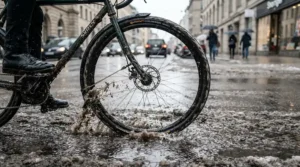
Wide tires throw wide spray. Winter cyclists have long relied on front and rear fenders, studded tires and flashing LED lights, and fender and mudguard accessories matter even more on a 4-inch tire because the spray plume is bigger. Here are the common problems and fixes.
- Problem: a soaked back and legs. Fit a full-length rear fender sized for your tire width. Measure tire width plus clearance to the stays, not just the wheel diameter.
- Problem: salt on the drivetrain. Salt-covered spring roads corrode exposed components, so a front fender and chain guard protect the parts that cost real money. Rinse and dry the bike and battery after snowy rides.
- Problem: slush packing under the fork crown. Choose fender stays with extra clearance, or a short extension flap, so slush has somewhere to go.
- Problem: a rattling fender in the cold. Plastic stiffens below zero. Tighten fasteners after the first cold snap and add thread-locker where the manufacturer allows.
Check what each bike includes before buying accessories. One dealer listing for the Himiway D5 2.0 includes a fender kit and rear rack, while the Hiboy EX6 Step-Thru, Heybike Ranger 2.0 and Hiboy P6 may need aftermarket fenders sized for 4-inch tires. The Tern Orox S12 needs a similar check on your configuration.
Off-Season Storage: Parking Your E-Bike and Battery Properly
Maybe you ride from November to March, or maybe you pause for a few months. Either way, off-season storage is about the battery, because lithium-ion cells hate extremes. Health Canada and Transport Canada advise using the battery that came with your e-bike, favouring UL-compliant systems and unplugging once charging is complete.
Follow this off-season storage routine:
- Store indoors. A dry spot at roughly 10–20°C is ideal, and cold garages and damp sheds are poor choices.
- Aim for a half charge. Guidance commonly points to 40–70 percent, because full or empty storage stresses cells.
- Check every 4–6 weeks. Batteries self-discharge, so top up if the level drops below about 30 percent.
- Avoid radiators and heaters. Rapid temperature swings can cause condensation inside the casing.
- Never charge a frozen battery. Let it warm indoors first, because charging below 0°C can permanently damage cells.
- Mind the summer too. Heat can permanently harm a battery, so skip hot sheds and sunny balconies.
For the bike itself, wash off salt, lubricate the chain, set tire pressure and cover it. Removable batteries on the Hiboy P6, Taubik Tour and Tern Orox S12 make this simple, since you can carry the pack to a closet.
How to Choose an All-Season E-Bike for Canadian Winters
Choose by traction first, legality second and battery third, then check certification, brakes, mounts and weight. Here are seven steps with the reasoning behind each.
- Start with traction. For snow, look for 4.0-inch tires, and add studs if you will meet ice. Traction decides whether you ride or walk.
- Check power legality. Transport Canada notes that the federal power-assisted bicycle definition stopped applying on February 4, 2021, leaving provinces to set rules. Most kept 500W and 32 km/h, so confirm yours.
- Size the battery for cold. Expect 10–30 percent range loss, and more at deep-freeze temperatures. A 700Wh pack gives more buffer than 500Wh.
- Demand certification. UL 2849 covers the whole electrical system, while UL 2271 covers the battery pack. Both are voluntary nationally, but they matter for indoor charging.
- Insist on hydraulic brakes and good lights. Winter stopping distances stretch and daylight shrinks.
- Confirm fender and rack mounts. Bolt-on accessories beat zip-tie hacks.
- Check weight, storage and service. A 36 kg bike needs a ground-floor spot, and a brand needs a warranty you can actually reach.
Features That Actually Matter (And Those That Don’t)
Marketing loves big numbers. Winter riding rewards a different list.
Features that matter:
- Torque over wattage. Newton-metres tell you more about climbing a snowy hill than a peak-watt label.
- Hydraulic disc brakes. They modulate better on slick surfaces.
- A removable battery. Carrying it indoors solves charging, storage and theft in one move.
- Sealing and ingress ratings. IPX4 covers splashes, so you still need to dry the bike after salt.
- Tire and rim compatibility. It decides whether studs are even an option.
- Integrated lights. Winter commutes happen in the dark.
Features that don’t:
- Peak watts. A 1,400W peak on a Canadian road is a marketing number, not a legal one.
- “Class 3” labels. Canada does not use those classes, and assist above 32 km/h falls outside the usual provincial definition.
- Top speed. Studded tires on ice reward restraint, not speed.
- Maximum range claims. A claim of 100 km on a mild day shrinks in January.
- Fancy app features. Nice to have, irrelevant when your fingers are numb.
Judged this way, the Taubik Tour and Tern Orox S12 score well on substance, while the Himiway D5 2.0 scores on traction and suspension.
Year Round E-Bike Canada: What Each Season Throws at Your Bike
A year round e-bike Canada setup has to cope with four very different seasons, and winter is only the loudest one.
Winter brings range loss, ice and cold-sensitive batteries. One retailer’s example shows a 60 km ride dropping to about 40 km in the cold. A larger battery gives you a buffer, and lower assist levels stretch it.
Spring is a salt-and-slush season. Freeze-thaw cycles punish cheap suspension seals, and road salt lingers on every exposed bolt. Rinse often and relube the chain.
Summer brings heat. High temperatures can permanently harm batteries, so avoid leaving the pack in a hot car or on a sunny balcony.
Fall means wet leaves and early darkness. Swap to knobby tires if needed, and check your lights before the clocks change.
Cold range loss is the part most buyers underestimate. Charge at room temperature, keep the battery indoors until you leave, and consider a neoprene cover for longer rides. On a bike like the Hiboy EX6 Step-Thru with about 700Wh, plan conservatively. On the Tern Orox S12, the dual-battery option and insulated cover address the problem more directly.
Fat Tire vs Regular Tire E-Bikes in Winter
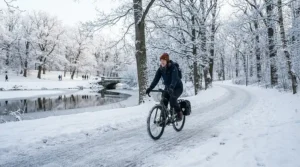
Fat tires are not automatically better. They float on loose snow and cushion rough ground, but they weigh more and roll with more resistance, which trims range. A medium-width bike with studded tires can be the smarter pick for plowed commutes with ice risk.
| Factor | Fat-tire (4.0″+) | Regular tire (under 2.5″) | Best For |
|---|---|---|---|
| Loose or unplowed snow | Floats and grips | Sinks and slips | Fat tire |
| Plowed lanes, ice patches | Needs studs | Studs work well | Regular with studs |
| Range | Lower (more rolling resistance) | Higher | Regular tire |
| Weight and handling | Heavier, stable | Lighter, nimble | Regular tire |
| Parts availability | Specialist parts | Widely available | Regular tire |
Look at the pattern. If your route is plowed and your biggest worry is ice, a narrower bike with studs gives you range and agility. If your route includes unplowed paths, trails or deep slush, fat tires remove most terrain conflicts. For most Canadians who want a single all-season bike, fat tires are the safer default, and the models above all use them.
All-Weather Commuter E-Bike: Matching the Bike to Your Route
The right all-weather commuter e-bike depends on distance, parking and route, so here are three hypothetical profiles.
Nadia, a grad student with a 12 km one-way ride on plowed bike lanes and a small apartment. Her round trip is 24 km. A Hiboy EX6 Step-Thru with studded tires handles that with margin, even after cold trims range. If storage is the real problem, the Heybike Ranger 2.0 folds, provided she confirms the motor rating.
Marcus, who rides 25 km each way on a mix of paths and roads. That 50 km round trip stresses a single 720Wh pack in winter, since one retailer’s estimate suggests a 100 km-rated bike may manage roughly 50–70 km near freezing. The Taubik Tour is a sensible fit, with careful assist use and a warm battery.
A family hauling two kids and groceries. The Tern Orox S12 is purpose-built for this, with cargo capacity, an insulated battery cover and the option of a second battery.
For any all-weather commuter e-bike, add lights, fenders and a lock, and rehearse your route on a weekend before trusting it on a workday.
Four Season Electric Bike Review: How to Separate Evidence From Marketing
Reading a four season electric bike review takes some skepticism. Several 2026 “best of” guides I came across were published by brands or retailers that sell the models they rank, which is a conflict of interest worth noticing.
Here is a quick filter:
- Who wrote it? Independent reviewers beat brand blogs.
- Does it mention winter specifically? Look for cold-weather range, battery handling and brake feel.
- Does it cover more than one season? First-month impressions miss salt corrosion and battery fade.
- Are claims specific? Vague praise is a red flag, while measured range and weight are green flags.
- What about support? One Canadian retailer’s guide reports that Rad Power Bikes filed for Chapter 11 in December 2025 and stopped selling new bikes in Canada, a reminder that warranty strength is part of any review.
Applying that filter, the Tern Orox S12 and Himiway D5 2.0 have the strongest independent coverage here, the Hiboy P6 and Hiboy EX6 Step-Thru have decent mixed coverage, and the Taubik Tour is mostly dealer-supported. That doesn’t make the Taubik Tour a worse bike. It means you should ask more questions.
Long-Term Cost and Maintenance: What Winter Really Costs
The sticker price is the beginning of the bill. Over several winters, a few items add up.
- Tires. Studded tires may last roughly two to three winters, and studs wear faster on dry pavement.
- Drivetrain and brakes. Salt shortens chain, cassette and pad life, so budget for cleaning and replacement.
- Battery. It is the priciest wear item, so confirm that replacements are available before buying.
- Accessories. Fenders, lights, a lock and a low-pressure gauge are small but real costs.
- Support risk. A bike with no reachable warranty can turn a minor fault into a total loss.
Cost per ride is an illustrative way to frame it. Say you spend about C$2,400 on a bike and ride 200 days a year for four years. That is 800 rides, or about C$3 per ride before maintenance. A cheaper bike that fails after two seasons can cost more per ride than a pricier one that lasts.
For an all-season e-bike for Canadian winters, the practical rule is to spend on certification, support and a larger battery, and economize on cosmetic extras.
Safety, Certification and Rules for Canadian Riders
Rules vary by province, and they are changing. Most provinces define a legal e-bike as having working pedals, a motor of 500W or less, and motor assist that cuts out at 32 km/h. Summary guides list helmets as required in most provinces, with minimum ages that vary. Ontario has also been consulting on a modernized, class-based framework, and British Columbia introduced its own e-bike regulation in 2024, so check current local rules. For a provincial example, the SAAQ explains Québec’s e-bike rules, including the 500 W and 32 km/h limits.
Bikes that exceed those limits may be classed as mopeds or motorcycles, with licensing, registration and insurance requirements. That is why this guide keeps flagging the Heybike Ranger 2.0, Himiway D5 2.0 and Eunorau Fat-AWD 3.0.
On battery safety, UL 2849 (full electrical system) and UL 2271 (battery pack) are voluntary at the national level, but Toronto has adopted a battery compliance rule requiring UL or CE certification, effective April 2024. Practically, charge indoors on a hard surface, never leave a charging battery unattended overnight if you can avoid it, and don’t use mismatched chargers.
FAQ
❓ Can you ride an electric bike in the snow in Canada?
❓ How much range does an e-bike lose in winter?
❓ Is it safe to charge my e-bike battery right after a cold ride?
❓ Do I need a licence or insurance for an e-bike in Canada?
❓ Do I really need fat tires for winter e-bike riding?
Conclusion
Winter does not have to end your riding season, but it does demand a better-chosen bike. The strongest all-season e-bike for Canadian winters pairs traction, a legally sensible motor, a battery with cold-weather buffer and credible safety certification, then backs it up with fenders, studded tire swaps and disciplined off-season storage.
If you want the safest legal bet, start with the Taubik Tour or the Hiboy EX6 Step-Thru. If storage is your constraint, look at the Heybike Ranger 2.0. If your route includes rough paths, the Himiway D5 2.0 and Eunorau Fat-AWD 3.0 bring real traction, as long as you confirm how your province would classify them. And if you are hauling people or loads, the Tern Orox S12 is in a league of its own, with a price to match. The Hiboy P6 sits in the middle as a budget 26-inch option, provided you verify the variant.
Whatever you choose, confirm the motor rating, the battery capacity and the certification on the exact amazon.ca listing, read recent winter-specific owner feedback, and plan your range with the cold in mind. Do that, and January becomes just another riding month.
✨ Ready to Pick Your Winter Ride?
🔍 Compare the models above, click any highlighted product name to check current pricing and availability, and get ready to turn the coldest months into your favourite riding season! 🚴♂️❄️
Recommended for You
- All-Terrain Fat Tire E-Bike: 7 Best Buys For Canada In 2026
- E-Bike For Extreme Cold And -20°C Riding: 7 Tough Picks 2026
- E-Bike Rated For Sub-Zero Temperatures: 7 Best Picks 2026
Disclaimer: This article contains affiliate links. As an Amazon Associate, I earn from qualifying purchases. If you purchase products through these links, we may earn a small commission at no additional cost to you.
✨ Found this helpful? Share it with your friends! 💬🤗
