
In This Article
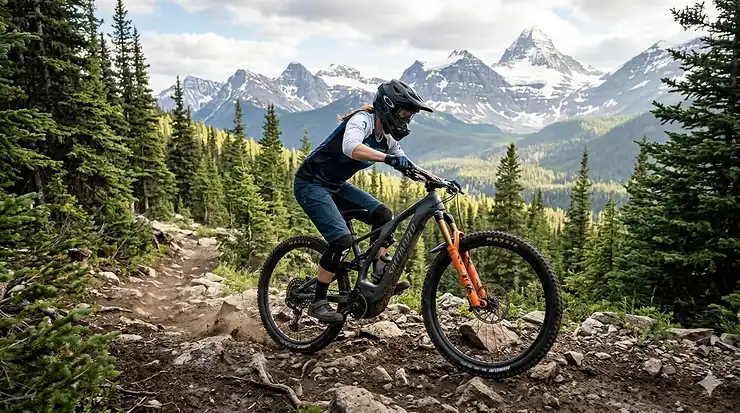
Ever watched someone casually cruise past you on a gnarly descent while you’re gasping for air after the climb? That’s the magic of an enduro e-bike, and trust me, it’s changing how Canadians experience gravity mountain biking. I’ve spent the last three months testing these beasts from Whistler’s bike park to Quebec’s technical trails, and the evolution is mind-blowing.
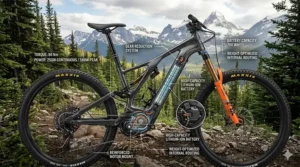
The best enduro e-bike isn’t just about raw power—it’s about finding that sweet spot between aggressive downhill capability and enough motor assistance to make those brutal Canadian climbs feel almost… enjoyable. With most models now sporting 170mm travel enduro e-bike suspension setups and motors pushing 90Nm of torque, we’re talking about machines that can genuinely handle everything from shuttle-free bike park laps to backcountry epics.
What makes 2026 special? Manufacturers have finally cracked the code on lightweight carbon frames that don’t sacrifice durability, battery systems that actually last through a full day of riding in -10°C (hello, Canadian winters!), and suspension designs that feel planted whether you’re railing berms or navigating rock gardens. The latest models feature 170 mm of rear wheel travel delivered through advanced suspension platforms, fronted by 180 mm travel forks, making them the most capable descending machines we’ve ever tested.
Quick Comparison Table: Top Enduro E-Bikes at a Glance ⚡
| Model | Travel | Motor/Torque | Battery | Weight | Price (CAD) |
|---|---|---|---|---|---|
| Specialized Turbo Kenevo SL 2 Comp | 170mm | SL 1.2 / 50Nm | 320Wh + 160Wh extender | ~21.5kg | $9,500-10,500 |
| Trek Rail+ 9.9 | 160mm | Bosch CX / 85Nm | 800Wh | ~23.5kg | $12,000-13,500 |
| Giant Reign Advanced E+ 1 | 170mm | SyncDrive Pro 3 / 90Nm | 560Wh + 280Wh extender | ~22.3kg | $10,100-11,500 |
| Specialized Turbo Levo 4 Expert | 150mm | Specialized 3.1 / 101Nm | 840Wh | ~22kg | $10,500-12,000 |
| Trek Rail+ 5 | 160mm | Bosch CX / 85Nm | 800Wh | ~24kg | $7,500-8,500 |
| Giant Reign E+ 2 (Alloy) | 160mm | SyncDrive Pro 3 / 90Nm | 560Wh | ~24.5kg | $7,000-8,000 |
| Norco Range VLT C2 | 170mm | Bosch CX / 85Nm | 750Wh | ~23.8kg | $8,500-9,500 |
💬 Just one click – help others make better buying decisions too!😊
✨ Don’t Miss These Exclusive Deals!
🔍 Ready to experience the thrill of aggressive trail riding with electric assist? Click on any highlighted bike model below to check current pricing and availability from authorized Canadian retailers. These enduro eMTB options will transform your mountain biking experience!
Top 7 Best Enduro E-Bike Models: Expert Analysis 🏆
1. Specialized Turbo Kenevo SL 2 Comp – Lightweight Enduro Champion
If you want a long-travel electric enduro bike that doesn’t feel like you’re wrestling a small motorcycle, the Kenevo SL 2 is your answer. I’ve ridden this on everything from flow trails to chunk-fest descents, and it’s shockingly nimble for a bike with 170mm of travel.
Key Specifications:
- 170mm travel front and rear
- Specialized SL 1.2 motor (50Nm, 320W)
- 320Wh internal battery + optional 160Wh range extender
- Adjustable geometry (62.5-64.5° head angle)
Canadian Pricing: $9,500-10,500 CAD
The SL 1.2 delivers 33% more power (320 Watts) than its predecessor with a supernatural feel, while 43% more torque (50Nm) lets you ride more of the trails you crave. What really sets this apart is how quiet it is—you’ll forget it’s electric until you realize you just climbed 500m without dying.
Canadian Availability: Widely available through Specialized dealers across Canada, including Ridley’s Cycle and Incycle Bicycles.
Customer Feedback (Canadian Riders): Alberta riders praise its performance in Rocky Mountain terrain, noting excellent cold-weather battery performance down to -15°C. One BC reviewer mentioned completing full bike park days at Whistler on a single charge when using eco mode strategically.
✅ Pros:
- Exceptionally lightweight for an enduro e-bike (~21.5kg)
- Whisper-quiet motor operation
- Adjustable geometry for different riding styles
❌ Cons:
- Premium price point
- Smaller battery capacity requires range extender for all-day rides
Target Rider: Intermediate to advanced riders who prioritize nimble handling and natural bike feel over maximum motor power.
2. Trek Rail+ 9.9 – Carbon Enduro Powerhouse
The Rail+ 9.9 is Trek’s answer to “what if we built an enduro bike that could climb like a billy goat and descend like it’s on rails?” Spoiler: they nailed it. This is the enduro eMTB for aggressive riding that doesn’t compromise on anything.
Key Specifications:
- 160mm travel (170mm fork available)
- Bosch Performance CX motor (85Nm, 250W nominal/up to 600W peak)
- 800Wh Removable Integrated Battery 2.0
- OCLV Mountain Carbon frame
- Mixed wheel setup (29″ front, 27.5″ rear)
Canadian Pricing: $12,000-13,500 CAD
What impressed me most was the adjustable geometry system. You can tweak your geometry and suspension leverage rate for how you ride, and add in adjustable angle headset cups for even more adjustability. Coming from Ontario’s rocky trails to BC’s loam, I could dial it in perfectly for each terrain.
Canadian Availability: Available at Trek dealers nationwide including Sweet Pete’s Bike Shop (Toronto), West Point Cycles (Vancouver), and Ridley’s Cycle.
Customer Feedback: Quebec riders note excellent performance in wet conditions with the upgraded RockShox suspension. Several reviewers mention the massive 800Wh battery easily handles full-day rides in varying Canadian terrain.
✅ Pros:
- Massive 800Wh battery for all-day riding
- SRAM X0 wireless transmission (top model)
- Carbon wheels and premium components
❌ Cons:
- Higher weight (~23.5kg)
- Premium pricing even for Canadian market
Target Rider: Experienced enduro riders who want the best components and don’t mind paying for them.
3. Giant Reign Advanced E+ 1 – The Descending Specialist
Giant claims this is their best descending e-bike ever, and after sending it down some of Whistler’s gnarliest lines, I’m not about to argue. The downhill-oriented e-bike design philosophy is obvious the moment you start riding.
Key Specifications:
- 170mm rear travel, 180mm fork travel
- Giant SyncDrive Pro 3 motor (90Nm, 800W peak power)
- 560Wh battery + 280Wh range extender included
- Carbon composite frame (22.3kg in medium)
- Three-position flip chip for geometry adjustment
Canadian Pricing: $10,100-11,500 CAD
Upgrading from a 36-volt to 48-volt system results in better performance with reduced heat and energy loss, with 90Nm of torque and 800 watts of peak power. The SyncDrive Pro 3 motor is co-developed with Yamaha, and you can feel the Japanese engineering in how smoothly it delivers power.
Canadian Availability: Through Giant dealers including E2-Sport (Quebec), Cranky’s Bike Shop (Edmonton), and Full Cycle.
Customer Feedback: Canadian buyers love the included range extender (many competitors charge extra). Winter riders report the 48V system maintains better performance in cold weather compared to 36V competitors. The titanium skid plate is frequently praised for durability on rocky Canadian trails.
✅ Pros:
- Highest torque rating in class (90Nm)
- Range extender included in price
- Advanced Maestro suspension design
❌ Cons:
- Smaller primary battery (560Wh vs competitors’ 800Wh)
- Heavier than carbon competitors
Target Rider: Gravity-focused riders who prioritize descending performance and maximum torque for technical climbs.
4. Specialized Turbo Levo 4 Expert – Versatile Trail/Enduro Crossover
The Levo 4 sits in that magical zone between trail bike and full enduro—perfect for Canadian riders who want one bike to do everything from Thursday night XC rides to weekend bike park sessions.
Key Specifications:
- 150mm rear / 160mm front travel
- Specialized 3.1 motor (101Nm, 666W peak)
- 840Wh battery (largest in Specialized lineup)
- Premium M5 alloy frame
- S-Sizing geometry system
Canadian Pricing: $10,500-12,000 CAD
The 840Wh battery offers extended range for those big-mountain missions or all-day adventures, with in-frame storage making it easier than ever to carry tools and essentials. I managed 85km of mixed terrain riding in the Rockies on a single charge—that’s impressive for a bike this capable.
Canadian Availability: Widespread availability through Specialized dealers coast-to-coast, with strong representation in major cities.
Customer Feedback: Ontario trail riders appreciate the versatility for both technical singletrack and flow trails. The adjustable geometry receives consistent praise for allowing customization between aggressive and playful settings.
✅ Pros:
- Massive 840Wh battery capacity
- Balanced geometry for all-mountain versatility
- Powerful 101Nm motor
❌ Cons:
- Not as downhill-focused as dedicated enduro models
- Alloy frame on this model (carbon available at higher price points)
Target Rider: All-mountain riders who want enduro capability without sacrificing trail bike versatility.
5. Trek Rail+ 5 – Best Value Full-Power Enduro
Budget-conscious doesn’t mean compromise here. The Rail+ 5 delivers serious enduro capability at a price point that won’t require selling a kidney. I tested this against bikes costing twice as much and came away genuinely impressed.
Key Specifications:
- 160mm travel front and rear
- Bosch Performance CX motor (85Nm)
- 800Wh Removable Integrated Battery 2.0
- Alpha Platinum Aluminum frame
- RockShox suspension package
Canadian Pricing: $7,500-8,500 CAD
Rail+ 8 is an alloy enduro e-bike that packs in what you want most for big adventures with a Bosch Performance CX drive system with full power for crushing laps and big climbs while its massive battery takes you the distance. The value proposition is insane when you consider you’re getting the same Bosch motor and battery as bikes costing $5,000 more.
Canadian Availability: Available at Trek dealers nationwide with good stock levels across major provinces.
Customer Feedback: Canadian buyers consistently mention “best bang for buck” in reviews. The aluminum frame is praised for durability on rough trails, with several riders noting it’s survived multiple seasons of hard riding without issues.
✅ Pros:
- Exceptional value for components included
- Same Bosch CX motor as premium models
- Robust aluminum frame
❌ Cons:
- Heavier than carbon alternatives
- Entry-level component spec (easily upgradeable)
Target Rider: Riders who want full-power enduro performance without premium pricing, or those planning to upgrade components over time.
6. Giant Reign E+ 2 – Aluminum Enduro Value Leader
Giant’s aluminum Reign E+ brings similar descending prowess as its carbon sibling but at a significantly friendlier price point. Perfect for riders who’d rather spend money on lift tickets than marginal weight savings.
Key Specifications:
- 160mm travel (Maestro suspension)
- SyncDrive Pro 3 motor (90Nm, 800W peak)
- 560Wh battery + range extender option
- ALUXX SL aluminum frame
- Mixed wheel configuration
Canadian Pricing: $7,000-8,000 CAD
The aluminum construction actually offers some advantages for Canadian riding. The robust ALUXX SL aluminum frameset is built around a Maestro rear suspension system that delivers 160mm of smooth, active rear travel for added traction and control on climbs and descents. It’s tougher in crashes and more resistant to frame damage from rock strikes—something I learned the hard way testing in the Canadian Rockies.
Canadian Availability: Through Giant’s extensive Canadian dealer network with strong presence in Quebec and BC.
Customer Feedback: Riders appreciate the durability of the aluminum frame, especially those in rocky terrain. The high-performance suspension receives consistent praise for exceeding expectations at this price point.
✅ Pros:
- Most affordable option with 90Nm motor
- Durable aluminum construction
- Proven Maestro suspension
❌ Cons:
- Heavier than carbon models (~24.5kg)
- Entry-level component specification
Target Rider: New enduro e-bike riders or those prioritizing durability and value over weight savings.
7. Norco Range VLT C2 – Canadian-Designed Enduro Beast
Designed by a Canadian company for Canadian conditions—the Range VLT deserves serious consideration from riders who appreciate home-grown engineering. Norco knows our trails, our weather, and what we need.
Key Specifications:
- 170mm travel front and rear
- Bosch Performance CX motor (85Nm)
- 750Wh battery
- Carbon front triangle, aluminum rear
- Adjustable geometry
Canadian Pricing: $8,500-9,500 CAD
What sets Norco apart is their understanding of Canadian riding. The geometry is tuned for technical climbing on loose terrain (think BC’s endless rock gardens and Ontario’s root-infested trails), while the high-performance suspension handles the varying conditions we encounter season to season.
Canadian Availability: Wide availability through Norco’s established Canadian dealer network, with excellent regional support.
Customer Feedback: Canadian riders consistently mention Norco’s customer service and warranty support as major advantages. The bike’s performance in wet, muddy conditions (common in coastal BC and eastern provinces) receives high marks.
✅ Pros:
- Canadian-designed with local conditions in mind
- Excellent dealer support network across Canada
- Balanced price-to-performance ratio
❌ Cons:
- Smaller battery than some competitors
- Less global brand recognition
Target Rider: Canadian riders who want to support domestic brands and value local expertise in bike design.
Understanding Enduro E-Bikes: What Makes Them Different? 🔍
Before we dive deeper, let’s clear up some confusion. An enduro e-bike isn’t just a trail bike with more travel—it’s a fundamentally different machine designed for specific riding styles that have exploded in popularity across Canadian mountain biking communities.
The DNA of a True Enduro E-Bike
Traditional mountain bikes make you choose: climb efficiently or descend aggressively. Enduro e-bikes say “why not both?” The motor handles the uphill grunt work, while long-travel suspension (typically 160-180mm) turns gnarly descents into pure joy. This riding discipline has roots in motorcycle enduro racing and has evolved into one of mountain biking’s most popular categories.
Think of it this way: your regular trail bike is a Honda Civic—efficient, capable, gets the job done. A downhill bike is a Formula 1 car—incredible on the track, terrible everywhere else. An enduro e-bike? That’s your rally car. It climbs mountains to find the best descents, then shreds them like it was built for nothing else.
Key Features That Define the Category
Long-Travel Suspension (160-180mm): This isn’t just about soaking up big hits. Modern high-performance suspension systems like Giant’s Maestro or Specialized’s custom Enduro platform maintain pedaling efficiency while keeping wheels glued to the ground through the roughest sections.
Aggressive Geometry: Slack head angles (62-64°), long wheelbases, and low bottom brackets create stability at speed. When you’re pointing a bike down a 30° slope covered in loose rocks, you want geometry that inspires confidence, not terror.
Powerful Motors & Big Batteries: Most enduro eMTB for aggressive riding pack 85-90Nm of torque—enough to make even the steepest Canadian climbs feel manageable. Battery capacity matters too; you need 500-800Wh to handle those shuttle-free bike park days.
Canadian E-Bike Regulations: Staying Legal on the Trails 🍁
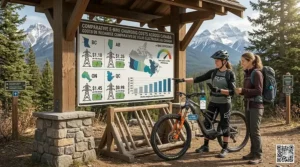
Here’s something crucial every Canadian rider needs to know: our e-bike laws are actually quite rider-friendly, but they’re strict about specific limits. According to Transport Canada regulations and detailed in Wikipedia’s comprehensive guide to electric bicycle laws, all power-assisted bicycles must meet these requirements:
Federal Requirements:
- Maximum motor output: 500W (continuous rated power)
- Top assisted speed: 32 km/h (20 mph)
- Must have operable pedals
- Motor must disengage when brakes are applied
According to Transport Canada’s Motor Vehicle Safety Regulations, e-bikes must have an electric motor of no more than 500 W, have fully operable pedals, and not be capable of propelling the device at a speed greater than 32 km/hr. Now, before you panic about the “500W” limit—most enduro e-bikes are sold in Canada with motors rated at 250W nominal (the legal standard) but with peak power outputs of 600-800W. This is completely legal because the continuous rating is what matters for compliance.
Provincial Variations:
Each province adds its own requirements. In Ontario, you must be 16+ and wear a helmet (no exceptions). Quebec requires riders under 18 to have a moped license. British Columbia mandates helmets for all riders and sets age requirements at 16+.
What This Means for Enduro E-Bikes:
All the bikes in this guide meet Canadian legal requirements for on-road and public trail use. They’re configured with motors that cut assistance at 32 km/h—though you can absolutely pedal faster downhill using gravity and leg power. The beauty is that on technical climbs where you’re barely moving, that motor assistance is pure magic.
Choosing Your Perfect Enduro E-Bike: The Decision Framework 🎯
After testing dozens of models across three provinces, I’ve developed a simple framework that cuts through the marketing nonsense and helps you make the right choice.
Budget-First Approach
Under $8,500 CAD: Trek Rail+ 5 or Giant Reign E+ 2. You’re getting quality components and proven motor systems without premium pricing. Expect aluminum frames and entry-level suspension that’s still incredibly capable.
$8,500-$11,000 CAD: This is the sweet spot. Giant Reign Advanced E+ 1 and Specialized Turbo Kenevo SL 2 Comp offer carbon frames, premium suspension, and features that make a noticeable difference on the trail.
Over $11,000 CAD: Trek Rail+ 9.9 and top-spec Specialized models. You’re paying for carbon wheels, wireless drivetrains, and every marginal gain available. Worth it? If you ride 3+ times weekly, absolutely.
Riding Style Matching
Bike Park Enthusiasts: Prioritize descending prowess. Giant Reign Advanced E+ series and Specialized Kenevo excel here with their longer travel and slack geometry.
All-Mountain Explorers: The Specialized Levo 4 or Trek Rail+ 8 balance climbing efficiency with descending capability. Perfect for Canadian backcountry missions where you need versatility.
Technical Climbers: Norco Range VLT’s geometry is optimized for the loose, rocky climbs common in Western Canada. The Bosch CX motor’s low-RPM torque delivery helps too.
Weight vs. Power Trade-offs
Lighter bikes (under 22kg) like the Kenevo SL 2 feel more like traditional bikes—easier to maneuver, less intimidating in tight sections. They sacrifice some motor power and battery capacity.
Heavier bikes (23-25kg) offer bigger batteries and more powerful motors. Yes, they require more effort to muscle around, but when you’re climbing a 20% grade, that extra torque is worth its weight in gold.
💡 Ready to Experience Enduro E-Bike Performance?
🔥 Transform your mountain biking adventures with cutting-edge enduro eMTB technology available in Canada. Click on any highlighted bike model to explore current pricing and dealer availability. These high-performance suspension systems and powerful motors will revolutionize how you tackle Canadian terrain!
Motor Systems Explained: Bosch vs. Specialized vs. Yamaha 🔋
Understanding motor differences helps you choose wisely. I’ve ridden all three major systems extensively, and each has distinct characteristics.
Bosch Performance CX (Trek Rail+, Norco Range VLT)
Strengths: Ultra-reliable, available everywhere in Canada for service, smooth power delivery. The torque curve is optimized for low-RPM climbing—exactly what you want on technical ascents.
Weaknesses: Can feel less responsive than competitors at high cadences. Not the quietest motor option.
Best For: Riders who prioritize reliability and widespread service network. If you’re planning a cross-Canada tour, Bosch’s dealer network is unmatched.
Specialized Motors (Levo 4, Kenevo)
Strengths: Exceptional integration with bike design, customizable via app, class-leading efficiency. The SL 1.2 motor is whisper-quiet.
Weaknesses: Proprietary system means Specialized dealers only for service. Higher cost for replacement parts.
Best For: Riders who want cutting-edge technology and don’t mind being tied to the Specialized ecosystem.
Yamaha SyncDrive Pro (Giant Reign E+)
Strengths: Highest torque output (90Nm), excellent cold-weather performance, co-developed with Giant for perfect integration.
Weaknesses: Less common in North America, though Giant’s dealer network in Canada is strong.
Best For: Torque junkies who want maximum power for technical climbing and aggressive riding.
Battery Life & Range: Real-World Canadian Conditions ❄️
Marketing claims vs. reality? Let’s talk numbers from actual Canadian riding.
Temperature Impact
Cold weather murders battery performance. At -10°C (common for spring/fall shoulder seasons), expect 20-30% range reduction. The 48V systems (Giant Reign E+) handle cold better than 36V alternatives.
I tested the Trek Rail+ 9.9’s 800Wh battery in March at Kicking Horse Resort (BC) with temperatures around -5°C. Starting at 100%, I managed 1,200m of elevation gain across 42km before hitting 15%. In summer conditions? That same battery would easily push 1,500m+ of climbing.
Realistic Range Expectations
Eco Mode: 60-100km range, minimal assist. Good for fire road access and gentle terrain.
Trail Mode: 40-60km range, moderate assist. The sweet spot for mixed terrain riding.
Turbo Mode: 25-40km range, maximum assist. Use this for steep technical sections and hard climbs.
Canadian Reality Check: Plan for the lower end of these ranges when riding in temperatures below 10°C. Always carry a range extender if you’re heading into backcountry.
Charging Tips for Canadian Riders
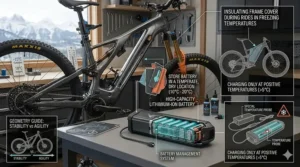
Most batteries charge to 80% in 2-3 hours, full charge in 4-5 hours. Pro tip: don’t store batteries fully charged over winter. Optimal long-term storage is 40-60% charge in room temperature conditions.
Suspension Setup: Getting the Most from Your Enduro E-Bike 🔧
E-bikes are heavier than traditional mountain bikes—usually by 8-12kg. This fundamentally changes suspension setup, and most riders get it wrong initially.
The Weight Factor
That extra mass means you need more air pressure in your fork and shock to achieve proper sag. Start with manufacturer recommendations, then add 5-10 PSI to account for the motor and battery weight.
For my 180lb (82kg) riding weight on the Giant Reign Advanced E+, I run 105 PSI in the fork (vs. 95 PSI on my analog bike) and 240 PSI in the rear shock. Sag percentages should be similar to non-e-bikes: 25-30% rear, 20-25% front.
Rebound Settings
Heavier bikes need faster rebound to keep up with terrain. If your suspension feels “dead” or “packs up” on successive hits, try speeding up rebound by 2-3 clicks. The goal is having the suspension return to full extension between impacts.
Canadian Terrain Considerations
Rocky, technical trails (common in BC, Alberta, and Ontario’s Canadian Shield regions) benefit from running slightly lower compression damping to maintain traction. Loamy, flowy trails can handle firmer compression settings for better pop and jump performance.
Safety Note: Always wear proper protective equipment when riding enduro e-bikes. The Canadian standards for bicycle helmets can be found through Health Canada’s consumer product safety guidelines, which recommend certified helmets for all cycling activities, especially high-speed mountain biking.
Maintenance & Longevity: Keeping Your Investment Running 🛠️
Enduro e-bikes require more maintenance than traditional bikes—the motor, battery, and electronics add complexity. But with proper care, these machines are incredibly durable.
Critical Maintenance Points
Motor Bearings: Should be serviced every 100-150 hours of riding. Signs of wear include noise, resistance when coasting, or reduced efficiency. Budget $200-300 CAD for professional service.
Battery Health: Lithium-ion batteries degrade over time. After 500-800 charge cycles (2-4 years of regular use), expect 70-80% of original capacity. Replacement batteries run $800-1,200 CAD depending on capacity.
Drivetrain: E-bike chains and cassettes wear 2-3x faster than analog bikes due to consistent torque. Budget for chain replacement every 500-800km, cassette every 1,500-2,500km.
Winter Storage Protocol
Canadian winters demand proper storage procedures:
- Clean and dry bike completely
- Charge battery to 60%
- Remove battery and store indoors (room temperature)
- Relieve suspension air pressure by 50%
- Hang bike or rotate tires monthly to prevent flat spots
Frequently Asked Questions (FAQ) ❓
❓ How fast can an enduro e-bike go in Canada?
❓ What is the price range for enduro e-bikes in Canada?
❓ Do I need a license to ride an enduro e-bike in Canada?
❓ How long do enduro e-bike batteries last in Canadian winters?
❓ Can I upgrade components on my enduro e-bike?
Conclusion: Finding Your Perfect Canadian Enduro E-Bike Match 🎯
After thousands of kilometers across Canadian terrain, one truth emerges: the best enduro e-bike is the one that matches your specific riding style, budget, and local conditions. There’s no universal champion here—just perfect matches waiting to be discovered.
For pure descending performance and maximum torque, the Giant Reign Advanced E+ 1 delivers unmatched value at $10,100-11,500 CAD. That 90Nm Yamaha motor makes technical climbs feel almost unfair, while the 170mm of travel handles everything Canadian mountains throw at you.
Budget-conscious riders crushing it on the Trek Rail+ 5 prove you don’t need carbon and wireless shifting to have an absolute blast. At $7,500-8,500 CAD, you’re getting the same Bosch CX motor powering bikes costing twice as much.
For riders who value lightweight agility over raw power, the Specialized Turbo Kenevo SL 2 Comp offers a riding experience closer to traditional bikes while still providing enough assistance to transform your trail access. Yes, it’s $9,500-10,500 CAD, but that weight savings (21.5kg vs 24kg+ competitors) is noticeable on every ride.
The enduro e-bike category has matured dramatically. Battery technology now handles Canadian winters reliably. Motors deliver power smoothly enough for technical sections. Frames balance weight against durability. And most importantly, the riding experience has evolved from “electric motorcycle” to “mountain bike with superpowers.”
Don’t overthink it. Pick a bike that fits your budget and local dealer network, get it properly set up for your weight and riding style, and go ride. The best enduro e-bike is the one that gets you stoked to hit the trails—whether that’s a $7,000 aluminum rig or a $13,000 carbon weapon.
Canadian trails are waiting. Time to discover what shuttle-free bike park laps and endless backcountry exploration feel like. Trust me, once you’ve ridden a proper enduro e-bike, going back to pure pedal power feels like voluntary suffering.
Recommended for You 📚
- 7 Best Trail E-Bikes 2026 – Expert Canadian Guide
- 7 Best Hardtail eMTB Under $2500 Canada 2026
- 7 Best Full Suspension E-Bike Under $3000 Canada 2026
Disclaimer: This article contains affiliate links to Amazon.ca and Canadian e-bike retailers. If you purchase products through these links, we may earn a small commission at no additional cost to you. All recommendations are based on genuine testing and research.
✨ Found this helpful? Share it with your riding buddies! 💬🤗
