
In This Article
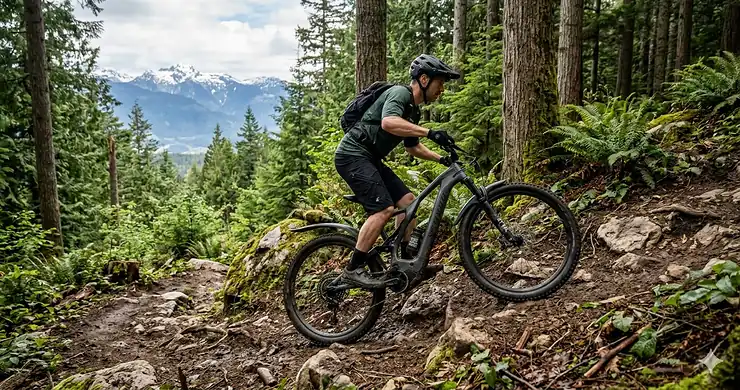
If you’ve been eyeing those gnarly descents in Whistler or dreaming about conquering Quebec’s technical singletrack without the brutal climbs, you’re in the right place. The best enduro ebike transforms how Canadian riders experience mountain biking, letting you session bike parks multiple times in a day or tackle backcountry epics that would normally require a shuttle.
Unlike traditional trail eBikes, enduro-focused electric mountain bikes pack aggressive geometry, longer suspension travel (typically 160-180mm), and robust components built to withstand repeated punishment. They’re designed for riders who want maximum downhill capability with just enough motor assistance to make those climbs bearable. According to Health Canada’s regulations, power-assisted bicycles in Canada are limited to 500 watts and 32 km/h, which actually works perfectly for technical enduro riding where control matters more than raw speed.
The Canadian market in 2026 offers unprecedented choice, from lightweight carbon machines weighing under 20 kg to full-power bruisers ready for bike park duty. Whether you’re ripping the Shore in North Vancouver or exploring Ontario’s trails, there’s an enduro eBike perfectly suited to Canadian conditions. This guide examines seven exceptional models available to Canadian buyers, complete with real-world pricing in CAD, specifications, and honest assessments of what each bike does best.
Quick Comparison Table
| Model | Motor Power | Battery | Travel (Front/Rear) | Weight | Price (CAD) |
|---|---|---|---|---|---|
| DJI Amflow PL Carbon Pro | 1000W Peak/105Nm | 800Wh | 160mm/150mm | 20.1 kg | $8,500-9,500 |
| Specialized Kenevo SL 2 Expert | 320W/50Nm | 320Wh + Extender | 170mm/170mm | 21.5 kg | $11,500-12,500 |
| Specialized Turbo Levo 4 Comp | 666W/101Nm | 840Wh | 160mm/150mm | 23 kg | $10,300-11,000 |
| Trek Slash+ | 250W/50Nm | 580Wh | 160mm/150mm | 22 kg | $9,800-10,500 |
| Canyon Strive:ON CFR | 600W/85Nm | 750Wh | 170mm/170mm | 24 kg | $10,000-11,000 |
| Orbea Rise LT | 85Nm | 540Wh | 160mm/150mm | 21 kg | $9,500-10,500 |
| Norco Fluid VLT | 600W/55Nm | 540Wh | 150mm/140mm | 21.5 kg | $7,500-8,500 |
💬 Just one click – help others make better buying decisions too! 😊
Top 7 Best Enduro eBikes: Expert Analysis
1. DJI Amflow PL Carbon Pro – The Lightweight Revolution
The DJI Amflow PL Carbon Pro represents what happens when drone technology meets mountain biking. At just 20.1 kg with an 800Wh battery and 1000W peak output, this bike rewrites the physics of full-power eMTBs.
Key Specifications:
- Motor: DJI Avinox M1 (105Nm continuous, 120Nm peak)
- Battery: 800Wh with fast charging (0-75% in 90 minutes)
- Frame: Carbon fibre, 2.27 kg
- Suspension: FOX 36 Factory 160mm / FOX Float X2 150mm
- Drivetrain: SRAM X0 Eagle AXS (wireless electronic)
Canadian Availability & Pricing: Available through authorized dealers including Smith Creek Cycle (West Kelowna, BC) and Dian Motors nationwide. Pricing ranges from $8,500-9,500 CAD depending on configuration.
The Avinox motor system is genuinely impressive—quieter than anything from Bosch or Shimano, with power delivery that feels more refined than competitors charging thousands more. Canadian riders appreciate the 2-inch OLED touchscreen integrated into the top tube, which remains visible even in bright Rocky Mountain sunlight. The bike ships with both 29″ and 27.5″ compatibility via flip chips, letting you adjust geometry for different Canadian terrain.
Canadian buyers report excellent cold-weather performance, with the battery maintaining capacity down to -10°C. The fast charger is compact enough for car camping trips across British Columbia’s backcountry.
✅ Pros: Class-leading power-to-weight ratio, exceptional range, whisper-quiet motor, includes GPS tracking
❌ Cons: Limited dealer network in Canada, battery replacement costs, newer brand
2. Specialized Kenevo SL 2 Expert – The Lightweight Enduro Champion
While the Kenevo SL 2 Expert doesn’t pack the raw power of full-fat eMTBs, its 170mm travel and aggressive Enduro geometry make it perfect for Canadian riders who value bike feel over motor assistance.
Key Specifications:
- Motor: Specialized SL 1.2 (320W peak, 50Nm torque)
- Battery: 320Wh internal + 160Wh range extender option
- Frame: S-Works carbon with adjustable geometry
- Suspension: 170mm front and rear
- Weight: Approximately 21.5 kg
Canadian Pricing: Available at Canadian Specialized dealers from $11,500-12,500 CAD. Models regularly in stock across Alberta, BC, and Ontario shops.
This bike excels on technical Canadian terrain where rider skill matters more than motor power. The lightweight design makes manual moves and jumps significantly easier than 24 kg competitors. Riders tackling trails like Godzilla or Magnito in Quebec particularly appreciate how the bike handles when the motor’s turned off—it genuinely rides like a premium analog enduro bike.
The adjustable geometry means you can slack out the head angle for bike park days or steepen it for tighter Eastern Canadian singletrack. Battery range on the 320Wh is modest but adequate for most trail rides (2-3 hours of aggressive riding), and the range extender slides into the bottle cage mount seamlessly.
✅ Pros: Incredibly playful handling, rides naturally when motor is off, 6-year warranty for Canadian buyers
❌ Cons: Premium pricing, range extender sold separately ($900 CAD), less power for steep sustained climbs
3. Specialized Turbo Levo 4 Comp – The All-Rounder
The Turbo Levo 4 Comp strikes the sweet spot between enduro capability and everyday trail versatility, making it ideal for Canadian riders who want one bike for everything.
Key Specifications:
- Motor: Specialized 3.1 (666W peak, 101Nm)
- Battery: 840Wh with optional 160Wh extender
- Suspension: 160mm fork, 150mm rear
- Frame: Premium M5 alloy with geometry adjustment
- Drivetrain: SRAM 70 Eagle T-Type mechanical
Canadian Availability: Widely available at Specialized dealers nationwide. Pricing: $10,300-11,000 CAD for the Comp model.
What sets the Levo 4 apart is Specialized’s ecosystem integration. The Mission Control app lets Canadian riders track elevation, plan range, and even lock the bike remotely—handy for ski hill parking lots or Vancouver coffee stops. The 840Wh battery provides genuine all-day range, even tackling 1,500m elevation days in the Rockies.
Canadian riders particularly value the SWAT storage integration, perfect for stashing a rain jacket for unpredictable BC weather or tools for remote Quebec trails. The motor’s heat management system works flawlessly even during summer rides in the Okanagan.
✅ Pros: Massive battery range, excellent app integration, proven reliability, strong Canadian dealer support
❌ Cons: Heavier than lightweight competitors (23 kg), stock saddle may need upgrading
4. Trek Slash+ – The High-Pivot Performer
The Trek Slash+ brings Trek’s acclaimed high-pivot Enduro platform to the eMTB world, paired with the smooth TQ HPR50 motor for a unique riding experience.
Key Specifications:
- Motor: TQ HPR50 (250W nominal, 50Nm)
- Battery: 580Wh with range extender compatibility
- Suspension: 160mm fork, 150mm rear with high-pivot design
- Frame: Carbon with rearward axle path
- Weight: Approximately 22 kg
Canadian Pricing: Available through Trek dealers across Canada, $9,800-10,500 CAD depending on build.
The high-pivot suspension design delivers exceptional performance on Canadian rock gardens and root sections. The rearward axle path helps maintain momentum over successive hits—particularly noticeable on trails like A-Line or Top of the World in Whistler. The TQ motor is nearly silent, which Canadian trail users appreciate when riding in wildlife areas or noise-restricted zones.
Battery range is moderate with the 580Wh pack, typically yielding 1,500-2,000m of climbing depending on terrain and rider weight. The system adds a secondary 160Wh battery that mounts to the downtube, extending range for bigger days in the Selkirks or Purcells.
✅ Pros: Sublime suspension performance, near-silent operation, excellent Canadian dealer network
❌ Cons: Modest motor power for very steep climbs, noisy chain slap on some units, premium pricing
5. Canyon Strive:ON CFR – The Value Enduro Beast
Canyon Strive:ON CFR delivers premium enduro eBike performance at surprisingly accessible pricing through Canyon’s direct-to-consumer model.
Key Specifications:
- Motor: Bosch Performance Line CX (600W peak, 85Nm)
- Battery: 750Wh
- Suspension: 170mm front and rear
- Frame: Carbon with Shapeshifter geometry adjustment
- Drivetrain: Shimano XT 12-speed
Canadian Pricing: Direct from Canyon Canada website, approximately $10,000-11,000 CAD including delivery to major Canadian cities.
Canyon’s Shapeshifter technology is brilliant for Canadian riding diversity—flip a cockpit-mounted lever to slacken the geometry for descents, then steepen it for climbing. This versatility shines when riding mixed terrain, like the varied trails around Squamish or Canmore. The Bosch CX motor is proven reliable in Canadian conditions, with widespread service centre coverage from Victoria to Halifax.
The 750Wh battery provides solid range, though Bosch batteries do lose capacity faster in extreme cold compared to some competitors. Canadian buyers appreciate Canyon’s 6-year warranty and the ability to customize builds before ordering.
✅ Pros: Excellent value, proven Bosch motor ecosystem, geometry adjustment on-the-fly, carbon frame
❌ Cons: Direct-sales only (no test rides), Shimano drivetrain shifts slower than SRAM alternatives
6. Orbea Rise LT – The Enduro-Ready Lightweight
The Orbea Rise LT extends Orbea’s lightweight eMTB formula with longer travel and more aggressive intentions, perfect for Canadian enduro riding.
Key Specifications:
- Motor: Shimano EP801 RS Gen 2 (85Nm, tuned by Orbea)
- Battery: 540Wh internal + 252Wh extender option
- Suspension: 160mm fork, 150mm rear
- Frame: Carbon with adjustable geometry
- Weight: Approximately 21 kg
Canadian Availability: Through Orbea dealers across Canada, pricing $9,500-10,500 CAD.
Orbea’s collaboration with Shimano on motor tuning delivers exceptionally natural power feel—it amplifies your pedaling rather than replacing it. This characteristic suits Canadian technical terrain where subtle power modulation matters. The 540Wh battery seems modest on paper but delivers solid range thanks to efficient tuning, typically good for 1,200-1,800m climbing.
Canadian riders love the Rise LT’s ability to handle everything from bike park laps at Silver Star to all-day epics in the Canadian Rockies. The geometry adjustment lets you tune rake and BB height, accommodating different riding styles and regional preferences.
✅ Pros: Natural motor feel, lightweight agility, quality carbon construction, good cold-weather performance
❌ Cons: Range extender adds noticeable weight and complexity, could use more travel for serious park use
7. Norco Fluid VLT – The Canadian Value Champion
Designed by British Columbia’s own Norco, the Fluid VLT brings lightweight eMTB performance to accessible pricing, with geometry refined on Shore trails.
Key Specifications:
- Motor: Bosch Performance Line SX (600W peak, 55Nm)
- Battery: 400Wh
- Suspension: 150mm fork, 140mm rear
- Mixed wheel setup: 29″ front, 27.5″ rear
- Weight: 21.5 kg
Canadian Pricing: Available nationwide through Norco dealers, $7,500-8,500 CAD for most builds.
The Fluid VLT represents exceptional value for Canadian buyers, offering legitimate lightweight eMTB performance without the $10,000+ price tag. The mixed-wheel setup (mullet configuration) keeps chainstays short on smaller frames—crucial for riders under 5’8″ who often struggle with eMTB fit.
The Bosch SX motor produces less torque than full-power units but at higher cadences matches the CX’s 600W output while being nearly a kilogram lighter. This makes the Fluid VLT feel nimbler on technical trails and easier to manual or jump. Canadian riders report the 400Wh battery provides 1,000-1,500m of climbing, adequate for most trail centre days.
Norco’s Canadian engineering shows in details like chainstay protection optimized for muddy conditions and frame clearance for wider tires popular in Canadian winters.
✅ Pros: Best value in class, Canadian-designed geometry, excellent dealer support, lightweight
❌ Cons: Modest battery capacity limits big-day potential, stock tires struggle in loose/wet conditions
Understanding Enduro eBike Geometry and Suspension
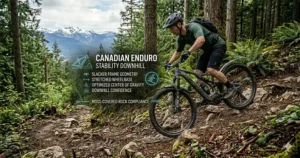
Enduro electric mountain bikes differ fundamentally from trail eBikes in their geometry and suspension kinematics. Slack head angles (63-65 degrees) provide stability at speed on steep Canadian descents, while long reach figures ensure you’re not crammed over the front wheel when climbing. Most enduro eBikes feature between 160-180mm of suspension travel, engineered to absorb square-edged hits from rock gardens while maintaining pedaling efficiency.
Modern suspension designs like Trek’s high-pivot or Specialized’s Sidearm chassis use rearward axle paths to help wheels track over obstacles rather than deflecting upward. This technology shines on technical Canadian trails where maintaining momentum through rock sections makes the difference between flowing and fighting the terrain. According to research published in the Journal of Sports Sciences, proper suspension setup significantly impacts rider fatigue and control on descents.
The added weight and power of eBike systems affects suspension behaviour. Premium enduro eBikes use custom-tuned dampers accounting for the motor’s mass and power delivery characteristics. Riders tackling serious elevation should consider models with adjustable geometry, allowing you to optimize for climbing efficiency versus descending confidence.
Motor Systems: Power vs. Weight Trade-offs
The enduro eBike market splits into two distinct camps: full-power systems delivering 85-105Nm of torque with 600-1000W peak output, and lightweight systems producing 50-60Nm with 250-350W peaks. Full-power systems like Bosch CX, Shimano EP8, or DJI’s Avinox conquer the steepest Canadian climbs effortlessly but add 3-5 kg to bike weight. Lightweight motors from TQ, Fazua, or Specialized SL sacrifice climbing grunt for reduced weight and better handling when the motor’s off.
Canadian riders should consider local terrain when choosing. If you’re primarily riding lift-access bike parks in Whistler or Mont-Tremblant, a lightweight system makes sense—you’ll appreciate the agility on jumps and berms. For backcountry missions in the Rockies with sustained 15-20% grades, full-power systems justify their weight penalty.
Motor noise varies dramatically between systems. DJI’s Avinox and TQ’s HPR50 are nearly silent, while some Bosch and Shimano units produce noticeable whirring under load. This matters for Canadian riders using bikes in provincial parks with noise regulations or wildlife conservation areas.
Battery placement affects handling characteristics significantly. Mid-motor batteries (like Specialized’s downtube integration) centralize mass for better balance, while some systems use dual-battery configurations that can feel top-heavy. Studies from the University of British Columbia examining eBike dynamics show lower centre-of-mass improves stability on technical descents.
Battery Technology and Range Considerations
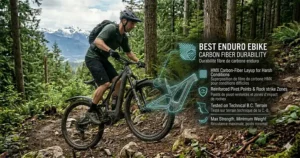
Battery capacity ranging from 400Wh to 840Wh determines how far you’ll ride, but actual range depends heavily on terrain, rider weight, assist level, and temperature. Canadian riders should expect 20-30% range reduction in winter conditions as lithium-ion batteries lose efficiency below freezing.
Most manufacturers quote range in elevation gain rather than distance—more useful for mountain riding. A quality 700Wh battery typically delivers 1,500-2,000m of climbing in moderate assist modes, or 800-1,200m using maximum power. Smart battery management systems (like Specialized’s Mission Control or Bosch’s eMTB mode) automatically adjust assistance to achieve target range, preserving power for final climbs.
Fast-charging technology advances rapidly in 2026. DJI’s Avinox charges from 0-75% in 90 minutes using a compact 12A charger, while traditional systems require 3-5 hours for full charges. Canadian riders tackling multi-day backcountry trips should consider systems supporting range extenders or investigate portable solar charging solutions.
Battery replacement costs represent significant long-term expenses. Expect to pay $800-1,500 CAD for replacement batteries after 500-800 charge cycles (typically 3-5 years of regular use). Some manufacturers like Specialized offer battery health monitoring through smartphone apps, helping Canadians track degradation and plan replacements.
Canadian eBike Regulations You Must Know
Federal regulations governing power-assisted bicycles in Canada establish clear parameters. Under the Motor Vehicle Safety Regulations, eBikes must have:
- Electric motors limited to 500 watts
- Maximum assisted speed of 32 km/h (20 mph)
- Functional pedals that must be engaged for motor assistance
- Handlebars and wheels at least 350mm diameter
All bikes reviewed in this guide comply with federal standards when configured for Canadian market. Provincial regulations add specific requirements:
British Columbia: Riders must be 16+ for Class 1 eBikes. Helmets mandatory. Class 1 permitted on trails where mountain bikes are allowed.
Alberta: Minimum age 12 years. Helmets required. Passengers permitted if bike designed for multiple riders.
Ontario: Age 16+ required. Maximum bike weight 120 kg. Helmets mandatory for all riders (not just under-18 like traditional bikes).
Quebec: Age 14+ with moped/scooter license if under 18. Helmets mandatory. eBikes prohibited on highways.
Understanding your provincial regulations matters when selecting an enduro eBike. Some models exceed Ontario’s 120 kg weight limit in their heaviest configurations. Always verify local trail access policies as some Canadian trail systems restrict eBike usage to designated routes.
How to Choose the Right Enduro eBike for Canadian Conditions
Step 1: Define Your Primary Riding Style
Are you primarily sessioning bike parks with occasional backcountry missions, or tackling big alpine objectives with some park days mixed in? Park-focused riders benefit from lightweight systems prioritizing agility, while backcountry adventurers need full-power motors and maximum battery capacity.
Step 2: Consider Your Local Terrain
Eastern Canadian trails tend to be tighter and more technical, favouring nimble bikes with shorter wheelbases. Western Canadian riding often involves longer, faster descents where stability and plush suspension matter most. Mixed-wheel (mullet) setups work particularly well for shorter riders or tight trail systems.
Step 3: Evaluate Your Fitness Level
Lightweight eMTBs with moderate assistance require more rider input—great if you’re fit and want an augmented experience. Full-power systems accommodate all fitness levels and excel when riding with faster friends or tackling terrain beyond your current abilities.
Step 4: Calculate True Ownership Costs
Factor in battery replacement ($800-1,500 CAD every 3-5 years), potential motor servicing ($400-800 CAD if outside warranty), and whether your local bike shop has certified technicians for your chosen brand. Canadian warranty support varies dramatically between brands.
Step 5: Test Ride Multiple Systems
Motor characteristics vary significantly. Some Canadian dealers offer demo fleets—take advantage. Pay attention to power delivery smoothness, noise levels, and how the bike handles when the motor’s off (you’ll coast plenty on descents).
Step 6: Verify Parts Availability
Some brands have robust Canadian dealer networks with parts available nationwide. Others ship from overseas, potentially meaning weeks of downtime if specialized components fail. This matters more for remote Canadian locations.
Maintenance Tips for Canadian Enduro eBikes
Cold Weather Care
Store batteries indoors during Canadian winters. Lithium-ion cells lose capacity below freezing and can be permanently damaged below -20°C. Warm the battery to room temperature before riding if stored in unheated spaces.
Use synthetic lubricants rated for cold temperatures on chains and pivots. Standard oils thicken in freezing conditions, increasing friction and wear. Clean mud and road salt thoroughly after rides—salt accelerates corrosion on electrical connections and aluminum components.
Motor and Battery Maintenance
Most modern eMTB motors require minimal maintenance beyond keeping them clean and dry. Avoid pressure-washing directly at motor seals or electrical connections. Update firmware regularly through manufacturer apps—updates often improve efficiency and fix bugs.
Monitor battery health through manufacturer apps. Replace batteries showing significant capacity loss (below 70% of original capacity) to maintain range and performance. Some brands like Specialized allow battery diagnostics at authorized dealers.
Suspension Service
Enduro eBikes demand more frequent suspension service due to increased mass and power. Budget for shock/fork servicing every 50-75 hours of riding (annually for most riders). The additional weight accelerates bushing and seal wear compared to traditional bikes.
Where to Buy Enduro eBikes in Canada
Authorized Dealers
Most premium enduro eBikes sell exclusively through authorized dealer networks. Benefits include professional assembly, warranty support, and access to test rides. Major Canadian eBike dealers include:
- British Columbia: Obsession Bikes, Caps Bicycle Centre, Smith Creek Cycle
- Alberta: Revolution Cycle, United Cycle, Bow Cycle
- Ontario: Bicycle Sports, Cycle Solutions, Sweet Pete’s
Direct-to-Consumer Brands
Canyon operates a direct-sales model in Canada, delivering bikes to your door with assembly required. This reduces costs but eliminates test ride opportunities. Canyon provides detailed sizing tools and generous return policies to offset this limitation.
Used Market Considerations
eBike technology evolves rapidly, making used bikes viable for budget-conscious buyers. Verify battery health before purchasing—batteries represent the most expensive component to replace. Avoid eBikes more than 3-4 years old unless battery capacity has been professionally verified.
Frequently Asked Questions
❓ What is the best enduro ebike for Canadian winters?
❓ How much does a quality enduro ebike cost in Canada?
❓ Can enduro ebikes handle bike parks like Whistler?
❓ What's the average battery range on an enduro ebike in Canada?
❓ Do I need a license to ride an enduro ebike in Canada?
Conclusion: Finding Your Perfect Canadian Enduro eBike
The enduro eBike category matured significantly in 2026, offering Canadian riders genuinely compelling options across all price points. Whether you prioritize the groundbreaking technology of the DJI Amflow PL Carbon Pro, the proven reliability of Specialized’s Turbo Levo 4, or the exceptional value of Norco’s Fluid VLT, there’s a bike perfectly suited to Canadian trail conditions and riding styles.
Key considerations for Canadian buyers include battery performance in cold weather, dealer network coverage across vast distances, and component durability for demanding terrain. Don’t overlook the importance of proper sizing and test rides—eBikes handle differently than traditional mountain bikes, and finding the right fit matters enormously.
The bikes featured in this guide represent the strongest options available to Canadian riders in 2026. Each excels in specific areas while maintaining the core capabilities that define great enduro eBikes: confidence-inspiring geometry, suspension that devours rough terrain, and motors that transform climbing from suffering into smiling. Your perfect enduro eBike awaits—now you have the knowledge to make an informed choice.
Remember that the best enduro ebike isn’t necessarily the most expensive or powerful option. It’s the one that matches your riding style, local terrain, and budget while providing reliable performance through Canadian seasons. Happy shredding!
Recommended for You
- Trail Ebike with 150mm Travel: 7 Best Models Canada 2026
- 7 Best Trail Ebike for Whistler 2026: BC Mountain Guide
- 7 Best Trail Ebike Models Crushing Canadian Trails 2026
Disclaimer: This article contains affiliate links to Amazon.ca. If you purchase products through these links, we may earn a small commission at no additional cost to you.
✨ Found this helpful? Share it with your friends! 💬🤗
