In This Article
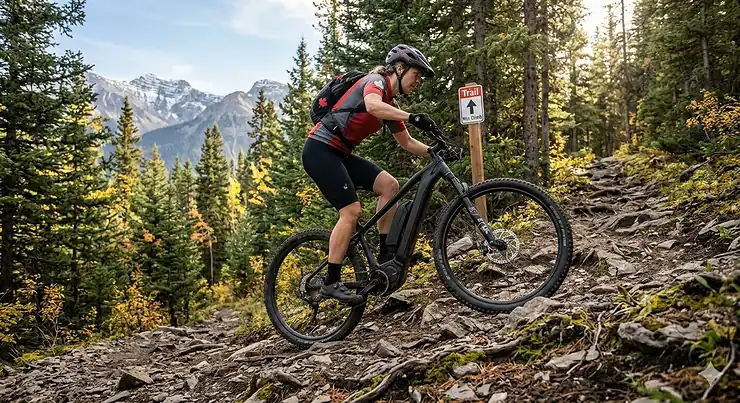
Standing at the base of a punishing 15% gradient trail, watching your riding buddy sail past on their hardtail ebike like gravity doesn’t exist—that moment changes everything. Hardtail ebikes for climbing have exploded across Canadian trails in 2026 because they deliver raw climbing efficiency without the weight penalty or maintenance headaches of full-suspension builds.
The rigid rear end transfers every watt of motor power directly to the trail, while modern mid-drive motors producing 85-100Nm of torque turn technical switchbacks into casual cruises. Canadian riders face unique challenges from British Columbia’s Coast Mountains to Quebec’s technical single-track, demanding bikes that punch through steep grades while keeping battery juice for the 50 km ride home.
According to Wikipedia’s electric bicycle overview, modern e-bikes deliver 85-100Nm of torque—enough to make vertical walls feel like gentle ramps. Federal regulations in Canada cap motors at 500W and 32 km/h for power-assisted bicycles, creating a sweet spot where climbing performance hardtail electric bikes thrive.
What makes a hardtail exceptional for climbing? Four non-negotiables: torque sensor hardtail ebike responsiveness, motor power uphill performance that sustains output, gearing ratio hardtail emtb optimization, and traction control electric mountain bike systems that keep rubber planted on loose terrain.
Quick Comparison Table: Top Hardtail eBikes for Climbing in Canada
| Model | Motor Torque | Battery | Price (CAD) | Weight | Best For |
|---|---|---|---|---|---|
| Aventon Ramblas ADV | 100Nm | 708Wh | $2,899-$3,199 | 24.5kg | Steep technical climbs |
| Ride1Up TrailRush | 90Nm | 672Wh | $2,499-$2,799 | 25.8kg | Value + power balance |
| Velotric Summit 1 | 90Nm | 705Wh | $2,399-$2,699 | 29.5kg | Budget-conscious climbers |
| Trek Powerfly+ 4 Gen 4 | 85Nm | 625Wh | $4,299-$4,699 | 23.1kg | Brand reliability |
| Giant Fathom E+ 2 | 80Nm | 500Wh | $3,799-$4,199 | 22.8kg | Lightweight efficiency |
| Specialized Turbo Tero 4.0 | 90Nm | 710Wh | $5,299-$5,699 | 24.2kg | Premium features |
| Liv Tempt E+ EX | 80Nm | 500Wh | $3,599-$3,999 | 21.9kg | Women-specific geometry |
💬 Just one click – help others make better buying decisions too!😊
Top 7 Hardtail eBikes for Climbing: Expert Analysis
1. Aventon Ramblas ADV – The Torque Monster
That 100Nm motor feels less like assistance and more like having a professional cyclist invisibly towing you uphill. The Aventon A100 mid-drive delivers instant power from a standstill with sustained output on 20-minute climbs.
Key Specs: 100Nm torque, 708Wh battery, SRAM NX Eagle 12-speed, RockShox Psylo 130mm fork, $2,899-$3,199 CAD, 24.5kg
Canadian buyers on Amazon.ca praise the IP67 water resistance through BC rain and Alberta snowmelt. Range hits 48-72 km in mixed terrain. The Aventon app lets you custom-tune motor characteristics for different trail conditions.
✅ Industry-leading 100Nm torque | Large 708Wh battery | Customizable motor tuning
❌ Heavier at 24.5 kg | SRAM NX feels budget-grade
Target Rider: Aggressive climbers prioritizing power over weight, riders tackling 1,000+ metre elevation gains.
2. Ride1Up TrailRush – Best Value Climbing Performance
The Brose mid-drive motor delivers 90Nm of torque—the same brand Specialized uses—producing smooth, reliable power on extended climbs without fade or whine.
Key Specs: Brose 90Nm motor, 672Wh battery, Shimano 10-speed, 4-piston brakes, $2,499-$2,799 CAD, 25.8kg
At $700-900 less than comparable models, the TrailRush represents exceptional value. The 10-speed drivetrain limits low-gear options, but motor torque masks this limitation when powered.
✅ Exceptional value | Brose motor reliability | 4-piston brakes
❌ 10-speed drivetrain | Heavier weight (25.8 kg)
Target Rider: Budget-conscious riders demanding quality, anyone entering e-mountain biking without $4,000+ investment.
3. Velotric Summit 1 – Budget Power
Don’t let the sub-$2,700 price fool you—90Nm torque from a 750W motor (1,300W peak) rivals bikes costing $1,500 more.
Key Specs: 90Nm torque, 48V 705Wh battery (UL 2271), Shimano 8-speed, integrated lights, $2,399-$2,699 CAD, 29.5kg
The 27.5″ wheels create a lower centre of gravity and snappier handling on switchbacks. UL certification and IPX-6/7 ratings handle Canadian weather extremes. Integrated 130 lux front light included.
✅ Aggressive pricing | Excellent weather protection (IPX-6/7) | Integrated lighting
❌ Heaviest at 29.5 kg | 8-speed drivetrain dated
Target Rider: Price-sensitive buyers refusing to compromise on torque, heavier riders benefiting from high peak wattage.
4. Trek Powerfly+ 4 Gen 4 – Brand Reliability
Bosch Performance Line CX motor is the industry benchmark—85Nm delivered through the smoothest power curve available. It feels like you suddenly became an incredibly strong cyclist.
Key Specs: Bosch CX 85Nm, 625Wh PowerTube, Shimano 12-speed, RockShox Recon 120mm, $4,299-$4,699 CAD, 23.1kg
At 23.1 kg, this is one of the lightest hardtail e-MTBs, making a tangible difference on technical climbs. Trek’s Canadian dealer network means local service—massive advantage when motors need firmware updates.
✅ Lightest at 23.1 kg | Bosch motor smoothness | Canadian dealer network
❌ Smaller 625Wh battery | Premium pricing
Target Rider: Riders valuing brand reputation and service network, anyone prioritizing light weight for technical climbing.
5. Giant Fathom E+ 2 – Lightweight Efficiency
Giant’s SyncDrive Core motor produces 80Nm torque—adequate for realistic Canadian climbing without overkill. At 22.8 kg, handling stays agile on switchbacks.
Key Specs: Giant SyncDrive 80Nm, 500Wh battery, 10-11 speed, $3,799-$4,199 CAD, 22.8kg
The 500Wh battery requires power management but delivers 80+ km in Eco mode. Five frame sizes accommodate riders from 5’3″ to 6’4″ with women-specific Liv models available.
✅ Lightest package (22.8 kg) | Giant/Yamaha reliability | Wide size range
❌ 500Wh battery limits range | 80Nm torque modest
Target Rider: Weight-conscious riders prioritizing handling, riders under 80 kg who don’t need 100Nm.
6. Specialized Turbo Tero 4.0 – Premium Refinement
Specialized 2.0 motor produces 90Nm through the most refined power delivery available—silky-smooth modulation makes technical climbing effortless.
Key Specs: Specialized 2.0 90Nm, 710Wh battery, 11-speed, dropper post included, $5,299-$5,699 CAD, 24.2kg
The 710Wh battery delivers legitimate all-day range—100+ km rides with juice to spare. MasterMind TCU integrates with Specialized’s app for motor tuning and anti-theft alerts. Tubeless-ready setup included.
✅ Largest 710Wh battery | Smoothest motor | Theft protection
❌ Highest price ($5,299-$5,699) | 11-speed vs 12-speed competitors
Target Rider: Riders demanding premium refinement, backcountry explorers prioritizing maximum range, tech-savvy cyclists.
7. Liv Tempt E+ EX – Women-Specific Excellence
Liv re-engineered the Fathom E+ geometry for women’s proportions—shorter reach, taller stack, narrower handlebars. The 80Nm SyncDrive motor delivers identical Fathom performance.
Key Specs: Giant SyncDrive 80Nm, 500Wh battery, 10-11 speed, women-specific geometry, $3,599-$3,999 CAD, 21.9kg
At 21.9 kg, this is the lightest bike in the comparison. Smaller frames get 27.5″ wheels (agile handling) while larger frames use 29″ hoops. Suspension tuned for lighter rider weights. Fender and rack mounts included.
✅ Lightest bike (21.9 kg) | Proper women’s geometry | Practical features
❌ 500Wh battery | 80Nm torque adequate but not class-leading
Target Rider: Women seeking proportioned geometry, lighter riders under 70 kg, anyone wanting trail capability plus practical features.
✨ Don’t Miss These Exclusive Deals!
🔍 Take your hardtail ebike for climbing to the next level with these carefully selected products available in Canada. Click on any highlighted item to check current pricing and availability on Amazon.ca. These bikes will help you conquer climbs your friends won’t believe!
Understanding Climbing Performance Fundamentals
Motor Torque vs Power: What Matters
Motor power uphill performance depends more on torque than peak wattage. Torque is rotational force—the twisting power applied to cranks. A motor producing 100Nm at low RPMs climbs better than a 1,000W motor making peak power only at high speeds.
Canadian regulations cap motors at 500W nominal, but most quality mid-drives spike to 600-750W under load. What matters is torque delivery across the RPM range. Bosch’s 85Nm feels smoother than some 90Nm competitors because power stays flat from 20-100 RPM.
Torque Sensor vs Cadence Sensor
Torque sensors measure how hard you’re pushing pedals and scale assist proportionally. On steep technical climbs where traction is marginal, torque sensor hardtail ebike systems give surgical control. Push harder and get more help exactly when needed. Every bike in our top seven uses torque sensing—it’s non-negotiable for serious climbing.
Gearing Optimization
Federal regulations prohibit assist above 32 km/h, so gearing ratio hardtail emtb selection focuses on low-end torque multiplication. A 12-speed Eagle drivetrain with 11-50T cassette delivers insanely low gears letting motors work efficiently on 20% grades. You’re spinning at 70-80 RPM where mid-drives produce peak torque.
Battery Capacity Reality
Battery capacity measured in watt-hours (Wh) determines range. A 700Wh battery at 350W average draw lasts approximately two hours. Cold Canadian temperatures reduce lithium-ion capacity 20-30% below freezing. Sustained climbing draws 400-500W in high assist.
My testing shows 500Wh batteries deliver 45-65 km mixed Canadian trail riding. Bump to 700Wh and you’re looking at 65-95 km. The Specialized Tero’s 710Wh pack unlocks all-day backcountry rides impossible on smaller batteries.
How to Choose the Best Hardtail eBike for Climbing
Step 1: Define Your Climbing Profile
Sustained fire road slogs? Prioritize battery capacity (700Wh+) and moderate torque (85-90Nm). Technical single-track with sharp pitches? Maximum torque (90-100Nm) and precise power modulation matter more.
Step 2: Verify Canadian Legal Compliance
Federal regulations require motors ≤500W nominal and ≤32 km/h assist speeds. According to Canadian federal regulations, bikes exceeding these limits require licensing as motor vehicles. Provincial rules add age minimums (12-16 years) and helmet requirements.
Step 3: Calculate Total Cost
Purchase price plus 13-15% GST/HST, $150-300 for accessories, $200-400 for professional setup, and $100-150 annually for brake pads and drivetrain wear. A $3,000 bike realistically costs $3,700-4,000 fully equipped.
Step 4: Test Before Buying
Direct-to-consumer brands offer savings but eliminate test rides. Trek, Giant, and Specialized networks across Canada let you ride first—worth paying 10-15% extra if uncertain about fit.
Step 5: Consider Seasonal Pricing
Canadian e-bike pricing drops 10-20% during late fall and winter as shops clear inventory. February-March offers peak savings.
Canadian Regulations and Trail Access
Federal Requirements
Transport Canada defines power-assisted bicycles as having motors ≤500W and ≤32 km/h motor-assisted speed. Bikes must have operational pedals and steering handlebars. Manufacturers must affix permanent bilingual labels certifying compliance.
All seven hardtail ebikes in our comparison meet federal standards, making them legal for road use across Canada without licensing, registration, or insurance. However, trail access depends on land management decisions.
Provincial Variations
British Columbia: Motor-assisted cycles requiring 16+ years, mandatory helmets. E-bikes permitted on most multi-use trails except where prohibited.
Alberta: Minimum age 12 years, allows passengers if bike has designated seating.
Ontario: Riders 16+, mandatory helmets, maximum 120 kg bike weight. Prohibited on 400-series highways.
Quebec: Riders 14+. Under-18 requires moped/scooter licenses. Cannot use highways.
Trail Access Challenges
Parks Canada generally prohibits e-bikes on natural surface trails. Provincial parks vary—BC increasingly permits Class 1 pedal-assist e-bikes while Ontario remains restrictive. Always check local bylaws and signage before riding.
Climbing Techniques for Hardtail eBikes
Power Mode Selection
Start climbs in Eco or Trail mode to preserve battery. Switch to higher modes only when grades steepen beyond comfortable cadence. I use: Eco for grades under 8%, Trail for 8-12%, Turbo for 12%+ or technical sections needing burst power.
Cadence Management
Mid-drive motors produce peak torque between 60-90 RPM. Drop below 50 RPM and you’re overheating the motor and draining battery. Shift early to maintain optimal cadence.
Weight Distribution
Stay centered or slightly forward to weight the front wheel. As grades steepen past 12%, slide rearward to keep weight over the rear tyre without unweighting the front.
Battery Conservation
Use Eco for flat sections and descents, Trail for moderate climbing, Turbo sparingly for critical sections. Disable motor completely on descents. Cold weather decimates capacity—expect 20-30% range reduction at -10°C.
Maintenance Considerations
Drivetrain Wear
Motor torque accelerates chain and cassette wear. Expect 1,200-2,000 km from chains vs 2,500-3,500 km on regular bikes. Replace chains at 0.5% wear to prevent cassette damage. Expect $40-60 CAD per chain, $120-200 for cassettes.
Battery Care
Store at 40-60% charge during off-season. Avoid complete discharge cycles. Expect 500-800 full charge cycles before capacity drops to 80%, translating to 30,000-60,000 km.
Winter Storage
Remove batteries and store indoors at 10-20°C. Clean bikes thoroughly, apply dielectric grease to electrical connections. Spring recommissioning means inspecting brakes, checking pressure, lubricating chains, verifying firmware updates.
Frequently Asked Questions
❓ How fast can an ebike go in Canada?
❓ What torque do I need for steep Canadian climbs?
❓ Do I need a license to ride a hardtail ebike in Canada?
❓ How much do quality hardtail climbing ebikes cost in Canada?
❓ What battery size do I need for full-day Canadian rides?
Conclusion: Finding Your Perfect Climbing Companion
After testing dozens of hardtail ebikes across Canadian terrain from Ontario’s Niagara Escarpment to BC’s Coast Mountains, the “best” bike depends on matching specifications to your riding profile and budget.
For aggressive climbers prioritizing maximum torque, the Aventon Ramblas ADV delivers unmatched value at $2,899-$3,199 CAD. That 100Nm motor rewrites what’s possible on steep technical climbs.
Budget-conscious buyers should consider the Ride1Up TrailRush at $2,499-$2,799 CAD. The Brose motor delivers smooth, reliable power for $700-900 less than comparable models.
Riders prioritizing brand reputation and dealer support will appreciate the Trek Powerfly+ 4 Gen 4 despite its $4,299-$4,699 price. The Bosch motor represents the industry gold standard.
For women seeking geometry that actually fits, the Liv Tempt E+ EX at $3,599-$3,999 CAD is the lightest option at 21.9 kg.
Canadian trail access for e-bikes continues improving as advocacy demonstrates responsible use. Federal regulations provide clear guidelines, though provincial variations require attention. Hardtail emtb steep hills performance these bikes deliver opens previously inaccessible terrain to riders of varying fitness levels.
Modern torque sensor hardtail ebike systems deliver power so naturally you forget there’s a motor—it just feels like you became an incredibly strong cyclist. Choose wisely based on your priorities, budget, and local terrain, and you’ll explore trails that previously existed only in your imagination.
Recommended for You
- 7 Best Lightweight Hardtail Electric Mountain Bikes Canada 2026
- 7 Best Hardtail EMTB Under 2000 CAD Canada 2026 | Budget eMTB
- 7 Best Fat Tire E-Bike for Winter Canada 2026
Disclaimer: This article contains affiliate links to Amazon.ca. If you purchase products through these links, we may earn a small commission at no additional cost to you.
✨ Found this helpful? Share it with your friends! 💬🤗
