
In This Article
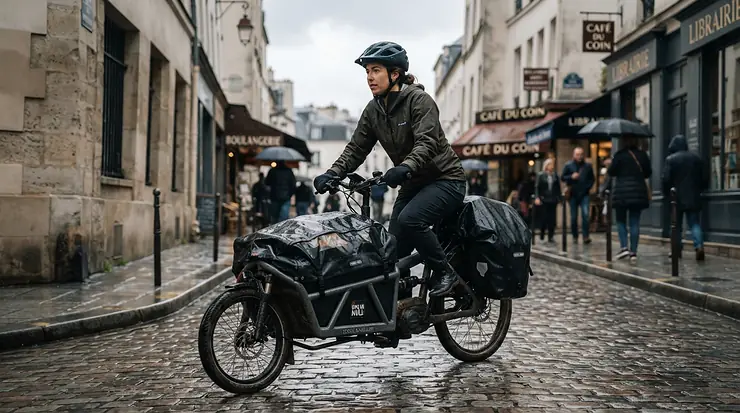
The two-litre jug of milk is the villain of every grocery run by bicycle. It sloshes, it shifts, and it conspires with a bag of potatoes to pull your handlebars sideways at the exact moment a minivan appears. That is why more Canadians are choosing an e-bike for grocery shopping: the motor shrugs off the weight, and the rack does the carrying.
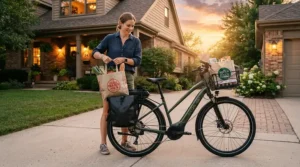
What is an e-bike for grocery shopping? It is a power-assisted bicycle set up to carry food safely. That means a sturdy rear rack or integrated cargo deck, a low step-through frame, a motor strong enough to climb with a loaded bike, and bags or baskets that keep heavy items low. In Canada it must also stay within your province’s power and speed limits.
A power-assisted bicycle is the same thing as an e-bike. The catch is that “e-bike” covers everything from a C$1,500 folding runabout to a C$7,000 longtail, and only some of them are good at hauling dinner. This guide narrows 2026’s field to seven real bikes, with honest analysis of their racks, motors and quirks. It also covers the practical stuff that spec sheets skip: rear rack weight limits, pannier bags for groceries, and how to plan neighbourhood errand riding so your eggs survive.
Every spec below comes from manufacturer listings and published third-party tests. Where a Canadian listing may differ from the US-market spec, I say so. Availability and configuration on amazon.ca vary by seller and model year, so verify the listing before you buy.
Quick Comparison: 7 E-Bikes for Grocery Shopping at a Glance
| E-Bike | Motor (US-market spec) | Rear rack rating | Battery | Best For |
|---|---|---|---|---|
| Heybike Mars 2.0 | 750 W rear hub | 54 kg (120 lb) | 600 Wh | Condo dwellers on a budget |
| Velotric Go 1 | 500 W rear hub | 54 kg (120 lb) | Check listing | Short, flat errand loops |
| Aventon Level.3 Step-Through | 500 W rear hub | 27 kg (59.5 lb) | 708 Wh | Light daily shops and commuting |
| Lectric XPedition 2.0 | 750 W rear hub | 136 kg (300 lb) | 624-1,680 Wh | Big weekly shops on a budget |
| Velotric Packer 1 | 750 W rear hub | 80 kg (176 lb) | 692 Wh | Stable, comfortable heavy hauling |
| Aventon Abound | 750 W rear hub | 65 kg (143 lb) | About 720 Wh | Families who also carry passengers |
| Momentum PakYak E+ | 250 W mid-drive | 46 kg (102 lb) | 500 Wh | Hilly routes and premium build |
Read the table in two layers. The Velotric Go 1 and Aventon Level.3 Step-Through are the two models here listed with 500 W motors, which sit inside the typical Canadian cap. The Momentum PakYak E+ uses a 250 W mid-drive, which also stays comfortably inside it. The 750 W entries are US-market specs, so confirm the Canadian configuration before ordering.
On rack ratings, the Lectric XPedition 2.0 is in a class of its own, but a big rack does not make a bike nimble. If your shop is a few bags, the Aventon Level.3 Step-Through rack is enough. If it is a week of groceries for four, start higher up the table.
💬 Just one click — help others make better buying decisions too!😊
Top 7 E-Bikes for Grocery Shopping: Expert Analysis
Quick note on method. The “review sentiment” lines below summarize what published testers and owners report. I have not ridden these bikes, and nothing here is first-hand testing.
1. Heybike Mars 2.0 — folding fat-tire value with a 54 kg rack
The folding frame is the party trick. When the shopping is done, the bike collapses to fit a condo hallway or a hatchback trunk. Its 20″ x 4″ fat tires swallow potholes and frost heaves that make eggs nervous, and the 600 Wh removable battery is a sensible size for city loops.
The rear rack is rated for 54 kg (120 lb), with a total payload of 150 kg (330 lb) including you. Those are two separate limits, and the second one is the one most riders forget. Based on the spec comparison, this bike suits one or two bags over a few kilometres, not a family’s weekly stock-up.
Reviewers at Electric Bike Report found the range modest for a 750 W motor paired with a 600 Wh battery. Some owner reviews on Heybike’s own site say the battery drains quickly on hills, while others like the usable rack. In Canada, confirm the listing is a 500 W power-assisted configuration, because the US model is sold at 750 W and above.
Pros:
- ✅ Folds for tight storage
- ✅ Fat tires smooth rough pavement
- ✅ Generous rack rating for the price
Cons:
- ❌ Range falls fast on hills
- ❌ Heavy for a folder at about 34 kg
Expect a price in the mid-C$1,000s to C$2,000s. Good value if storage is your main problem.
2. Velotric Go 1 — compact 500 W errand-runner
Short wheelbase, upright posture and a frame-integrated rear platform make this the “grab the keys, skip the car” bike. The 500 W rear hub motor (900 W peak, 65 Nm) lines up with Canadian power-assisted bicycle norms better than most 750 W rivals.
The rack carries 54 kg (120 lb), and the total payload is 200 kg (440 lb). That means the frame is stronger than the rack, which is the right way around. What matters in practice is the cargo deck’s width: panniers and a rear basket both mount cleanly, and a wooden-panel top with mesh wheel guards keeps loose bag straps away from the spokes.
Reviewers describe it as powerful for its size, and one published review calls the rear basket accessory close to essential for errands. At roughly 29.5 kg, it is easier to wrangle up a porch step than a longtail.
Pros:
- ✅ 500 W motor fits Canadian limits
- ✅ 54 kg rack rating with accessory support
- ✅ Short, easy-to-park footprint
Cons:
- ❌ Less volume than longtail cargo bikes
- ❌ Baskets and pegs cost extra
Expect the mid-C$2,000s. A strong pick if the e-bike for grocery shopping needs to double as a daily rider.
3. Aventon Level.3 Step-Through — commuter polish with a modest rack
Here is the honest outlier. This is a commuter, not a cargo bike, and its rack is rated for just 27 kg (59.5 lb). In exchange you get a 500 W torque-sensing motor, a 708 Wh battery and a claimed range of up to about 113 km (70 mi).
Torque sensing matters for groceries. The motor responds to how hard you pedal, so a loaded start at a red light feels smooth rather than lurchy. The step-through frame also lets you swing a leg over without kicking a pannier. Aventon’s built-in security module, which adds GPS and alarm features, is reassuring when you leave the bike outside the supermarket.
Published testers praise the range and ride feel and note it can beat the advertised figure. The trade-off is plain: 27 kg of groceries disappears fast if you buy bottled water or litter. This bike is for a loaf, vegetables and a few cans, not a Costco run.
Pros:
- ✅ Smooth torque-sensor assist
- ✅ Big battery for long errand loops
- ✅ Built-in security tech
Cons:
- ❌ Rack is the lightest on this list
- ❌ No front rack
Expect the mid- to high-C$2,000s. Best for light, frequent shops.
4. Lectric XPedition 2.0 — the heavy-hitting value longtail
Numbers first: a 136 kg (300 lb) rear rack, 204 kg (450 lb) total payload, and three battery options from 624 Wh to 1,680 Wh. That rack is long enough to take child seats, which tells you how much grocery volume you can strap down.
The torque sensor is new in this generation and should make the big motor feel more natural than the original. A larger rack means more places to put baskets, panniers and crates, and the included rear fender wraps part of the rear wheel to protect cargo.
Reviewers point to responsive assist, range and capacity, but some complain of a harsh ride on bumpy roads when the rack is loaded. Earlier critiques of the original XPedition’s kickstand are reported as improved in 2.0. The US bike is a 750 W unit, so check for a Canadian-market 500 W version.
Pros:
- ✅ Enormous 136 kg rack rating
- ✅ Long deck takes bags and crates
- ✅ Battery size options for any range
Cons:
- ❌ Firm ride over rough roads
- ❌ Long and heavy to store
Expect roughly C$2,000 to C$3,000 depending on battery. The value pick if best e-bike for hauling groceries means “carry anything.”
5. Velotric Packer 1 — mixed wheels for a stable, planted haul
The odd wheel pairing, a 26″ front and a 20″ rear, is deliberate. The big front smooths bumps; the small rear keeps the rack and your cargo low. Electric Bike Report and OutdoorGearLab both credit that setup for a stable, balanced ride under load.
The numbers are 80 kg (176 lb) on the rack, 200 kg (440 lb) total, and a 692 Wh battery. In plain terms, you could load two panniers and a rear basket and still have headroom. Electric Bike Report recorded about 59 km (36.9 mi) on its range test at the highest assist level, which is realistic planning data for shopping loops.
Reviewers’ complaints: Electrek wanted a torque sensor and noted some power lag; GearJunkie flagged narrow handlebars for such a long bike and tires better suited to paved surfaces. This is not a bike for gravel shortcuts.
Pros:
- ✅ Low, stable rear cargo area
- ✅ 80 kg rack with accessory support
- ✅ Full-coverage fenders
Cons:
- ❌ Power delivery can feel abrupt
- ❌ Narrow bars for a long frame
Expect the high-C$2,000s to low-C$3,000s. Strong choice for confident heavy loads.

6. Aventon Abound — passenger-ready cargo with a 65 kg rack
This is a 20″ longtail with footboards, a dropper seatpost and a built-in storage bag. The rack is rated for 65 kg (143 lb), and the total limit is 200 kg (440 lb). Aventon later added the Abound SR and LR variants, so confirm which version you are looking at.
The torque sensor makes a 750 W motor feel more like cycling than motorcycling, and a 20″ wheel keeps the deck low. Grocery-wise, a rear basket and a pair of panniers make the weekly shop manageable. One published review said it would have done weekly shopping with it if the rear basket had been fitted.
Common complaint: the weight. Reviewers repeatedly call the Abound heavy, around 36.7 kg (81 lb) on some versions. That matters if your bike lives on a second-floor landing, and municipal rules about weight and paths apply, as the next sections explain.
Pros:
- ✅ Torque-sensor assist feels natural
- ✅ Footboards and storage bag included
- ✅ 65 kg rack for big shops
Cons:
- ❌ Heavy to lift or store
- ❌ Throttle launches are punchy
Expect the high-C$2,000s to C$3,000s. Good if the bike also moves kids.
7. Momentum PakYak E+ — premium mid-drive for hilly neighbourhoods
Giant’s Momentum sub-brand builds this one with a 250 W SyncDrive Pro mid-drive (80 Nm), a 500 Wh battery, and a rear rack rated for 46 kg (46 kg is about 102 lb) plus a 15 kg (33 lb) front-basket limit. Total load tops out near 164 kg (361 lb).
Why choose 250 W over 750 W? Mid-drive motors use the bike’s gears, so they climb hills with a heavy rack far better than their wattage suggests. GearJunkie’s testing found the PakYak climbing big hills well under load, and it can take a second 500 Wh battery to roughly double range. The rack is built for panniers.
Its drawbacks are cost and fiddliness. At roughly C$6,000 and above, it is the priciest bike here. One review notes that swapping between a kid carrier and the cargo rack is awkward, so choose a lane and stick with it.
Pros:
- ✅ Mid-drive power excels on hills
- ✅ Dealer support through Giant network
- ✅ Front and rear carrying options
Cons:
- ❌ Highest price on the list
- ❌ Rack swaps are fiddly
Expect above C$6,000. A premium, long-term investment.
What Is an E-Bike for Grocery Shopping? The Features That Matter Most
Think of it as a pack mule that pedals back. Five features define whether a bike earns the title.
First, a rack or deck rated for what you actually buy. Second, a step-through or low frame, so you never swing a leg over a loaded rack. Third, hydraulic or otherwise confident brakes, because stopping 40 kg of bike plus 20 kg of groceries is not a place to save money. Fourth, full fenders, since wet-road spray lands directly on your bread. Fifth, a kickstand that holds the bike upright while you load it.
Here is the part marketing skips. A “cargo bike” label does not make a bike good at groceries. A basic commuter with a quality rack and panniers handles one or two bags easily, while a longtail makes more sense once your shopping looks like a restocking mission. Match the bike to the bag count, not the brand’s adjectives.

How to Choose an E-Bike for Grocery Shopping
Use this checklist before you add anything to your cart:
- Count your real load. Weigh a typical shop. If it is under 15 kg, a commuter rack is fine; above 25 kg, look at 100 kg-plus racks.
- Check both limits. Rack rating and total payload are separate. Add your weight, the bike’s cargo, a lock and your jacket.
- Verify Canadian legality. Look for a motor rated 500 W or less and an assisted cutoff at 32 km/h.
- Choose your frame height. Step-through is easier when loaded; step-over is stiffer.
- Plan storage. A 36 kg longtail does not belong in a walk-up apartment.
- Look for safety certification. UL 2849 covers the whole electrical system, not just the battery.
- Check the accessories. Does the bike take panniers, a rear basket and a front rack, and are they sold in Canada?
Honestly, step 1 settles most arguments. Weigh the groceries and let the number choose the bike.
E-Bike With Rear Cargo Rack Canada: Rules to Know Before You Buy
Buying an e-bike with rear cargo rack Canada-wide is not a single set of rules. The provinces and municipalities do the regulating, and the details differ.
On power and speed, Quebec’s SAAQ states that a power-assisted bicycle’s motor must be 500 W or less and cut out at 32 km/h. Ontario’s rules are similar, with an OPP-published summary also listing 120 kg maximum weight, two independent brakes and riders aged 16 or over. Helmets are required in most provinces.
On cargo bikes specifically, municipal rules add wrinkles. The City of Toronto says power-assisted e-bikes weighing more than 40 kg, or those that do not require pedalling, are not permitted on park trails or multi-use paths. Many heavy cargo e-bikes sit close to that line, so weigh the bike you are considering.
Practical translation:
- A 750 W US-spec bike may not qualify as a power-assisted bicycle in your province.
- A throttle-only mode can cost you access to protected bike lanes in some cities.
- Check your own municipality’s bylaws before buying a heavy longtail.
Rear Rack Weight Limits: The Number Everyone Misreads
Rear rack weight limits are the most misunderstood figure in e-bike shopping. A rack rated for 54 kg does not mean the bike can carry 54 kg more than its rider. It means the rack itself will not fail at that load.
Think in three layers: the rack rating, the total payload, and the pannier or basket rating. Whichever is lowest rules your load. Some commuter racks sit near 27 kg, while longtails run from 65 kg to 136 kg.
| Bike | Rack rating | Total payload |
|---|---|---|
| Aventon Level.3 Step-Through | 27 kg (59.5 lb) | About 136 kg (300 lb) |
| Momentum PakYak E+ | 46 kg (102 lb) | 164 kg (361 lb) |
| Heybike Mars 2.0 | 54 kg (120 lb) | 150 kg (330 lb) |
| Aventon Abound | 65 kg (143 lb) | 200 kg (440 lb) |
| Velotric Packer 1 | 80 kg (176 lb) | 200 kg (440 lb) |
| Lectric XPedition 2.0 | 136 kg (300 lb) | 204 kg (450 lb) |
Look at the pattern: big rack numbers belong to long, heavy bikes. The Lectric XPedition 2.0 leads the rack column, but its payload is only slightly higher than the Aventon Abound, because the frame, not the rack, is the real limit. If you weigh 90 kg and carry 20 kg of groceries, the Aventon Level.3 Step-Through is mathematically fine, but its rack is already near its ceiling.
Weight placement matters as much as weight. Ten kilograms low beside the rear wheel feels calmer than ten kilograms perched on top of the rack.
Pannier Bags for Groceries: What Actually Works
Pannier bags for groceries beat handlebar bags every time. Hanging shopping from the handlebars swings into the front wheel and interferes with steering, which is why testers consistently advise against it.
What to look for:
- Waterproofing. Taped seams or roll-top closures protect your bread in a Canadian downpour.
- A rigid back panel. Floppy bags sag into spokes.
- Quick-release hooks. You will be clipping them on and off at every stop.
- Right-size capacity. Two panniers of around 20 litres each hold a standard shop.
- Rack compatibility. Some hooks need thin rack rails, so check the tube diameter.
Pack heavy items like milk, canned goods and bottles at the bottom and toward the bike’s centre line. Put bread and eggs on top. Split the weight evenly left and right, because an unbalanced rack tugs the bike sideways. That one habit does more for stability than any accessory.
Rear Basket E-Bike Review: Basket vs Panniers
A fair rear basket e-bike review comes down to speed versus stability. A basket on the rear rack lets you toss bags in and go, which is wonderful for quick stops. The downside is height: weight sits high on the rack and makes the bike feel top-heavy.
Panniers carry weight low and centred around the rear axle, so they win for heavy shops and rough pavement. Baskets win for small, frequent errands where bags are light.
Accessory support helps. The Velotric Go 1 and Aventon Abound both have rear basket accessories sold by their makers, and reviewers describe a basket as an essential accessory on those bikes. On any rear basket e-bike, check three things: the rack’s rating, the basket’s own limit, and whether the basket blocks your rear light.
My rule of thumb is simple. If your bags rarely exceed 10 kg, a basket is perfect. Beyond that, buy panniers and stop thinking about it.
Best E-Bike for Hauling Groceries: Cargo Bike vs Commuter E-Bike
The best e-bike for hauling groceries depends on volume, not ego. Here is how the two main designs stack up.
| Factor | Commuter with rack and panniers | Longtail cargo e-bike |
|---|---|---|
| Typical rack rating | 27-54 kg | 65-136 kg |
| Weight | Lighter, easier to lift | Heavy, around 34-37 kg |
| Storage | Fits most hallways | Needs a garage or shed |
| Path access | Fewer restrictions | Weight limits may apply |
| Best For | Aventon Level.3 Step-Through riders | Lectric XPedition 2.0 or Velotric Packer 1 riders |
The table makes the trade-off visible. A commuter wins on handling, portability and path access, but it runs out of rack quickly. A longtail wins on carrying, but it asks more of your storage space and your municipality’s bylaws. Most households buying their first bike for errands overestimate how much cargo they need, so start with the lighter category unless your weekly shop genuinely fills four bags.
The Heybike Mars 2.0 and Velotric Go 1 sit in the middle, with decent racks and compact bodies. If you shop for one or two people, they are the sweet spot.
Your First 30 Days: A Practical Setup and Packing Guide
Most grocery-bike mishaps happen in week one, and nearly all are avoidable.
Week one: set up. Torque your rack bolts and recheck after 50 km, since vibration loosens fasteners. Set tire pressure to the sidewall range and add a little for loaded rides. Adjust the saddle so your knee has a slight bend, which saves energy on starts.
Week two: practise loaded. Fill panniers with bottled water in an empty parking lot. Practise slow turns, braking and getting on and off. A loaded bike behaves differently, and a lot of the surprise wears off in an afternoon.
Week three: build the routine. Keep reusable bags folded in a pannier. Lock the frame, not just the wheel, and take the battery inside if it is removable.
Week four: maintain. Check brake pads, tire wear and chain lubrication. Heavy loads wear brakes faster than ordinary commuting, so listen for squeal.
Common first-month mistakes: overloading one side, forgetting to check rack bolts, hanging bags from the handlebars, and charging the battery overnight unattended. Avoid those four and you are ahead of most beginners.
Real-World Scenarios: Three Shoppers, Three Bikes
Scenario 1: the condo single. A downtown Montreal renter shops for one, climbs stairs to a small unit and rides 2 km each way. A folder like the Heybike Mars 2.0 fits the storage reality, and a rack bag handles a small basket of food. Budget: under C$2,000.
Scenario 2: the suburban couple. Two adults in a Calgary suburb do one big weekly shop and a few top-ups, about 6 km each way with a gentle slope. A Velotric Packer 1 or Aventon Abound can carry two panniers and a basket comfortably. Budget: around C$3,000.
Scenario 3: the hilly-neighbourhood shopper. A Halifax rider faces steep streets and fog-damp pavement. The Momentum PakYak E+ mid-drive earns its premium by climbing under load, and dealer support helps during winter. Budget: above C$6,000.
Notice that none of these shoppers needs the biggest rack. Each needs the right balance of capacity, storage and terrain, and that is the logic worth copying.
Problem → Solution: Fixing the Most Common Grocery-Run Headaches
Problem 1: Everything shifts on the rack. Solution: use panniers or a basket with a bungee net, and load heavy items at the bottom. A wobbling load is usually an unbalanced load.
Problem 2: The bike feels twitchy loaded. Solution: lower tire pressure slightly for grip, move weight toward the rear axle and lower, and slow down through corners. If it is still unstable, your load may exceed the bike’s real payload.
Problem 3: Battery range drops on shopping days. Solution: use a lower assist level on flat ground, and keep tires fully inflated. The Heybike Mars 2.0 and Velotric Packer 1 both show how range depends on assist level in published tests.
Problem 4: No safe place to park. Solution: choose a heavy-duty lock, secure the frame to a fixed rack, and take the battery with you. The Aventon Level.3 Step-Through security tech helps, but a good lock is still essential.
Problem 5: Rain. Solution: waterproof panniers and full fenders. Every bike in this guide ships with fenders or accepts them.
Neighbourhood Errand Riding: Routes, Timing and Habits That Work
Neighbourhood errand riding is a different sport from commuting. You stop constantly, load and unload, and share narrow streets with delivery vans.
Pick routes with fewer hills and more protected lanes, even if they add a few minutes. Shop outside rush hour, since a loaded bike is happier with space around it. Keep your most perishable purchases for the last stop, and pack the heaviest items first.
Build a routine around three rules. Bring your own bags, so nothing arrives on the rack loose. Ride with a bell and lights on, because you are slower and wider than a regular rider. And treat the first week as practice rather than speed: a calm 15 km/h with a loaded rack is a fine pace.
Check municipal rules for the pathways you use. Some cities restrict heavier or throttle-only e-bikes from multi-use paths, as Toronto’s guidance on weight above 40 kg shows. If your errand route includes a shared path, verify it first.
Long-Term Cost and Maintenance: What an E-Bike Costs Over Five Years
Total cost of ownership beats sticker price. An e-bike for grocery shopping replaces short car trips, and short trips are the most expensive per kilometre because cold engines burn more fuel and parking costs add up.
| Cost item | Budget bike | Premium bike |
|---|---|---|
| Purchase | C$1,500-C$2,500 | C$6,000+ |
| Panniers and basket | C$100-C$300 | C$100-C$300 |
| Lock | C$80-C$200 | C$80-C$200 |
| Annual tune-up | C$100-C$200 | C$150-C$250 |
| Battery replacement | Possible after several years | Possible after several years |
These are ballpark ranges and prices vary, so check current prices. The analysis is straightforward: a budget bike pays back faster against car costs, while a premium mid-drive like the Momentum PakYak E+ spreads its cost over longer service life and dealer support. Neither is wrong, but the premium only makes sense if you will ride it most days.
Battery safety belongs in the cost conversation. Health Canada and Transport Canada advise using only the battery that came with your e-bike and recommend products compliant with ANSI/CAN/UL 2849. CBC reporting shows transit agencies such as Metrolinx requiring UL or CE compliant batteries. UL 2849 is not legally required in Canada, but it is a useful tiebreaker between two similar bikes.

FAQ
❓ How much weight can an e-bike carry for groceries?
❓ Is an e-bike or a cargo bike better for grocery shopping?
❓ Are 750 W e-bikes legal in Canada?
❓ Do I need panniers or is a basket enough?
❓ How far can a grocery e-bike go on one charge?
Conclusion
The right e-bike for grocery shopping is the one that matches your bags, your stairs and your streets, not the one with the biggest number on its spec sheet. If your shopping is light and frequent, the Aventon Level.3 Step-Through and Velotric Go 1 are sensible, legal-friendly choices. If you carry a week of food, the Lectric XPedition 2.0, Velotric Packer 1 and Aventon Abound give you real capacity. If you live on a hill, the Momentum PakYak E+ is the premium answer, and if storage is the constraint, the Heybike Mars 2.0 folds away.
Before you buy, do three things. Confirm the Canadian configuration is a 500 W power-assisted bicycle. Compare the rack rating with the total payload. And check your municipality’s rules on bike weight and paths. Do that, add a good set of pannier bags for groceries, and the car keys can stay on the hook.
Recommended for You
- Cargo E-Bike For Families: 7 Best Safe Picks In Canada 2026
- Heavy-Duty Cargo Ebike For Maximum Load Capacity: 7 Best Picks 2026
- Front-Load Vs Longtail Cargo E-Bike: 7 Proven Picks 2026
Disclaimer: This article contains affiliate links. As an Amazon Associate, I earn from qualifying purchases. If you purchase products through these links, we may earn a small commission at no additional cost to you.
✨ Found this helpful? Share it with your friends! 💬🤗
