
In This Article
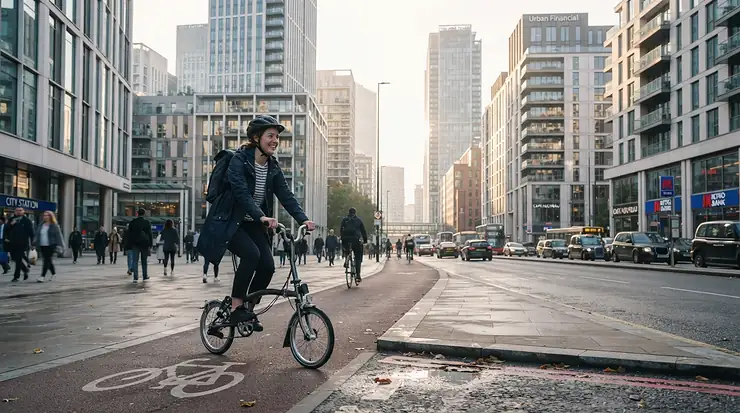
A premium compact folding ebike is a pedal-assist electric bicycle that folds small enough for a condo closet, a commuter train or a car trunk. It is built from higher-grade materials and hardware than budget folders. Think titanium, carbon fibre, magnesium, a refined motor system and hinges designed to survive thousands of folds.
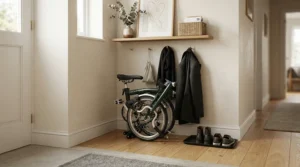
Why does that matter in Canada? Because our cities punish bad compromises. Walk-up apartments, GO Train platforms, transit transfers and minus-twenty mornings all work against a bike that is awkward to carry. A bike you dread lifting simply stops getting used. Meanwhile, the old complaint that folders ride like toys has faded as motors and frames have improved.
The rules are friendlier than many riders expect. Provinces broadly cap an ebike at a 500 W motor and a 32 km/h assisted speed, a baseline laid out in Prince Edward Island’s power-assisted bicycle guidance. Every bike below sits comfortably inside it, since most use 250 W motors.
Here’s how this guide works. I haven’t ridden these bikes, and I won’t pretend otherwise. Instead, I’ve gathered manufacturer specifications, Canadian dealer listings and published reviews, then asked one blunt question of each spec: what does it mean for a real rider? Three themes run through the analysis:
- premium carbon or magnesium components, and what they actually buy you
- the weight-to-quality ratio, which separates clever engineering from expensive jewellery
- travel-case compatibility, the unglamorous detail that decides whether a folder can really travel
The short version is that money buys lightness and refinement, but only up to a point. Let’s find that point.
Quick Comparison: The Premium Compact Folding Ebike Shortlist
| Model | Key materials | Weight with battery (claimed) | Battery and claimed range | Approx. price (CAD) | Best For |
|---|---|---|---|---|---|
| Brompton Electric T Line | Titanium frame, carbon fork, seatpost and bars | ~14.1 kg | 345 Wh, up to 90 km | C$10,000–C$11,000 | Daily stair-carriers |
| Brompton Electric P Line | Titanium rear frame, steel main frame, carbon fork | ~16.2 kg | 345 Wh, up to 90 km | C$7,000–C$8,000 | Best weight-to-price balance |
| Gocycle G4i+ | Carbon mid-frame and fork, magnesium drive, carbon wheels | ~16.7 kg | 375 Wh, up to 80 km | Typically above C$8,000 (confirm) | Design-minded riders who want bigger wheels |
| Hummingbird Electric Gen 2.0 | Carbon fibre monocoque | ~10.3 kg | Hub-integrated battery, ~40–50 km | ~C$8,000–C$9,500 after conversion | Weight-obsessed travellers |
| Brompton Electric C Line | Steel | ~17.3–17.9 kg | 345 Wh, up to 90 km | C$5,500–C$6,500 | Value and the smallest fold |
| Brompton Electric G Line | Steel, 20-inch wheels | ~19.4 kg | 345 Wh, 30–60 km | C$6,000–C$7,500 | Rougher streets and gravel |
| Tern Vektron S10 | Hydroformed aluminum | ~22 kg | 400 Wh Bosch | C$4,500–C$5,500 | Hills and cargo |
Read this table by priority rather than by price. If carrying weight is your daily pain, the Hummingbird Electric Gen 2.0 and the Brompton Electric T Line sit in a class of their own. The Brompton Electric P Line delivers much of that benefit for roughly C$3,000 less than the T Line. If hills and cargo matter more than stairs, the Tern Vektron S10 trades kilograms for a stronger motor and a real rack. All weights and ranges are manufacturer claims, so treat them as best-case figures.
💬 Just one click — help others make better buying decisions too!😊
Top 7 Premium Compact Folding Ebike Picks for Canada: Expert Analysis
Each pick below gets the same treatment: what the specs mean in practice, who the bike suits, and what published reviews consistently say. Prices are ranges based on listings at the time of research, so check current pricing before you buy.
1. Brompton Electric T Line — titanium-and-carbon featherweight
The standout here is mass, or rather the lack of it. The Brompton Electric T Line weighs a claimed 14.1 kg with its battery attached and 11.2 kg without, making it Brompton’s lightest ebike yet.
The frame uses Grade 9 titanium tubes with a carbon fork, seatpost and handlebar. A 250 W rear-hub motor with 24 Nm of torque and a removable 345 Wh battery (up to 90 km claimed) complete the package. The 11.2 kg bare weight is where the magic lives. Unclip the battery and you’re hauling roughly what a light road bike weighs up a flight of stairs. The torque sensor matters too, because assist scales with your effort, so it feels like pedalling with a tailwind rather than riding a scooter.
Based on the spec comparison, this is a premium compact folding ebike for people who lift their bike every single day. If you mostly roll it, the extra spend buys bragging rights more than function, because the P Line captures much of the benefit for less.
Reviewers consistently note that it folds and rides like a classic Brompton, while flagging the bulky battery bag and the price. Dealer commentary adds that riders who carry little often get similar performance from the C Line or P Line.
Pros:
- ✅ Titanium-and-carbon build keeps carry weight very low
- ✅ Torque-sensor assist feels natural and responsive
- ✅ Seven-year frame and three-year electrical warranty (when registered)
Cons:
- ❌ Premium price is hard to justify if you mostly roll it
- ❌ Battery bag adds noticeable bulk up front
Dealer listings sit around C$10,000–C$11,000. The verdict: superb engineering, best value only if weight is your top priority.
2. Brompton Electric P Line — the titanium sweet spot
The Brompton Electric P Line keeps a steel main frame but swaps in a titanium rear frame and a carbon fork. Brompton says that makes it about 1.5 kg lighter than the C Line, with a smoother ride.
Weight starts around 16.2 kg with the battery (about 12.5 kg without), per Brompton’s European spec page. Aluminum handlebar supports and cranks trim a little more. It shares the same 345 Wh pack and rear-hub motor as its siblings.
Here the weight-to-quality ratio peaks. Titanium appears in the rear triangle, where shaving grams helps the fold and the carry, and the cost doesn’t balloon the way it does on the T Line. For a daily train commuter, I’d argue this is the logical pick.
Independent reviews of this specific 2026 version are thinner than for the C Line and G Line, and I couldn’t verify a deep pool of owner feedback. One reviewer comparing it with the G Line found the bigger-wheeled bike more stable, a reminder that 16-inch wheels trade stability for compactness.
Pros:
- ✅ Titanium rear frame trims meaningful weight
- ✅ Carbon fork helps absorb road buzz
- ✅ Same compact fold as the classic Brompton
Cons:
- ❌ Steel main frame, so not the lightest option
- ❌ Noticeable price step up from the C Line
A Canadian dealer lists it near C$7,500 with rack, so expect a C$7,000–C$8,000 range. The verdict: the best all-round value among the lightweight options.
3. Gocycle G4i+ — carbon and magnesium design statement
Few bikes show off premium carbon or magnesium components as openly as the Gocycle G4i+. It pairs a carbon-fibre mid-frame and fork with an injection-moulded magnesium Cleandrive that hides the chain, plus carbon wheels.
Its claimed weight is about 16.7 kg including pedals and kickstand. The 36 V, 375 Wh battery is rated for up to 80 km and charges in about 3.5 hours. It folds in roughly ten seconds and rolls on its wheels. The maximum rider weight is 100 kg, so heavier riders need to look elsewhere.
The enclosed drive is the clever bit for Canadian riders: no greasy chain, less road-salt exposure and cleaner trousers. The 20-inch wheels also ride more like a full-size bike than 16-inch folders do. But “compact” is relative, because the folded bike is larger than a Brompton.
Availability deserves honesty. Aventon acquired the brand in 2025 and planned a relaunch, and one Canadian owner reported low inventory, weaker support and difficulty sourcing a replacement battery. Confirm local service before committing.
Reviewers praise how light and fast it is, while noting that you pay for the features.
Pros:
- ✅ Carbon and magnesium construction with a sealed drive
- ✅ Fast fold that rolls easily on its wheels
- ✅ Larger wheels give a fuller-size ride
Cons:
- ❌ Brand and service uncertainty in Canada
- ❌ 100 kg rider limit and a bulkier fold
Historical list prices sat in the mid-to-high US$6,000s, so expect well above C$8,000. Verdict: spectacular engineering, but verify support first.
4. Hummingbird Electric Gen 2.0 — the world’s lightest folding ebike
At a claimed 10.3 kg, the Hummingbird Electric Gen 2.0 is the weight-loss extremist of this list. Its carbon-fibre frame is hand-built with motorsport engineering expertise from Prodrive.
A 250 W rear hub houses the motor and battery together, weighing about 3.4 kg in total. Assist is capped at 25 km/h, which is comfortably legal in Canada. Claimed range is roughly 40–50 km, charging takes about three hours, and the fold takes about five seconds.
This is the weight-to-quality ratio taken to its logical extreme. You get unmatched portability, but the trade-offs are real: a small battery, minimal extras and, according to reviewers, ride quality that trails its rivals.
Sentiment is mixed. One reviewer called it sprightly but jittery on its tiny wheels. Another found the ride behind its chief rivals and the wake-up routine odd, calling it the priciest folding ebike they’d tried. Ride Review’s scores put build (4.4) and design (4.5) ahead of ride (3.8) and value (3.6).
Pros:
- ✅ Lightest folding ebike in this guide by a wide margin
- ✅ Extremely quick five-second fold
- ✅ Carry bag available for transport
Cons:
- ❌ Ride quality trails the best rivals
- ❌ Canadian shipping, duties and warranty need confirming
UK pricing in the mid-£4,000s to just under £5,000 converts to roughly C$8,000–C$9,500 before shipping and duties. Verdict: only for riders who truly prioritize every gram.
5. Brompton Electric C Line — classic steel, best value in the set
The Brompton Electric C Line is the benchmark everything else gets measured against. It keeps the all-steel frame and adds the rear-hub e-Motiq system.
Weight runs about 17.3–17.9 kg depending on the source and spec, and about 14.3 kg without the battery. The 250 W motor, 24 Nm of torque and 345 Wh battery match the pricier models. One listing puts the folded size near 58 × 57 × 27 cm, among the smallest in this guide.
For many buyers, this is the smartest premium compact folding ebike on the list. You keep the fold, the motor system and the handlebar control, and you only give up some carry weight. If your bike lives mostly on wheels or in a trunk, that’s an easy trade.
An August 2026 test report from Toronto describes the C Line as intuitive, a joy to ride and capable on pavement and gravel. The report also notes that Brompton has partnered with Toronto’s Pedaal as exclusive Canadian distributor.
Pros:
- ✅ Among the smallest folded footprints in this guide
- ✅ Proven steel durability
- ✅ Lowest-priced Brompton electric of the 16-inch models
Cons:
- ❌ Heaviest of the 16-inch Brompton electrics
- ❌ Steel adds mass on stair carries
A Canadian dealer lists it near C$5,950 with rack, so expect C$5,500–C$6,500. Verdict: the value anchor of the group.
6. Brompton Electric G Line — 20-inch ride for rougher streets
The Brompton Electric G Line swaps 16-inch wheels for 20-inch ones, wrapped in Schwalbe G-One Allround tires. That change lets it handle gravel paths and rough pavement more comfortably.
It uses the 345 Wh battery and 250 W rear hub, with slightly higher torque (about 30 Nm). Weight starts around 19.4 kg with the battery, and the folded size is roughly 73 × 69 × 40 cm. Claimed range is 30–60 km, lower than the 16-inch models because of the heavier build.
The honest framing is that this is a Brompton for people who find 16-inch bikes twitchy. You gain stability and confidence, but lose some of the compactness that defines a premium compact folding ebike.
TechRadar called it the most stable electric Brompton yet, though less nippy and much less compact when folded, and suggested battery life could improve. PopSci’s reviewer said it handles like a full-size bike but criticized the larger fold and the removable left pedal.
Pros:
- ✅ Stable, confident 20-inch ride
- ✅ Handles gravel and rough pavement better
- ✅ Same fold logic, under 20 seconds
Cons:
- ❌ Much larger folded size
- ❌ Heaviest electric Brompton
Reviewers say it prices between the C Line and P Line, so expect roughly C$6,000–C$7,500. Verdict: a better fit for rough streets than tight closets.
7. Tern Vektron S10 — Bosch muscle for hilly commutes
The Tern Vektron S10 is the control group in this guide: no carbon, no magnesium, just a hydroformed aluminum frame and serious muscle. A Bosch Performance drive delivers 65 Nm of torque, paired with a 400 Wh PowerPack.
It weighs about 22 kg (48.7 lb) and folds in about ten seconds to roughly 41 × 86 × 68 cm. The integrated rack carries up to 27 kg, and the frame adjusts for riders from about 145 to 195 cm. The frame is also certified to the European EN 15194 standard for pedal-assist bikes.
The weight-to-quality ratio here is honest: heavy, but strong and practical. If your commute climbs hills or hauls groceries, torque and cargo capacity matter more than shaving 8 kg.
Owners praise the Bosch system and the trolley-style roll when folded, calling the bike heavy for a folder but light for an ebike. One critical reviewer found folding more annoying once accessories were attached, and the weight awkward to lift.
Pros:
- ✅ 65 Nm of torque handles steep hills
- ✅ Rack carries up to 27 kg
- ✅ Adjusts for a wide range of rider heights
Cons:
- ❌ 22 kg is awkward for repeated carrying
- ❌ Bulkier fold than the 16-inch options
Expect roughly C$4,500–C$5,500, based on older US listings. Verdict: the best value for hills, but not for stair-heavy lifestyles.
Setup and Care: Your Premium Compact Folding Ebike in the First 30 Days
Getting the first month right protects your investment. Here’s a practical plan.
Week one: register and inspect. Register the bike to unlock the full warranty. Brompton cites a seven-year frame and three-year electric-system warranty when you register. Check tire pressure against the sidewall rating, then confirm the hinges and latches close firmly without wobble.
Practise the fold. Do it ten times at home before you need it on a crowded platform. Brompton claims a fold in under 20 seconds, the Gocycle G4i+ about ten, and the Hummingbird Electric Gen 2.0 about five. Muscle memory beats speed.
Battery habits. In winter, bring the battery indoors and let it reach room temperature before charging. A full charge on the 345 Wh Brompton pack takes about five hours, so plan overnight charging.
Maintenance rhythm:
- Monthly: wipe and lightly lube hinges and chain
- After salted roads: rinse and dry the frame and drivetrain
- Every few months: check brake pads and tire wear
- Whenever prompted: apply app updates, since the Brompton system supports over-the-air updates
Common first-month mistakes:
- 🔋 Leaving the battery in a freezing car
- 🚲 Folding with a heavy bag still attached
- ⚡ Ignoring firmware prompts

Real-World Scenarios: Matching a Premium Compact Folding Ebike to Your Life
Specs only matter in context. Here are three profiles with budget, environment and frequency of use.
The Toronto condo commuter. Eight kilometres each way, five days a week, a third-floor walk-up and a train transfer, with a budget up to about C$8,000. Carry weight is the daily pain point, so the Brompton Electric P Line fits best. It saves meaningful weight without paying the T Line premium.
The Halifax hill-climber. A steep route plus grocery runs and a budget near C$5,000. The Tern Vektron S10 is the sensible match. Its 65 Nm Bosch drive and 27 kg rack handle the work, and since it mostly rolls rather than gets carried, the 22 kg doesn’t hurt.
The cottage-country weekender. Two or three trips a month, the bike riding in a small hatchback alongside gear, with a budget around C$6,000. The Brompton Electric C Line is the pragmatic choice. It’s among the smallest folded packages here, and since it’s used occasionally, steel durability beats chasing grams.
If none of these describes you, notice what they share: each buyer matched the dominant daily pain to a specific bike rather than buying the most expensive one.
Problem → Solution: Fixing the Everyday Headaches of Folding Ebike Life
“It’s too heavy to carry.” Choose by battery-off weight. The T Line drops to 11.2 kg without its pack, and the Hummingbird Electric Gen 2.0 is 10.3 kg throughout. Alternatively, accept rolling instead of carrying and pick the C Line or Tern Vektron S10.
“It won’t fit my case or trunk.” Measure the folded bike with your actual accessories fitted. Remember that Brompton electric bags are reportedly not compatible with non-electric Brompton bags, per one Canadian dealer, so check before reusing luggage.
“Winter salt and slush.” The Gocycle G4i+‘s enclosed drive reduces exposure, and any bike benefits from a post-ride rinse and dry. Fit mudguards if they aren’t standard.
“My battery can’t fly.” See the travel-case section below. In short, plan to ship it separately or arrange alternatives.
“I’m worried about service.” Ask about local dealers and parts before buying. That’s especially important for the Gocycle G4i+ during its relaunch period.
✨ Ready to Shop Smarter?
🔍 Take your commute to the next level with these carefully selected folding ebikes. Click on any highlighted product name to check current pricing and availability. The right fold will make your daily ride simpler and more enjoyable!
How to Choose a Premium Compact Folding Ebike
To choose a premium compact folding ebike, match carry weight, fold size, battery rating and local service to your real daily routine. Then weigh the extra cost of premium materials against what they save you.
- Set your carry-weight limit. Weigh the bike with and without the battery. A 3 kg difference matters on stairs and means little when rolling.
- Check where premium materials sit. Titanium or carbon in the frame and fork changes weight and ride feel. On trim parts, it changes little.
- Measure the fold against your real spaces. Closet, trunk, under-desk or case. Listings vary with handlebars and racks.
- Read the battery watt-hours. Anything over 160 Wh is a flying problem (more below).
- Verify Canadian service. Ask who repairs it and who stocks batteries.
- Calculate cost per kilogram saved. This is your weight-to-quality ratio check.
- Confirm the rules. Since 2021 the federal definition of a power-assisted bicycle has been removed, a gap discussed in McMillan’s analysis of the ebike regulatory gap. Provincial limits and independent certifications therefore matter more.
Premium Carbon or Magnesium Components: What They Actually Buy You
Marketing loves materials, so here’s what premium carbon or magnesium components do in practice.
Titanium appears on the T Line and P Line. Brompton markets it as exceptionally strong for its weight. In practice, that supports a thin, light frame that tolerates daily abuse.
Carbon fibre is stiff and light, and Hummingbird says it absorbs vibration. Brompton credits the carbon fork on the P Line with a smoother ride. The caution: carbon handles sharp impacts less forgivingly than metal, so inspect it after any hard knock.
Magnesium is lighter than aluminum. The Gocycle G4i+ uses it for its sealed drive housing, and one reviewer noted that Gocycle’s rigid magnesium wheels look clean and need less truing than spoked wheels.
The takeaway: premium carbon or magnesium components deliver real benefits, but only when they sit in the frame, fork or drive rather than in decorative parts. Look at where the material is used, not that it exists.
Weight-to-Quality Ratio: The Number That Matters More Than Weight Alone
The weight-to-quality ratio asks a simple question: how much real build and ride quality do you get per kilogram and per dollar? Lightness without refinement is just fragility with a price tag.
Using the C Line (about 17.5 kg, roughly C$5,950) as a baseline, here is a rough back-of-envelope comparison. It uses dealer and manufacturer figures that vary by accessories.
| Model | Weight (claimed) | Approx. price | Weight vs C Line | Extra cost vs C Line | Best For |
|---|---|---|---|---|---|
| Brompton Electric T Line | ~14.1 kg | C$10,000–C$11,000 | ~3.4 kg lighter | ~C$4,500 | Weight above all |
| Brompton Electric P Line | ~16.2 kg | C$7,000–C$8,000 | ~1.3 kg lighter | ~C$1,500 | Balanced value |
| Gocycle G4i+ | ~16.7 kg | Above C$8,000 | ~0.8 kg lighter | C$2,000+ | Design and wheel size |
| Hummingbird Electric Gen 2.0 | ~10.3 kg | ~C$8,000–C$9,500 | ~7 kg lighter | ~C$2,000–C$3,500 | Extreme lightness |
| Tern Vektron S10 | ~22 kg | C$4,500–C$5,500 | ~4.5 kg heavier | ~C$1,000 less | Hills and cargo |
The P Line costs roughly C$1,000–C$1,200 per kilogram saved, against about C$1,300 for the T Line. The Hummingbird Electric Gen 2.0 looks cheapest per kilogram on paper, but reviewers rate its ride below its rivals. The Gocycle G4i+ saves little weight versus the C Line, so its premium buys design and wheel size, not lightness.
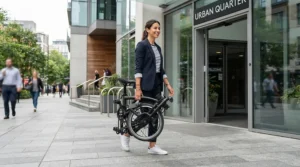
Premium Compact Folding Ebike vs Full-Size Commuter Ebike
A premium compact folding ebike solves a storage and portability problem, while a full-size commuter ebike solves a ride-comfort problem. Neither is universally better.
| Factor | Premium compact folding ebike | Full-size commuter ebike | Budget folding ebike |
|---|---|---|---|
| Carry weight | ~10–22 kg in this guide | Many ebikes exceed 23 kg (50 lb) | Can be much heavier |
| Storage | Closet, under a desk, trunk | Needs a rack or hallway space | Folds, but often bulky |
| Ride feel | Small wheels trade stability for compactness | Stable on long rides | Variable component quality |
| Upfront cost | Highest | Moderate to high | Lowest |
| Best For | Multimodal commuters, small homes | Long, flat commutes | Occasional, low-budget use |
If your commute includes a train, stairs or a cramped apartment, the premium compact folding ebike usually wins on convenience. If you ride 20 km on bike lanes and park outdoors, a full-size ebike may deliver more comfort for less money. Be honest about how much of your week involves lifting or storing the bike.
Long-Term Cost and Maintenance
The sticker price is only the opening bid. Over time, you’ll also pay for tires, brake pads, chains and eventually a battery.
Battery health is the big long-term variable. Hummingbird claims a replaceable battery rated for about 3,000 cycles, and Brompton covers its electric system for three years when registered. One Canadian Gocycle owner reported rebuilding a failed battery with new cells for about a third of the replacement cost, a useful fallback if the brand’s supply chain is shaky.
Here’s a value check. A bike costing around C$7,500, ridden 220 days a year for five years, covers about 1,100 trips. That’s roughly C$7 per trip before maintenance. Add the transit fares or parking you avoid and the maths looks better.
Insurance is worth a call too. A bike worth thousands of dollars may need a specific rider or listing on your home policy, and a quality lock is non-negotiable. The folding advantage is that you can often bring the bike inside with you.
Safety, Regulations and Certification for Canadian Riders
Provincial rules set the practical limits. Broadly, a legal ebike has a motor of 500 W or less, assist that cuts out at 32 km/h, and working pedals. Minimum age and helmet requirements vary by province, so check yours.
Every bike here uses a 250 W motor and keeps assist at or below these limits. The Hummingbird Electric Gen 2.0 caps assist at 25 km/h. Never modify a bike to exceed the limits, because that can reclassify it as a motor vehicle.
Certification is the grey area. Since the federal definition was removed in 2021, and with Health Canada reportedly declining jurisdiction over ebike product oversight, you should check certification yourself. The Tern Vektron S10 frame is certified to EN 15194. One competitor retailer notes that neither Brompton nor Gocycle certifies the complete bike to UL standards. Some landlords and condo boards ask for certified batteries and chargers, so confirm requirements before buying.
Travel-Case Compatibility: Flying, Trains and Trunks
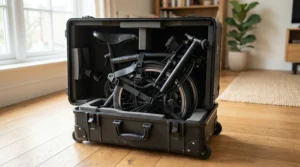
Treat the bike and its battery as two separate travel problems. Travel-case compatibility starts with size, then moves to power.
The battery problem. CATSA’s lithium battery guidance separates batteries into under 100 Wh, 100–160 Wh (airline approval needed) and over 160 Wh. International dangerous-goods guidance does not permit passengers to carry batteries over 160 Wh. The 345 Wh Brompton packs, 375 Wh Gocycle G4i+ pack and 400 Wh Tern Vektron S10 pack all exceed that. I couldn’t confirm the Hummingbird Electric Gen 2.0‘s watt-hour rating. Plan to ship batteries separately, and confirm with your airline.
The size problem. Add the listed folded dimensions of the T Line and P Line (645 + 600 + 320 mm) and you get about 157 cm. That is right at the 158 cm linear limit many airlines use for checked bags, before any case padding. The C Line (about 142 cm) has more headroom. The Gocycle G4i+ and Tern Vektron S10 fold closer to 190 cm, so they suit trunks and transit better than flights.
Case options. Gocycle says its G4-generation bikes work with a bespoke travel case. Hummingbird sells a carry bag separately, around £170 in the UK. Verify listing dimensions against your exact build, and confirm your airline’s rules.

Frequently Asked Questions
❓ How much does a premium compact folding ebike cost in Canada?
❓ Do I need a licence or insurance to ride a premium compact folding ebike in Canada?
❓ How long does a folding ebike battery last on one charge?
❓ Is carbon fibre or titanium better for a premium compact folding ebike?
❓ Where can I buy a Brompton Electric in Canada?
Conclusion
After comparing specs, listings and published reviews, the pattern is clear. The best premium compact folding ebike is the one that fixes your biggest daily friction.
- Want the best balance of weight and price? The Brompton Electric P Line is the logical pick.
- Carrying the bike every day and budget isn’t the limit? The Brompton Electric T Line is the featherweight.
- Want the smallest fold and the best value? The Brompton Electric C Line.
- Need rougher-street stability? The Brompton Electric G Line.
- Chasing the most dramatic engineering and willing to verify service? The Gocycle G4i+.
- Prioritizing the lowest possible weight? The Hummingbird Electric Gen 2.0, with eyes open on ride quality.
- Climbing hills and hauling cargo? The Tern Vektron S10.
Whatever you choose, measure your spaces, check the battery rating against your travel plans, and confirm local service. Premium materials are worth paying for only when they improve something you’ll feel every day.
Recommended for You
- Compact Folding E-Bike For Small Storage Spaces: 7 Best 2026
- 20 Inch Folding E-Bike For Apartments: 7 Best Picks In 2026
- 7 Best Folding E-Bikes Under $1000 CAD In 2026
Disclaimer: This article contains affiliate links. As an Amazon Associate, I earn from qualifying purchases. If you purchase products through these links, we may earn a small commission at no additional cost to you.
✨ Found this helpful? Share it with your friends! 💬🤗
