
In This Article
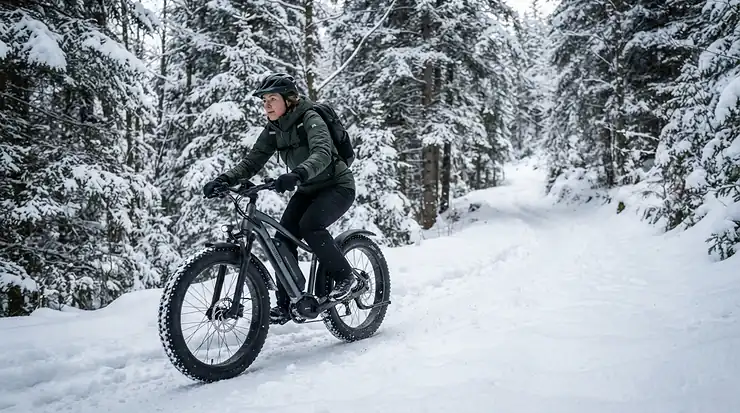
A winter outdoor fat tire electric bike is a pedal-assist e-bike built around fat bikes tires of roughly 97 mm (3.8 in) or wider, plus a torque-rich motor and a removable battery. It floats over packed snow and hauls gear to the trailhead, the cabin or the fishing spot, instead of sitting in the garage until April.
Snow is slow, and slush is slower. Pedalling a skinny-tired commuter through a plowed-and-refrozen bike lane feels like arguing with a wet mattress. A fat-tired, motor-assisted machine turns the same trip into something close to fun. It also turns “I can’t get to the trailhead” into “I’m leaving in ten minutes.”
This guide was researched in October 2026 for Canadian riders. Every spec comes from manufacturer listings and independent review sites, and every comment about owner sentiment is an aggregate of what reviewers report. Nothing here is a personal test ride, and nothing is invented. Prices are CAD ranges, because they move constantly.
Three questions drive winter buyers: what can this bike pull (sled/gear towing capacity), what can it carry (rear rack weight ratings for gear), and is the surface under it actually safe (frozen lake ice safety)? Most buyer guides skip all three. We won’t.
Quick Comparison: 7 Winter Fat Tire E-Bikes at a Glance
| Model | Motor | Battery | Tires | Price range (CAD) | Best For |
|---|---|---|---|---|---|
| Hiboy P6 | 750 W (1,000 W peak), 80 Nm | 48 V, about 556-624 Wh (11.6-13 Ah by listing) | 26×4.0″ | Around C$1,100-C$1,400 | Budget winter commuting |
| Himiway D5 Zebra | 750 W hub | 960 Wh | 26×4″ | C$2,300-C$2,700 | Long range with loads |
| Aventon Aventure 3 | 750 W (1,188 W peak), 80 Nm | 733 Wh | 26×4″ | Around C$2,300 | Tech, security, certification |
| Velotric Nomad 2 | 750 W, 90 Nm | Verify on listing | Fat tire (verify size) | Around C$2,200 | Highest published load numbers |
| Taubik Tour | 500 W, 80 Nm | 720 Wh | 26×4.0″ | C$2,700-C$2,900 | Staying within the 500 W limit |
| Eunorau FAT-AWD 3.0 | Dual 500 W hubs | Verify on listing | 26×4.0″ | Around C$2,300 | Slippery uphill starts |
| Himiway Cobra Pro | 1,000 W mid-drive, up to 160 Nm | 960 Wh | 26×4.8″ | Premium tier; check current price | Steep terrain and hauling |
Looking at the table, the Himiway D5 Zebra and Himiway Cobra Pro carry the biggest packs, which is the cushion you want when cold weather trims range. The Hiboy P6 undercuts everything on price but gives up pack size and braking refinement. The Taubik Tour is the only motor here rated at the 500 W limit most provinces use for power-assisted bicycles. Several of these brands also sell direct, so confirm the seller and current listing on amazon.ca before you buy.
💬 Just one click — help others make better buying decisions too!😊
Top 7 Winter Outdoor Fat Tire Electric Bike Picks: Expert Analysis
1. Hiboy P6 — cheapest ticket onto real 4-inch rubber
The Hiboy P6 proves you don’t need a C$2,500 cheque to float over snow. It pairs a 750 W Bafang rear hub (1,000 W peak, 80 Nm) with 26×4.0″ tires, a Shimano 7-speed drivetrain and an IPX4-rated removable 48 V battery. The maker lists 11.6 Ah (about 556 Wh), while a Canadian retailer lists 13 Ah. Confirm which version you’re buying.
On paper, 80 Nm is enough to push through packed snow, and the downtube battery keeps weight low. That helps when a rear wheel gets squirrelly. The brakes are 180 mm mechanical discs, not hydraulic. They’re fine for flat commutes but less reassuring if you plan to haul heavy gear. The retailer spec lists no rear rack, and max load is 120 kg (265 lb).
Based on the spec comparison, this suits a light-load commuter doing 10-15 km trips. At about 29.5 kg (65 lb), it’s also easier to wrestle up steps than most rivals. Reviewers consistently describe it as stable with surprising punch for the money. The compromises they mention are brake feel and a few design details.
Pros:
- ✅ Genuine 4.0″ tires at an entry price
- ✅ 80 Nm motor climbs with authority
- ✅ Lightest bike on this list
Cons:
- ❌ Mechanical brakes limit heavy-load confidence
- ❌ No stock rear rack on the retailer spec
Price: around C$1,100-C$1,400, so check the current price. It’s the best value if you carry little and brake gently.
2. Himiway D5 Zebra — a 960 Wh pack built for long, loaded days
The Himiway D5 Zebra is the one to study when the plan involves distance. A 750 W geared hub motor pairs with a removable 960 Wh (48 V, 20 Ah) battery. BikeRide’s testing logged about 83 km at pedal-assist level 3 over roughly 540 m of climbing. In winter terms, that leaves a real buffer even after cold shaves a quarter off capacity.
Payload is rated at 181 kg (400 lb), but the rear rack itself is rated for only about 15 kg (33 lb). We unpack that gap in the rack section below. The updated model adds UL 2849 certification, a faster 3 A charger, and a choice between torque and cadence sensors.
Here’s what to weigh: this suits riders who want one bike for commuting and the occasional gear run, and who can live with heft. Testers found the torque-sensor version climbs more slowly than comparable 750 W fat bikes. Reviewers highlight range, included fenders and lights, and the load rating. Common complaints are weight and a 95 mm fork that bottoms out easily.
Pros:
- ✅ 960 Wh pack gives a serious winter buffer
- ✅ 181 kg payload rating
- ✅ Fenders, lights and rack included
Cons:
- ❌ Fork bottoms out on bigger hits
- ❌ Heavy, with a rack rated for just 15 kg
Price: C$2,300-C$2,700 range. It’s strong value per watt-hour for riders who prize range over lightness.
3. Aventon Aventure 3 — the app-connected, certified all-rounder
The Aventon Aventure 3 is the tech-forward pick. Its 750 W hub (1,188 W peak, 80 Nm) uses a torque sensor, so assistance follows how hard you pedal. The 36 V, 20 Ah (733 Wh) LG 21700 pack holds slightly more energy than the common 48 V, 15 Ah pack. Tires are 26×4″, the fork is an 80 mm air unit, and the brakes are hydraulic discs.
Total weight limit is 181 kg (400 lb), the rear rack is rated at 27 kg (59 lb), and the bike weighs about 35 kg (77 lb). It carries both UL 2271 (battery) and UL 2849 (system) certification. The app adds GPS tracking and a wheel lock.
On slick pavement, a torque sensor is the quiet hero. Power ramps with effort instead of lunging, which cuts the wheel-spin drama at stop signs. Reviewers praise the polish, security features and capacity. Their recurring complaints are weight and the 27 kg rack ceiling if you want to carry more.
Pros:
- ✅ Torque sensor smooths slippery starts
- ✅ UL 2271 and UL 2849 certified
- ✅ Hydraulic brakes with GPS and wheel lock
Cons:
- ❌ About 35 kg is a lot to lift
- ❌ Rack tops out at 27 kg
Price: around C$2,300, so check the current price. It’s good value if safety certification matters to you.
4. Velotric Nomad 2 — the biggest published load numbers on this list
The Velotric Nomad 2 pairs a 750 W hub (90 Nm) with a listed maximum bike load of 229 kg (505 lb). It weighs about 34 kg (75 lb), and its rear rack is listed at 30 kg (66 lb) in the comparison we found. Media coverage has also reported a 454 kg (1,000 lb) towing figure. That number isn’t prominent in the spec table, so confirm it in the current owner’s manual before trusting it.
That towing number is a ceiling, not a promise for a sled on hard snow. Payload is what the bike carries, while towing capacity is what it pulls, and the two are not interchangeable. Think of the Nomad 2 as a high-capacity fat-tire utility bike rather than a cargo bike. The battery size for this model wasn’t confirmed in the sources used here.
One review site reports 450+ miles of testing, including January rides through roughly 15 cm of fresh snow, and calls it highly capable. That’s single-source data, so treat it as indicative rather than settled.
Pros:
- ✅ 90 Nm motor suits loaded starts
- ✅ Highest listed payload on this list
- ✅ Rack rated about 30 kg
Cons:
- ❌ Towing and rack figures vary between listings
- ❌ Battery details unconfirmed in our sources
Price: around C$2,200, so check the current price. It’s good value if you read the manual before loading it.
5. Taubik Tour — the step-through built to the 500 W limit
The Taubik Tour is the compliance-minded choice. It uses a 500 W Bafang hub (80 Nm), a 48 V, 15 Ah Samsung pack (720 Wh) with a claimed range up to 100 km, and 180 mm hydraulic discs. Tires are 26×4.0″, and it offers dual torque and cadence pedal assist. A Canadian retailer lists it as UL 2849 full-system certified.
Staying inside the 500 W and 32 km/h definition most provinces use makes it the cleanest fit for public paths. The step-through frame also earns its keep in winter. Bulky boots and thick layers don’t cooperate with swinging a leg over a high top tube. The trade is lower peak power than the 750 W bikes here, though 80 Nm still handles most commuting grades.
Most favourable coverage comes from Canadian retailer roundups rather than independent labs. That’s useful but not neutral, so weigh it accordingly.
Pros:
- ✅ Rated at the 500 W provincial limit
- ✅ Step-through suits winter layers
- ✅ 720 Wh Samsung pack with hydraulic brakes
Cons:
- ❌ Less peak power than 750 W rivals
- ❌ Thin independent review data
Price: C$2,700-C$2,900 range, so check the current price. It’s a premium for legal peace of mind.
6. Eunorau FAT-AWD 3.0 — two motors for slippery uphill starts
The Eunorau FAT-AWD 3.0 attacks one specific winter problem: the glare-ice uphill start. Dual 500 W hub motors drive both wheels through 26×4.0″ tires, with a torque sensor metering the power. A step-through version is available.
All-wheel drive spreads traction across two contact patches, so a slick launch is less likely to become a rear-wheel spin. Two 500 W motors combined exceed the single-motor 500 W definition provincial rules use, so treat it as a private-land and trail machine. Eunorau’s trailer guide says hunting-style trailers typically carry 45-90 kg (100-200 lb) when the bike, hitch and terrain line up. Battery, rack and payload figures weren’t verified here.
Praise comes mainly from Canadian retailer content, which calls it the traction winner. Independent testing data was scarce.
Pros:
- ✅ Powered front wheel for slick starts
- ✅ Torque sensor meters assistance
- ✅ True 4.0″ tires
Cons:
- ❌ Combined motor power exceeds the 500 W definition
- ❌ Battery and payload specs unverified here
Price: around C$2,300, so check the current price. It’s worth it for hill-start anxiety, but verify specs first.
7. Himiway Cobra Pro — mid-drive muscle and 4.8-inch float
The Himiway Cobra Pro (also marketed as the D7 Pro) is the heavy hitter. It has a Bafang M620 1,000 W mid-drive with up to 160 Nm, a 960 Wh battery, full suspension and 26×4.8″ tires. The wider tires float better in soft snow, and the mid-drive uses the gears to multiply torque. That’s why accessory-maker guidance generally favours mid-drives for serious towing.
Electric Bike Report describes it as pedal-friendly and able to climb loose, steep terrain. A 1,000 W motor is far beyond the 500 W provincial definition, so this is for private land and backcountry. Rack capacity and payload weren’t verified in our sources. Expect weight in the same heavy full-suspension class as its sibling, the Cobra.
Pros:
- ✅ Mid-drive torque suits towing and climbs
- ✅ 960 Wh battery with 4.8″ float
- ✅ Full suspension for rough terrain
Cons:
- ❌ Far beyond the 500 W legal definition
- ❌ Heavy, with unverified rack rating
Price: premium tier, so check the current price. Expect it to sit above the other six.
✨ Ready to Gear Up for Winter?
🔍 Take your winter riding to the next level with these carefully selected bikes. Click any highlighted bike name to check current pricing and availability. A well-matched bike is what lets you enjoy cold-weather riding instead of enduring it!
How to Choose a Winter Outdoor Fat Tire Electric Bike
Follow these steps in order, because each filters out bikes the next one would otherwise tempt you with.
- Start with the tires. Look for genuine 4.0″ or wider rubber with an open tread. A 3″ “plus” tire is not a fat bike, and snow punishes the difference.
- Match the motor to your legal reality. Provinces use a 500 W, 32 km/h definition for power-assisted bicycles, and Quebec’s SAAQ spells it out plainly. Higher-wattage bikes aren’t useless, but they live on private land.
- Size the battery for January, not June. A 960 Wh pack losing 30% still leaves about 672 Wh. A 556 Wh pack in the same cold leaves about 389 Wh.
- Demand hydraulic brakes if you haul. Added weight lengthens stopping distance, and mechanical discs fade sooner.
- Check certification. UL 2849 covers the whole e-bike system and UL 2271 covers the battery. You’ll be charging it indoors all winter, so this matters.
- Read payload and rear rack weight ratings for gear separately. They are different numbers, as the rack section shows.
- Weigh the bike. At 30-35 kg or more, ask whether you’ll be lifting it onto a porch or into a truck bed.
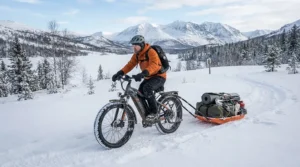
Sled/Gear Towing Capacity: What a Fat Tire E-Bike Can Actually Pull
Here’s the number most listings blur: towing capacity is the weight of the trailer or sled behind you, while payload is what the bike itself carries. They are separate ratings, and a bike can have a generous payload and no published towing limit at all.
What the available guidance supports:
- Power: accessory makers suggest at least 750 W for confident hauling. Mid-drives tend to do better with heavy trailers.
- Realistic loads: one fat-bike maker says hunting trailers typically tow 45-90 kg (100-200 lb) when everything lines up.
- System limits: Tern’s Quick Haul trailer states a 150 kg gross weight for the whole setup, including bike, trailer, cargo and rider. Always read whether a rating counts you.
- Hitching: most trailers attach at the rear axle, so confirm your axle type and adapter. Hydraulic discs are recommended because towing lengthens stopping distance.
- Range: towing drains batteries faster, so don’t plan any ride that arrives with the pack nearly empty.
No manufacturer in our research published a sled-specific figure. Use trailer ratings as upper limits, not targets. A rigid-pole sled stays behind you on downhills, while a rope sled can overrun you, though that’s reasoning rather than tested data.
Rear Rack Weight Ratings for Gear: Payload vs Rack Limit
| Model | Total payload | Rear rack rating | Towing note |
|---|---|---|---|
| Hiboy P6 | 120 kg (265 lb) | None listed on retailer spec | Not specified |
| Himiway D5 Zebra | 181 kg (400 lb) | About 15 kg (33 lb) | Not specified |
| Aventon Aventure 3 | 181 kg (400 lb) | 27 kg (59 lb) | Reviewers mention trailers; no rating found |
| Velotric Nomad 2 | 229 kg (505 lb) listed | 30 kg (66 lb) | 454 kg (1,000 lb) reported; verify |
| Taubik Tour | Not verified | Not verified | Not verified |
| Eunorau FAT-AWD 3.0 | Not verified | Not verified | Maker’s guide: 45-90 kg trailers |
| Himiway Cobra Pro | Not verified | Not verified | Mid-drive suits towing |
Payload includes you. A 95 kg rider plus 20 kg of gear is 115 kg. That fits inside the 120 kg limit of the Hiboy P6 with almost no margin, and it fits easily under the 181 kg payload of the Himiway D5 Zebra. But the Zebra’s rack is rated for only about 15 kg, so 5 kg of that gear must ride in panniers or on a front rack. Total capacity and rack capacity are separate gates, and your load has to clear both.
The table shows how uneven the published data is. The Velotric Nomad 2 and Aventon Aventure 3 give you the clearest rack numbers, while three bikes leave gaps you must fill by asking the maker. If you’re hauling an ice-fishing kit, ask for the rear rack weight ratings for gear in writing before you buy.
Frozen Lake Ice Safety for E-Bike Riders: Numbers Before Nerve
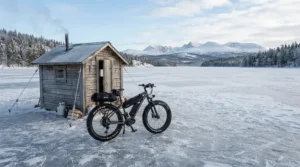
Frozen lakes are the most tempting and most dangerous place to ride a winter outdoor fat tire electric bike. Frozen lake ice safety is not a gut feeling, and it isn’t what the surface looks like.
The thresholds Canadian sources publish depend on the activity:
- The Lifesaving Society lists a minimum of 10 cm (4 in) for a single person and 12 cm (5 in) for a snowmobile or ATV.
- Destination Ontario cites at least 25 cm (10 in) for a sled or snowmobile, and 30 cm (12 in) for a light vehicle.
- The OPP says no one should walk on ice thinner than 7 cm (3 in).
A fat tire e-bike with a rider and gear is closer to a snowmobile than a skater, so the conservative 25 cm figure is the sensible planning number. No source consulted for this guide publishes an e-bike-specific figure.
Practical rules that follow from the sources:
- Chip a hole and measure the ice in several spots, because thickness is rarely uniform.
- Never test alone, and tell someone your route and return time.
- Avoid currents, river mouths and ice after dark.
- Remember that snow insulates and slows ice growth, so a snowy surface is not reassuringly solid.
- Carry safety picks and wear a lifejacket.
Winter Battery Care and Long-Term Cost
Cold increases internal resistance in lithium-ion cells, so the same battery delivers less. Estimates vary: 10-30% range loss in one e-bike retailer’s guide, and 20-50% in other sources. Wind, hills, low tire pressure and heavy cargo make it worse.
Habits that protect range and battery life:
- Charge indoors. Charging a very cold lithium pack can cause lithium plating, so let it warm to room temperature first.
- Store it warm. A battery kept in a freezing shed is quietly losing health.
- Ride smart. Constant top assist drains packs faster, and lower gears with a higher cadence are gentler on the motor.
- Insulate. A thermal cover slows heat loss on longer rides but doesn’t replace indoor storage.
For cost of ownership, think per ride. A C$2,300 bike used for 100 winter commutes a year over three years is about C$7.70 per ride before maintenance. The battery is the big wear item, which is another reason to favour certified systems and bigger packs. A larger pack cycles less deeply for the same trip.
Your First 30 Days: Setting Up a Fat Tire E-Bike for Snow
Most winter problems appear in the first month, and most are fixable in an afternoon.
- Drop the tire pressure. Lowering fat tires to 8-12 PSI (55-83 kPa) improves control on fresh and packed snow. You’ll need a low-pressure gauge, because standard pump gauges read poorly down there. Check your tire’s minimum rating.
- Match tires to surface. Non-studded fat tires suit packed snow, while studded tires make sense on ice.
- Fit fenders. They keep slush off your face, drivetrain and electronics.
- Lube the chain after every wet ride. Winter grit eats drivetrains.
- Brake early and gradually. Slow down for turns on icy surfaces.
- Do a one-week check. Re-tension spokes, test brake pad bite and confirm the battery latch is secure.
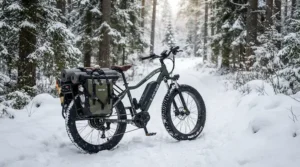
Which Bike Fits Which Winter? Three Rider Profiles
The city commuter (budget around C$1,500, 12 km each way, five days a week). Cold, plowed roads and packed bike lanes. The Hiboy P6 fits if you carry a laptop bag rather than groceries, with panniers added for any rack-like use.
The gear hauler (budget around C$2,500-C$3,500, weekend runs, 25 kg kit). Trails to a cabin or fishing access. The Himiway D5 Zebra or Himiway Cobra Pro suit this. Do your frozen lake ice safety homework first.
The rule-conscious rider (budget around C$2,800, mixed public paths and winter streets). The Taubik Tour stays inside the 500 W definition and its step-through frame is easier with layers. If your trouble is a steep driveway start, the Eunorau FAT-AWD 3.0 is the one built for it, but it lives on private land.
Fat Tire E-Bike vs Snowmobile and Other Winter Alternatives
| Option | Snow traction | Gear hauling | Licensing (typical) | Best For |
|---|---|---|---|---|
| Winter outdoor fat tire electric bike | Wide tires float; motor helps | Racks, panniers, trailers within ratings | Most provinces: no licence for qualifying bikes; helmet required | Commuting and short trail access |
| Snowmobile | Excellent on trails | Highest | Ontario: licence, insurance, registration, helmet, trail permit | Long backcountry trips |
| Regular narrow-tire e-bike | Struggles in soft snow | Good | Same as qualifying e-bikes | Plowed roads only |
| Pedal-only fat bike | Good float | Limited by your legs | None | Fitness riding |
A fat tire e-bike sits in a sweet spot: far less paperwork and cost than a snowmobile, far more capability in snow than a narrow-tire e-bike. The wide tires spread weight like snowshoes, which is why they’re the most effective option on soft snow and slush. The catch is that rules vary by province, and bikes above 500 W may not qualify as power-assisted bicycles on public roads.
Canadian Rules for Fat Tire E-Bikes: Power, Speed and Helmets
The definition most provinces use caps motors at 500 W and assisted speed at 32 km/h. Transport Canada stepped back from regulating qualifying power-assisted bicycles in February 2021, so provinces now set the details. Alberta allows riders from 12, Manitoba from 14, and Ontario and British Columbia from 16. Helmets are required in most provinces, and Prince Edward Island treats e-bikes like mopeds.
Several bikes in this guide carry 750 W or higher ratings. They may fall outside the power-assisted bicycle definition on public roads, which can change helmet, licence and insurance obligations. Riding on private land is a different regulatory question. Check your province’s current rules before you ride, and consider the Taubik Tour if staying inside the 500 W definition matters to you.
Common Mistakes When Buying a Winter Outdoor Fat Tire Electric Bike
- Buying on peak watts. Nominal power and torque matter more than a peak number on the box.
- Treating rack rating as payload. They are separate limits, as the earlier table shows.
- Charging a frozen battery. Bring it inside first.
- Over-inflating tires. High pressure kills the float that justifies fat tires.
- Trusting how ice looks. Ice that appears solid can be weak, and nearly 35% of Canadian drownings occur between October and April, according to the Lifesaving Society.
- Skimping on brakes. Heavy bikes plus slick surfaces demand stopping power.
- Ignoring weight. A 35 kg bike is a different object from a 29 kg one when you’re lifting it.
FAQ
❓ Can you ride a fat tire electric bike on a frozen lake?
❓ How much weight can a fat tire e-bike rear rack hold?
❓ How much range does a fat tire e-bike lose in winter?
❓ Do you need studded tires on a winter fat tire e-bike?
❓ Is a 750 W fat tire e-bike legal in Canada?
Conclusion
The best winter outdoor fat tire electric bike is the one that matches how you ride, what you carry and where the law lets you go. The Hiboy P6 is the budget way onto real fat tires. The Himiway D5 Zebra is the range-first pick, and the Aventon Aventure 3 adds certification and smart security. The Velotric Nomad 2 offers the largest published load numbers, while the Taubik Tour stays inside the 500 W definition. The Eunorau FAT-AWD 3.0 attacks slippery starts, and the Himiway Cobra Pro is the heavy-duty hauler for private land.
Whatever you choose, do the unglamorous homework. Read the sled/gear towing capacity in the owner’s manual rather than the marketing page. Compare rear rack weight ratings for gear against your real load. And treat frozen lake ice safety as a measured fact, not a mood. Prices and availability change, so check current listings on amazon.ca before you commit.
✨ Your winter doesn’t have to be spent indoors!
🚴♂️ Click any highlighted bike name above to check current pricing and availability, and get ready for your best cold-weather riding season yet.
Recommended for You
- Studded Vs Non-Studded Fat Tire E-Bike: 7 Best Picks (2026)
- Fat Tire E-Bike For Snow: 7 Best Winter Picks In Canada (2026)
- Fat Tire E-Bike For Snow: 7 Best Winter Picks In Canada (2026)
Disclaimer: This article contains affiliate links. As an Amazon Associate, I earn from qualifying purchases. If you purchase products through these links, we may earn a small commission at no additional cost to you.
✨ Found this helpful? Share it with your friends! 💬🤗
