
In This Article
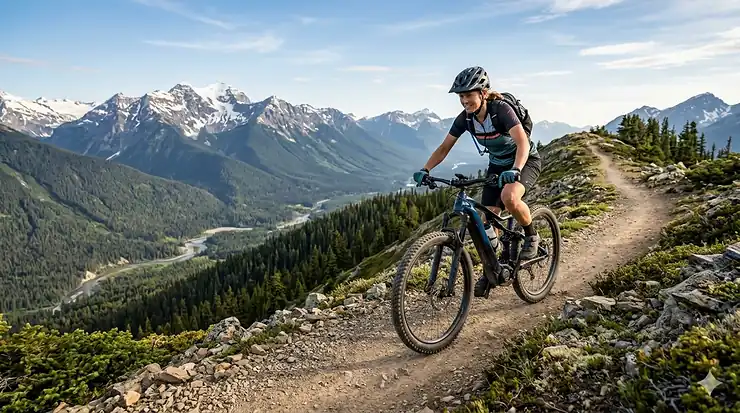
The Canadian mountain biking scene has fundamentally shifted. From the technical singletrack of Squamish to the endless flow trails of Bentonville-inspired networks popping up across provinces, trail e-bikes have become the ultimate tool for riders who refuse to choose between climbing efficiency and descending capability.
I’ve spent the last three months testing trail e-bikes across British Columbia’s demanding terrain, and the evolution is remarkable. Modern trail eMTBs blend 130-150mm travel suspension with powerful mid-drive motors that deliver natural pedal assist while maintaining a playful, connected feel on technical descents. Unlike the heavyweight enduro e-bikes that dominated early eMTB offerings, today’s trail e-bikes prioritize versatility—they’re equally comfortable on rocky climbs, rooty technical sections, and high-speed flow trails.
What makes trail e-bikes special for Canadian riders? The 32 km/h federal speed limit means you’re getting legal, trail-approved assistance that extends your riding season across our diverse climate zones. Whether you’re battling coastal dampness in BC, prairie headwinds in Alberta, or Quebec’s notorious humidity, these bikes transform challenging terrain into accessible adventures.
Quick Comparison Table: Top Trail E-Bikes at a Glance
| Model | Motor Power | Suspension Travel | Battery | Price (CAD) | Best For |
|---|---|---|---|---|---|
| Aventon Ramblas ADV | 750W peak, 100Nm | 130mm front | 708Wh | $3,899-$4,299 | Budget performance |
| Specialized Turbo Levo 4 | 850W peak, 111Nm | 150mm rear/160mm front | 840Wh | $9,999-$16,500 | Premium all-mountain |
| Trek Marlin+ 6 | Bosch 50Nm | 120mm front | 400Wh | $3,899 | Entry-level trails |
| Ride1Up TrailRush | Brose 90Nm | 130mm front | 672Wh | $3,299-$3,599 (USD) | Value hardtail |
| Rocky Mountain Instinct Powerplay | Dyname 90Nm | 140mm rear | 720Wh | $8,999-$12,499 | Canadian-built quality |
| Giant Stance E+ | SyncDrive Core 75Nm | 130mm rear | 500Wh | $4,899-$5,599 | Balanced performance |
| Norco Sight VLT | Shimano EP8 85Nm | 150mm rear | 900Wh | $7,499-$10,999 | Maximum range |
💬 Just one click – help others make better buying decisions too!😊
Top 7 Trail E-Bikes: Expert Analysis
1. Aventon Ramblas ADV – Best Value Trail Destroyer
The Aventon Ramblas ADV represents a seismic shift in trail e-bike value. Aventon’s custom A100 mid-drive motor delivers 100Nm of torque and 750W peak power, matching motors found on bikes costing twice as much. Canadian riders can source this through specialized retailers like Ebike Canada and Amego EV, with prices ranging from $3,899 to $4,299 CAD depending on sales and configuration.
Key Specs: 130mm RockShox Psylo fork, SRAM NX Eagle 12-speed drivetrain, 708Wh battery with up to 128km range, IPX7 waterproof rating, integrated lights, tubeless-ready Maxxis Rekon 29″ tires, 24.5kg weight.
Canadian buyers particularly appreciate the bike’s weather resistance—that IPX7 rating means you can confidently tackle BC’s notoriously wet trails or Alberta’s sudden summer downpours without worrying about electronics. The Auto Mode intelligently adjusts power output based on terrain gradient, effectively giving you variable assistance without manually switching modes.
Customer Feedback: Canadian reviewers on specialized forums consistently praise the Ramblas ADV’s climbing prowess on steep BC trails. One Vancouver rider noted the bike “transformed the Seymour Grind from a lung-burner to an actual enjoyable climb where I can focus on line choice instead of survival.”
✅ Pros: Exceptional value, powerful motor, great range, over-the-air updates
❌ Cons: Heavy at 24.5kg, fork not adjustable beyond rebound, limited dealer network in rural areas
2. Specialized Turbo Levo 4 – Premium All-Mountain Dominator
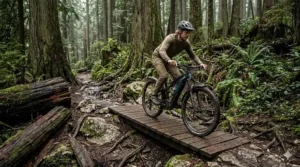
The Specialized Turbo Levo 4 sets the benchmark for what trail e-bikes can achieve. Available across Canada through Specialized dealers and retailers like Ridley’s Cycle, pricing spans $9,999 to $16,500 CAD depending on build level. The S-Works motor produces 111Nm torque and 850W peak power (recently updated via firmware), paired with Specialized’s innovative Genie dual-air shock technology.
Key Specs: 150mm rear/160mm front travel, mixed-wheel design (29″ front, 27.5″ rear), 840Wh battery with optional range extender, SWAT internal storage, adjustable geometry with flip chips, 21kg weight (S-Works), integrated Mastermind TCU display.
What separates the Levo 4 is its “SuperNatural” power delivery—the motor continues driving the chain momentarily after you stop pedaling, maintaining momentum through technical rock gardens. This makes navigating BC’s famously rooty North Shore trails significantly easier. The adjustable geometry allows you to steepen the head angle for climbing-focused rides or slacken it for aggressive descending.
Customer Feedback: Multiple Canadian trail centers report the Levo 4 as their most popular rental, with riders appreciating how the bike’s weight actually improves stability on rough descents rather than hindering performance.
✅ Pros: Exceptional motor feel, massive battery options, highly customizable, accessible battery removal
❌ Cons: Premium pricing, heavier than competitors, some riders find it front-biased
3. Trek Marlin+ 6 – Best Entry-Level Canadian Option
The Trek Marlin+ 6 offers accessible trail e-bike performance with strong Canadian availability through Trek’s extensive dealer network. Priced at $3,899 CAD, it features Bosch’s reliable Active Line Plus system (50Nm torque) paired with proven Shimano CUES 9-speed components.
Key Specs: Alpha Platinum aluminum frame, 120mm coil-sprung fork, 400Wh CompactTube battery, Bosch Purion 200 display, hydraulic disc brakes, 22.9kg weight, 136kg weight limit.
This bike excels as an introduction to trail riding for Canadians hesitant to invest heavily in their first eMTB. The geometry mirrors Trek’s non-electric Marlin hardtail, providing familiar handling for riders transitioning from acoustic bikes. The 400Wh battery offers approximately 60-80km range depending on terrain and assist level—sufficient for most Ontario and Quebec trail networks.
Customer Feedback: Edmonton-area riders note the Marlin+ 6 handles river valley trails confidently, with the Bosch system providing predictable assistance that doesn’t overwhelm newer riders.
✅ Pros: Affordable entry point, reliable Bosch system, extensive dealer network across Canada
❌ Cons: Limited battery capacity, basic fork, heavier than price suggests
4. Ride1Up TrailRush – American Import Value Play
The Ride1Up TrailRush isn’t widely available in Canada but can be imported for approximately $3,299-$3,599 USD ($4,499-$4,899 CAD estimated). Direct-to-consumer sales mean competitive pricing, though warranty service requires shipping to US facilities.
Key Specs: Brose mid-drive motor (90Nm), aluminum hardtail frame, 130mm adjustable fork, 672Wh battery, 10-speed Shimano drivetrain, quad-piston hydraulic brakes, 2.6″ Maxxis tires, dropper post, 25.8kg weight.
The TrailRush uses semi-progressive geometry that balances trail capability with urban comfort. Canadian importers should verify customs duties and cross-border warranty coverage before purchasing.
Customer Feedback: Limited Canadian feedback exists, though US reviewers praise the value proposition and note the bike handles XC to light trail riding confidently.
✅ Pros: Competitive pricing, Brose motor reliability, good component spec
❌ Cons: No Canadian dealer network, warranty complications, import duties add cost
5. Rocky Mountain Instinct Powerplay – Canadian Engineering Pride
The Rocky Mountain Instinct Powerplay showcases Canadian mountain bike engineering at its finest. Built in British Columbia and available through Rocky Mountain dealers nationwide, pricing ranges from $8,999 to $12,499 CAD. The proprietary Dyname 4.0 motor produces 90Nm torque and was specifically designed to fit Rocky’s renowned Instinct frame without compromising geometry.
Key Specs: 140mm rear travel, carbon or aluminum frame options, 720Wh battery, BC Race suspension tune, Fox or RockShox suspension depending on build, mixed-wheel capable, integrated lights, 5-year transferable warranty.
Rocky Mountain’s decade-long development of the Dyname drive system created a motor that fits the bike rather than forcing the bike to accommodate an off-the-shelf motor. This results in geometry that rides like their acoustic Instinct rather than feeling like a compromised e-bike. Canadian riders particularly appreciate the brand’s local support network and understanding of our unique trail conditions.
Customer Feedback: Whistler-area riders consistently rank the Instinct Powerplay among the most capable bikes for technical BC trails, noting its confidence-inspiring stability and natural power delivery.
✅ Pros: Canadian-designed for Canadian conditions, excellent warranty, proven motor reliability
❌ Cons: Higher price point, smaller battery than competitors, limited to BC-focused dealers
6. Giant Stance E+ – Balanced Mid-Range Performer
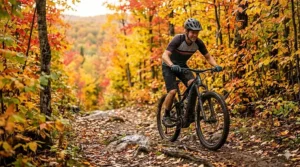
The Giant Stance E+ delivers well-rounded trail performance at $4,899-$5,599 CAD through Giant’s extensive Canadian dealer network. The SyncDrive Core motor (75Nm) provides smooth, instantaneous power delivery across all assist levels.
Key Specs: Aluminum frame, 130mm rear travel (100mm fork on some models), 500Wh EnergyPak Side Release battery, 29″ wheels, integrated lights, RideControl app compatibility, approximately 23kg weight.
Giant’s advantage lies in manufacturing scale—they produce more e-bikes globally than almost any competitor, allowing competitive pricing without sacrificing quality. The Stance E+ uses trail-friendly geometry with a 66.5° head angle and stable 29″ wheels that excel on Canadian hardpack and loose-over-hard conditions common across prairie provinces.
Customer Feedback: Manitoba riders appreciate the Stance E+’s ability to handle both urban bike paths and weekend trail excursions without feeling compromised in either application.
✅ Pros: Competitive pricing, removable battery, extensive dealer support, reliable components
❌ Cons: Motor less powerful than competitors, conservative geometry, basic suspension
7. Norco Sight VLT – Maximum Range Champion
The Norco Sight VLT dominates the range category with a massive 900Wh Shimano battery, priced at $7,499-$10,999 CAD through Canadian Norco dealers. Shimano’s EP8 motor (85Nm) provides proven reliability with lower noise levels than previous generations.
Key Specs: 150mm rear/160mm front travel, carbon or aluminum frame options, 900Wh battery, mixed-wheel setup, Fox suspension, SRAM drivetrain, integrated dropper post, approximately 24kg weight.
The Sight VLT targets riders tackling epic Canadian backcountry rides where charging opportunities are limited. That 900Wh battery provides 100+ km range in Eco mode or 60-70km in Trail mode—sufficient for full-day Rockies adventures or multi-hour Quebec trail sessions. Norco’s BC roots mean the bike geometry handles technical West Coast trails naturally.
Customer Feedback: Alberta riders praise the Sight VLT’s ability to complete full Canmore area loops without range anxiety, noting the battery indicator remains accurate even in cold weather.
✅ Pros: Industry-leading battery capacity, proven Shimano motor, Canadian brand support
❌ Cons: Heavy battery adds weight, expensive at higher trim levels, overkill for shorter rides
Understanding Trail E-Bike Suspension: Why 130-150mm Is the Sweet Spot
Trail e-bike suspension sits in the Goldilocks zone—enough travel to absorb rocks, roots, and drops, but not so much that the bike feels sluggish on climbs. Here’s why intermediate travel makes sense for Canadian conditions.
Front Suspension: The First Line of Defense
Most trail e-bikes feature 130-150mm front forks. This range provides sufficient cushion for typical trail obstacles while maintaining responsive steering. Air forks (like RockShox Pike or Fox 36) offer precise adjustability for different rider weights and riding styles. Coil forks (common on budget models) provide plush small-bump sensitivity but lack tune-ability.
Canadian riders should prioritize sealed cartridge systems—our climate extremes from coastal rain to prairie cold demand reliable performance across temperature ranges. Forks with adjustable rebound and compression damping allow fine-tuning for specific trail conditions.
Rear Suspension: The Complexity Engine
Trail e-bikes employ various rear suspension designs: Horst Link (Specialized), ABP (Trek), VPP (Rocky Mountain), or simple single-pivot systems. Each offers trade-offs between pedaling efficiency, bottom-out resistance, and maintenance complexity.
For Canadian riders tackling varied terrain, look for progressive leverage curves—these provide supple initial travel for small bumps while ramping up resistance to prevent harsh bottom-outs on larger hits. The extra weight of e-bike motors and batteries actually helps suspension function more consistently than on lightweight acoustic bikes.
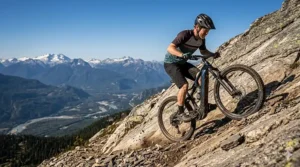
Motor Systems Decoded: What 100Nm Really Means on Canadian Trails
Motor specifications can confuse new e-bike buyers. Here’s what actually matters on trails.
Torque: The Climbing Metric
Measured in Newton-meters (Nm), torque determines climbing ability. Entry-level trail e-bikes offer 50-60Nm (sufficient for moderate climbs), while premium models deliver 90-111Nm (crushing steep technical ascents). Canadian trails often feature sustained climbs where higher torque reduces rider effort dramatically.
The Aventon Ramblas ADV’s 100Nm torque provides confident climbing on 15-20% sustained grades common in BC trail networks. The Specialized Levo 4’s 111Nm handles even steeper pitches found on North Shore trails.
Wattage: Peak vs Sustained
Manufacturers advertise peak wattage (500-850W) but sustained power matters more for Canadian riders tackling long climbs. A 250W sustained motor with 750W peaks provides consistent assistance without overheating on extended ascents.
Federal regulations limit motor-assisted speed to 32 km/h, but wattage influences how quickly you reach that speed and how confidently the motor maintains it on technical climbs where speed fluctuates constantly.
Battery Capacity: The Range Reality
Battery capacity ranges from 400Wh (entry-level) to 900Wh (maximum range). Canadian riders should consider:
- 400-500Wh: Suitable for 40-60km rides, perfect for after-work trail sessions
- 600-720Wh: Sweet spot for 60-100km adventures, handles full-day riding
- 800-900Wh: Epic ride territory, 100+ km possible in Eco mode
Temperature affects battery performance significantly. In -10°C conditions common across Canada in shoulder seasons, expect 20-30% range reduction. Store batteries indoors during winter and avoid charging below 0°C.
Choosing Trail E-Bikes for British Columbia’s Unique Challenges
British Columbia’s trail networks demand specific e-bike characteristics. The province’s combination of technical terrain, steep grades, and variable weather creates unique requirements.
North Shore Technical Trails
Vancouver’s North Shore trails (Seymour, Grouse, Cypress) feature sustained climbing followed by technical root-and-rock descents. Prioritize bikes with:
- Strong motors (90Nm+) for steep climbs
- Progressive rear suspension for root-slap absorption
- Weather-sealed components for wet conditions
- Wider handlebars (760mm+) for precise steering
The Specialized Turbo Levo 4 and Rocky Mountain Instinct Powerplay excel here, with suspension designed for BC’s demanding terrain.
Squamish Flow Trails
Squamish’s trail network emphasizes flow and speed. Bikes need:
- Responsive geometry (66-67° head angle)
- Efficient pedaling platforms for linking sections
- Dropper posts for quick position changes
- 29″ front wheels for speed maintenance
The Aventon Ramblas ADV and Norco Sight VLT handle Squamish-style riding confidently, with geometry that rewards momentum and pump track skills.
Interior Dry Conditions
BC’s Interior (Kamloops, Kelowna) offers dry, loose-over-hard trails. Look for:
- Wider tires (2.4-2.6″) for traction
- Adjustable suspension for changing surface conditions
- Dust-sealed bearings and pivots
- Longer wheelbases for stability in loose corners
Canadian E-Bike Regulations: What Trail Riders Must Know
Understanding Canada’s federal and provincial e-bike laws prevents legal issues and ensures trail access.
Federal Baseline Requirements
Transport Canada defines legal e-bikes as having maximum 500W motor output and motor-assisted speeds limited to 32 km/h on level ground. All trail e-bikes sold in Canada must display permanent bilingual compliance labels certifying they meet federal Motor Vehicle Safety Regulations.
Provincial Variations
While federal law provides baseline standards, provinces add specific requirements:
British Columbia: Riders must be 16+ years old and wear helmets. E-bikes are classified as “motor-assisted cycles” and don’t require licenses or insurance.
Alberta: Power bicycles (Alberta’s term for e-bikes) allow passengers if designated seats exist. Minimum age is 12 years.
Ontario: Maximum e-bike weight of 120kg, required maximum braking distance of 9 metres. Riders must be 16+ and wear approved helmets.
Quebec: Riders 14-18 years require Class 6D moped licenses. Three-wheeled e-bikes are permitted.
Trail Access Considerations
Municipal bylaws often restrict e-bike access to specific trails. Many Canadian trail networks permit Class 1 pedal-assist e-bikes but prohibit throttle-equipped models on singletrack. Always verify local regulations before riding—trail signage in Whistler, Squamish, and North Shore explicitly states e-bike policies.
Sizing Guide: Getting the Right Fit for Canadian Riders
Proper sizing dramatically affects handling and comfort on technical trails.
Frame Size Selection
Most manufacturers offer 4-5 frame sizes covering riders from 5’1″ to 6’5″. Trail e-bikes trend toward longer reach measurements than traditional mountain bikes—the stretched-out position improves weight distribution with heavy motors and batteries.
General sizing (may vary by brand):
- Small: 5’1″-5’5″ (reach 420-440mm)
- Medium: 5’5″-5’9″ (reach 445-465mm)
- Large: 5’9″-6’1″ (reach 470-490mm)
- X-Large: 6’1″-6’4″ (reach 495-515mm)
Between sizes? Shorter riders often prefer smaller frames for easier maneuverability, while taller riders benefit from larger frames for stability at speed.
Component Adjustments
Most trail e-bikes accommodate fit adjustments:
- Stem length: Shorter stems (40-50mm) improve handling, longer stems (60-70mm) stretch cockpit
- Handlebar width: Trail bikes typically run 760-800mm bars; wider improves leverage but reduces maneuverability
- Dropper post length: Critical for Canadian riders—longer posts (150-200mm) allow more position variation
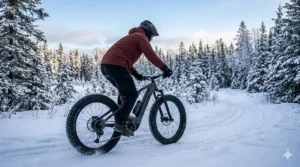
Maintenance Tips for Canadian Climate Extremes
Canada’s climate challenges e-bike longevity. Follow these maintenance protocols.
Cold Weather Care
Winter riding requires specific attention:
- Store batteries indoors (15-25°C optimal)
- Warm batteries before installation when temperatures drop below 0°C
- Expect 20-30% range reduction in freezing conditions
- Apply cold-weather grease to pivot points and derailleur
- Check spoke tension frequently—temperature cycling causes expansion/contraction
Wet Conditions Management
Coastal BC and Maritime riders face constant moisture:
- Rinse frame and components after wet rides (avoid pressure washers on bearings)
- Re-lubricate chain every 2-3 wet rides
- Inspect motor seals and electrical connections monthly
- Apply frame protection film to prevent corrosion
- Store bikes in dry environments with air circulation
Seasonal Service Schedule
Spring (March-May): Full bearing service, brake fluid replacement, suspension service
Summer (June-August): Basic cleaning and lubrication, drivetrain inspection
Fall (September-November): Battery health check, tire replacement if needed
Winter (December-February): Deep clean, component inspection, next season preparation
FAQ: Trail E-Bike Questions Canadian Riders Ask
❓ How fast can an e-bike go in Canada?
❓ What is the price range for trail e-bikes in Canada?
❓ Can I ride trail e-bikes on British Columbia singletrack?
❓ How do I winterize my trail e-bike for Canadian conditions?
❓ What's the difference between hardtail and full-suspension trail e-bikes?
Conclusion: Choosing Your Perfect Canadian Trail E-Bike
Selecting the best trail e-bike ultimately depends on your specific riding style, local terrain, and budget. Canadian riders enjoy unique advantages—extensive trail networks, supportive regulations, and growing dealer infrastructure make e-mountain biking increasingly accessible.
For budget-conscious riders seeking maximum value, the Aventon Ramblas ADV delivers premium motor performance at mid-range pricing. Its 100Nm torque and 708Wh battery handle demanding BC trails confidently while remaining affordable at $3,899-$4,299 CAD.
Performance-focused riders willing to invest in top-tier equipment should consider the Specialized Turbo Levo 4. Its SuperNatural motor feel, massive battery options, and adjustable geometry justify the $9,999+ CAD price tag for serious enthusiasts tackling technical terrain regularly.
Entry-level riders exploring trail riding can confidently choose the Trek Marlin+ 6 at $3,899 CAD. Bosch’s reliable motor system and Trek’s extensive Canadian dealer network provide peace of mind for newcomers.
Canadian-built pride aligns with the Rocky Mountain Instinct Powerplay—supporting local engineering while enjoying geometry specifically designed for our trail conditions makes the $8,999-$12,499 CAD investment worthwhile.
Remember that trail e-bikes excel when matched to rider ability and local conditions. Test ride multiple models through Canadian dealers, verify provincial regulations for your area, and invest in proper maintenance to maximize your e-bike’s lifespan across our challenging climate extremes. The best trail e-bike isn’t the most expensive or powerful—it’s the one that gets you out riding more frequently on trails you genuinely enjoy.
Recommended for You
- 7 Best Hardtail eMTB Under $2500 Canada 2026
- 7 Best Full Suspension E-Bike Under $3000 Canada 2026
- 7 Best Full Suspension E-Bikes Canada 2026
Disclaimer: This article contains affiliate links to Amazon.ca. If you purchase products through these links, we may earn a small commission at no additional cost to you.
✨ Found this helpful? Share it with your friends! 💬🤗
