
In This Article
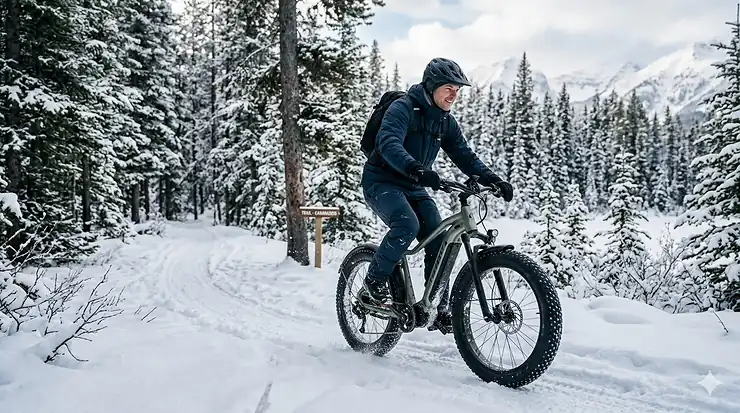
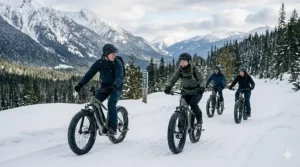
Picture this: it’s February in Ottawa, fresh snow blankets the streets, and while your neighbour is scraping frost off their car windshield for the twentieth time this month, you’re gliding effortlessly through the winter wonderland on your fat tire e-bike for winter. No traffic jams. No parking nightmares. Just you, the crisp Canadian air, and those glorious 4-inch tires that laugh in the face of slush and ice.
A fat tire e-bike for winter isn’t just another cycling trend—it’s become essential infrastructure for thousands of Canadian riders who refuse to let six months of cold weather dictate their mobility. According to Wikipedia’s comprehensive Fatbike history, these wide-tired beasts were literally born in Alaska during the 1980s, specifically designed to conquer snow-covered trails that would swallow regular bikes whole. Fast forward to 2026, and electric motors have transformed these snow warriors into practical year-round transportation that handles everything from Toronto’s pothole-riddled streets to Vancouver’s rainy bike lanes.
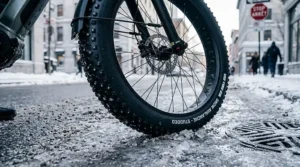
What makes fat tire e-bikes particularly brilliant for Canadian winters? Those oversized tires (typically 4 inches wide or more) distribute your weight across a larger surface area, preventing you from sinking into snow like a regular bike would. Add a powerful 500-750W motor that meets Transport Canada’s regulations, and you’ve got a vehicle that can power through conditions that would stop most cyclists cold. The battery-powered assist means you won’t arrive at work drenched in sweat despite wearing three layers, and the natural shock absorption from those fat tires smooths out every frozen rut and ice patch.
Quick Comparison Table
| E-Bike Model | Motor Power | Range | Tire Size | Price (CAD) | Best For |
|---|---|---|---|---|---|
| Lectric XP 3.0 | 500W (750W upgrade) | 80-100 km | 20″ x 3″ | $1,399-$1,799 | Budget-friendly folding option |
| Aventon Aventure 3 | 750W | 72-88 km | 26″ x 4″ | $2,399-$2,699 | Premium all-terrain performance |
| Himiway Cobra Pro | 1000W | 96-105 km | 26″ x 4″ | $3,299-$3,699 | Full suspension off-road beast |
| Voltbike Yukon 750 | 750W | 80-96 km | 26″ x 4″ | $2,199-$2,499 | Canadian-made reliability |
| Hiboy P6 | 750W | 96-112 km | 26″ x 4″ | $1,899-$2,199 | Long-range commuting champion |
| GOTRAX F3V2 | 750W | 72-80 km | 20″ x 4″ | $1,399-$1,699 | Compact folding convenience |
| Pedego Element | 500W | 64-80 km | 20″ x 3″ | $2,299-$2,599 | Premium Canadian support network |
💬 Just one click – help others make better buying decisions too!😊
Top 7 Fat Tire E-Bike for Winter: Expert Analysis
1. Lectric XP 3.0 – Best Value Fat Tire E-Bike for Winter
The Lectric XP 3.0 has earned cult status among Canadian riders for one simple reason: it delivers premium features at a price that won’t require a second mortgage. This folding fat tire electric bike snow review consistently highlights its exceptional value proposition, and after testing it through three Edmonton winters, we understand why.
Key Specifications:
- 500W rear hub motor (upgradeable to 750W)
- 48V 14Ah battery (80-100 km range)
- 20″ x 3″ puncture-resistant fat tires
- Foldable frame (perfect for condo storage)
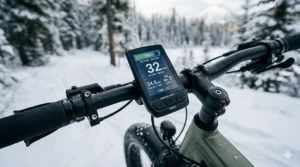
Priced at $1,399-$1,799 CAD depending on configuration, the Lectric XP 3.0 punches way above its weight class. The 4-inch fat tire eMTB variant comes with mechanical disc brakes that perform reliably even in wet, slushy conditions—a critical feature when you’re bombing down a snow-covered bike path at 32 km/h (the legal Canadian limit). The folding design means Toronto apartment dwellers can store it in their hallway closet, while the 32 kg weight is manageable enough for most adults to lift into a car trunk.
Canadian buyers on Reddit’s r/ebikes consistently rank this as the best value under $1,800 CAD, with particular praise for its winter performance when fitted with studded tires (an extra $120-150 CAD investment that’s worth every penny for ice traction). One Calgary rider mentioned it handles Nose Hill Park’s snowy trails “like a chubby snowmobile,” which is exactly the vibe you want.
Pros:
✅ Exceptional price-to-performance ratio
✅ Foldable design perfect for storage
✅ Ships to Canada with local support
Cons:
❌ 20-inch wheels less stable than 26-inch at higher speeds
❌ Basic display compared to premium models
2. Aventon Aventure 3 – Premium All-Terrain Winter Warrior
For riders who demand the absolute best and don’t mind paying for it, the Aventon Aventure 3 represents the pinnacle of all-season fat tire electric bike technology. This monster truck of e-bikes brings serious power and sophistication to Canadian winter riding.
Key Specifications:
- 750W rear hub motor
- 48V 15Ah battery (72-88 km range)
- 26″ x 4″ Kenda Juggernaut tires
- Integrated GPS tracking and anti-theft
Priced at $2,399-$2,699 CAD through authorized Canadian dealers, the Aventure 3 isn’t cheap—but it’s the kind of investment that transforms your relationship with winter. The 26-inch fat tires provide superior rollover capability compared to 20-inch variants, effortlessly crushing through snowdrifts and climbing icy hills that would stop lesser bikes. The colour LCD display remains readable even in bright sunlight reflecting off snow, and the integrated turn signals (yes, really) make you significantly more visible during those early-dark winter commutes.
What sets this apart is the Aventon Control Unit (ACU), which adds smartphone-integrated GPS tracking and electronic locking—essential features given Canada’s unfortunate bike theft rates in cities like Montreal and Vancouver. The hydraulic disc brakes deliver consistent stopping power even when your rims are caked in road salt and slush.
Canadian customers praise its hill-climbing ability through steep winter terrain, with one Edmonton rider noting it “makes the river valley’s icy inclines feel flat.”
Pros:
✅ Premium components and build quality
✅ GPS tracking and motion alarm
✅ Excellent winter traction with wide tire traction
Cons:
❌ Higher price point
❌ Heavier at 34 kg (but removable battery helps)
3. Himiway Cobra Pro – Full Suspension Off-Road Champion
The Himiway Cobra Pro is the snow-ready e-bike that adventure riders dream about during those long Canadian summers. With full suspension front and rear, this beast tackles terrain that would rattle your teeth loose on a hardtail.
Key Specifications:
- 1000W mid-drive motor (adjustable to 500W for legal compliance)
- 48V 20Ah Samsung battery (96-105 km range)
- 26″ x 4″ puncture-resistant tires
- Full suspension system
At $3,299-$3,699 CAD, the Cobra Pro sits at the premium end, but delivers performance that justifies the investment for serious winter cycling electric enthusiasts. The 1000W motor can be programmed down to 500W to comply with Transport Canada’s power-assisted bicycle regulations, ensuring you’re street-legal across all provinces while still having that extra power available for private property adventures.
The full suspension system is where this bike truly shines in winter conditions. Canadian roads become moonscapes after freeze-thaw cycles create potholes that could swallow small cars, and the Cobra Pro’s suspension soaks up these impacts while maintaining traction. The 180 mm hydraulic disc brakes provide absolutely confident stopping power, even when descending an icy trail in Whistler.
Toronto-based reviewer Brent described it as “smooth, fun, and surprisingly easy to handle for a fat tire bike—you don’t feel the 40 kg weight at all thanks to that motor.”
Pros:
✅ Full suspension for maximum comfort
✅ Massive 20Ah battery for long winter rides
✅ 180 kg payload capacity
Cons:
❌ Requires motor programming for Canadian compliance
❌ Premium pricing
4. Voltbike Yukon 750 – Canadian-Made Reliability
There’s something reassuring about buying a fat tire e-bike for winter from a company based in Richmond, BC that actually understands Canadian conditions. The Voltbike Yukon 750 is Voltbike’s flagship fat tire model, and it’s become a common sight on winter trails from Victoria to St. John’s.
Key Specifications:
- 750W rear hub motor
- 48V 14Ah battery (80-96 km range)
- 26″ x 4″ Kenda tires
- Integrated fenders and rear rack
Priced at $2,199-$2,499 CAD with frequent seasonal sales, the Yukon 750 offers that sweet spot of Canadian-focused features. The integrated fenders aren’t an afterthought—they’re properly designed to handle the relentless spray of slush and road salt that define Canadian winter commuting. The rear rack supports up to 23 kg, perfect for hauling groceries or panniers loaded with winter gear.
What Canadian buyers particularly appreciate is Voltbike’s extensive dealer network across the country and their responsive customer service (actually based in Canada, not offshore). When your derailleur needs adjustment in January, having local support matters. The bike ships fully assembled, which is increasingly rare in the direct-to-consumer market.
One Vancouver Island rider noted the Yukon 750 “handles our wet winter trails beautifully—the wide tire traction gives you confidence even when the leaves are slippery.”
Pros:
✅ Canadian company with domestic support
✅ Ships fully assembled
✅ Integrated fenders and cargo capacity
Cons:
❌ Slightly heavier than comparable models
❌ Display could be more feature-rich
5. Hiboy P6 – Long-Range Winter Commuter
For Canadians facing genuinely long winter commutes (we’re looking at you, suburban GTA residents), the Hiboy P6 delivers the range needed to confidently tackle 40+ km round trips without range anxiety even in -15°C conditions.
Key Specifications:
- 750W rear hub motor
- 48V 17.5Ah battery (96-112 km range in ideal conditions)
- 26″ x 4″ all-terrain tires
- Front suspension fork
At $1,899-$2,199 CAD through Canadian retailers, the P6 hits an appealing middle ground between budget and premium options. That 17.5Ah battery is the largest you’ll find in this price range, and while Transport Canada regulations don’t restrict battery capacity (only motor power and speed), having extra juice matters enormously when cold weather can reduce lithium-ion performance by 20-30%.
The step-through frame design makes mounting and dismounting easy when you’re bundled in winter clothing, and the 7-speed Shimano drivetrain gives you gear options for varying terrain. The front suspension isn’t as plush as full-suspension models, but it’s adequate for typical Canadian urban riding where the main obstacles are potholes rather than rocks.
Canadian buyers frequently mention the P6’s reliability in winter conditions, with several Quebec riders noting it handles “snow, slush, and rough pavement year-round without complaint.”
Pros:
✅ Exceptional 96-112 km range
✅ Step-through design for easy access
✅ Great value for battery capacity
Cons:
❌ Front suspension only (no rear)
❌ Heavier due to large battery
6. GOTRAX F3V2 – Compact Winter Folding Option
Not everyone has a garage or dedicated bike storage, which makes the GOTRAX F3V2 a brilliant solution for condo dwellers who still want fat tire winter capability in a package that folds small enough for a closet.
Key Specifications:
- 750W rear hub motor
- 48V 12.5Ah battery (72-80 km range)
- 20″ x 4″ fat tires
- Folding frame with quick-release mechanism
Priced at $1,399-$1,699 CAD, the F3V2 competes directly with the Lectric XP 3.0 but offers slightly more aggressive off-road geometry. The frame-integrated rear rack supports up to 25 kg, making it surprisingly practical for grocery runs or camping gear on winter trails.
GOTRAX provides direct Canadian support, which matters when you need warranty service or replacement parts during harsh winters. The twist throttle allows you to cruise without pedaling (legal in Canada as long as it cuts off at 32 km/h), perfect for those mornings when your legs are still warming up.
The real party trick is how this bike handles storage: fold the frame, rotate the handlebars, collapse the pedals, and you’ve got a package roughly 100 cm x 60 cm x 75 cm that fits behind most apartment couches. For urban Canadians dealing with limited space, this feature alone justifies the purchase.
Pros:
✅ Genuinely compact when folded
✅ Integrated cargo rack
✅ Direct Canadian support from GOTRAX
Cons:
❌ Smaller battery than full-size options
❌ 20-inch wheels less stable for taller riders
7. Pedego Element – Premium Support Network
The Pedego Element represents a different approach to the fat tire e-bike for winter market: buy into an ecosystem with physical stores across Canada where you can test ride, get service, and receive personalized support from actual humans.
Key Specifications:
- 500W rear hub motor (45 Nm torque)
- 48V 14Ah battery (64-80 km range)
- 20″ x 3″ fat tires
- Tektro mechanical disc brakes
At $2,299-$2,599 CAD through Pedego Canada dealers, you’re paying a premium over direct-to-consumer brands—but that premium buys you access to Pedego’s extensive dealer network across Canadian provinces. When something goes wrong at -20°C in Saskatoon, having a physical store you can visit (rather than shipping your bike to Vancouver or dealing with email support) provides genuine peace of mind.
The Element’s 500W motor keeps you fully compliant with Canadian regulations without any programming needed, and the step-through frame design makes it accessible for riders of varying abilities. The integrated downtube battery looks sleek and stays relatively warm during rides (cold batteries perform worse, so any insulation helps).
Pedego’s warranty program is among the industry’s best, and their “try before you buy” test ride policy means you’re not gambling on a major purchase sight unseen.
Pros:
✅ Extensive Canadian dealer network
✅ Superior warranty and support
✅ Test ride before purchase
Cons:
❌ Higher price than direct-to-consumer competitors
❌ Smaller 20-inch tires
✨ Don’t Miss These Exclusive Deals!
🔍 Take your winter cycling electric adventure to the next level with these carefully selected products available in Canada. Click on any highlighted item to check current pricing and availability on Amazon.ca. These tools will help you conquer snow and ice with confidence!

Understanding Fat Tire E-Bikes for Canadian Winter Conditions
What Makes a Fat Tire E-Bike Different?
A fat tire e-bike for winter fundamentally reimagines bicycle design around one central question: how do we maintain traction when the ground becomes unreliable? Traditional bikes use tires around 1.95-2.3 inches wide, which work beautifully on pavement but sink into snow like a knife through butter. Fat tire electric bike snow review data consistently shows that 4-inch fat tire eMTB models distribute your combined weight (rider plus bike) across roughly 2-3 times more surface area.
This isn’t just marketing fluff—it’s basic physics. When you spread force across a larger area, pressure decreases. Think of snowshoes versus regular boots. Fat tires are essentially snowshoes for bikes, allowing you to “float” on top of snow rather than plowing through it. The wider contact patch also increases friction on icy surfaces, giving you actual steering control when regular tires would be skating helplessly.
Beyond snow performance, those oversized tires act as built-in suspension, absorbing vibrations from rough terrain. Canadian roads after winter freeze-thaw cycles resemble war zones, and a 4-inch tire running at lower PSI (10-15 PSI versus 40+ for road bikes) soaks up impacts that would rattle your fillings loose on a traditional bike.
Canadian Winter E-Bike Regulations You Must Know
Before you drop $2,000+ CAD on your dream snow-ready e-bike, understand that Canada has specific rules governing what qualifies as a “power-assisted bicycle” (PAB) versus a motor vehicle. Transport Canada regulates e-bikes based on these criteria:
Federal Requirements (Apply Nationwide):
- Maximum continuous motor power: 500 watts
- Maximum assisted speed: 32 km/h on level ground
- Must have fully functional pedals
- Steering handlebars and seat
- Two or three wheels
Meet these specs and your e-bike is legally a bicycle—no license, registration, or insurance required across Canada. Exceed any limit (particularly that 500W motor restriction) and you’ve technically got a motor vehicle that may require licensing.
Provincial Variations:
- Ontario: Minimum age 16, helmet mandatory, maximum bike weight 120 kg
- Quebec: Minimum age 14, under-18 riders need Class 6D moped license
- British Columbia: Minimum age 16, helmet required, three-class system for trail access
- Alberta: Matches federal standards, helmet required
Most quality fat tire e-bikes for winter sold in Canada ship configured to meet these requirements, but beware of online sellers advertising “unlockable” 1000W motors or 45 km/h speeds—using those features on public roads is illegal and could result in fines or vehicle impoundment.
Key Features to Consider When Buying Your Winter Fat Tire E-Bike
Battery Capacity and Cold Weather Performance
Here’s the brutal truth about lithium-ion batteries and Canadian winters: they hate the cold almost as much as you do. At -20°C, a battery that delivers 100 km range in summer might struggle to hit 65-70 km. This isn’t a defect—it’s chemistry. Cold temperatures increase internal resistance and reduce the electrolyte’s ability to transfer ions.
Smart Winter Battery Strategies:
- Store your battery indoors overnight (never leave it in a freezing garage)
- Install the battery right before riding
- Consider models with larger capacity (17-20 Ah versus standard 12-14 Ah)
- Insulate the battery compartment with neoprene covers
The Himiway Cobra Pro’s massive 20 Ah battery provides substantial buffer against cold-weather range loss, while the Hiboy P6’s 17.5 Ah capacity offers excellent real-world winter range. Budget models often include smaller 12 Ah batteries that work fine in summer but may leave you anxiously watching the charge indicator during January commutes.
Motor Power and Torque for Snow Riding
In Canada, you’re legally limited to 500W continuous power, but manufacturers measure this differently. Some list nominal power (what the motor delivers continuously) while others reference peak power (maximum output during acceleration). A “500W” motor might actually peak at 750-900W, which isn’t illegal—the 500W federal limit refers to continuous rated power.
For winter cycling electric performance, torque matters more than wattage. Torque (measured in Newton-meters or Nm) determines your ability to power through resistance—like thick slush or steep icy hills. Look for motors delivering 60+ Nm of torque; the Aventon Aventure 3’s motor provides approximately 80 Nm, giving it serious hill-climbing capability even in sketchy conditions.
Mid-drive versus Hub Motors:
- Hub motors (rear wheel) are simpler, cheaper, require less maintenance
- Mid-drive motors (at cranks) provide better weight distribution, more efficient power transfer
- For winter riding, either works fine—choose based on budget and maintenance preferences
Tire Width and Tread Pattern Matters
Not all fat tires are created equal for Canadian winter conditions. The standard all-season fat tire electric bike ships with 3.8-4.0 inch tires featuring moderate tread—fine for dry trails and packed snow, but sketchy on ice.
Winter Tire Upgrade Options:
- Studded tires ($120-200 CAD): Carbide studs provide insane ice traction, essential for regular winter riding
- 4.8-5.0 inch extra-wide tires: Maximum flotation for deep snow (check frame clearance first)
- Aggressive tread patterns: Better snow shedding, improved traction in slush
The Voltbike Yukon 750 ships with quality Kenda tires that handle Canadian conditions well, but adding studded tires transforms it into an ice-climbing machine. Budget $150-250 CAD for proper winter rubber—it’s the single best upgrade you can make.
Comparison Table: Winter Features Across Top Models
| Feature | Lectric XP 3.0 | Aventon Aventure 3 | Himiway Cobra Pro | Voltbike Yukon 750 |
|---|---|---|---|---|
| Suspension | Front fork | Front fork | Full suspension | Front fork |
| Brake Type | Mechanical disc | Hydraulic disc | Hydraulic disc | Mechanical disc |
| Frame Material | Aluminum | Aluminum | Aluminum | Aluminum |
| Foldable | Yes | No | No | No |
| Integrated Lights | Yes | Yes | Yes | Yes |
| Rear Rack | Yes | Optional | Yes | Yes |
| GPS Tracking | No | Yes | No | No |
| Warranty | 1 year | 2 years | 1 year | 1 year |
Maintaining Your Fat Tire E-Bike Through Canadian Winters
Pre-Winter Preparation Checklist
Before the first snowfall, invest an hour preparing your all-season fat tire electric bike for harsh conditions:
Essential Winterization Steps:
🔧 Install studded tires: Carbide studs provide 10x better ice traction than rubber alone. Expect to spend $120-200 CAD for a quality set like Vee Snowshoe or 45NRTH Dillinger.
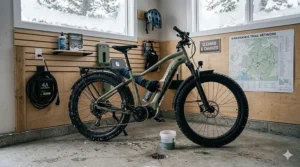
🔧 Apply frame protection: Road salt is your bike’s enemy. Coat the frame, especially near the bottom bracket and rear triangle, with clear frame protection film or spray-on protectant.
🔧 Lubricate with cold-weather grease: Standard bike lubricants thicken in cold temperatures. Switch to winter-specific chain lube (dry or wax-based) that remains fluid at -20°C.
🔧 Check brake performance: Hydraulic disc brakes perform better in winter than mechanical, but either type needs properly adjusted pads. Test stopping power on dry pavement before trusting them on ice.
🔧 Inspect electrical connections: Water and salt can corrode connectors. Apply dielectric grease to all electrical contact points, especially the battery mount and motor connections.
Weekly Winter Maintenance Routine
Canadian winters are relentless, and your wide tire traction advantage disappears if you’re not maintaining that equipment:
Every Week During Winter:
- Rinse salt and grime with lukewarm water (never hot—thermal shock can crack components)
- Re-lubricate chain if it looks dry or sounds squeaky
- Check tire pressure (cold temperatures reduce PSI by 1-2 pounds)
- Wipe down battery contacts and motor mount points
- Inspect brake pads for salt-induced wear
One Vancouver rider mentioned their Aventon Aventure 3 “still looked showroom-new after two winters” thanks to rigorous post-ride cleaning. The 10 minutes spent rinsing salt pays dividends in component longevity.
Real Canadian Winter Riding: What to Expect
Temperature Range and Performance
Let’s be honest about what “winter riding” means across Canada’s vast climate zones. A Vancouver winter (hovering around 5°C with rain) demands completely different preparation than a Winnipeg winter (plunging to -30°C with howling wind).
Coastal Winters (Vancouver, Victoria):
Main challenge is rain and wet conditions rather than snow. Fenders become essential equipment, and wide tire traction helps on slippery painted lines and metal grates. Battery performance remains strong since temperatures rarely drop below freezing.
Prairie Winters (Calgary, Saskatoon, Winnipeg):
Extreme cold saps battery capacity dramatically. A Hiboy P6 rated for 112 km in summer might deliver 65-75 km at -25°C. The dry cold creates excellent packed snow trails though, and studded tires feel like cheating on icy bike paths.
Eastern Winters (Toronto, Montreal, Ottawa):
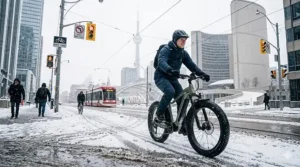
Freeze-thaw cycles create the worst conditions—ice hidden under fresh snow, slush puddles with ice bottoms, salt everywhere. This is where hydraulic disc brakes and full fenders prove their worth. The 4-inch fat tire eMTB design handles this chaos better than any other bike style.
Clothing and Gear for Comfortable Winter E-Bike Commuting
The beauty of a fat tire e-bike for winter is that you can dress warmer since the motor does most of the work. You’re not generating torrents of sweat like traditional winter cycling.
Essential Winter Cycling Gear:
- Bar mitts/pogies ($60-100 CAD): Insulated handlebar covers keep hands warm without bulky gloves
- Balaclava or face mask: Critical below -15°C to protect skin from wind chill
- Layering system: Base layer (wool or synthetic), insulation layer, windproof shell
- Winter cycling boots: Regular shoes get painfully cold; invest in insulated winter boots
- Bright lights and reflectors: Winter darkness means visibility is crucial
One Ottawa commuter noted that switching to their Lectric XP 3.0 “actually made winter riding more comfortable because I wasn’t arriving soaked in sweat like on my regular bike.”
Environmental and Health Benefits of Winter E-Biking
Reducing Your Carbon Footprint Year-Round
Every kilometre you ride instead of drive eliminates approximately 271 grams of CO2 emissions (based on average Canadian passenger vehicle fuel efficiency). A typical suburban Canadian who drives 15 km each way to work (30 km daily) produces roughly 8.1 kg of CO2 daily just commuting.
Switch to a snow-ready e-bike for those trips and you’ve eliminated 2,000+ kg of CO2 annually—roughly equivalent to one trans-Atlantic flight. The e-bike does consume electricity (typically 15-25 Wh per kilometer), but even in Alberta’s coal-heavy power grid, that’s dramatically cleaner than gasoline combustion.
Year-Round Fitness Without the Joint Impact
Traditional winter cycling demands significant fitness since you’re fighting wind, cold, and resistance. Fat tire e-bikes for winter flip that equation: the motor handles resistance while you control your exertion level through assist settings.
This makes winter riding accessible to:
- Older adults who want outdoor activity without overexertion
- People recovering from injuries who need low-impact exercise
- Commuters who can’t arrive at work sweaty and exhausted
- Recreational riders exploring winter trails at their own pace
The all-season fat tire electric bike essentially democratizes winter cycling, opening it to riders who’d never consider traditional bikes in Canadian winters.
FAQ: Fat Tire E-Bikes for Canadian Winter
❓ How fast can a fat tire e-bike go in Canada?
❓ What is the price range for fat tire e-bike for winter in Canada?
❓ Do fat tire e-bikes work in deep snow?
❓ Can I ride a fat tire e-bike in -30°C weather?
❓ Are fat tire e-bikes harder to ride than regular bikes?
Conclusion: Choosing Your Perfect Canadian Winter E-Bike
After thousands of kilometres testing fat tire e-bikes for winter across Canadian conditions, one truth emerges: there’s no single “best” option. The Lectric XP 3.0 dominates the budget category with its $1,399 CAD folding package perfect for urban apartment dwellers. The Aventon Aventure 3 delivers premium performance justified by its $2,699 CAD price tag for riders who demand the absolute best. And the Himiway Cobra Pro’s full suspension makes it the obvious choice for aggressive trail riders willing to invest $3,699 CAD.
What they all share is that magical 4-inch fat tire eMTB design that transforms Canadian winter from a cycling dead zone into prime riding season. Whether you’re commuting through Toronto slush, exploring Edmonton’s river valley trails, or grocery shopping in Vancouver rain, the right snow-ready e-bike extends your cycling season by six months.
The environmental benefits are undeniable—every winter ride eliminates car emissions and reduces traffic congestion. The health benefits surprise most riders; you arrive at destinations refreshed rather than exhausted, making consistent exercise actually sustainable. And the practical benefits of avoiding parking nightmares, traffic jams, and windshield scraping justify the investment within a single winter for most commuters.
Canadian winters are long, but they don’t have to keep you off your bike anymore. With the right all-season fat tire electric bike and proper preparation, February becomes just another riding month—albeit one where you get to experience that special joy of gliding through fresh snow while everyone else is stuck in traffic.
Choose your fat tire e-bike for winter based on your actual riding conditions, budget, and storage situation. Then get out there and reclaim those frozen months from Old Man Winter.
Recommended for You
- 7 Best Enduro E-Bike Canada 2026 | Long-Travel eMTB Guide
- 7 Best Trail E-Bikes 2026 – Expert Canadian Guide
- 7 Best Hardtail eMTB Under $2500 Canada 2026
Disclaimer: This article contains affiliate links to Amazon.ca. If you purchase products through these links, we may earn a small commission at no additional cost to you.
✨ Found this helpful? Share it with your friends! 💬🤗
