
In This Article
A moped style electric bike is a pedal bicycle built with a low-slung frame, a long bench seat, wide handlebars, and moto-inspired styling, powered by a hub or mid-drive motor that can be pedal-assisted, throttle-driven, or both. That’s the short version. The longer version is a little messier, and honestly, a lot more interesting.
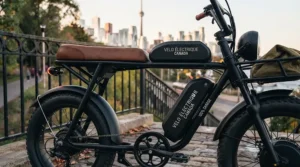
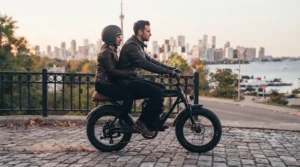
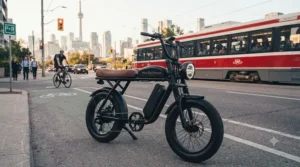
Somewhere between “regular bike” and “actual motorcycle,” a whole category of electric two-wheelers has quietly taken over Canadian driveways, bike paths, and apartment balconies. You’ve probably seen one — that low-slung, banana-seated, chrome-mirrored thing that looks like it rolled straight out of a 1978 California surf town, except it’s silent and somebody’s kid is riding it to school. These bikes borrow their looks from vintage minibikes and their guts from modern e-bike engineering, and the combination has turned into one of the fastest-growing niches in Canadian cycling.
This guide breaks down seven genuinely available models — from budget-friendly street-legal cruisers to dual-motor monsters that blur the line between bicycle and motorcycle — with honest analysis of who each one actually suits, what the spec sheets mean once you’re actually riding, and where Canadian law draws its very specific lines. We’ll also get into classification headaches, licence requirements, and why some of these bikes need a moped licence in Quebec while an identical-looking model needs nothing at all in Alberta. Buckle up. Or don’t — most of these don’t have buckles.
Quick Comparison Table
| Model | Price Range (CAD) | Motor / Power | Best For |
|---|---|---|---|
| Super73-ZX Core | around C$2,200–C$2,700 | 750W hub | Budget-conscious retro commuters |
| Super73-S2 | around C$3,300–C$3,800 | 750W hub | All-round vintage moped feel |
| Ariel Rider Grizzly 52V | around C$3,600–C$4,300 | Dual 1,000W hub (AWD) | Off-road power and payload |
| Ariel Rider X-Class 60V | around C$3,000–C$3,600 | Single high-torque hub | Fast pavement cruising |
| Juiced Bikes HyperScrambler 2 | around C$3,400–C$4,000 | 1,000W Bafang hub | Longest real-world range |
| Himiway Escape Pro | around C$1,800–C$2,200 | 750W hub | Legal-by-default fat-tire value |
| Addmotor CITYPRO E-43 | around C$1,300–C$1,700 | 500W hub | Cheapest street-legal option |
Looking across this table, the split between “Canadian street-legal out of the box” and “US-spec import that needs speed-limiting” is the single biggest factor separating these seven bikes, not price. The Himiway Escape Pro and Addmotor CITYPRO E-43 ship compliant with the federal 500W/32 km/h power-assisted bicycle rule, while the Ariel Rider Grizzly 52V and Juiced Bikes HyperScrambler 2 are built around US Class 2/3 e-bike law and need to be reconfigured (or ridden on private land) to stay street-legal here. That distinction matters more than torque or top speed once you’re actually trying to ride one on a public road in Ontario or BC.
💬 Just one click — help others make better buying decisions too!😊
Top 7 Moped Style Electric Bikes: Expert Analysis
1. Super73-ZX Core — retro commuter styling on a budget
The ZX Core is Super73’s entry point into the moped-style lineup, and it’s the bike I’d point a curious first-timer toward before anything flashier. It carries the same scrambler-inspired silhouette as the brand’s pricier models but in a lighter, more manageable 59–62 lb package.
Its 750W hub motor and swappable 480 Wh battery system are modest by Super73 standards, but that’s actually the point — a smaller battery means a lighter bike that’s easier to lift onto a bike rack or up a few stairs, and the trade-off in range (Super73 estimates roughly 25–35 km in throttle-heavy riding) is one most short-hop commuters will barely notice. Based on the spec comparison with the rest of the lineup, this is the model for someone who wants the look without the bulk or the price tag of the S2 or R-series bikes.
Reviewers and long-term owners across forums consistently flag the ZX’s upright riding position and low seat height as beginner-friendly, though several also note the single-speed drivetrain limits pedalling range once the battery runs low — worth knowing if you’re hoping to pedal home on a dead battery.
Pros:
- ✅ Lighter and easier to handle than most moped-style bikes
- ✅ Authentic retro styling at a lower entry price
- ✅ Simple single-speed drivetrain means less maintenance
Cons:
- ❌ Smaller battery limits range on longer rides
- ❌ No gearing makes unassisted pedalling difficult
Priced around C$2,200–C$2,700 depending on trim, the ZX Core earns its keep as a style-forward city bike rather than a long-range machine — check current pricing before you buy, since Super73 adjusts trims and colourways regularly.
2. Super73-S2 — best all-rounder vintage moped feel
If the ZX is the appetizer, the S2 is the main course. It’s the model most people picture when they hear “moped-style e-bike,” and for good reason — the aerospace-grade aluminum frame, air-spring suspension fork, and 750W direct-drive motor combine for a ride that genuinely feels like a small motorbike rather than a bicycle wearing a costume.
What the spec sheet won’t tell you, but owner communities note repeatedly, is that the S2’s stepped seat and low centre of gravity make it unusually confidence-inspiring at stoplights and in tight parking situations — something riders coming from taller mountain-bike-style e-bikes tend to comment on immediately. The trade-off is weight: at roughly 70–75 lb, this isn’t a bike you’re casually carrying up an apartment stairwell.
Aggregated review sentiment on the S2 is generally positive around build quality and the vintage aesthetic, though a recurring theme in longer-term owner feedback is that the stock tires and brakes are adequate but not class-leading, and many riders eventually upgrade one or both.
Pros:
- ✅ Genuine moped-like ride feel and stopping power
- ✅ Adjustable suspension fork smooths rough pavement
- ✅ Strong resale value thanks to brand recognition
Cons:
- ❌ Heavier than the ZX, harder to store or transport
- ❌ Stock components often get upgraded by owners
At around C$3,300–C$3,800, the S2 sits squarely in the mid-range and is the bike most reviewers point to as the “safe” Super73 choice for buyers who want the look without going to extremes on power or price.
3. Ariel Rider Grizzly 52V — most powerful dual-motor AWD
The Grizzly is not a subtle machine. Dual 1,000W continuous hub motors (1,850W peak each) mean this is functionally an all-wheel-drive electric moped, with a front/rear/both toggle that lets you choose your drivetrain like you’re picking a setting on a snowmobile.
In practice, that dual-motor setup translates to genuinely useful traction advantages on gravel, wet pavement, or loose trail surfaces — something a single rear-hub motor simply can’t replicate, since a single-wheel-drive bike will spin out under hard throttle in exactly the conditions where the Grizzly stays composed. Paired with two removable 52V batteries totalling roughly 1,820 Wh, manufacturer-estimated range runs up to 120 km, though real-world use with both motors engaged will land meaningfully lower.
Owner reviews consistently praise the Grizzly’s acceleration and stability at speed, while also noting — honestly and repeatedly — that its 100+ lb curb weight makes it a poor fit for anyone who needs to carry, store, or manoeuvre the bike without a garage or ground-floor access.
Pros:
- ✅ All-wheel drive traction unmatched by single-motor rivals
- ✅ Dual batteries deliver genuinely long real-world range
- ✅ Full suspension smooths out rough or unpaved terrain
Cons:
- ❌ Very heavy at over 100 lb with batteries installed
- ❌ Exceeds Canada’s federal 500W/32 km/h limit unmodified
Expect to pay in the C$3,600–C$4,300 range for the Grizzly — and budget extra time to understand the classification section below, because this bike ships well outside Canada’s power-assisted bicycle definition out of the box.
4. Ariel Rider X-Class 60V — highest torque single-motor cruiser
Where the Grizzly doubles up, the X-Class 60V goes tall instead — a single high-voltage motor system delivering strong low-end torque without the added weight of a second motor and battery. Ariel Rider markets this as the brand’s flagship performance cruiser, and the higher voltage architecture is what lets it maintain torque at speed rather than tapering off the way lower-voltage hub motors typically do on hills.
Here’s what most buyers overlook about voltage versus wattage: a 60V system moving the same wattage as a 48V competitor will generally deliver quicker acceleration and better hill performance because higher voltage reduces current draw and heat for the same power output. That’s a real, physics-backed advantage, not just marketing language, and it’s the main reason the X-Class earns a reputation among enthusiasts as one of the quicker-feeling single-motor moped bikes on the market.
Reviewers and forum owners frequently mention the fat tires and long wheelbase as contributing to a planted, stable feel at speed, though several also flag that the standover height and seat position favour taller riders.
Pros:
- ✅ Strong torque delivery thanks to higher voltage system
- ✅ Lighter than dual-motor Grizzly for similar performance
- ✅ Fat tires provide stability on mixed surfaces
Cons:
- ❌ Less capable off-road than the AWD Grizzly
- ❌ Taller frame geometry may not suit shorter riders
Pricing typically falls around C$3,000–C$3,600, making the X-Class the better value pick for riders who want Ariel Rider’s performance reputation without paying for a second motor they may not need.
5. Juiced Bikes HyperScrambler 2 — longest real-world range
Juiced Bikes has been building “moped e-bikes” since before the category had a name, and the HyperScrambler 2 remains one of the most range-focused options in this list. Its dual removable batteries total roughly 38.4 Ah, and Juiced’s own estimates put maximum range near 160 km — though as with any manufacturer figure, that’s measured under ideal, low-throttle conditions.
Based on the spec comparison with the rest of this list, the HyperScrambler 2’s single 1,000W Bafang motor produces less peak power than the Grizzly’s dual setup, but the trade-off is a notably lighter and more balanced ride, since all that weight isn’t split across two separate motor-and-battery assemblies. Reviewers who’ve spent extended time with the bike consistently point to the RetroBlade cast aluminum wheels as a standout — they’re maintenance-free in a way spoked wheels simply aren’t, since there’s no truing required.
A recurring theme in aggregated owner feedback is that the HyperScrambler 2’s 275 lb payload capacity is lower than some competitors, which matters if you’re planning to regularly carry a passenger on the extended seat.
Pros:
- ✅ Exceptional range thanks to dual removable batteries
- ✅ Maintenance-free cast aluminum wheels
- ✅ Comes street-ready with lights, mirrors, and turn signals
Cons:
- ❌ Lower payload capacity than some AWD competitors
- ❌ Heavier than single-battery moped-style alternatives
Budget around C$3,400–C$4,000 for the HyperScrambler 2 — and note that Juiced’s direct-to-consumer model means Canadian buyers should factor in shipping and import duties when comparing this price against locally stocked alternatives.
6. Himiway Escape Pro — best fat-tire value with full PAB compliance
The Escape Pro takes a different approach from the California-brand mopeds above: it’s built and speed-limited from the factory to sit within Canada’s federal power-assisted bicycle definition, meaning no reconfiguration is needed to ride it legally on public roads anywhere in the country.
Its 750W motor (limited to the legal 32 km/h assisted speed on Canadian units) pairs with dual suspension and genuinely oversized fat tires that flatten out potholes and rough pavement seams most narrower-tired bikes transmit straight into your wrists. Here’s what most buyers overlook about fat tires on a moped-style frame specifically: because the riding position is already upright and low, the extra tire volume does double duty — improving both comfort and low-speed stability, which matters more on a heavier bike than it would on a lightweight road e-bike.
Aggregated customer sentiment on Himiway’s moped-style models tends to highlight strong value for the price point and responsive customer support, while some longer-term reviewers note the stock saddle isn’t ideal for multi-hour rides and gets swapped out.
Pros:
- ✅ Legally compliant out of the box, no modification needed
- ✅ Dual suspension and fat tires smooth out rough roads
- ✅ Strong value relative to similarly equipped competitors
Cons:
- ❌ Lower top speed than unmodified US-spec imports
- ❌ Stock saddle often replaced for longer rides
At roughly C$1,800–C$2,200, the Escape Pro is the pick for buyers who want moped styling and genuine comfort without wading into grey-area legality — a real strength Amazon listings for competing imports rarely mention upfront.
7. Addmotor CITYPRO E-43 — lightest, most affordable street-legal option
Closing out the list is the CITYPRO E-43, Addmotor’s only fully road-legal two-wheel model in its otherwise trike-heavy Canadian lineup. It’s the least expensive bike here, and it’s built specifically to satisfy the federal 500W/32 km/h power-assisted bicycle standard without compromise.
The trade-off for that lower price and lighter build is straightforward: less peak power, a smaller battery, and none of the dual-suspension drama of the pricier options above. On paper this means slower acceleration and shorter range than every other bike on this list, and that’s an honest read of the spec sheet rather than a knock — for flat urban commuting under 15–20 km per trip, the CITYPRO E-43 covers the basics without asking you to pay for capability you won’t use.
Because this is a newer addition to Addmotor’s Canadian lineup, verified long-term owner reviews are still thinner than for the more established brands above; buyers should weigh that against Addmotor’s stated two-year warranty, which is longer than the one-year industry standard.
Pros:
- ✅ Lowest price point of any bike on this list
- ✅ Fully compliant with federal PAB rules from the factory
- ✅ Backed by a two-year manufacturer warranty
Cons:
- ❌ Less power and range than every other model here
- ❌ Fewer long-term owner reviews to draw on
Expect a price around C$1,300–C$1,700, making the CITYPRO E-43 the clear budget champion — provided you don’t need dual suspension or serious hill-climbing torque.
Practical Usage Guide: Your First 30 Days
Getting a moped-style e-bike set up right matters more than with a standard bicycle, mostly because these bikes are heavier, faster, and more expensive to get wrong. Start by charging the battery fully before your first ride, even if it arrived partially charged — lithium batteries settle into their full capacity after a couple of complete charge cycles, and skipping this step is one of the most common reasons new owners report disappointing early range.
Tire pressure deserves more attention than most riders give it. Fat tires on these bikes are typically rated for a pressure range printed directly on the sidewall, and running them too high sacrifices the comfort and traction you paid for, while running them too low increases rolling resistance and battery drain. Check pressure weekly for the first month while you learn how your specific bike behaves. Brake bedding-in is another commonly skipped step — new hydraulic or mechanical disc brakes need their first 50–100 km of moderate, controlled braking to seat the pads properly, and skipping this leads to squeaky, underperforming brakes down the line.
The single most common first-month mistake, according to dealer service departments across several brands, is riders leaving bikes fully charged in hot garages or direct sun for extended periods, which measurably shortens battery lifespan. Store your bike’s battery between 40–70% charge if it’ll sit unused for more than a couple of weeks, and bring it inside during Canadian summer heat waves.
Real-World Scenarios: Who Actually Buys These Bikes
The suburban commuter. Picture someone living 8–12 km from their downtown office, tired of transit delays and parking costs. For this rider, a lighter, PAB-compliant model like the Himiway Escape Pro or Addmotor CITYPRO E-43 makes the most sense — legal on every Canadian road without modification, comfortable enough for a daily 20-minute ride, and cheap enough that the payback period against monthly parking fees is measured in months, not years.
The weekend trail explorer. This rider wants a bike that can handle gravel forest roads, sandy shoreline paths, and the occasional creek crossing without flinching. The Ariel Rider Grizzly 52V, with its all-wheel-drive traction and long-travel suspension, is built specifically for this use case — though it’s worth being upfront that some of that off-road capability only applies on private land or designated trails, since the bike exceeds federal PAB limits unmodified.
The style-first city rider. For someone who wants to turn heads on a Saturday cruise along the waterfront and cares more about vintage aesthetics than raw specs, the Super73-S2 delivers the strongest combination of look and ride feel, with the Super73-ZX Core as a lighter, cheaper entry point into the same design language.
How to Choose a Moped Style Electric Bike
- Decide your primary use case first. Commuting, off-roading, and cruising each favour different weight, tire, and suspension trade-offs — don’t buy for a use case you’ll rarely pursue.
- Check the legal classification before the styling. A bike that looks identical to a compliant model can ship with an unrestricted motor that pushes it outside federal PAB rules.
- Weigh weight against your storage reality. A 100+ lb bike is a poor fit for a third-floor walk-up with no elevator, regardless of how capable it is.
- Compare battery capacity to your actual commute distance, not the manufacturer’s best-case range figure, which is typically measured with minimal throttle use.
- Look at brake type and rotor size, since heavier moped-style bikes need more stopping power than a standard 20 kg commuter bike.
- Factor in total cost of ownership, including any accessories, aftermarket saddle, or provincial safety add-ons you’ll likely need in the first year.
- Read aggregated owner sentiment, not just marketing copy, paying particular attention to long-term durability comments rather than first-ride impressions.
Electric Moped Bicycle vs Traditional Scooter Style: Picking Your Category
Electric moped bicycle hybrid: why pedals still matter
Every bike on this list is, technically, an electric moped bicycle hybrid — meaning it retains fully functional pedals alongside its motor, which is precisely what allows it to qualify as a bicycle rather than a motor vehicle under Canadian law when kept within federal limits. This hybrid design isn’t just a legal technicality dressed up as a feature; functional pedals mean you can still get home if the battery dies mid-ride, something a true electric moped or scooter without pedals can’t offer.
Scooter style electric bike vs a genuine gas scooter
A scooter style electric bike shares visual DNA with a Vespa or gas-powered moped — the step-through frame, the flat floorboard-adjacent footprint, the upright seating — but the underlying mechanics and legal treatment are worlds apart. A true gas scooter requires provincial registration, insurance, and typically a moped or motorcycle licence in most provinces. A compliant moped-style e-bike, by contrast, needs none of that, provided its motor and speed stay within the federal power-assisted bicycle definition. The catch, and it’s an important one, is that “looks like a scooter” and “is legally a scooter” are entirely separate questions, and several bikes in this guide land on the wrong side of that line unless reconfigured.
Retro & Vintage Style Electric Mopeds: Where the Look Comes From
Retro moped ebike canada: a design lineage worth knowing
The retro moped ebike look sweeping across Canadian cities traces its visual roots to 1970s Southern California minibike culture — small, banana-seated, knobby-tired machines built by backyard fabricators for cruising boardwalks and neighbourhood streets. Brands like Super73 have leaned into that heritage deliberately, and it’s not just nostalgia marketing: that low-slung, long-wheelbase geometry genuinely improves stability at low speeds, which is part of why the aesthetic has outlasted the trend cycle that might otherwise have sunk it.
Vintage style electric moped: café racer and scrambler influences
A slightly different strand of vintage style electric moped design borrows more directly from scrambler and café racer motorcycles — visible in models like the Ariel Rider line, with their chopper-inspired handlebars and motorcycle-style seating. What most buyers overlook here is that this styling isn’t purely cosmetic: wider handlebars genuinely improve low-speed control on a heavier bike, which is exactly the control heavy dual-motor and dual-battery models need most.
Moped Ebike Classification in Canada & Licence Requirements
Moped ebike classification canada: the federal baseline
Under Canadian federal rules, a legal power-assisted bicycle (PAB) must have a motor of 500 watts or less, a maximum motor-assisted speed of 32 km/h, and fully operable pedals — meet all three and the bike is treated as a bicycle, with no licence, registration, or insurance required anywhere in Canada. You can review the government’s own framework directly through Transport Canada’s vehicle importation guidance, which lays out exactly where the line between a bicycle and a regulated vehicle sits.
Here’s the honest complication: several bikes in this guide, including the Ariel Rider Grizzly 52V and Juiced Bikes HyperScrambler 2, are engineered around US Class 2 and Class 3 e-bike standards, which allow more power and higher assisted speeds than Canada’s federal definition permits. Ship one of these bikes north unmodified and it can fall outside the PAB definition entirely, which — per federal customs guidance on importing vehicles into Canada — may reclassify it as a regulated vehicle requiring compliance with the full Motor Vehicle Safety Regulations rather than bicycle rules.
Licence requirements moped ebike buyers actually need to know
For any e-bike that meets the federal PAB definition, no driver’s licence is required federally — but provinces layer their own rules on top. Quebec requires riders aged 14 to 17 to hold a Class 6D moped licence to legally operate a compliant e-bike, while adult riders 18 and older need no licence at all in that province. British Columbia splits e-bikes into two categories (250W/25 km/h and 500W/32 km/h), both licence-free but with a minimum rider age. If your moped-style bike exceeds the federal wattage or speed threshold and doesn’t carry a compliance label, it may need to be registered and insured like a limited-speed motorcycle, with the operator holding an appropriate provincial licence — details that vary enough by province that it’s worth confirming directly with your local transportation ministry before your first ride. Wikipedia’s overview of electric bicycle laws is a useful starting point for comparing how different jurisdictions draw these lines.
Common Mistakes When Buying a Moped Style Electric Bike
Buyers new to this category tend to make a handful of predictable errors. The first is assuming that because a bike “looks legal,” it is — as covered above, styling has nothing to do with classification, and only the motor spec and speed limiter actually matter. The second is underestimating weight: a 100+ lb bike that seemed manageable in a showroom becomes a genuine problem the first time it needs to go up a curb or into an elevator. The third is buying based on manufacturer range estimates alone, which are almost always measured under ideal, low-throttle conditions that don’t reflect how most people actually ride a fun, powerful bike. The fourth is skipping insurance entirely — even legally exempt e-bikes can benefit from optional coverage against theft, given how expensive replacement batteries and motors are. The fifth is overlooking service network availability; a bike ordered direct from a US manufacturer may mean longer waits for warranty parts than one sold through a Canadian dealer network.
✨ Ready to Find Your Perfect Ride?
🔍 Compare current pricing and availability on any of the seven models above before you commit. Click through to check today’s numbers, real owner photos, and colour options — the retro-styled ride you’ve been picturing might be closer than you think! 🛵⚡
What to Expect: Real-World Performance
Spec sheets tell you what a motor can theoretically do; they don’t tell you what riding actually feels like. In practice, a 750W-class moped-style bike accelerates noticeably harder off the line than a standard 250–350W commuter e-bike, enough that new riders often report needing a ride or two to calibrate their throttle hand. Dual-motor AWD bikes like the Grizzly feel dramatically more planted on loose surfaces than single-motor rivals, but that extra confidence comes paired with genuinely longer stopping distances given the added weight — a trade-off worth internalizing before your first hard stop in traffic. Range figures also compress hard under real conditions: a manufacturer’s 100+ km estimate, achieved with minimal throttle and a light rider on flat ground, routinely halves for a heavier rider using throttle-only power on hilly terrain — plan your commute around the lower number, not the marketing number.
Long-Term Cost & Maintenance
The purchase price is only the opening chapter. Budget for a replacement battery roughly every 3–5 years of regular use, since lithium cells degrade with charge cycles regardless of how well you maintain them — and a replacement battery for a dual-battery premium bike can run into several hundred dollars. Tire replacement comes sooner than most riders expect given the extra weight these bikes carry; budget for new fat tires annually if you ride year-round. Brake pads on heavier moped-style bikes wear faster than on lightweight commuters, simply due to the physics of stopping more mass. On the other side of the ledger, the total cost of ownership over several years still compares favourably to a car for short urban trips once you account for zero fuel costs, minimal insurance, and no parking fees — the math genuinely works in the e-bike’s favour for commutes under 15 km each way.
Buyer’s Decision Framework
If your priority is legal simplicity and lowest upfront cost, choose a PAB-compliant model like the Addmotor CITYPRO E-43 because it needs zero modification and carries no licensing complexity. If your priority is off-road capability and you have private land or trail access, choose the Ariel Rider Grizzly 52V because its AWD system is unmatched for traction in this list. If your priority is maximum range for longer commutes, choose the Juiced Bikes HyperScrambler 2 because its dual-battery setup outlasts every single-battery competitor here. If your priority is vintage styling above all else, choose the Super73-S2 because its build quality and aesthetic consistency lead the category. And if your priority is simply trying the category without overcommitting financially, the Super73-ZX Core or Himiway Escape Pro both offer a lower-risk entry point.
Benefits vs Traditional Gas Mopeds and Scooters
| Factor | Moped Style Electric Bike | Gas Moped/Scooter |
|---|---|---|
| Licence required (if PAB-compliant) | No | Yes, in most provinces |
| Insurance required | Optional | Mandatory |
| Fuel/running cost | Electricity only | Gasoline, oil changes |
| Noise | Near-silent | Audible engine noise |
| Best For | Short-to-mid urban commutes | Longer trips, higher top speeds |
The comparison above makes the appeal obvious for short-distance riders: skipping mandatory insurance, licensing, and gasoline costs adds up fast for anyone commuting a handful of kilometres each day. That said, a gas scooter still wins on raw range and top speed for longer intercity trips, so the right choice genuinely depends on your typical distance rather than one option being universally better.
Frequently Asked Questions
❓ Is a moped style electric bike street legal in Canada?
❓ Do you need a licence for a moped ebike in Canada?
❓ How fast can a moped style electric bike go in Canada?
❓ How far can a moped style electric bike travel on one charge?
❓ Are moped style electric bikes good for winter riding in Canada?
Conclusion
The moped-style electric bike category has grown from a niche curiosity into one of the most compelling ways to get around a Canadian city, and the seven bikes here span the realistic range of what’s available — from the budget-friendly, fully compliant Addmotor CITYPRO E-43 up through the genuinely fast, dual-motor Ariel Rider Grizzly 52V. What separates a good purchase from a regretted one isn’t really the styling, since honestly, most of these bikes look fantastic. It’s matching the bike’s legal classification, weight, and range to how you’ll actually use it day to day, and going in with clear eyes about Canada’s specific licensing and speed rules rather than assuming that “e-bike” means “no rules apply.” Do that homework upfront, and any bike on this list can become the easiest, most enjoyable commute you’ve had in years.
Recommended for You
- Electric Mountain Bike for Teenagers: 7 Top Picks in Canada 2026
- Best Electric Bike for Teenagers in Canada 2026: Top 7 Picks
- 7 Best Affordable Kids Electric Bikes in Canada 2026 (Ranked)
Disclaimer: This article contains affiliate links. As an Amazon Associate, I earn from qualifying purchases. If you purchase products through these links, we may earn a small commission at no additional cost to you.
✨ Found this helpful? Share it with your friends! 💬🤗
