
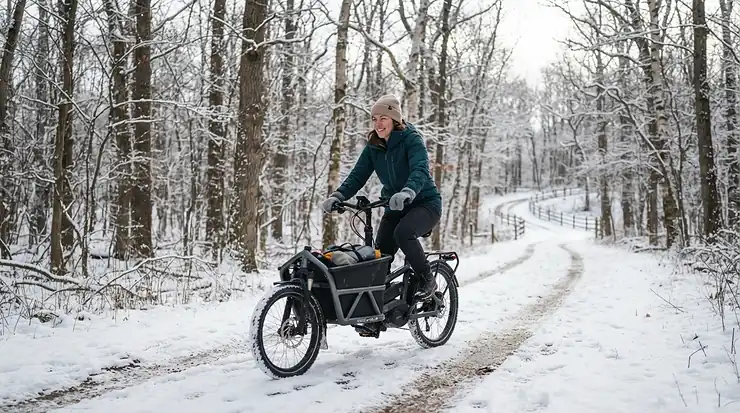
In This Article
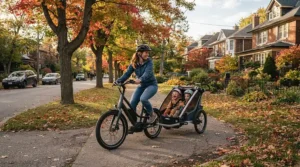
Picture 8:12 on a drizzly October morning. Two backpacks have gone missing, one boot is somewhere in the house, and the minivan is blocked in by a neighbour’s pickup. Now picture a cargo e-bike for families rolling out of the garage instead: kids helmeted, snacks bungeed to the rack, motor humming at the first hill. In 2026, that scene is far more realistic than it used to be.

Think of a cargo e-bike for families as a bicycle that went to the gym and learned to carry people. The frame is longer, the wheels and brakes tougher, and the motor takes the misery out of starting a loaded bike at a red light. It won’t replace every car trip. For school runs, grocery hauls and weekend errands within a few kilometres of home, though, it can replace a surprising number of them.
Here’s how I approached this guide. I compared seven real models using their published specs and the patterns that show up across independent reviews. I have not ridden these bikes, and I won’t pretend otherwise. You’ll get a budget-to-premium lineup, a clear explanation of child bike seat weight limits, and a practical look at cargo bike stability. You’ll also get the Canadian wrinkle that most US-written guides skip: our 500 W and 32 km/h legal limit, which several popular bikes exceed on paper.
Prices below are ranges in Canadian dollars, gathered at the time of research. They shift constantly, so check current pricing and Amazon.ca availability before you commit.
Cargo E-Bike for Families: Quick Comparison
Start here if you want the short version. The table below sorts seven bikes by what they do best for a family.
| Bike | Best For | Total Payload | Price Range (CAD) |
|---|---|---|---|
| isinwheel U7S | Tight budgets and long range | 330 lb (150 kg) | C$1,100–C$1,600 |
| EUYBIKE F8P | All-in-one two-seat package | About 300 lb (136 kg) rack rating | C$1,200–C$1,800 |
| SISIGAD Family Electric Bike | One young child with a built-in seat | 450 lb (204 kg) | C$1,200–C$1,800 |
| Lectric XPedition 2.0 | Most payload for the money | 450 lb (204 kg) | C$2,000–C$2,700 |
| Velotric Packer 1 | Stable, composed handling | 440 lb (200 kg) | C$2,600–C$3,000 |
| Heybike Hauler | Long range with a second battery | 440 lb (200 kg) | C$2,300–C$2,900 |
| Aventon Abound LR | Accessory ecosystem and two-kid setups | 440 lb (200 kg) | C$2,700–C$3,200 |
Looking at the comparison above, the SISIGAD Family Electric Bike and isinwheel U7S keep the entry price low, but they trade away payload headroom or refinement to do it. The Lectric XPedition 2.0 is where the payload-per-dollar maths gets interesting. If you’re hauling two kids plus gear every day, the premium group, led by the Aventon Abound LR and Velotric Packer 1, offers calmer handling and deeper accessory support.
💬 Just one click — help others make better buying decisions too!😊
What Is a Cargo E-Bike for Families?
A cargo e-bike for families is an electric-assist bicycle with a reinforced, extended frame built to carry children, groceries and gear. Total payload usually runs 150–200 kg (330–440 lb), rider included. Longtail designs seat passengers behind the rider, while front-loaders (bakfiets-style) put them in a box up front.
For most households, the longtail wins on price, storage and the ability to carry older kids who can hold on. Front-loaders shine with toddlers because you can see them, but they’re pricier and longer to park.
Here’s the legal piece that matters in Canada. To ride on public roads as a power-assisted bicycle, the motor generally must be rated 500 W or less, and assistance must cut off at 32 km/h. Quebec’s SAAQ lays this out clearly, and the same federal definition underpins rules in most provinces. Federal rules also call for a permanent manufacturer label identifying the vehicle as a power-assisted bicycle.
Why does this matter for shopping? Many bikes in this guide are advertised in the US with 750 W motors, 1,450–1,500 W “peak” figures, and top speeds near 45 km/h (28 mph). Those numbers describe the US-market configuration. A bike that exceeds Canadian limits can land in moped or motorcycle territory, with licensing, registration and insurance obligations attached. So treat every motor spec below as a starting point, and confirm the Canadian-market version carries the compliance label before you buy.
Top 7 Cargo E-Bikes for Families: Expert Analysis
Each pick below is ordered from budget to premium. Specs come from manufacturer listings and independent reviews, and the review sentiment is aggregated from published reviewer and buyer reports.
1. isinwheel U7S — long range on a lean budget
The isinwheel U7S is the “how much bike can I get for under two grand” answer. It pairs front and rear cargo racks with a step-through frame and 20-inch fat tires.
The listing pairs a 48V 20Ah battery (roughly 960 Wh) with a claimed range of up to 80 miles (about 129 km) in pedal-assist. In practice, a heavily loaded bike will land well below any claim, but a big battery still means fewer charging anxieties on school-run weeks. The 330 lb (150 kg) payload sounds fine until you do the maths: a 75 kg rider plus two 20 kg children leaves little room for groceries.
Based on the spec sheet, this fits a single-child family or one with a lighter rider. Reviewers consistently praise stable handling with loaded racks, easy assembly and responsive customer support. The recurring complaints are a harsh ride over bumps and a payload that sits below average for the category.
Pros:
- ✅ Large battery for long loaded range
- ✅ Front and rear racks included
- ✅ Stable handling when loaded
Cons:
- ❌ 330 lb payload limits two-kid setups
- ❌ Ride turns harsh on rough pavement
Expect roughly C$1,100–C$1,600. Value verdict: a smart budget pick for one child, but not for two.
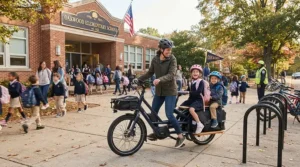
2. EUYBIKE F8P — two-seat package with a big battery
The EUYBIKE F8P is built around a simple idea: arrive with the passenger seat, footpegs and basket already in the box. It runs a 750 W motor (1,450 W peak) at 82 N·m of torque, plus a removable 48V 20Ah (960 Wh) battery and 20×4-inch fat tires.
That torque figure is the useful one. It’s what helps a loaded bike climb out of a stop without drama, and one review credits it with handling steep ramps. The rack carries around 300 lb, so think one child plus cargo, or two lighter kids.
Here’s what the spec sheet won’t tell you, but buyers do. One owner loved the included child seat and the long-lasting battery, yet another reported that the passenger seat’s mounting holes didn’t line up on the black frame. Other roundups mention occasional motor and battery failures and a loose battery mount. Check whether your variant uses mechanical or hydraulic disc brakes before buying.
Pros:
- ✅ Child seat and basket options in one package
- ✅ 960 Wh removable battery
- ✅ Strong torque for hills
Cons:
- ❌ Reported fitment and quality-control inconsistencies
- ❌ Brake type varies by variant
Expect roughly C$1,200–C$1,800. Value verdict: strong specs per dollar, with some quality-control risk to weigh.
3. SISIGAD Family Electric Bike — a built-in child seat
The SISIGAD Family Electric Bike answers the “which seat fits my bike?” question by skipping it. The child seat is integrated, with a tall guardrail, footrest and harness. The listing pairs a 1,500 W peak motor with a high-carbon steel step-through frame, 48V 15Ah (720 Wh) battery and dual hydraulic brakes, all rated for 450 lb (204 kg).
What this means in practice: a seat engineered with the frame avoids the compatibility guesswork that plagues bolt-on seats. The trade-off is flexibility. Reviewers describe it as best for one child, roughly ages two to seven, and note the integrated seat eats most of the rear space. One roundup puts the practical child-weight ceiling near 50 lb (22 kg), which lines up with typical seat limits.
Reviewers like the family-ready design and UL 2849 battery certification. Buyer complaints include parts missing or damaged on arrival and uneven customer care. Rear basket sold separately.
Pros:
- ✅ Integrated seat with high guardrail
- ✅ UL 2849 battery certification
- ✅ Hydraulic brakes
Cons:
- ❌ Best suited to one child, not two
- ❌ Reported shipping and support issues
Expect roughly C$1,200–C$1,800. Value verdict: great for toddlers and preschoolers, weaker as your kids grow.
4. Lectric XPedition 2.0 — most payload per dollar
The Lectric XPedition 2.0 has built a reputation as the cargo bike that makes premium brands sweat. It carries 450 lb (204 kg) total, with up to 300 lb on the rack, and a 750 W rear hub motor (about 1,310 W peak).
Two upgrades matter for families. First, a torque sensor replaced the older cadence sensor, which means assistance follows your pedalling instead of lurching in. Second, a front suspension fork takes the sting out of potholes. Independent reviewers also praise its fit for riders from 4’11” to 6’5″ (about 150–196 cm), useful when two adults share one bike.
The catch is mass. At roughly 83 lb (38 kg), reviewers warn it’s a handful on stairs, so storage is a real consideration. Range figures are optimistic for the bigger battery options, but testers found efficiency better than expected.
Pros:
- ✅ Torque sensor for smoother starts
- ✅ 450 lb total payload
- ✅ Front suspension included
Cons:
- ❌ Heavy at about 38 kg
- ❌ Peak power exceeds Canadian limits on paper
Expect roughly C$2,000–C$2,700. Value verdict: the best balance of capacity and cost for most families.
5. Velotric Packer 1 — composed, stable handling
The Velotric Packer 1 uses a mixed-wheel design: a 26-inch front wheel for control and a 20-inch rear wheel to keep cargo low. That arrangement is the heart of its cargo bike stability story, and reviewers keep returning to how composed it feels even with added load.
Specs back it up: 750 W motor (about 1,200 W peak), 692 Wh battery, 4-piston hydraulic brakes on 180 mm rotors, and a front thru-axle. The rear rack carries 176 lb (80 kg) within a 440 lb (200 kg) total. In one standardized test, a reviewer measured about 59 km of range at maximum assist, a useful reality check against the claim.
Reviewers do flag some rough edges: no torque sensor, power that cuts in abruptly or lingers briefly after you stop pedalling, and handlebars that feel narrow for such a long bike. At roughly 75 lb (34 kg), it’s lighter than some rivals.
Pros:
- ✅ Mixed wheel sizes keep cargo low
- ✅ Powerful 4-piston hydraulic brakes
- ✅ Family accessory bundles available
Cons:
- ❌ Cadence-based assist can feel abrupt
- ❌ Narrow bars for the bike’s length
Expect roughly C$2,600–C$3,000. Value verdict: worth it if handling confidence is your top priority.

6. Heybike Hauler — range that outlasts the school week
The Heybike Hauler is Heybike’s first dedicated cargo bike, and range is its headline. The main battery is 864 Wh, and an optional 600 Wh second pack takes the total to 1,464 Wh. Heybike claims 55 miles on one battery and 85 on two.
Translate that: for a family doing 8 km school runs, the dual-battery version could stretch a charge across much of the week. The second pack is sold separately, so factor that in. Payload is 440 lb (199.6 kg) total, with hydraulic brakes, front suspension with lockout, turn signals and brake lights. A pegboard and footboards extend the cargo options.
Be honest about weight: roughly 40 kg with one battery and 44 kg with two. Reviewers like the visual appeal, plush seat and cargo space. The advertised 45 km/h top speed is a US figure, so check Canadian configuration.
Pros:
- ✅ Dual-battery option for long range
- ✅ Turn signals and brake lights
- ✅ Front and rear cargo racks
Cons:
- ❌ Heavy, especially with two batteries
- ❌ Second battery costs extra
Expect roughly C$2,300–C$2,900. Value verdict: ideal for long-distance families who dislike charging.
7. Aventon Abound LR — the family accessory ecosystem
The Aventon Abound LR is the one most reviewers recommend when a family wants a polished, accessory-rich platform. A 750 W rear hub motor, a 440 lb (200 kg) payload and a 143 lb (65 kg) rear-rack limit set the baseline, while a step-through frame helps with kids in arms.
Family features are thoughtful: a kickstand lock keeps the bike planted while loading, Boost Mode adds short bursts of extra power for starts, and a suspension seatpost smooths the ride. One reviewer’s test found it carried two preschoolers (30–40 lb each) well on short trips. Its Range Test result was among the longest the site has seen for a cargo e-bike.
Know the trade-offs. The child handrail and seat pad are sold separately (about US$185 combined in one review), and a small storage-bag zipper drew complaints.
Pros:
- ✅ Kickstand lock for safer loading
- ✅ Broad accessory range for kids
- ✅ Strong range in independent testing
Cons:
- ❌ Kid accessories cost extra
- ❌ Fiddly storage-bag zipper
Expect roughly C$2,700–C$3,200. Value verdict: the premium pick for two-kid families who’ll use it daily.
Here’s how the seven stack up on the numbers that shape daily life.
| Bike | Motor (Rated / Peak) | Battery | Weight | Kid Setup | Best For |
|---|---|---|---|---|---|
| isinwheel U7S | 1,500 W peak | About 960 Wh | Not verified | Add-on seat | Budget, one child |
| EUYBIKE F8P | 750 W / 1,450 W | 960 Wh | Not verified | Seat and footpegs included | Package buyers |
| SISIGAD Family Electric Bike | 1,500 W peak | 720 Wh | Not verified | Integrated seat | Toddlers |
| Lectric XPedition 2.0 | 750 W / 1,310 W | Varies by trim | About 38 kg | Accessory kits | Value, hills |
| Velotric Packer 1 | 750 W / 1,200 W | 692 Wh | About 34 kg | Family bundles | Handling |
| Heybike Hauler | 750 W / 1,400 W | 864 Wh (+600 Wh) | 40–44 kg | Footboards, rack | Range |
| Aventon Abound LR | 750 W | About 708–720 Wh | Not verified | Handrail and seat pad | Two kids |
Read the table as a trade-off map. The Heybike Hauler and isinwheel U7S lean toward range, the Velotric Packer 1 toward control, and the SISIGAD Family Electric Bike toward turnkey child safety. The big picture: every bike here advertises motor numbers above Canada’s 500 W limit, so verifying the Canadian version matters more than any single spec.
How to Choose a Cargo E-Bike for Families
A cargo e-bike for families is a ten-year relationship with a heavy object, so choose with your head first. Work through these steps in order.
- Count real passengers, then add one. Include the child who’ll start school next year. A bike that fits today’s toddler may not fit tomorrow’s two.
- Do the payload maths. Add rider, passengers, helmets, backpacks and groceries. Stay comfortably under the rated total, and check the rack limit separately, since it’s usually far lower.
- Prioritize braking. Hydraulic discs are the safe default for a 35–45 kg bike carrying kids.
- Check the Canadian legal fit. Confirm a 500 W motor, 32 km/h cut-off and a power-assisted bicycle label. Rules vary by province. P.E.I.’s recent changes, reported by CBC, set 16 as the minimum riding age, while Quebec generally says 18.
- Weigh the starting feel. Torque sensors feel smoother than cadence sensors when launching a loaded bike from a stop.
- Plan storage and stairs. A 38 kg bike is a garage bike, not a third-floor-walk-up bike.
- Confirm child seat compatibility. Use brand-approved accessories wherever possible.
Pro tip: sit down with a calendar and list the real trips you’d swap. The answer tells you more than any spec sheet.
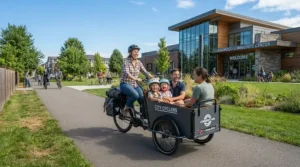
Cargo E-Bike for Two Kids: What Actually Works
Carrying two children is where cargo bikes either shine or frustrate. The truth is that a cargo e-bike for two kids rarely means two bolt-on rear seats. Standard rear child seats are designed for one child each, so two usually means a seat plus a seat pad and handrail for an older child who can hold on.
That’s the approach Aventon describes for its own longtail: older children who follow instructions ride on the seat pad with footboards, a setup many families use daily. The Aventon Abound LR is the obvious fit. The Velotric Packer 1 also offers family bundles, and the Lectric XPedition 2.0 carries the highest rack rating at 300 lb.
Do the arithmetic honestly. A 75 kg rider, two 20 kg children and a 38 kg bike come to about 153 kg, comfortably inside a 200 kg rating. Add groceries and a scooter, and you’re approaching the limit.
For families with a third child, expect a workaround. Real-world guidance is that no standard road cargo e-bike carries three, so most families ride with two at a time or share the load with a second adult.
Family E-Bike With Child Seat: Getting the Fit Right
A family e-bike with child seat sounds simple until you’re staring at a rack that doesn’t match the seat. Start with the mounting standard: many rear seats require a rack conforming to ISO 11243, with a stated rack load (27 kg in one example).
Here’s the catch. One rack-mounted seat I reviewed lists compatible wheel diameters of 26 to 29 inches, yet many compact cargo bikes run 20-inch rear wheels. That doesn’t make the bike unsafe, but it does mean you should prefer the bike brand’s own seat or handrail kit, or a seat explicitly approved for that model.
Think about the child’s posture, too. A rider must sit upright and keep their head up while wearing a helmet. Footrests and straps should hold their feet away from the spokes.
For the SISIGAD Family Electric Bike, the question disappears because the seat is built in. For the EUYBIKE F8P, check the seat fit on your colour before assembly, since one buyer reported misaligned holes on the black version. Whichever route you pick, a family e-bike with child seat should never be mounted by guesswork.
Child Bike Seat Weight Limits Explained
Child bike seat weight limits cluster around one number: 22 kg (48.5 lb). Thule’s Yepp Maxi frame seat, available in Canada for around C$300, is rated for children from about nine months to six years, up to 22 kg. A rear carrier seat from Polisport lists the same ceiling.
European standards follow the logic. The CEN standard covers child seats for children from 9 kg to 22 kg who can sit unaided, roughly nine months to five years. That’s why a pediatrician-style rule of thumb applies: a child who can’t sit up by themselves isn’t ready for a bike seat.
Two more limits tend to get overlooked. First, the total bike rating includes the rider, the child and the seat. Second, some seats specify a maximum speed. One rear seat states it’s compatible with e-bikes up to 25 km/h, and warns against using it faster. If your cargo bike’s app lets you cap assistance, cap it.
Weigh your child every few months. Child bike seat weight limits are ceilings, not targets, and a 22 kg child in a seat is a different load on cargo bike stability than a 10 kg one.
Cargo Bike Stability: Why Heavy Bikes Behave
Cargo bike stability comes down to physics you can feel. A loaded cargo e-bike is heavy, long and top-heavy if you pack it wrong. Good designs fight that with low centres of gravity and smart geometry.
Small rear wheels are the clearest example. The Velotric Packer 1 pairs a 20-inch rear wheel with a 26-inch front, which keeps cargo low while preserving steering feel. A double-leg kickstand matters just as much, and the Aventon Abound LR adds a kickstand lock so the bike doesn’t wander while you buckle a child in.
Then there’s the hardest moment of any cargo ride: getting moving. Pulling away from a stop sign with two kids aboard is where weak motors and cadence-based assist show their limits. A torque sensor, like the one on the Lectric XPedition 2.0, helps.
Load smart. Put heavy items low and forward, kids centred over the rear axle, and keep the rack under its rated limit. Practise starting, stopping and turning in an empty car park before you carry passengers. Cargo bike stability is a skill you build, not just a feature you buy.
Safe Cargo E-Bike for School Drop Off: A Practical Guide
A safe cargo e-bike for school drop off is part equipment, part routine. Here’s a first-30-days playbook that Amazon listings never give you.
Week one: empty-bike practice. Ride the loaded-bike route with no kids. Learn where you brake, where the pavement is rough and where school traffic bunches up.
Week two: add one child. Check that the child sits upright, feet are strapped, and the helmet fits. The Canadian Paediatric Society advises choosing a helmet with an approved standards label and replacing it after a hard fall, as Caring for Kids explains.
Week three: the full load. Add the second child, backpacks and lunch. Notice how braking distance changes.
Weekly maintenance: check tire pressure, brake pads and quick-release levers. Charge after every ride rather than at 5%, and keep the battery out of freezing garages overnight.
Common first-month mistakes include overloading the rack, skipping pre-ride checks and riding at full assist with children aboard. Pick a safe cargo e-bike for school drop off by what it does at 15 km/h, not 40.
The EUYBIKE F8P and SISIGAD Family Electric Bike make ideal budget candidates for this routine, while the Aventon Abound LR adds the kickstand lock that makes the morning scramble calmer.
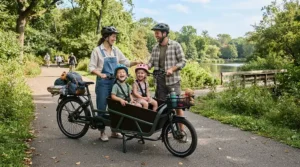
Family Biking Safety Gear and Canadian Rules
Family biking safety gear starts with helmets and ends with visibility. Don’t skimp on either.
Helmets sold in Canada should carry a CSA, CPSC, Snell or ASTM sticker, and bike helmets are single-impact: replace one after a hard fall. In several provinces, anyone under 18 must wear one. Ontario’s regulation, for example, lists accepted cycling helmet standards, including CAN/CSA D113.2.
Beyond helmets, build a simple kit:
- A bright rear light and a front light, even in daytime.
- Reflective vests or ankle bands for kids.
- A bell and a rear-view mirror.
- Gloves and rain gear for the rider, because a wet ride sours kids fast.
- A sturdy lock plus a second layer for the battery, if removable.
Choose family biking safety gear for your child’s seat position as well: a helmet that tilts forward against a seat back is a poor fit, so test the combination before you buy.
Then there’s the legal side. Age limits vary: P.E.I. permits riders 16 and older, while Quebec generally requires 18. A bike exceeding 500 W or 32 km/h may be treated as a moped or low-speed motorcycle, requiring a licence and insurance. When in doubt, check your province’s transportation ministry.
Cargo E-Bike vs Car: Does the Maths Work for Families?
A cargo e-bike for families won’t replace the minivan, but it can replace most short trips. Families who do it well usually keep one car trip a week for bulk items and ride for the rest.
| Factor | Cargo E-Bike | Car or Minivan | Best For |
|---|---|---|---|
| Upfront cost | About C$1,100–C$3,200 | Many times higher | Tight budgets |
| Running cost | Electricity, tires, pads | Fuel, insurance, parking | Short, frequent trips |
| Winter | Needs prep and good tires | Heated and enclosed | Long winter commutes |
| Capacity | Two kids, light cargo | Several kids, bulk | Big families |
| Door-to-door | Ride to the school gate | Parking and queueing | Urban school runs |
The analysis is straightforward. Under about five kilometres, the cargo e-bike often beats the car door to door, because there’s no parking hunt and no drop-off queue. Over longer distances, in deep winter or with three or more children, the car still wins. The smartest households treat the two as a team.
Pair the Lectric XPedition 2.0 or Velotric Packer 1 with an existing car, and the maths gets even kinder.
Long-Term Cost and Maintenance
Sticker price is only the opening bid. Over several years, the real cost of ownership comes from consumables and the battery.
Budget for tires, brake pads, chains and the occasional tune-up, all of which wear faster under 150-plus kilograms of bike, rider and passengers. Hydraulic brakes need periodic bleeding. Batteries slowly lose capacity, and replacements for bikes like the Heybike Hauler, with its 864 Wh pack, are a meaningful expense later on.
Three habits stretch every dollar. Store the battery indoors and avoid leaving it fully drained for weeks. Clean and lubricate the chain monthly. Re-check bolts on racks and child seat mounts, since vibration loosens them.
Also factor in warranty. Heybike lists one year on the Hauler (extendable), so read terms and who actually services the bike. Budget direct-to-consumer brands can leave you shipping parts yourself, while a local shop can only service what it can source. Total cost of ownership favours the Aventon Abound LR and Velotric Packer 1 for service support, while the isinwheel U7S and EUYBIKE F8P save money upfront at the cost of more self-reliance.
Real-World Scenarios: Which Bike for Which Family?
Specs only matter when matched to a life. Here are three profiles built from the data above.
The condo family with one toddler. One child, flat terrain, a small garage. The SISIGAD Family Electric Bike‘s integrated seat removes guesswork, and its roughly C$1,200–C$1,800 price keeps the experiment affordable. Mind the stairs.
The hilly-suburb family with two preschoolers. Two kids at 15–20 kg each, a 12% grade on the school route, one car in the driveway. The Lectric XPedition 2.0‘s torque sensor and 450 lb payload are well suited, and its front suspension helps on patched roads.
The rural family with long distances. Gravel shoulders, 10 km each way, no transit. The Heybike Hauler with its second battery covers the range gap, and fat tires handle rougher surfaces. A built-in speed limiter keeps it within Canadian rules.
In each case, the question isn’t “which bike is best?” It’s “which constraint is hardest?” Budget points to the isinwheel U7S, handling to the Velotric Packer 1, and accessories to the Aventon Abound LR.
FAQ
❓ How old should a child be to ride on a cargo e-bike?
❓ Do I need a licence or insurance for a cargo e-bike in Canada?
❓ How far can a family cargo e-bike go on one charge?
❓ Can I fit any child seat to a cargo e-bike?
❓ Can I ride a cargo e-bike with kids in winter?
Conclusion
Choosing a cargo e-bike for families comes down to honest answers about your kids, your hills and your storage space. The isinwheel U7S and EUYBIKE F8P are the budget gateways, the SISIGAD Family Electric Bike is the turnkey toddler option, and the Lectric XPedition 2.0 delivers the best capacity per dollar. For calmer handling and deeper accessory support, the Velotric Packer 1, Heybike Hauler and Aventon Abound LR lead the premium group.
Whatever you choose, keep the fundamentals in view. Respect child bike seat weight limits, prioritise cargo bike stability when you load, and invest in proper family biking safety gear. A safe cargo e-bike for school drop off is a system: bike, seat, helmet and routine working together. And before you buy, confirm the Canadian-market version meets the 500 W and 32 km/h rules.
Do that, and the 8:12 scramble gets a lot less chaotic.
✨ Ready to swap a few car trips for family rides?
🚴♂️ Click through to check current pricing and availability on Amazon.ca, and pick the bike that fits the way your family actually lives!
Recommended for You
- Heavy-Duty Cargo Ebike For Maximum Load Capacity: 7 Best Picks 2026
- Front-Load Vs Longtail Cargo E-Bike: 7 Proven Picks 2026
- Best E-Bike For Women: 7 Proven Picks For Canada (2026)
Disclaimer: This article contains affiliate links. As an Amazon Associate, I earn from qualifying purchases. If you purchase products through these links, we may earn a small commission at no additional cost to you.
✨ Found this helpful? Share it with your friends! 💬🤗
