
In This Article
Somewhere around the first proper dump of snow, most riders make the same quiet deal with themselves: bike goes in the garage, transit pass comes out. A growing crowd is refusing that trade. Their secret weapon is a fat tire e-bike for snow, a heavy, wide-tired, motor-assisted workhorse that treats a slushy commute as a mild inconvenience rather than a personal insult.
This isn’t a fringe hobby anymore. CBC has profiled the growing number of Canadians who ride year-round, and fat bikes now turn up everywhere from Whitehorse to Halifax. Add a motor and the maths changes. You arrive warm instead of frozen, and you can keep rolling through the kind of soft stuff that would have a regular commuter walking.
Here is how this guide works. I haven’t ridden these bikes, and I won’t pretend otherwise. Everything below comes from manufacturer specs, published expert reviews, Canadian regulations and plain reasoning about what the numbers mean on a frozen road. Prices appear as CAD ranges only, so check current pricing before you buy.
You’ll get seven real bikes ranked by use case, then the stuff spec sheets skip: tire pressure for snow riding, snow tire tread patterns, winter commuting safety and the Canadian rules that quietly decide which bikes you can legally ride on the road. Think of it as the knowledgeable friend who has read all the manuals so you don’t have to.
Fat Tire E-Bike for Snow at a Glance
| Product | Motor | Battery | Tires | Approx. Price (CAD) | Best For |
|---|---|---|---|---|---|
| Aventon Aventure.3 | 750W hub (1,188W peak), 80 Nm | 733 Wh | 26 x 4.0 in | C$2,500-C$3,000 | Plowed paths and mixed commutes |
| Lectric XPeak 2.0 | 500W or 750W options | 720 Wh | 26-inch fat | C$1,900-C$2,400 | Value-minded daily riders |
| Himiway D7 Cobra | 750W hub, 96 Nm | 960 Wh | 26 x 4.5-4.8 in | Above C$3,000 | Unplowed trails, heavy loads |
| Eunorau FAT-AWD 3.0 | Dual 500W hubs, up to 110 Nm | 720 Wh (second pack optional) | 26 x 4.0 in | C$2,200-C$2,500 | Maximum traction, rural roads |
| Hiboy P6 | 750W hub | 624 Wh | 26 x 4.0 in | C$1,300-C$1,700 | Tight budgets |
| Heybike Mars 2.0 | 750W or 1000W options | 600 Wh | 20 x 4.0 in | C$1,300-C$2,200 | Folding and storage-limited riders |
| Rocky Mountain Blizzard Powerplay | Mid-drive, 250W nominal, 108 Nm | 720 Wh | 27.5 x 4.5 in | C$6,000-C$7,500 | Cold-rated, dealer-supported premium |
The table shows a clear split between price and sophistication. The Aventon Aventure.3 and Lectric XPeak 2.0 sit in the sweet spot of power, battery size and polish, while the Hiboy P6 wins on price alone. If deep, unplowed snow is your reality, the Eunorau FAT-AWD 3.0 and Himiway D7 Cobra give you the traction and battery depth that cheaper bikes can’t match. The Rocky Mountain Blizzard Powerplay is the outlier: the only mid-drive here, and the only one with a 250W nominal rating that sits comfortably under Canada’s power cap.
💬 Just one click — help others make better buying decisions too!😊
Top 7 Fat Tire E-Bikes for Snow: Expert Analysis
1. Aventon Aventure.3 — best all-rounder for plowed paths
The Aventon Aventure.3 suits winter that means plowed bike lanes and slushy shoulders more than virgin powder. A 750W hub motor (1,188W peak, 80 Nm) pairs with a torque sensor, so assist follows your pedal pressure instead of lunging forward. On a slick surface that gentleness is worth more than raw wattage, because a jumpy motor is how rear wheels spin out. The 733 Wh battery carries a 65-mile (about 105 km) claim, but Electric Bike Review measured roughly 34 miles (55 km) at maximum assist, and cold air trims that further. The 26 x 4.0 in tires, 80 mm fork and hydraulic brakes round out a sensible winter kit.
Based on the spec comparison, this is the bike for riders who want one machine for all four seasons plus a dealer network. Reviewers consistently praise its range honesty, braking and off-road composure. The recurring complaints are weight (about 77 lb, or 35 kg) and an awkwardly placed charging port.
One Canadian caveat: a 750W rating exceeds the 500W cap for road-legal power-assisted bicycles, so confirm the Canadian configuration before buying.
Pros:
- ✅ Torque sensor gives smooth, slip-resistant power delivery
- ✅ Hydraulic brakes and suspension fork inspire confidence
- ✅ Honest, well-reviewed range for its battery size
Cons:
- ❌ Heavy to lift or carry up stairs
- ❌ Charging port is awkward to reach
Expect roughly C$2,500-C$3,000, which is fair value for the polish and support.
2. Lectric XPeak 2.0 — best value for daily winter commuting
The Lectric XPeak 2.0 is the budget-conscious rider’s cheat code: big-bike capability without the premium sticker. The 2.0 upgrade swapped the old cadence sensor for a torque sensor and reinforced a frame that earlier owners found twitchy. It comes in 500W and 750W versions, and US listings quote a 1,310W peak on the stronger one. The 720 Wh battery (48V, 15Ah) means a full-size reserve for cold days, and the roughly 75 lb (34 kg) weight is lighter than most rivals with comparable range.
On paper this is the smart pick for commuters who want winter capability without paying for features they won’t use. The 500W version also lines up neatly with Canadian power limits, which matters more than any marketing sticker. Reviewers rate its value, quiet hub motor and long-term durability highly. Freshly Charged flags battery removal and headlight strength as areas needing refinement, so budget for an aftermarket light if you ride after dark.
Pros:
- ✅ Torque sensor and large 720 Wh battery
- ✅ 500W version fits Canadian power rules
- ✅ Strong reputation for value and durability
Cons:
- ❌ Stock headlight is merely adequate
- ❌ Battery removal is fussier than rivals
Plan on about C$1,900-C$2,400, which makes it the value leader of this group.
3. Himiway D7 Cobra — full suspension for chunky, unplowed trails
The Himiway D7 Cobra is the monster truck of this list, built around 26 in wheels with 4.5-4.8 in tires, depending on the version. A 750W hub motor makes 96 Nm, and a giant 960 Wh battery supplies the stamina to match. Add full suspension and a payload of about 400 lb (180 kg), and you have a bike that shrugs off ruts, frozen ruts and the kind of crusty snow that tosses lesser bikes sideways.
That size is a double-edged sword. At roughly 88.6 lb (40 kg), it’s a bike you park rather than carry. Reviewers at Electric Bike Report were pleasantly surprised by how well the suspension worked, though they noted the fork isn’t high-end hardware. Other testers consistently describe the motor as notably punchy.
Based on the spec comparison, this is the right call for trail riders, hunters and anyone hauling gear through soft terrain. It’s overkill for a city commute, and a 750W rating needs checking against Canadian rules.
Pros:
- ✅ Huge 960 Wh battery for long cold rides
- ✅ Full suspension smooths frozen ruts
- ✅ Extra-wide tires with generous flotation
Cons:
- ❌ Very heavy at roughly 40 kg
- ❌ Overpowered for casual commuting
Expect prices above C$3,000, which is premium money for a specialist tool.
4. Eunorau FAT-AWD 3.0 — two driven wheels for the sloppiest conditions
The Eunorau FAT-AWD 3.0 takes a different approach to traction: it simply powers both wheels. Dual 500W hub motors, up to 110 Nm combined, push through 26 x 4.0 in tires, and a 48V 15Ah battery has an optional second pack for far longer range. A step-through frame, torque sensor and hydraulic brakes round things out.
Why does AWD matter? On loose snow or wet hills, a single driven rear wheel can spin while you stall. A front motor pulls you out of that rut. For rural roads, steep driveways and snow that hasn’t seen a plow, this layout is genuinely helpful.
Honest caveats apply. One Canadian retailer labels this bike as exceeding 500W and intended for off-road use, so it may not be road-legal as shipped. Independent testing of the current 3.0 is thinner than for the big-name bikes; older reviews of the original noted basic components built for slow, tough crawls. Treat it as a capable utility tool rather than a refined commuter.
Pros:
- ✅ AWD traction in loose snow and on hills
- ✅ Optional second battery doubles range
- ✅ Step-through frame eases winter layers
Cons:
- ❌ Dual motors exceed Canadian road limits
- ❌ Limited independent testing of this version
Roughly C$2,200-C$2,500 buys a lot of traction per dollar.
5. Hiboy P6 — cheapest way into winter fat tire riding
The Hiboy P6 proves you don’t need a second mortgage to ride through January. A 750W Bafang rear hub, 26 x 4.0 in tires, a 48V 13Ah (624 Wh) battery and a suspension fork cover the fundamentals. At about 65 lb (29.5 kg), it’s also lighter than most bikes here, which helps when you’re wrestling it through a snowbank or up the back steps.
What does the budget cost you? Reviewers on The Gadgeteer called it a fun commuter that could benefit from design tweaks, and a trail tester singled out pedals and brakes as the weak points. Aggregated expert scores cluster around the low 80s out of 100. Components are basic, so budget for better brake pads and sturdier pedals if winter is your main season.
Important legal note: some Canadian retail listings advertise speeds near 45 km/h, which exceeds the 32 km/h limit for road-legal power-assisted bicycles. Ask for a compliant configuration before riding on public roads.
Pros:
- ✅ Lightest bike in this group
- ✅ Solid battery size for the price
- ✅ Easy entry to winter fat tire riding
Cons:
- ❌ Basic brakes and pedals need upgrading
- ❌ Advertised speeds exceed Canadian limits
Look for around C$1,300-C$1,700, an outstanding value if you accept the basics.
6. Heybike Mars 2.0 — folding fat tires for tight storage
The Heybike Mars 2.0 squeezes fat-tire capability into a folding frame, which is a lifesaver in condos, small garages and car trunks. It runs 20 x 4.0 in tires, a 600 Wh battery and a choice of 750W (80 Nm) or 1000W (100 Nm) hub motors. Tom’s Guide rode it shortly after a snowfall, dropped the tire pressure, and reported plenty of grip, especially cornering.
Folding sounds light, but it isn’t. The bike weighs about 75 lb (34 kg), so “portable” is relative. Reviewers also consider the suspension fork largely unnecessary, since the tires do most of the bump absorption, and Freshly Charged found components basic and app features limited. Smaller 20-inch wheels also sink more readily in deep snow than the 26-inch bikes above.
On balance, this is the choice for riders whose real constraint is storage, not snow depth. The 750W version is the better starting point for staying near Canadian limits.
Pros:
- ✅ Folds for apartments and trunks
- ✅ Good grip at reduced tire pressure
- ✅ Lots of motor options for different budgets
Cons:
- ❌ Heavy for a folding bike
- ❌ 20-inch wheels float less in deep snow
Expect around C$1,300-C$2,200 depending on version, a fair price for the flexibility.
7. Rocky Mountain Blizzard Powerplay — a Canadian winter specialist
The Rocky Mountain Blizzard Powerplay is the only bike here designed around winter from day one. Developed by a Canadian brand, it uses a Dyname 4.0 mid-drive (250W nominal, 108 Nm) on 27.5 x 4.5 in tires. The 720 Wh battery is engineered to work down to about -20°C, according to the manufacturer, and that cold rating matters when lithium cells sulk in the frost.
A mid-drive also changes the ride. Power flows through the chain and gears, so you can climb in a low gear and let the motor work efficiently instead of lugging. It’s lighter than the hub-motor giants at roughly 24 kg, and its 250W nominal rating fits comfortably inside Canadian power-assisted bicycle rules.
The catch is price and availability. Forum owners in Toronto and BC report enjoying theirs, but others call the component spec modest for the cost. It’s sold through dealers, so you may not find it on Amazon.ca, but it’s a useful benchmark.
Pros:
- ✅ Battery engineered for sub-zero conditions
- ✅ Mid-drive efficiency and natural climbing
- ✅ Legal-friendly 250W nominal rating
Cons:
- ❌ Very expensive for the components
- ❌ Dealer-only purchase, limited online availability
Launch pricing sat in the C$6,000-C$7,500 range, which is steep but purpose-built.
What Is a Fat Tire E-Bike for Snow?
A fat tire e-bike for snow is an electric bike with 4-inch or wider tires, a motor and battery, and a build suited to winter conditions. The wide tires run at low pressure to float over snow, while the motor adds traction and stamina. It’s essentially a snow-ready bicycle that doesn’t punish you for hills.
Why does that definition matter? Because not every “fat” bike earns the title. A genuine winter machine has tires of 4.0 inches or more, an open and aggressive tread, and enough battery to survive the cold. Marketing words like “all-terrain” or “mountain” on a bike with 2.5-inch tires don’t count. Check the measurement, not the adjective.
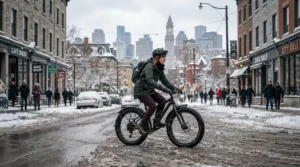
How to Choose a Fat Tire E-Bike for Snow
- Match tire width to snow depth. For plowed paths, 4.0 in is plenty. For unplowed trails, look for 4.5-4.8 in, which floats better.
- Prioritize a torque sensor. It delivers smooth, proportional power, which reduces wheel spin on ice.
- Check the legal rating. Canada’s limit is 500W continuous and 32 km/h assisted. A bike over that may only be legal off-road.
- Size the battery for cold. Cold air cuts range, so a 700 Wh pack or larger gives a useful reserve.
- Demand hydraulic disc brakes. Wet and icy conditions punish weak stopping power.
- Think about weight. Anything near 35-40 kg is awkward to lift, so plan storage that doesn’t involve stairs.
- Consider drive type. Dual motors help in deep soft snow, while a mid-drive suits climbs and cold efficiency.
Work through those seven in order and most bikes eliminate themselves quickly.
Fat Tire E-Bike Traction in Snow: What Actually Grips
Traction isn’t one thing. It’s a stack of four: contact patch, pressure, tread and torque delivery. Fat tire e-bike traction in snow starts with the contact patch, because a 4-inch tire at low pressure spreads weight across a far larger footprint than a slim commuter tire. That footprint is why fat bikes float where skinny tires dig in.
Pressure comes next, and it’s the cheapest upgrade you’ll ever make. Dropping a few PSI lets the tire conform to the surface and grip, though go too low and you risk rim strikes and squirmy steering.
Then comes power delivery. A torque sensor ramps assist smoothly, while a throttle can dump power the instant you twist it. On packed ice, smooth wins every time.
Finally, weight cuts both ways. Heavy e-bikes press the tire into the snow, which helps grip, but they also take longer to stop and are harder to recover when they slide. Based on the spec comparison, the sweet spot sits around 30-35 kg with a torque sensor and wide tires. The Aventon Aventure.3 and Lectric XPeak 2.0 live there, while the Eunorau FAT-AWD 3.0 adds a second driven wheel when the surface gets truly sloppy.
Deep Snow E-Bike Canada: When AWD or Mid-Drive Earns Its Keep
Here’s the uncomfortable truth about any deep snow e-bike in Canada: no fat tire bike turns unplowed, knee-deep snow into a pleasant ride. Eunorau’s own tire-pressure guidance makes the point bluntly, saying lower pressure helps but won’t turn a fat e-bike into a snowmobile. When the front tire starts plowing rather than rolling, you’ve found the limit.
So what does help? Three things, roughly in this order. First, width: 4.5-4.8 in tires like those on the Himiway D7 Cobra float better than 4.0 in rubber. Second, driven wheels: the Eunorau FAT-AWD 3.0 powers both ends, so the front wheel pulls instead of ploughing passively. Third, gearing: a mid-drive like the Rocky Mountain Blizzard Powerplay lets you spin a low gear and keep momentum.
Be realistic about the surface, too. Freshly groomed snow, packed farm roads and snowmobile trails work well. Fresh powder over a foot deep usually means walking. For most Canadians, the deep snow e-bike Canada question really means “can I survive an unplowed side street?” and the answer is yes, if you pick wide tires and stay patient.
Snow Tire Tread Patterns: Studs, Lugs and Sipes
Snow tire tread patterns follow a simple logic: open for snow, tight for ice. Tall, widely spaced lugs bite into loose snow and, crucially, shed it so the tire doesn’t pack up into a slick cylinder. Fat-bike tire makers describe this as an open tread that clears itself.
Ice demands the opposite. Tight, low center knobs roll fast on hardpack, and carbide studs bite into frozen surfaces. 45NRTH’s Dillinger line, for instance, offers studded versions with around 240 concave studs for icy conditions. Canadian riders on a retailer’s review page praised the confidence on ice, while another found the studs a little short for aggressive cornering.
Siping, the tiny slits cut into knobs, helps rubber grip cold, slick surfaces much like car winter tires do. Some designs use dual-compound rubber for the same purpose.
One warning merits attention. A major studded-tire maker cautions against pairing at least some of its tires with power-assist bikes, citing extra torque and system weight that can wear casings and loosen studs. Check the manufacturer’s e-bike guidance before spending C$200 or more per tire. For most commuters, an open-lug tire plus the right pressure covers snow, and studs only earn their place if your route is genuinely icy.
Tire Pressure for Snow Riding: A Practical Setup Guide
Tire pressure for snow riding is the single most effective adjustment you can make, and it costs nothing. The rule is simple: run the lowest PSI that still supports you without rim strikes, squirming or sluggish steering.
| Surface | Starting PSI | Approx. kPa | Goal |
|---|---|---|---|
| Loose or deep snow | 3-6 | 21-41 | Maximum float |
| Packed or groomed snow | 6-10 | 41-69 | Float plus traction |
| Mixed slush and bare pavement | Raise gradually from the packed range | Stay under sidewall max | Rolling efficiency |
Treat those numbers as starting points drawn from several manufacturers. One older formula divides rider weight in pounds by 20 for packed snow, so a 150 lb rider starts near 7.5 PSI, with a touch less in front and a touch more in the rear. Include your backpack and gear in that number.
Here’s my reasoning on e-bikes: they weigh 30-40 kg before you board, so begin toward the higher end of each range, then adjust 1-2 PSI at a time. If the front tire plows or you leave ruts, go lower. If it feels vague or you hear the rim, go higher. Remember that cold air shrinks pressure, so recheck before every ride, and use a low-pressure gauge rated for single digits.
The table shows why one pressure never fits every day. A bike set for pavement will feel squirrelly on packed snow, and a bike set for powder will feel mushy on the road home. Keep a small gauge in your bag and adjust without fuss.
Snow Commuting E-Bike Review: What the Testers Agree On
A fair snow commuting e-bike review starts with a disclosure: some of the loudest “best for snow” lists come from retailers who sell the bikes. Upway, Zeus and Eunorau all publish helpful guides, but they also have something to sell. Treat their rankings as informed opinions, and note when a review was sponsored.
With that caveat, patterns emerge. Upway’s snow roundup names the Aventon Aventure.3 as its best overall snow-capable fat tire pick, and the Himiway D7 Cobra as best full-suspension value. A Canadian retailer’s winter guide crowns the Eunorau FAT-AWD 3.0 for traction. Tom’s Guide tried the Heybike Mars 2.0 after a snowfall and reported strong grip when pressure was lowered.
What do they share? Testers keep praising torque sensors, hydraulic brakes and big batteries, and they keep criticizing weight and thin stock lighting. Few publish true cold-weather range tests, which is a gap worth knowing about. Expect real-world winter range to land well below the claimed figure, and treat the claimed number as a ceiling.
If a snow commuting e-bike review doesn’t mention lights, brakes or battery behaviour in the cold, it’s really a summer review in a toque.
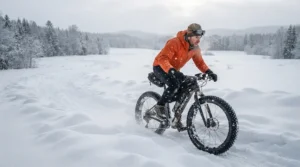
Winter Commuting Safety: Problems and Solutions
Winter commuting safety is mostly about solving five predictable problems before they solve you.
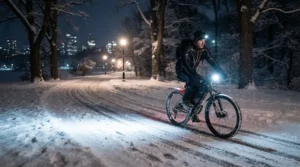
Problem: you can’t be seen. Winter daylight is short and snowfall hides riders. Toronto requires lights from half an hour before sunset to half an hour after sunrise, and Quebec’s road-safety agency stresses a white headlight and red taillight. Add reflective gear and a flashing rear light, even in daytime.
Problem: black ice. Toronto’s winter cycling guidance advises steering straight, not pedalling and avoiding braking if you hit black ice. That’s worth memorizing, because instinct says do the opposite.
Problem: brakes that lose bite. Wet pads glaze. Feather them early, and keep both fingers ready on the levers.
Problem: battery sag. Cold cuts range, so carry a reserve and plan routes with a backup, as Calgary advocates suggest. Quebec’s road-safety agency offers practical advice on winter bike setup including lights and tires.
Problem: salt and slush. They corrode drivetrains. Rinse and wipe the chain regularly.
Pair all of this with a helmet, which is legally required in many provinces, and winter commuting safety becomes routine rather than scary.
Real-World Scenarios: Which Bike Fits Which Rider
The Ottawa commuter. Twelve kilometres each way, plowed paths, daily use, a budget near C$2,500. The Aventon Aventure.3 or Lectric XPeak 2.0 fits: torque sensor, solid brakes, and reliable battery depth for a round trip in the cold. Add fenders and a bright light.
The Prairie rural rider. Unplowed gravel, drifted lanes, weekend errands and occasional hauling. The Eunorau FAT-AWD 3.0 with a second battery makes sense for traction and range, while the Himiway D7 Cobra suits anyone prioritizing ruts and payload. Both are likely off-road machines under Canadian rules, so private land and trails fit best.
The Montreal condo dweller. Limited storage, an elevator and short trips. The Heybike Mars 2.0 folds into a closet, though 75 lb is a real consideration. Practise carrying it before you buy.
The student on a budget. A couple of kilometres on campus, occasional weekends and maybe C$1,500 to spend. The Hiboy P6 delivers fat-tire stability for the least money, provided you upgrade the brake pads.
The Calgary or Whistler enthusiast. Cold-rated electronics, dealer servicing and long rides. The Rocky Mountain Blizzard Powerplay earns its premium here.
Canadian Rules: Power-Assisted Bicycle Guide
Canada’s rules matter more than any brochure. Provinces define a power-assisted bicycle (the legal term for an e-bike) with a motor of 500W or less and assistance that stops at 32 km/h. Prince Edward Island’s government page spells out the same limits and adds a 120 kg maximum bike weight and working pedals. Quebec states the same 500W and 32 km/h criteria.
That has real consequences for the bikes above. US-market ratings like 750W, 1000W or “28 mph” typically describe a vehicle that exceeds Canadian limits. Dual-motor bikes like the Eunorau FAT-AWD 3.0 and high-output options on the Heybike Mars 2.0 can fall outside the definition, and removing pedals or tuning past 32 km/h can reclassify a bike as a moped or motorcycle with licensing and insurance requirements.
What should you do? Check the Canadian product page for a compliant configuration or a PAB label, ask the seller directly, and keep records. Helmets are required in many provinces and minimum ages vary, so confirm your own. Compliance isn’t glamorous, but it protects your insurance, your liability and your right to use bike lanes.
Fat Tire vs Standard E-Bike in Winter
| Feature | Fat Tire E-Bike | Standard E-Bike with Winter Tires | Best For |
|---|---|---|---|
| Flotation in soft snow | Excellent | Poor | Eunorau FAT-AWD 3.0 on unplowed roads |
| Efficiency on pavement | Lower | Higher | Standard bikes on cleared streets |
| Weight | Heavy | Lighter | Hiboy P6 if weight matters |
| Comfort on rough snow | Cushioned by volume | Harsher | Himiway D7 Cobra on ruts |
| Purchase cost | Moderate to high | Moderate | Lectric XPeak 2.0 for value |
The table lays out the trade-off clearly: fat tires win on surfaces that move, standard tires win on surfaces that don’t. If your winter route is plowed and salted, a standard bike with proper winter tires may genuinely suit you better. If it includes shared paths, shortcuts and snowbanks, the Aventon Aventure.3 or Rocky Mountain Blizzard Powerplay earns its extra bulk.
Long-Term Cost and Cold-Weather Maintenance
Purchase price is only the opening bid. Winter adds consumables: brake pads, chain lubricant, a tire that wears faster on salted pavement, and potentially studs. Budget a few hundred dollars a season, and more if you add studded tires at C$200 or more each.
| Tier | Example | Approx. Price | Value Verdict |
|---|---|---|---|
| Budget | Hiboy P6 | C$1,300-C$1,700 | Great entry, plan for upgrades |
| Mid-range | Lectric XPeak 2.0 | C$1,900-C$2,400 | Best cost-per-use |
| Upper mid | Aventon Aventure.3 | C$2,500-C$3,000 | Polished, supported |
| Premium | Rocky Mountain Blizzard Powerplay | C$6,000-C$7,500 | Specialist, cold-rated |
Cost-per-use makes the mid-range look smart: a C$2,000 bike ridden 200 days a year is roughly C$10 a day in the first year and far less over several. The premium tier only wins if you value dealer service and cold-engineered parts.
Maintenance matters more than price. Most manufacturers advise against charging lithium batteries below freezing, so bring the pack indoors and let it warm up first. Check your manual for specifics. Wipe salt off the frame, relube the chain often, and recheck tire pressure weekly. Those small habits protect a four-figure investment.
Common Mistakes When Buying a Fat Tire E-Bike for Snow
Buying for peak watts, not legality. A 1000W badge is exciting until you learn it can’t legally ride the bike lane. Confirm the Canadian rating first.
Ignoring weight. A 40 kg bike is a joy to ride and a misery to carry. If your storage has stairs, test-lift before you commit.
Skipping lights. Many stock headlights are merely adequate. Upgrade, and add a rear flasher.
Running summer pressure. Pavement PSI in snow is how people end up on their backs.
Trusting claimed range. The Aventon Aventure.3 claims about 105 km but measured closer to 55 km at full assist. Cold subtracts more.
Over-buying drivetrain. Dual motors and mid-drives are wonderful, but if your route is plowed, the Lectric XPeak 2.0 probably does everything you need.
Forgetting service. A cheap bike without local support becomes an expensive ornament when a part fails in February. Ask where you’d get it repaired.
FAQ
❓ Can a fat tire e-bike go through deep snow in Canada?
❓ How cold is too cold to ride a fat tire e-bike?
❓ Is a 750W fat tire e-bike legal in Canada?
❓ Can I store my e-bike battery in a cold garage?
❓ How heavy is a typical fat tire e-bike for winter?
Conclusion
Winter doesn’t have to be bike season’s cold, lonely sequel. The right fat tire e-bike for snow turns frozen paths into a commute with personality, and it doesn’t ask you to be a hardened ice warrior to enjoy it.
If I had to simplify the choice, here’s how I’d think about it. For most riders on plowed paths, the Aventon Aventure.3 or Lectric XPeak 2.0 is the safest bet, with the Lectric XPeak 2.0 taking the value crown. For truly soft or unplowed terrain, the Eunorau FAT-AWD 3.0 and Himiway D7 Cobra bring traction and battery to the party, with legal caveats attached. The Hiboy P6 and Heybike Mars 2.0 keep budgets and storage in mind, and the Rocky Mountain Blizzard Powerplay is the Canadian-built specialist if cash allows.
Whatever you pick, remember the unglamorous basics: low tire pressure, good lights, a legal motor rating and a warm battery. Those four habits matter more than any spec sheet.
✨ Ready to Ride Through the Snow?
🔍 Compare current pricing and availability on the bikes above, pick the one that fits your route, and get out there before the plows beat you to it!
Recommended for You
- Fat Tire E-Bike For Snow: 7 Best Winter Picks In Canada (2026)
- E-Bike For Grocery Shopping: 7 Best Picks In Canada 2026
- Cargo E-Bike For Families: 7 Best Safe Picks In Canada 2026
Disclaimer: This article contains affiliate links. As an Amazon Associate, I earn from qualifying purchases. If you purchase products through these links, we may earn a small commission at no additional cost to you.
✨ Found this helpful? Share it with your friends! 💬🤗
