
In This Article
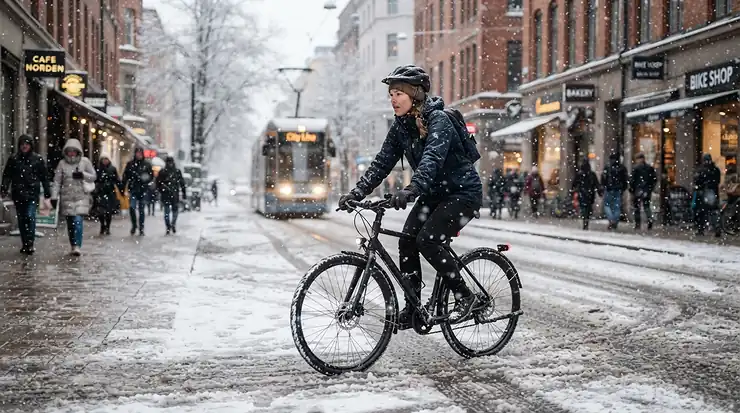
Canadian winter has a talent for exposing weak gear. Plastic goes brittle, batteries sulk, and a bike that felt heroic in September starts behaving like a shopping cart with opinions by January. So if you’re hunting for a cold-weather e-bike under $2500 CAD, you’re not being fussy. You’re being realistic.
Here’s the tension. Wide tires, sealed electrics and dependable brakes cost money, yet many of the cheapest online listings shout about huge “peak” wattage that means nothing on a public road. Provinces such as Quebec follow the same pattern laid out in Quebec’s e-bike rules: a motor of 500W or less, with assistance cutting out at 32 km/h (about 20 mph). A bike that ignores that isn’t a winter workhorse. It’s a legal headache with a battery.
This guide does the sorting. After researching real models sold in Canada, I narrowed the field to seven fat-tire and winter-friendly options, judged on actual specs and aggregated review sentiment rather than marketing adjectives. You’ll see what each number means in slush and sub-zero air, where the paperwork leaves gaps, and what to verify before you click anything on amazon.ca. Most picks sit comfortably under budget. One flirts with the ceiling, and I’ll say so plainly.
Want the lineup first? The table below gives you all seven in thirty seconds. Everything after it explains why those numbers matter when it’s −20°C and your thumbs have stopped negotiating. Whatever you choose, the best cold-weather e-bike under $2500 CAD is the one that matches your route, not the one with the loudest spec sheet.
What Is a Cold-Weather E-Bike?
A cold-weather e-bike is an electric bicycle built or configured to keep working in freezing conditions. That typically means wide, grippy tires, sealed electrics, a removable battery you can warm indoors, hydraulic brakes, and a motor that stays within Canada’s 500W and 32 km/h rules.
No official “winter-rated” badge exists, which is exactly why the label gets abused. You’re assembling the evidence yourself: tire width, brake type, battery handling, ingress protection, and a spec sheet honest enough to admit what temperatures the electronics were designed for.
Cold weather e-bike features Canada riders should insist on
- Fat tires about 10 cm (4 inches) wide: they float over soft snow and let you run lower pressure for grip.
- Hydraulic disc brakes: sealed fluid lines tend to cope with cold and road salt better than cable systems, which can get fussy.
- A removable battery: you can warm it indoors and charge it above freezing.
- Torque-sensing assist: power scales with pedal force, so the rear wheel doesn’t lunge on ice.
- A stated IP rating: it tells you how much slush spray the electronics were tested against.
- A legal 500W continuous motor: peak numbers are marketing, continuous numbers are law.
Miss two or three of these and you’re not buying a winter bike. You’re buying a summer bike and hoping.
Quick Comparison: 7 Cold-Weather E-Bikes at a Glance
Here’s the whole field side by side. Prices are ranges in Canadian dollars at the time of research, and the Hiboy, 5TH WHEEL and Samebike ranges are estimates from limited data, so treat them as starting points.
| Product | Rated Motor | Battery | Tires | Price Range (CAD) | Best For |
|---|---|---|---|---|---|
| EMMO Vegar Pro | 500W continuous (750W peak) | 48V 15.6Ah or 20Ah (about 749 or 960 Wh) | 26″ × 4″ | C$2,500–C$2,800 | Long, cold daily commutes |
| EMMO E-Wild Pro | Confirm on spec sheet | 48V 15.6Ah or 25Ah (about 749 or 1,200 Wh) | Fat tire | Low C$2,400s | Rough, rutted routes |
| Samebike RS-A02 Pro | 500W | 48V 15Ah (720 Wh) | 20″ × 4″ | Around C$1,500 | Apartment storage |
| Hiboy EX6 | 500W | 48V 14.5Ah (about 696 Wh) | 20″ × 4″ | C$1,100–C$1,600 | First-time buyers |
| Hiboy EX6F | 500W | 48V 14.5Ah (about 696 Wh) | 20″ × 4″ | C$1,300–C$1,800 | Low-step folding |
| 5TH WHEEL W11B-W | 500W | 48V 15.6Ah (about 749 Wh) | 20″ × 4″ | C$1,000–C$1,500 | Tight budgets |
| ANCHEER 500W Electric Mountain Bike | 500W | 48V 10.4Ah (499 Wh) | 26″ (not fat) | C$1,700–C$2,100 | Riders fitting winter tires |
Read the table sideways. The EMMO Vegar Pro and EMMO E-Wild Pro carry the strongest winter credentials but live at the top of the budget, while the Hiboy EX6, Hiboy EX6F and 5TH WHEEL W11B-W deliver big batteries for far less. The ANCHEER 500W Electric Mountain Bike is the outlier: a smaller battery and no fat tires make it the weakest winter fit on paper. Check current price on amazon.ca before committing, because sellers and sales shift constantly.
💬 Just one click — help others make better buying decisions too!😊
Top 7 Cold-Weather E-Bikes Under $2500 CAD: Expert Analysis
Each pick below gets the same treatment: what stands out, what the specs mean on a frozen commute, what reviewers consistently say, and where the weak spots hide. Where I couldn’t verify a detail, I say so rather than guess.
1. EMMO Vegar Pro — step-through comfort with a gel-sealed battery
The EMMO Vegar Pro is the most winter-minded bike here, mostly because its battery and brakes read like they were designed for long, cold commutes. It pairs a 500W continuous (750W peak) hub motor and 80 Nm of torque with a 48V battery in 15.6Ah or 20Ah versions, 26″ × 4″ tires, dual-piston hydraulic brakes and a torque sensor. That torque figure gets you moving from a stop on packed snow, while the sensor scales assist to your pedalling, which matters on ice, where a sudden cadence-sensor surge can spin the rear wheel. EMMO also advertises UL 2849 and UL 2271 certification.
Based on the spec comparison, this is the first bike I’d shortlist for a daily route with plenty of frost. What the spec sheet won’t tell you: I couldn’t find a published minimum operating temperature, so ask EMMO directly if your commute regularly dips below −25°C. EMMO also runs a storefront on amazon.ca, though you should confirm the exact configuration is listed.
Retailer-hosted reviews average around 4.9 out of 5, with recurring praise for the step-through frame, natural-feeling assist and stability under cargo. One Scarborough reviewer says slush gave it no trouble. Retailer-hosted feedback does skew positive, so weigh it accordingly.
Pros:
- ✅ Torque sensor for controlled starts on snow
- ✅ Dual-piston hydraulic brakes for wet, salty stops
- ✅ UL 2849 and UL 2271 certifications advertised
Cons:
- ❌ Base configuration sits at or above the budget line
- ❌ No published minimum operating temperature found
Expect roughly C$2,500–C$2,800 depending on battery size. Value verdict: worth the stretch only if you catch a sale or accept the smaller pack.
2. EMMO E-Wild Pro — big-battery upgrade path under budget
The EMMO E-Wild Pro is EMMO’s trail-comfort pick, and it’s the only model here that offers a genuinely large battery option while its entry version stays under the ceiling. The version I could verify lists a 48V 15.6Ah pack (about 749 Wh) and a 25Ah upgrade (about 1,200 Wh), plus an upgraded 34 mm front fork. That fork matters in winter: frozen ruts and ploughed ridges punish skinny suspension, and thicker stanchions flex less on hard hits.
I didn’t retrieve a full spec sheet, so treat this as a verify-before-you-buy bike. EMMO’s sibling models list a 500W continuous motor with torque sensing and hydraulic brakes, which is reassuring but not a guarantee for this one. Confirm the continuous motor rating, sensor type and brake type with the seller. If those check out, the 1,200 Wh version is a serious long-commute candidate, because bigger packs lose less usable range when the cold shrinks capacity.
The retailer displays a rating of about 4.8 out of 5, but the review count appears shared across several EMMO models, so read it as brand-level sentiment rather than proof about this bike.
Pros:
- ✅ Upgraded 34 mm fork for frozen ruts
- ✅ Entry version priced under C$2,500
- ✅ Optional 1,200 Wh battery for long routes
Cons:
- ❌ Big battery pushes price near C$2,900
- ❌ Full specifications need verifying first
Expect the low C$2,400s for the base model. Value verdict: strong if the specs match its siblings, premature to call otherwise.
3. Samebike RS-A02 Pro — folding fat-tire frame that fits a stairwell
The Samebike RS-A02 Pro solves a problem the big fat-bike brands ignore: where on earth do you keep it? It folds, carries a 48V 15Ah (720 Wh) removable battery, and rolls on 20″ × 4.0″ tires with front-fork and rear-shock suspension, a Shimano 7-speed and a rear rack. The listed payload is 150 kg (about 330 lb). Smaller wheels sit lower, which many riders find steadier at walking pace in heavy gloves.
The catch is braking. This model uses mechanical disc brakes, and cable systems need more winter care, meaning wipe-downs and fresh lubricant after salty slush. The listing is also inconsistent: Samebike’s spec table says 500W while its marketing copy says 250W. Both sit under the legal cap, but ask which applies. A folding frame lets you stash the bike and battery in a warm hallway, which is quietly the best battery-care strategy there is.
Public feedback is thin. The Samebike store on amazon.ca showed fewer than 20 lifetime ratings in a September 2026 audit, so I can’t summarize reviewer sentiment responsibly.
Pros:
- ✅ Roughly 720 Wh of battery for the price
- ✅ Folds for apartment or condo storage
- ✅ Fat tires with front and rear suspension
Cons:
- ❌ Mechanical brakes need more winter upkeep
- ❌ Thin independent review record
Expect around C$1,500 at a Canadian retailer. Value verdict: good hardware per dollar, with unusually little proof behind it.
4. Hiboy EX6 — easy-mount step-through with a real track record
The Hiboy EX6 earns its spot for being the most-reviewed budget fat-tire option I found. Hiboy lists a 500W rated motor (960W peak on its U.S. page), a 48V 14.5Ah battery, 20″ × 4.0″ tires, front shocks and an IPX4 rating. A Canadian retail listing describes a 500W Bafang motor, a 48V 15Ah pack and a 30 km/h top speed, comfortably inside the 32 km/h limit.
IPX4 means protection against splashes from any direction. In winter terms, that covers slush spray from passing cars, not a hose-down and not a deep puddle crossing. The step-through frame is the real star: climbing over a top tube in a puffy parka is a comedy nobody needs.
An aggregate site rates the bike around 80 out of 100 from three expert reviews and 89 out of 100 from 39 owner ratings. One expert called it decent but not great value, and commentary suggests other brands offer more components at the price. A magazine review called it a solid entry-level pick with decent range.
Pros:
- ✅ Step-through frame for bulky winter clothing
- ✅ IPX4 rating stated by the manufacturer
- ✅ Four-inch tires for soft snow
Cons:
- ❌ Mid-pack components versus pricier rivals
- ❌ No published cold-weather range figures
Expect roughly C$1,100–C$1,600 depending on seller. Value verdict: strong first winter bike, and a smart way to test the idea cheaply.
5. Hiboy EX6F — low-step folding with a UL 2849 battery
The Hiboy EX6F takes the EX6 formula and folds it. Specs include a 500W rated (750W peak) motor, a UL 2849-certified 48V 14.5Ah removable battery, 20″ × 4″ tires, an IPX4 rating, a 7–8 hour charge time and a recommended rider height of about 145–196 cm (4’9″–6’5″). A Canadian marketplace listing also describes front hydraulic suspension and a 32 km/h (20 mph) top speed.
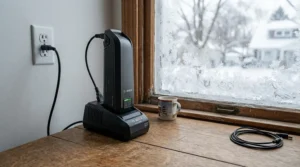
That long charge time sounds like a flaw, but in winter it’s convenient. You bring the battery inside, let it climb back above freezing, and let it charge overnight. The ritual practically writes itself. Folding means the whole bike can sleep indoors too, which spares the electronics repeated freeze-thaw cycles.
Reviews are sparse. Hiboy’s site shows only a handful, and the Canadian marketplace listing displays a seller-level rating of about 4.2 across 20 reviews, which says more about the seller than the bike. Treat sentiment as unproven.
Pros:
- ✅ UL 2849-certified battery stated on the listing
- ✅ Low-step frame and folding convenience
- ✅ Matching IPX4 splash rating
Cons:
- ❌ Very limited model-specific review data
- ❌ Seven-to-eight-hour charging suits overnight only
Expect roughly C$1,300–C$1,800 depending on seller and sale. Value verdict: fair, best if you specifically need the fold.
6. 5TH WHEEL W11B-W — 749 Wh pack in a budget folding shell
The 5TH WHEEL W11B-W is the budget battery champion on paper. It lists a 20″ fat-tire folding frame, a 500W motor, a 48V 15.6Ah removable battery (about 749 Wh), a 7-speed drivetrain and UL 2849 certification. That is more stored energy than the ANCHEER offers at roughly double the price, which counts for a lot when cold weather shrinks capacity.
Now the caution. 5TH WHEEL also sells models through Best Buy Canada marketed with 750W motors for “Canadian winter”. If a listing doesn’t state 500W nominal power, it isn’t a legal power-assisted bicycle on public roads. Confirm that the exact Canadian configuration matches the 500W figure above before ordering. Range claims published in miles describe ideal conditions, so shave generously for sub-zero air.
I couldn’t retrieve review data for this specific model, so no sentiment summary is possible. That absence is itself information: budget shoppers should expect a short feedback trail.
Pros:
- ✅ Large battery for the money
- ✅ UL 2849 listed on retail pages
- ✅ Folding frame saves indoor space
Cons:
- ❌ Review history unverified
- ❌ Brand also sells 750W models that aren’t road-legal here
Expect roughly C$1,000–C$1,500; confirm current price. Value verdict: promising if the paperwork checks out.
7. ANCHEER 500W Electric Mountain Bike — amazon.ca budget staple and a due-diligence lesson
The ANCHEER 500W Electric Mountain Bike is a prominent amazon.ca listing, but it’s the weakest winter fit here. It lists a 500W rated motor, a 48V 10.4Ah removable battery (499 Wh), 26″ standard-width wheels and UL 2849 compliance, with a claimed range of up to 50 miles. A September 2026 retailer audit placed ANCHEER listings on amazon.ca between about C$1,700 and C$2,100.
Here’s the analysis. A 499 Wh pack is the smallest in this lineup, so winter range will evaporate fastest, and standard-width tires mean you’d budget for winter or studded rubber to match the fat-tire picks. There’s also history: a U.S. regulator recalled about 22,000 ANCHEER e-bikes of one model number in 2022 over battery fire risk. The audit found that none of the currently listed model numbers matched the recalled one, but check your exact model yourself.
I couldn’t verify model-specific review sentiment, and the listings run through third-party seller accounts that had thin rating histories at audit time.
Pros:
- ✅ Widely listed on amazon.ca
- ✅ 500W rated motor inside the legal cap
- ✅ Removable battery for indoor charging
Cons:
- ❌ Smallest battery of the seven at 499 Wh
- ❌ Past battery recall on a different model number
Expect roughly C$1,700–C$2,100. Value verdict: poor next to the fat-tire options above.
✨ Ready to Pick Your Winter Ride?
🔍 Take your winter commute to the next level with these carefully selected e-bikes. Click on any highlighted item to check current pricing and availability. These picks will help you ride confidently through Canadian snow, slush and sub-zero mornings!
Motor Sealing Ratings: What the IP Code Really Promises
Motor sealing ratings sound dull until your hub motor meets its first February slush storm. The ingress protection system, defined by the IEC 60529 IP code standard, uses two digits: the first rates protection against solids such as dust (0–6), the second against water (0–9). An “X” means the maker simply didn’t claim a rating, which is not the same as no protection.
| Rating | What It Means | Winter Reality | Best For |
|---|---|---|---|
| IPX4 | Splashes from any direction | Slush spray from passing traffic | Plowed-road commuters, such as Hiboy EX6 and Hiboy EX6F owners |
| IPX5 | Low-pressure water jets | Heavy tire spray on wet days | Mixed-surface riders |
| IPX6 | Strong, high-pressure jets | Persistent wet-weather riding | Rain-and-slush climates |
| IP65 | Dust-tight, low-pressure jets | Fine road grit plus spray | Gravel-road winter riders |
| IPX7 | Temporary immersion | Spring meltwater crossings | Low, flooded paths |
Two cautions follow from that table. Ratings test clean water, not road-salt brine or repeated freeze-thaw cycles, and the stated rating often covers only the battery, not the whole motor. Several picks, including the EMMO Vegar Pro, state no IP rating at all, so ask. Prince Edward Island’s rules, for instance, also require electrical terminals to be fully covered, which is a regulatory nod to the same concern. In short, treat IPX4 as the sensible minimum, avoid pressure-washing hubs, and wipe salt off connectors.
Battery Insulation Covers: Helpful Layer or Overhyped Sock?
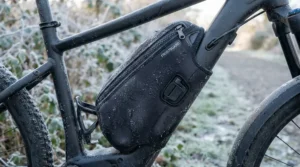
Battery insulation covers, usually neoprene sleeves, are the cheapest winter upgrade you can buy, and the honest verdict is “helpful, but not magical.” A cover slows heat loss. It doesn’t create heat. That distinction decides when it earns its place.
Canadian retailers such as Rize Bikes recommend neoprene battery covers for winter riding alongside the more important habit: keep the pack warm until you leave, and let it return to room temperature before charging. The logic is simple. A battery that starts a ride at 15°C and wears a cover stays warmer through a 30-minute commute than a bare one starting at 0°C. On very long rides at −15°C or colder, a cover buys you a modest range cushion.
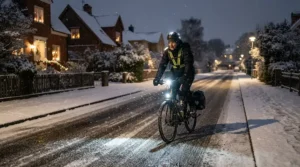
Watch for three pitfalls. Covers can trap moisture against the pack, so dry both after each ride. They must leave the key lock and charge port accessible. And fit varies by battery shape, since downtube, rack and frame-integrated packs all differ. I’d steer clear of improvised electric heating pads, because unapproved heat sources on a lithium pack are a gamble. A cover plus a warm-start routine beats gadgets. Sealed packs such as the gel-encased one on the EMMO Vegar Pro also make covers less critical, though not irrelevant.
Riding in Sub-Zero Temperatures: What to Expect on the Road
Riding in sub-zero temperatures changes the bike less than it changes you. Wind chill at 25 km/h is brutal on exposed hands, so lined gloves matter more than any motor spec. Also, check that thumb throttles and display buttons work while wearing them.
The battery will feel different. One battery maker’s guidance reports only moderate capacity loss between 0°C and −10°C, with roughly half the capacity gone near −30°C. Delivery-industry advice for Canadian riders warns that extreme cold can cut range by up to 50%. That means a bike rated for 55 km ideal-condition range might deliver far less. Plan commutes with a generous reserve, and ride in lower assist levels to stretch every watt-hour. Voltage “sag” under load also makes the display battery gauge jump, so trust distance travelled more than the bars.
Tires and traction change too. Air pressure falls as temperature does, so recheck pressure often. Many fat-bike riders run the lower end of the printed range on snow for grip. Brake early and gently, since stopping distances grow on packed snow. Finally, remember that discharging a lithium pack in the cold doesn’t harm it, but charging below freezing can. That’s why the warm-up-then-charge routine appears throughout this guide.
How to Choose the Best E-Bike for Canadian Winters Under $2500
To choose the best e-bike for Canadian winters under $2500, prioritize a legal 500W continuous motor, tires about 10 cm (4 inches) wide, a removable battery, hydraulic brakes, a stated IP rating and recognized safety certification. Then match battery size to your route length.
- Confirm the motor is legal. Look for 500W continuous and a 32 km/h assist cutoff. Peak wattage in a title isn’t the rating.
- Pick fat tires. Four-inch rubber floats over soft snow and tolerates lower pressure; narrow tires need winter studs to compete.
- Choose hydraulic brakes if possible. Sealed lines stay consistent in salt and cold, while cable systems demand more attention.
- Insist on a removable battery. Warming it indoors and charging above freezing protects both range and lifespan.
- Read the watt-hours, not the amp-hours. Compare packs in Wh, such as 749 Wh versus 499 Wh, because volts differ between bikes.
- Check certifications and the seller. Look for named standards such as UL 2849 and UL 2271, then confirm who handles warranty after day 30.
- Price the extras. Winter gloves, a battery cover and possibly studded tires should fit your budget too.
Features That Actually Matter in an E-Bike for Sub-Zero Temperatures (And Those That Don’t)
An e-bike for sub-zero temperatures lives or dies on a short list of features, and the marketing aisle is full of distractions. Here’s the filter.
What matters: torque-sensing assist for traction control, hydraulic brakes, battery capacity measured in watt-hours, removable packs, fenders and bright integrated lights for dark 4:30 p.m. commutes, and a stated sealing rating. Frame comfort counts too, because tense, shivering riders get fatigued quicker. A step-through frame such as the one on the Hiboy EX6 makes layered clothing far less of a hassle.
What doesn’t: peak wattage (the number provinces don’t use), top-speed boasts above 32 km/h (illegal assist speeds on roads), and fancy app features. One verified buyer of an EMMO model reported the companion app wasn’t available in Canada, a useful reminder to check regional support before paying for connectivity. Range claims in miles are also ideal-condition numbers, and cold air isn’t ideal.
Be skeptical about full-colour displays and GPS trackers when the budget is tight. Spend on tires, brakes and battery first. If money is left over, add a pair of lobster-style gloves. Seriously: your hands will complain before the motor does, and no spec sheet lists that.
Cold-Weather E-Bike vs Standard Commuter E-Bike
A cold-weather e-bike isn’t a different species from a standard commuter. It’s the same animal with better boots. Standard commuters trade traction for efficiency, which is lovely on dry pavement and sketchy on packed snow.
| Feature | Cold-Weather E-Bike | Standard Commuter E-Bike |
|---|---|---|
| Tires | About 10 cm (4″) fat tires, low pressure | Narrow tires, around 4–5 cm |
| Brakes | Hydraulic discs preferred | Often mechanical or rim brakes |
| Battery handling | Removable, warm-start routine | Often fixed or less considered |
| Sealing | Stated IP rating wanted | Often unspecified |
| Typical weight | Heavier, often 30–40 kg | Lighter, easier to carry |
| Best For | Snow, slush and frozen trails, as with the EMMO Vegar Pro and Samebike RS-A02 Pro | Cleared pavement in shoulder seasons |
Read that table honestly: fat tires cost you efficiency and weight, which is why standard commuters win on dry days. But if your route includes unplowed bike lanes or frozen multi-use paths, the extra rubber is stability you’ll use every ride. A fat-tire bike such as the Hiboy EX6 also tolerates a pothole with more dignity than a pencil-thin commuter tire.
Canadian Rules, Labels and Safety for Winter E-Biking
Winter doesn’t change the law, but it does change the stakes. Across provinces, power-assisted bicycles are generally capped at 500W with assistance ending at 32 km/h, and Quebec also expects a manufacturer’s compliance label. Provinces such as Prince Edward Island spell out further conditions in their power-assisted bicycle rules, including fully covered electrical terminals and a ban on modifications that raise power or speed.
Here’s the marketplace wrinkle. A Canadian retailer’s September 2026 audit of amazon.ca found that roughly nine in ten bike titles stating a wattage printed a number above 500W, and many of those were peak figures. Peak isn’t illegal in itself, but the nominal rating is what counts, so verify it on the motor plate or spec page before buying.
Helmet rules, minimum ages and pathway speed limits vary by province and municipality, so check yours. Some pathway authorities set limits far below 32 km/h. For safety, charge indoors on a non-flammable surface and never overnight unattended. Keep the charger matched to the bike, and treat any swollen or damaged battery as hazardous. A budget winter bike isn’t a bargain if it costs you your garage.
Long-Term Cost and Maintenance Through a Canadian Winter
The sticker price is only chapter one. Winter charges rent in other currencies: chain wear, brake pads, tires and battery health.
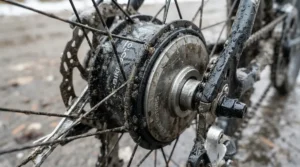
Road salt is a chain’s worst enemy. Wipe the drivetrain after wet or snowy rides and use a wet-weather lubricant, as Canadian delivery-industry maintenance guidance advises. Rinse salt from rims and connectors with a damp cloth rather than a pressure washer. Budget for brake pads sooner than you would in summer, particularly on mechanical-disc bikes such as the Samebike RS-A02 Pro.
The battery is the expensive component, so protect it. Store it indoors, avoid charging below freezing, and if the bike sits unused for two months or more, leave the pack around half charged and check it now and then. Replacement packs run into the hundreds of dollars, which dwarfs a cheap cover.
Think in cost per ride. If a C$1,500 bike replaces even a few parking fees or transit days a week across a four-month season, the arithmetic gets friendly quickly. If a C$2,500 bike like the EMMO Vegar Pro gets used year-round, the premium for torque sensing and a sturdier battery stops looking like a splurge. Warranty matters as well: on third-party amazon.ca sales, after the first 30 days you generally deal with the manufacturer, not Amazon.
Your First 30 Days: A Winter Setup Guide
The first month decides whether your bike becomes a habit or a garage ornament. Treat it as a structured trial, particularly since amazon.ca’s help pages describe a 30-day return window on third-party items.
Week one: inspect and baseline. Check every bolt, fenders, lights and brake feel. Confirm the motor’s continuous rating and certification wording match the listing. Set tire pressure and note it, then recheck weekly.
Week two: build the battery routine. Bring the battery indoors after each ride. Let it reach room temperature before plugging in, and charge it on a hard, clear surface. Pedego Canada’s winter-prep guide notes that riding below freezing doesn’t harm the battery, though you’ll notice less power and range. That fits what the chemistry suggests.
Week three: stress-test the brakes. On a quiet, cleared street, practise firm, early braking. Wipe salt off after every wet ride, and lube the chain.
Day 30: decide. Did the range survive your coldest commute? Did the brakes stay consistent? If anything felt wrong, start the return before the window closes. Common first-month mistakes include charging a cold battery straight from the bike, ignoring tire pressure and skipping the salt rinse.
Three Riders, Three Budgets: Winter Case Studies
Specs mean more when attached to a life. These are illustrative scenarios built from real specifications, not testimonials.
The condo commuter (6 km each way, tight storage). Her main constraint is space, so a folding fat-tire bike wins. A Samebike RS-A02 Pro (around C$1,500) or Hiboy EX6F gives a 700 Wh-class battery that comes inside every night. Because the bike lives in a hallway, the battery rarely spends hours in the cold. Her upgrade would be winter gloves, not a bigger motor.
The suburban parent (errands, packed-snow bike lanes). He needs stability and an easy mount while wearing a parka. The Hiboy EX6 (roughly C$1,100–C$1,600) offers a step-through frame and 4-inch tires at a gentle price. Spend the savings on a battery cover and fenders.
The rural rider (25 km each way, frozen gravel). She needs range margin. A larger pack, such as the 20Ah EMMO Vegar Pro (about 960 Wh) or the 25Ah EMMO E-Wild Pro (about 1,200 Wh), absorbs cold-weather capacity loss better. Even so, she’d plan around less than half the advertised range on the worst mornings and carry the charger.
Budget-wise, the lesson repeats: battery size and tire width buy winter confidence, not motor wattage.
Problem → Solution: Five Winter Headaches Fixed
Range collapses mid-ride. Cold shrinks usable capacity. Start with a warm battery, use lower assist, and favour larger packs such as those on the EMMO E-Wild Pro. Leave a margin of at least a third.
The battery won’t charge in the garage. Standard lithium packs shouldn’t be charged below 0°C, and many systems refuse. Bring the pack indoors and wait until it reaches room temperature.
Brakes feel mushy or slow. On cable-actuated systems, like the Samebike RS-A02 Pro, moisture and salt interfere. Clean and lubricate cables, and check pad wear sooner.
The rear wheel spins on ice. Reduce assist level, use a torque-sensing bike such as the EMMO Vegar Pro, lower tire pressure slightly and consider studded tires.
Salt is eating the drivetrain. Wipe the chain after wet rides, apply wet-weather lube and avoid pressure-washing hubs, whose ratings, like IPX4 on the Hiboy EX6, cover splashes rather than jets.
Most winter e-bike failures aren’t mysterious. They’re repeats of these five.

Frequently Asked Questions
❓ How much range does a cold-weather e-bike lose below 0°C?
❓ Is a 750W fat tire e-bike legal in Canada?
❓ Do I need studded tires on a fat tire e-bike in winter?
❓ Who handles warranty on an e-bike bought from a third-party seller on amazon.ca?
❓ Where should I store an e-bike battery during winter?
Conclusion
Winter e-biking rewards the prepared and punishes the optimistic. The strongest value in a cold-weather e-bike under $2500 CAD comes from four things: a legal 500W motor, fat tires, a removable battery of real size, and honest paperwork. By that standard, the EMMO Vegar Pro is the premium stretch, the EMMO E-Wild Pro is the big-battery contender to verify, the Samebike RS-A02 Pro and Hiboy EX6F suit folding needs, the Hiboy EX6 is the safest cheap start, and the 5TH WHEEL W11B-W is a battery-rich gamble worth checking carefully. The ANCHEER 500W Electric Mountain Bike is the one to approach with open eyes.
Before buying, confirm the nominal motor rating, the seller, the certification wording and the return window. Then build the habits that actually protect your range: warm battery, indoor charging, salt rinse, sensible tire pressure. Do that, and a Canadian January becomes just another commute with better scenery and worse wind.
Recommended for You
- Winter Outdoor Fat Tire Electric Bike: 7 Proven Picks 2026
- Studded Vs Non-Studded Fat Tire E-Bike: 7 Best Picks (2026)
- Fat Tire E-Bike For Snow: 7 Best Winter Picks In Canada (2026)
Disclaimer: This article contains affiliate links. As an Amazon Associate, I earn from qualifying purchases. If you purchase products through these links, we may earn a small commission at no additional cost to you.
✨ Found this helpful? Share it with your friends! 💬🤗
