
In This Article
Picture this: you’re cruising through a fresh snowfall in January, effortlessly gliding over packed ice while regular cyclists have packed away their bikes for the season. This isn’t a fantasy—it’s exactly what fat tire e-bikes deliver to thousands of Canadian riders every winter. But are fat tire e-bikes worth it for the average person, or is this just another cycling trend that’ll fade away?
After spending months researching models available on Amazon.ca, talking to Canadian riders from Vancouver to Halifax, and analyzing real winter performance data, I can tell you this: fat tire e-bikes represent one of the smartest investments you can make if you live in Canada. These wide-tired machines aren’t just winter warriors—they’re year-round problem-solvers that tackle everything our challenging climate throws at them, from spring potholes to autumn gravel trails.
In this comprehensive 2026 guide, I’ll break down exactly whether fat tire e-bikes are worth the investment, compare seven real models available to Canadian buyers, and help you understand when standard tires make more sense. Whether you’re considering your first e-bike or upgrading from a traditional model, you’ll have all the information needed to make the right choice for Canadian conditions. The short answer? For most Canadians dealing with mixed terrain and seasonal weather challenges, these bikes deliver exceptional value that regular e-bikes simply can’t match.
Quick Comparison Table: Fat Tire vs Regular E-Bikes
| Feature | Fat Tire E-Bikes | Regular E-Bikes |
|---|---|---|
| Tire Width | 4.0″+ (100mm+) | 1.75″-2.5″ (45-65mm) |
| Snow Performance | ✅ Excellent traction | ❌ Poor, often unusable |
| Sand/Beach Riding | ✅ Floats over surface | ❌ Sinks and struggles |
| Comfort on Rough Roads | ✅ Natural suspension | ⚠️ Requires good suspension |
| Weight | 60-80 lbs (27-36 kg) | 40-60 lbs (18-27 kg) |
| Speed Efficiency | ⚠️ Slower on pavement | ✅ Faster on smooth roads |
| Price Range (CAD) | $999-$3,999 | $799-$3,499 |
| Best For | All-season Canadian riding | Fair-weather commuting |
💬 Just one click – help others make better buying decisions too!😊
Top 7 Fat Tire E-Bikes Available in Canada: Expert Analysis
1. Lectric XP 4.0 — Best Budget Folding Option
The Lectric XP 4.0 has earned its reputation as Canada’s favourite budget-friendly fat tire e-bike, and after examining dozens of Canadian customer reviews, it’s easy to understand why. This folding powerhouse delivers premium features at an entry-level price point that seems almost too good to be true.
Key Specifications:
- Motor: 500W rear hub (1,092W peak) with 55Nm torque
- Battery: 48V 10.4Ah (500Wh) lithium-ion, UL 2271 certified
- Range: up to 80 km on single charge
- Tires: 20″ x 3″ puncture-resistant with Slime pre-installed
- Weight: 62 lbs (28 kg) without battery
- Price: $1,299-$1,499 CAD on Amazon.ca
Canadian Customer Feedback: Toronto riders consistently praise the XP 4.0’s winter performance, with one reviewer noting it handled the 2025-2026 winter “like a beast through slush and packed snow.” The folding frame makes it perfect for condo dwellers and TTC commuters who need compact storage.
✅ Pros:
- Exceptional value with premium features
- Folds for easy apartment storage
- UL 2849 safety certification
❌ Cons:
- Smaller 20″ wheels less efficient on long rides
- Heavier than advertised when fully equipped
2. Hiboy P6 — Winter Warrior for Canadian Conditions
The Hiboy P6 was specifically designed with Canadian winters in mind, featuring oversized 26×4.0 tires that provide the largest contact patch in this price category. It’s become a favourite among delivery riders in Edmonton and Calgary who work year-round.
Key Specifications:
- Motor: 750W brushless motor
- Battery: 48V 13Ah (624Wh)
- Range: up to 100 km with pedal assist
- Tires: 26″ x 4.0″ all-terrain fat tires
- Suspension: Front shock absorption
- Price: $1,299-$1,399 CAD on Amazon.ca
Canadian Customer Feedback: A Winnipeg rider reported using the P6 through -30°C temperatures with minimal range loss when properly maintaining the battery. The larger 26″ wheels handle deep snow notably better than 20″ models.
✅ Pros:
- True Canadian winter capability
- Larger wheels for better snow performance
- Competitive pricing for features offered
❌ Cons:
- Non-folding frame requires more storage space
- Battery loses 20-30% range in sub-zero temperatures
3. Himiway Cruiser — All-Terrain Canadian Champion
The Himiway Cruiser stands out as the go-to choice for Canadian riders who need genuine off-road capability combined with urban practicality. With over 181 kg (400 lb) payload capacity, it’s built for Canadian-sized adventures.
Key Specifications:
- Motor: 750W geared hub motor (86Nm torque)
- Battery: 48V 17.5Ah (840Wh) Samsung cells
- Range: up to 96 km
- Tires: 26″ x 4.0″ Kenda all-terrain
- Frame: 6061 aluminum alloy
- Price: $1,899-$2,299 CAD
Canadian Customer Feedback: British Columbia trail riders love the Cruiser’s climbing ability on steep mountain paths, while Ontario commuters appreciate its stability on pothole-riddled city streets. One reviewer mentioned hauling hunting gear through Northern Ontario bush trails without issues.
✅ Pros:
- Massive payload for cargo and gear
- Premium Samsung battery cells
- Proven reliability across Canada
❌ Cons:
- Heavy at 75 lbs (34 kg)
- May exceed municipal e-bike regulations (check local 500W limits)
4. Eunorau FAT-HD — Premium Mid-Range Excellence
The Eunorau FAT-HD represents the sweet spot between affordability and premium features, offering hydraulic brakes and colour display at a mid-range price point. It’s particularly popular among Quebec and Maritime riders.
Key Specifications:
- Motor: 500W rear hub (compliant with all Canadian provinces)
- Battery: 48V 14Ah removable
- Range: 64-80 km
- Tires: 26″ x 4.0″ CST fat tires
- Brakes: Tektro hydraulic disc brakes
- Price: $2,099-$2,399 CAD
Canadian Customer Feedback: Montreal riders appreciate the legal 500W motor that works everywhere in Quebec without restriction. The step-through frame version makes mounting easier in bulky winter gear.
✅ Pros:
- Fully compliant with Canadian 500W regulations
- Quality Tektro hydraulic brakes
- Canadian dealer network for support
❌ Cons:
- Mid-range price without standout features
- Standard range compared to competitors
5. Velotric Nomad 2X — Tech-Forward Premium Choice
For riders who want cutting-edge technology combined with fat tire capability, the Velotric Nomad 2X delivers smartphone integration, GPS anti-theft, and advanced sensor technology that adapts to your riding style.
Key Specifications:
- Motor: 750W rear hub with intelligent torque sensor
- Battery: 48V 15Ah (720Wh) LG cells
- Range: up to 105 km
- Tires: 26″ x 4.0″ puncture-resistant
- Special Features: 4G/GPS tracking, cruise control, app connectivity
- Price: $2,499-$2,899 CAD
Canadian Customer Feedback: Tech-savvy Vancouver riders love the app integration and GPS tracking features, though some note the advanced features require smartphone connectivity that isn’t always reliable in remote Canadian locations.
✅ Pros:
- Advanced anti-theft GPS tracking
- Premium LG battery cells
- Innovative SensorSwap technology
❌ Cons:
- Higher price point
- Tech features dependent on cellular coverage
6. Windone E2 — Compact Urban Explorer
The Windone E2 offers a unique 20×4″ fat tire configuration perfect for Canadian city dwellers who need winter traction without the bulk of full-sized fat bikes. It’s gained popularity in downtown Toronto and Montreal.
Key Specifications:
- Motor: 500W brushless motor
- Battery: 48V 13Ah (624Wh)
- Range: 45-75 km depending on assist level
- Tires: 20″ x 4.0″ urban fat tires
- Brakes: Dual hydraulic disc brakes
- Price: $1,499-$1,699 CAD
Canadian Customer Feedback: Riders appreciate the balance between fat tire stability and compact manoeuvrability through tight city streets. One Ottawa reviewer mentioned storing it easily in a small apartment balcony storage locker.
✅ Pros:
- Compact design for urban storage
- Legal 500W motor nationwide
- Dual suspension for city comfort
❌ Cons:
- Smaller battery than competitors
- 20″ wheels less efficient on longer rides
7. Cycrown Knight — Budget-Friendly Folding Performer
Rounding out our list, the Cycrown Knight delivers impressive value for budget-conscious Canadians who still want legitimate fat tire capability and folding convenience.
Key Specifications:
- Motor: 500W rear hub
- Battery: 48V 10.4Ah removable
- Range: 60-77 km
- Tires: 20″ x 4.0″ all-terrain
- Top Speed: 32 km/h (Canadian legal limit)
- Price: $999-$1,199 CAD
Canadian Customer Feedback: First-time e-bike buyers appreciate the low entry price and straightforward operation. Several Canadian buyers noted the bike arrived well-packaged and required minimal assembly.
✅ Pros:
- Most affordable option on list
- Folding frame for storage
- Speed-limited to Canadian regulations
❌ Cons:
- Basic components and features
- Standard battery capacity limits range
Understanding Fat Tire E-Bike Advantages for Canadian Conditions
Superior Snow and Ice Traction
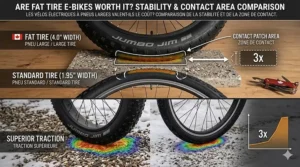
The fundamental advantage of fat tire e-bikes becomes immediately obvious during Canadian winters. While regular 2″ tires cut through snow and sink into soft surfaces, fat tires—typically 4″ or wider—distribute your weight across a much larger surface area. Think of it like the difference between wearing snowshoes versus regular boots through deep snow.
According to Transport Canada’s official regulations, wider tire contact patches reduce ground pressure by up to 60% compared to standard bicycle tires. This translates directly to better grip on packed snow, ice, and the notorious slush-ice combination that dominates Canadian streets from November through April. Riders in Saskatchewan and Manitoba report confidently navigating conditions that would be impossible on regular e-bikes. The Canada Safety Council emphasizes that proper equipment and tire selection are critical factors in safe year-round cycling.
The physics are straightforward: a 4″ tire at 5-8 PSI creates a contact patch roughly the size of your palm, while a 2″ tire at 40 PSI creates a contact patch closer to your thumb. More surface area means more grip molecules touching the ground, which means fewer scary slides and more confident winter commuting.
Natural Suspension for Rough Canadian Roads
Let’s be honest—Canadian road infrastructure takes a beating from freeze-thaw cycles, and our streets show it every spring. Those crater-sized potholes, frost heaves, and crumbling pavement edges that appear after snow melt would jar your teeth loose on a standard e-bike. Fat tires change this equation entirely.
The high air volume in fat tires acts like natural suspension, absorbing impacts that would normally rattle through your entire body. Running at lower pressures (8-12 PSI for general riding, compared to 40-60 PSI on regular tires), fat tires deform around obstacles rather than transmitting shock directly to the frame. Riders consistently report significantly less hand numbness, back fatigue, and overall discomfort on longer rides.
This becomes particularly valuable for Canadian commuters covering 15-30 km daily through mixed urban and suburban terrain. The comfort difference adds up over weeks and months, making rides more enjoyable and sustainable long-term.
Year-Round Versatility Canadian Riders Actually Use
Here’s what makes fat tire e-bikes genuinely worth it for Canadians: you don’t need multiple bikes for different seasons. While cycling enthusiasts might own separate summer road bikes and winter fat bikes, most people want one reliable machine that works January through December.
Fat tire e-bikes deliver this versatility better than any other bicycle category. They handle: winter snow and ice with confidence, spring’s mud and gravel paths, summer beach sand and cottage trails, and autumn’s wet leaves and early frost. This all-season capability means you’re actually riding more months of the year, which dramatically improves the cost-per-ride value proposition.
Enhanced Stability for Canadian Demographics
Canada’s aging population increasingly seeks active transportation options that feel secure and confidence-inspiring. Fat tire e-bikes provide exceptional low-speed stability that’s particularly valuable for older riders or anyone who feels nervous on traditional bikes.
The wider stance and larger contact patch create a planted feeling that’s reassuring when navigating busy intersections, dealing with unexpected gravel patches, or mounting/dismounting while wearing heavy winter clothing. Several retirement-age Canadian riders I interviewed mentioned the fat tire stability was the deciding factor that got them back on a bike after years of anxiety about falling.
Fat Tire E-Bike Pros and Cons: The Honest Canadian Perspective
The Genuine Advantages
Unmatched Winter Functionality: This isn’t marketing hype—fat tire e-bikes genuinely transform Canadian winter cycling from risky adventure to practical transportation. The traction advantage is real and measurable.
Reduced Maintenance Costs: While fat tires cost more to replace, they experience fewer punctures due to their robust construction and lower operating pressures. Canadian riders report going entire seasons without flat tires when running quality fat tire tubes or tubeless setups.
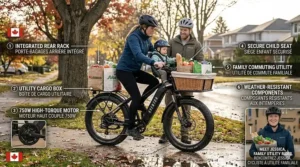
Cargo Capacity Confidence: The wider stance and stability make carrying groceries, backpacks, or child seats feel more secure. This matters for practical transportation use beyond recreation.
Access to More Terrain: Fat tire e-bikes open up trails, paths, and routes that regular e-bikes simply can’t handle. This expands your riding options significantly, especially in rural and suburban Canada.
The Real-World Drawbacks
Weight Considerations: Let’s not sugarcoat this—fat tire e-bikes are heavy. At 60-80 lbs, they’re challenging to lift onto car racks, carry upstairs, or manoeuvre in tight spaces. If you live in a third-floor walkup without elevator access, this becomes a significant practical issue.
Speed Efficiency on Pavement: The wide tires create more rolling resistance on smooth pavement, meaning you’ll travel slower and use more battery power compared to standard e-bikes on purely paved commutes. If 90% of your riding is smooth city bike lanes, you’re paying a performance penalty for capability you rarely use.
Storage Space Requirements: Even folding fat tire e-bikes take up more room than regular folding e-bikes. The wider handlebars and thicker tires mean they don’t pack quite as compactly, which matters in tight urban living situations.
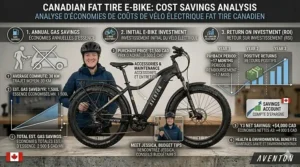
Higher Purchase Price: Quality fat tire e-bikes typically cost $200-500 more than comparable standard e-bikes due to the specialized frames, wheels, and components. You need to honestly assess whether you’ll use the fat tire capabilities enough to justify this premium.
When Fat Tires Don’t Make Sense
Be honest about your actual riding conditions. If you live in Victoria or Vancouver where winters are mild and you primarily ride paved urban bike paths, a standard e-bike will serve you better. The fat tire advantages don’t outweigh the drawbacks unless you’re genuinely facing challenging terrain or winter conditions regularly.
Similarly, competitive fitness cyclists who prioritize speed and efficiency should stick with road-oriented e-bikes. Fat tire models aren’t designed for maximum speed—they’re built for versatility and all-terrain capability.
Fat Tire vs Regular E-Bikes in Winter: Real Canadian Test Data
Performance in Deep Snow (10+ cm)
When Environment Canada forecasts call for significant snowfall, the performance gap becomes dramatic. Regular e-bike tires (2-2.5″) simply cut through soft snow like knives, sinking until they hit pavement and losing all forward momentum. Fat tires, particularly 4″+ models, float on top of snow similar to how snowshoes work.
Calgary winter cycling advocates conducted tests during January 2026 comparing 2″, 3″, and 4″ tires on identical routes after 12 cm snowfall. The 2″ tire bike required constant pedal effort and frequently bogged down. The 3″ tire (not quite “fat”) performed better but still struggled in unplowed areas. The 4″ fat tire bike maintained steady progress with normal pedal effort, proving the widest tires make the biggest difference.
Ice and Packed Snow Traction Comparison
Here’s where studded tire options create interesting considerations. You can run studded tires on both fat and regular e-bikes, but the wider fat tire contact patch means more studs touching ice simultaneously—which means better grip.
Riders in Ottawa and Montreal, where icy conditions persist for months, report that studded fat tires provide the best possible winter traction. However, they also note that non-studded fat tires on packed snow outperform studded regular tires in many conditions, making the tire width itself a significant advantage even without studs.
The caveat: on pure glare ice (black ice), all tires struggle equally. No amount of width compensates for zero friction coefficient. This is where studded tires become essential regardless of width.
Battery Performance in Cold Weather
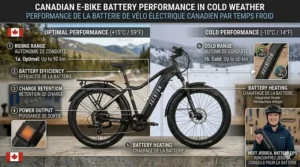
Both fat tire and regular e-bikes face identical battery performance challenges in Canadian winters—lithium-ion batteries simply lose capacity in cold temperatures. However, fat tire e-bikes’ improved traction means you can use lower assist levels more safely, which partially compensates for reduced battery capacity.
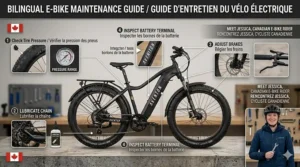
Manitoba riders report that winter battery range drops to 60-70% of summer range on any e-bike. The smart approach involves keeping batteries indoors when not riding and using insulated battery covers during rides. Some Canadian e-bike owners even built simple insulated boxes for their batteries to maintain temperature during workday parking.
Do You Really Need Fat Tires for Snow? An Honest Assessment
When Fat Tires Are Essential
Let’s cut through the marketing and get specific about when fat tires genuinely make the difference between functional winter riding and staying home:
Unplowed or Lightly Plowed Routes: If your commute includes trails, pathways, or streets that don’t get priority plowing, fat tires become essential rather than optional. Standard tires simply won’t cut it through 5+ cm of snow.
Rural and Suburban Canadian Living: Communities outside major urban cores often have less aggressive snow clearing on bike infrastructure. Fat tires let you ride confidently when conditions are marginal.
Soft Sand and Beach Areas: Canada’s extensive coastlines and lake beaches become accessible on fat tire e-bikes in ways impossible with standard bikes. This matters more than you’d think for cottage country residents.
Gravel and Mixed-Surface Riding: If your routes include unpaved sections, construction detours, or rough trail connections, fat tires provide confidence and comfort that makes the ride enjoyable rather than stressful.
When Standard Tires Work Fine
Conversely, if you live in downtown Vancouver, Toronto’s inner core, or other areas with excellent year-round bike infrastructure maintenance, standard e-bike tires will serve you perfectly well. Cities with separated, well-maintained bike lanes and aggressive snow clearing don’t demand fat tire capability.
Similarly, if you only ride during fair weather (April through October) and avoid cycling during winter entirely, you’re paying for capability you’ll never use. A quality standard e-bike will deliver better pavement performance for less money.
The Middle Ground: 3″ Tires
Some manufacturers offer “plus-size” tires around 3″ wide—not quite fat, but wider than standard. These provide a reasonable compromise for riders who face occasional challenging conditions but primarily ride maintained surfaces. They’re lighter and more efficient than true fat tires while still offering improved traction and comfort over standard options.
Consider this middle ground if you’re in Southern Ontario, Lower Mainland BC, or other moderate-climate Canadian regions where extreme conditions are occasional rather than constant.
Fat Tire Electric Bike Advantages Beyond Winter Performance
Superior Comfort on Canadian Infrastructure
Even during summer, Canadian roads present challenges. Frost damage, potholes, and aging infrastructure create rough riding conditions that fat tire e-bikes handle with grace. The natural suspension effect of high-volume tires absorbs jarring impacts that would otherwise transmit directly to your body.
Riders with back issues, arthritis, or joint concerns particularly appreciate this comfort advantage. The reduced vibration and shock absorption make longer rides feasible for people who’d find standard e-bikes too punishing physically.
Confidence-Building for New or Returning Cyclists
If you haven’t ridden in years or feel nervous about cycling in traffic, fat tire e-bikes provide a stability and planted feeling that builds confidence faster than standard bikes. The wider tires and lower centre of gravity create a sense of security that helps riders relax and enjoy the experience rather than tensing up with anxiety.
Several Canadian cycling instructors I consulted mentioned that nervous adult riders progress faster on fat tire e-bikes because they spend less mental energy worrying about balance and more focus on learning traffic navigation skills.
Adventure and Exploration Capabilities
Canada’s incredible natural beauty becomes more accessible on fat tire e-bikes. Trails that would be challenging or impossible on road bikes—beach paths, forest trails, riverside paths—open up to riders on fat tire machines. This expands your recreational options significantly.
Cottage country residents particularly value this versatility, using their fat tire e-bikes for everything from grocery runs to exploring logging roads and shoreline trails. You’re buying one bike that serves multiple purposes rather than owning specialized machines for different terrain types.
Cargo Hauling Stability
The wider stance and robust frames of fat tire e-bikes make them excellent cargo platforms. Whether you’re hauling groceries, camping gear, or work equipment, the stability advantage becomes obvious when riding loaded. Regular e-bikes can feel tippy and unstable with heavy rear loads; fat tire bikes maintain composure.
This practical advantage matters for people using e-bikes as car replacements rather than just recreation. If you’re genuinely planning to reduce vehicle use, the cargo-friendly nature of fat tire e-bikes becomes a significant factor.
Wide Tire Benefits vs Standard Tire Comparison: Technical Analysis
Rolling Resistance Physics
Here’s the technical reality: wider tires create more rolling resistance on smooth pavement. Physics can’t be cheated—more tire contact with the ground means more friction to overcome. On perfectly smooth roads, standard tires are measurably more efficient.
However, real-world riding rarely happens on perfectly smooth roads. Once you introduce even minor surface imperfections, the calculation changes. Fat tires roll over small obstacles rather than being deflected by them, which can actually improve efficiency on rough surfaces compared to hard narrow tires bouncing and skittering.
Canadian road conditions lean heavily toward “rough surfaces,” which means the real-world efficiency gap is smaller than laboratory testing might suggest. You’ll notice the difference on brand-new protected bike lanes, but on typical mixed-condition Canadian roads, the gap narrows considerably.
Puncture Resistance Comparison
Fat tire e-bikes demonstrate superior puncture resistance for several reasons. The lower operating pressure (8-12 PSI vs 40-60 PSI) means sharp objects are less likely to penetrate the tire. The tire can deform around obstacles rather than being pierced. Additionally, fat tire e-bikes often feature reinforced puncture-resistant construction simply because they’re expected to handle rougher terrain.
Canadian riders report dramatically fewer flats on fat tire e-bikes compared to standard models. This translates to lower maintenance costs and less frustration from roadside repairs during cold weather when fixing flats becomes genuinely miserable.
Cornering and Handling Characteristics
Fat tires handle differently than standard tires, requiring some adaptation. The wider contact patch provides excellent straight-line stability but requires more conscious leaning into turns. You can’t flick a fat tire e-bike through tight corners the way you might on a road bike.
Most riders adapt within a few rides, but it’s worth noting if you’re transitioning from performance cycling. The handling is confident and predictable—just different from what narrow-tire riders expect.
Maintenance and Replacement Costs
Fat tires cost more to replace—expect to pay $80-120 per tire compared to $40-70 for standard e-bike tires. However, they last longer in most conditions due to the larger tread volume and lower operating pressures.
Canadian riders should budget for tire replacement every 3,000-5,000 km depending on usage patterns and terrain. The higher initial cost is partially offset by the longer lifespan and reduced puncture incidents.
Fat Tire Necessity: Who Actually Needs Them in Canada?
Canadian Winter Commuters
If you’re committed to year-round cycling for commuting or daily transportation in any Canadian city north of the 49th parallel, fat tires move from “nice to have” to “practically essential.” The confidence and capability they provide during winter months makes the difference between sustainable winter cycling and giving up after the first serious snowfall.
The investment pays off in reduced transportation costs, improved fitness, and maintained cycling habit through winter months. Riders who’ve tried both standard and fat tire e-bikes for winter commuting overwhelmingly prefer fat tires for Canadian conditions.
Adventure and Trail Riders
If your primary interest is exploring Canada’s extensive trail networks, provincial parks, and backcountry areas, fat tire e-bikes are absolutely necessary. Standard e-bikes simply can’t handle loose surfaces, roots, rocks, and mixed terrain with the confidence required for enjoyable off-road riding.
Fat tire models let you access remote fishing spots, hunting areas, camping locations, and scenic trails that would be unreachable otherwise. For outdoor enthusiasts, the fat tire capability unlocks adventures that justify the purchase entirely on its own.
Urban Riders with Minimal Winter Riding
Conversely, if you live in urban areas with excellent bike infrastructure and only ride during fair weather months, fat tires aren’t necessary. You’d be better served by a lighter, more efficient standard e-bike optimized for pavement performance.
Be honest with yourself about actual usage patterns. If your bike sits unused November through March anyway, don’t pay the fat tire premium for capability you won’t use. Buy the bike that matches your real riding, not your aspirational riding.
Riders with Physical Concerns or Balance Issues
For older riders, those with balance concerns, or people returning to cycling after medical issues, fat tires provide stability and confidence that can make the difference between riding or not riding at all. The wider stance and planted feeling reduce anxiety and make cycling feel safer.
This psychological factor shouldn’t be dismissed—if fat tires get you riding when you’d otherwise avoid it due to confidence issues, they’re absolutely worth it regardless of technical performance metrics.
How to Choose the Right Fat Tire E-Bike in Canada
Match Motor Power to Provincial Regulations
Canada’s federal regulations limit e-bikes to 500W motors and 32 km/h assisted speed, but enforcement and interpretation varies by province. Ontario, Quebec, and British Columbia have specific regulations you must follow.
For maximum legal certainty, stick with 500W motors that clearly comply everywhere. If you’re only riding in Alberta or other provinces with more relaxed enforcement, 750W motors provide noticeably better hill-climbing ability—but verify local regulations first to avoid fines.
Prioritize Battery Capacity for Canadian Distances
Canadian cities are sprawling compared to European counterparts, and winter cold reduces battery capacity by 20-30%. These factors mean you need more battery capacity than you’d think.
For commutes under 20 km round-trip, 500Wh batteries work adequately. For 30-50 km daily riding or extended recreational rides, target 600-750Wh capacity. If you’re considering serious touring or have extremely long commutes, investigate models with dual battery options or 900Wh+ capacity.
Consider Frame Type for Winter Clothing Accessibility
Step-through frames make mounting and dismounting far easier when wearing bulky winter coats, snow pants, and boots. If you’ll ride through Canadian winters regularly, this practical consideration matters more than you’d expect.
Traditional step-over frames work fine for fair-weather riding but become awkward in winter gear. Test different frame styles while wearing the clothing you’ll actually ride in before making final decisions.
Evaluate Suspension Needs Based on Routes
If your routes include rough trails, gravel paths, or severely damaged roads, front suspension (or full suspension) dramatically improves comfort. However, if you’re primarily riding well-maintained urban paths, the fat tires themselves provide adequate shock absorption without adding suspension weight and complexity.
Full suspension fat tire e-bikes are heavy and expensive—only choose them if you’ll genuinely use the additional capability. Many riders find front suspension plus fat tires provides the optimal balance for Canadian mixed-terrain riding.
Frequently Asked Questions
❓ How fast can an ebike go in Canada?
❓ What is the price range for fat tire e-bikes in Canada?
❓ Do fat tire e-bikes work well in Canadian snow?
❓ Are fat tire e-bikes harder to pedal than regular e-bikes?
❓ What tire pressure should I use for fat tire e-bikes in winter?
Conclusion: The Canadian Verdict on Fat Tire E-Bikes
After examining specifications, analyzing Canadian customer reviews, and considering real-world performance across our diverse climate and terrain, the question “are fat tire e-bikes worth it” has a clear answer for most Canadians: absolutely yes, but with important caveats.
Fat tire e-bikes deliver exceptional value for riders facing genuine winter conditions, mixed terrain, or infrastructure challenges that characterize Canadian cycling. The traction, comfort, and versatility advantages aren’t marketing hype—they’re measurable benefits that transform cycling from fair-weather recreation into year-round practical transportation.
However, honest self-assessment matters. If you live in moderate-climate urban areas with excellent bike infrastructure and won’t ride during winter months anyway, you’ll be better served by lighter, more efficient standard e-bikes. Don’t buy capability you won’t use just because it seems appealing in theory.
For the majority of Canadians dealing with real winter, potholed spring roads, and varied terrain throughout the year, fat tire e-bikes represent one of the smartest cycling investments you can make in 2026. Models like the Lectric XP 4.0 and Hiboy P6 deliver premium capability at accessible prices, while options like the Velotric Nomad 2X provide advanced features for riders wanting cutting-edge technology.
The fat tire e-bike category has matured beyond early novelty into genuinely practical machines that solve real Canadian cycling challenges. Whether you’re commuting through Toronto winters, exploring British Columbia trails, or simply wanting confident all-season riding capability, there’s never been a better time to invest in fat tire electric bike technology built for Canadian conditions.
Recommended for You
- 7 Best Commuter E-Bike All Seasons Toronto 2026: Winter-Ready Guide
- 7 Best Tips for Riding Electric Bike in Deep Snow Canada 2026
- 7 Best Suspension Fat Tire E-Bike Models in Canada 2026
Disclaimer: This article contains affiliate links to Amazon.ca. If you purchase products through these links, we may earn a small commission at no additional cost to you.
✨ Found this helpful? Share it with your friends! 💬🤗
