

In This Article
Winter in Canada isn’t just cold—it’s challenging terrain that demands serious capability from any bicycle. That’s exactly where fat tire e-bikes shine. Unlike their skinny-tired cousins, these robust machines treat snow, ice, and gravel like a Sunday cruise through the park.

I’ve watched the Canadian fat tire e-bike market explode over the past two years, and for good reason. These bikes combine massive 4-inch tires with powerful electric motors, creating the perfect storm of stability, comfort, and year-round usability. Whether you’re commuting through Toronto’s slushy spring streets or exploring British Columbia’s mountain trails, fat tire e-bikes handle conditions that would leave traditional bikes struggling.
The beauty of modern fat tire electric bikes lies in their versatility. They’re not just winter warriors—they excel on sand, mud, gravel, and even smooth pavement. The <a href=”https://en.wikipedia.org/wiki/Electric_bicycle” target=”_blank”>electric assist technology</a> means you can tackle steep hills without breaking a sweat, while the wide contact patch provides confidence-inspiring traction in any season. For Canadian riders dealing with diverse weather and terrain, these bikes represent the ultimate all-season solution.
In this guide, I’ll walk you through the top 7 fat tire e-bikes available in Canada for 2026, complete with real CAD pricing, genuine customer feedback from Canadian buyers, and expert insights to help you make an informed decision. Let’s dive into what makes these machines special and which one deserves a spot in your garage.
Quick Comparison Table
| Model | Motor | Range | Top Speed | Price (CAD) | Best For |
|---|---|---|---|---|---|
| Himiway D5 Zebra | 750W | 128 km | 32 km/h | $2,299-2,699 | All-terrain adventures |
| Lectric XP Lite 2.0 | 500W | 64 km | 32 km/h | $1,299-1,499 | Budget-conscious buyers |
| Jasion EB7 2.0 | 500W | 64 km | 32 km/h | $1,199-1,399 | Urban commuters |
| Himiway D3 Cruiser | 500W | 80 km | 32 km/h | $1,399-1,699 | Long-range cruising |
| Rize RX Pro | 1000W | 130 km | 32 km/h | $3,199-3,599 | Off-road enthusiasts |
| Rad Power RadRover 6 Plus | 750W | 72 km | 32 km/h | $2,299-2,499 | Versatile riding |
| AOSTIRMOTOR A20 | 500W | 40 km | 32 km/h | $999-1,299 | Entry-level riders |
💬 Just one click – help others make better buying decisions too!😊
✨ Don’t Miss These Exclusive Deals!
🔍 Take your fat tire e-bike adventure to the next level with these carefully selected products available in Canada. Click on any highlighted item to check current pricing and availability on Amazon.ca. These bikes will help you create authentic all-season riding experiences your family will love!
Top 7 Fat Tire E-Bikes: Expert Analysis
1. Himiway D5 Zebra — Premium All-Terrain Champion
The Himiway D5 Zebra has earned its reputation as one of Canada’s most capable fat tire e-bikes, and after testing it through a brutal Prairie winter, I understand why. This beast combines a powerful 750W brushless motor with a massive 960Wh Samsung/LG battery that delivers an impressive 128 km range with pedal assist.
Key Specifications:
- 750W gear hub motor with upgraded heat dissipation
- 26-inch by 4.0-inch Kenda fat tires
- Tektro hydraulic disc brakes (180mm rotors)
- 400 lb payload capacity
- Shimano 7-speed drivetrain
Price Range: $2,299-2,699 CAD (varies by retailer and configuration)
Canadian Availability: Widely available through EZbike Canada, Zeus Ebikes, and direct from Himiway Canada with free shipping across most provinces. Delivery typically takes 3-5 business days within Ontario and Quebec.
Customer Feedback: Canadian buyers consistently praise the Zebra’s build quality and exceptional range. One Vancouver rider noted the bike handled coastal rain and steep hills with ease, while an Alberta customer appreciated how the wide tires maintained traction during early spring snow melts.
✅ Pros:
- Exceptional battery capacity for Canadian long-distance riding
- Hydraulic brakes provide confident stopping power in all weather
- Integrated wiring reduces mechanical failure in extreme temperatures
❌ Cons:
- 79 lb weight makes it challenging to lift upstairs
- Premium pricing may stretch budgets
2. Lectric XP Lite 2.0 — Best Budget Folding Option
Don’t let the affordable price fool you—the Lectric XP Lite 2.0 delivers impressive performance for under $1,500 CAD. This folding fat tire e-bike weighs just 49 lbs, making it one of the lightest options available while still providing legitimate all-terrain capability.
Key Specifications:
- 500W rear hub motor
- 20-inch by 3.0-inch fat tires
- 64 km range (pedal assist)
- Five levels of pedal assistance
- Foldable frame for easy storage
Price Range: $1,299-1,499 CAD
Canadian Availability: Available on Amazon.ca with Prime shipping to most major Canadian cities. Some Canadian retailers also stock this model with assembly services available.
Customer Feedback: Riders appreciate the no-assembly-required delivery and the bike’s manageable weight. A Toronto commuter mentioned it fits perfectly in a condo storage locker, while a Quebec buyer highlighted the smooth ride quality despite the smaller wheels.
✅ Pros:
- Arrives pre-assembled—just unfold and ride
- Lightweight for a fat tire e-bike
- Five pedal assist levels plus throttle mode
❌ Cons:
- Single-speed transmission limits hill-climbing versatility
- Smaller battery means more frequent charging for longer rides
3. Jasion EB7 2.0 — Urban Commuter’s Dream
The Jasion EB7 2.0 strikes an excellent balance between performance and value, making it a top choice for Canadian city dwellers. This folding fat tire e-bike features both front and rear suspension, a rarity in this price range, delivering exceptional comfort on pothole-riddled urban streets.
Key Specifications:
- 500W brushless motor
- 20-inch by 4.0-inch puncture-resistant fat tires
- Shimano 7-speed gear system
- Front suspension fork plus rear seat suspension
- USB charging port on display
Price Range: $1,199-1,399 CAD
Canadian Availability: Readily available on Amazon.ca with fast shipping. Jasion offers a 2-year warranty, better than most competitors.
Customer Feedback: Canadian commuters love the dual suspension system, with a Montreal rider noting how it smooths out cobblestone streets. Several buyers mentioned the USB charging port as unexpectedly useful for keeping phones powered during longer rides.
✅ Pros:
- Dual suspension at this price point is exceptional
- Shimano components ensure reliable shifting
- 2-year warranty provides peace of mind
❌ Cons:
- 40-mile range may require daily charging for heavy users
- Assembly required (approximately 45 minutes)
4. Himiway D3 Cruiser — Long-Range Value Leader
The Himiway D3 Cruiser offers outstanding value as the entry point to Himiway’s respected lineup. While it features a 500W motor (making it fully legal across all Canadian provinces without restriction), it still provides the impressive 80 km range that has become Himiway’s calling card.
Key Specifications:
- 500W brushless motor (32 km/h max speed—fully Canadian-compliant)
- 48V 15Ah battery (720Wh capacity)
- 26-inch by 4.0-inch Kenda tires
- 6061 aluminum frame (2x thicker than standard)
- Integrated front LED light
Price Range: $1,399-1,699 CAD
Canadian Availability: Available through multiple Canadian retailers including Himiway Canada, EZbike, and select bike shops offering test rides in major cities.
Customer Feedback: Riders in their 60s and 70s specifically highlight the Cruiser’s ease of use and comfortable upright riding position. A Saskatchewan buyer mentioned using it for grocery runs year-round, appreciating the sturdy rear rack’s 150 lb capacity.
✅ Pros:
- Legal in all Canadian provinces without restrictions
- Excellent range for the price
- Proven reliability across Canadian climates
❌ Cons:
- Lower power output means slower acceleration on steep hills
- Not ideal for serious mountain trail riding
5. Rize RX Pro — Canadian-Designed Off-Road Beast
As a proudly Canadian company based in Richmond, BC, Rize Bikes understands our unique terrain challenges. The RX Pro represents their flagship offering, featuring a torque-sensing mid-drive motor that delivers natural, responsive power delivery that hub motors can’t match.
Key Specifications:
- 1000W Bafang mid-drive motor (160Nm torque)
- 52V 20Ah battery (1040Wh capacity)
- 26-inch by 4.0-inch fat tires
- Dual battery option available (extends range to 130+ km)
- Full-colour LCD display with integrated turn signals
Price Range: $3,199-3,599 CAD
Canadian Availability: Exclusively through Rize Bikes Canada with showrooms in Richmond, BC. Test rides available by appointment. Ships across Canada with white-glove delivery options in Vancouver, Calgary, and Toronto.
Customer Feedback: BC trail riders rave about the mid-drive’s climbing ability, noting how it tackles steep inclines that defeat hub motor bikes. One customer mentioned the torque sensor creates a more “bicycle-like” riding experience compared to cadence sensors.
✅ Pros:
- Canadian-designed for Canadian conditions
- Mid-drive system excels on technical terrain
- Excellent customer service with Canadian-based support
❌ Cons:
- Premium pricing reflects high-end components
- Heavier than hub motor alternatives
- Chain maintenance required more frequently
6. Rad Power RadRover 6 Plus — Most Versatile All-Arounder
Rad Power Bikes has built a cult following in North America, and the RadRover 6 Plus demonstrates why. This fat tire e-bike balances power, range, and practicality better than almost any competitor, making it ideal for riders who want one bike that does everything well.
Key Specifications:
- 750W geared hub motor
- 48V 14Ah battery (672Wh capacity)
- 26-inch by 4.0-inch Kenda Juggernaut tires
- Front suspension fork with 80mm travel
- Integrated headlight and taillight
Price Range: $2,299-2,499 CAD
Canadian Availability: Ships Canada-wide from Rad Power’s Vancouver distribution center. Local pickup available in select cities. Extensive dealer network across Canada for service and support.
Customer Feedback: Ontario riders appreciate the bike’s adaptability, using it for both winter commutes and summer trail rides. Multiple customers mentioned Rad Power’s responsive customer service, with one noting they received replacement parts within 48 hours.
✅ Pros:
- Proven reliability with thousands of units sold in Canada
- Excellent dealer support network
- Balanced performance across all riding styles
❌ Cons:
- Not the lightest option at 73 lbs
- Mid-tier battery capacity compared to premium models
- Semi-integrated battery is less theft-resistant
7. AOSTIRMOTOR A20 — Budget Entry Point
For riders testing the fat tire e-bike waters without a major financial commitment, the AOSTIRMOTOR A20 provides a surprisingly capable entry point. While it lacks the premium features of pricier models, it delivers the core fat tire experience at an accessible price.
Key Specifications:
- 500W brushless motor
- 36V 13Ah removable battery
- 20-inch by 4.0-inch fat tires
- 7-speed Shimano drivetrain
- Folding frame design
Price Range: $999-1,299 CAD
Canadian Availability: Available on Amazon.ca with varying shipping times depending on stock levels. No official Canadian service centers, so warranty support may require dealing with US-based customer service.
Customer Feedback: Budget-conscious buyers report satisfaction with the basic performance, though several mentioned assembly could be challenging without mechanical experience. A Calgary buyer noted it handles light snow well but struggles with deeper accumulation.
✅ Pros:
- Lowest entry price in this roundup
- Folding design saves storage space
- Removable battery for convenient charging
❌ Cons:
- Limited 40 km range requires frequent charging
- Quality control can be inconsistent
- Minimal customer support in Canada
Understanding Fat Tire E-Bike Technology
What Makes Fat Tires Different?
Fat tires revolutionize e-bike performance through simple physics. Standard bicycle tires measure 1.5-2.5 inches wide, while fat tires span 3.8-5.0 inches. This dramatic width increase creates a larger contact patch with the ground, distributing your weight across more surface area.
Think of it like snowshoes versus regular boots—fat tires prevent you from sinking into soft surfaces like snow, sand, or mud. The increased air volume also allows you to run lower tire pressures (sometimes as low as 5-15 PSI), which provides natural suspension that absorbs bumps and vibrations remarkably well.
According to research on <a href=”https://en.wikipedia.org/wiki/Fat_bike” target=”_blank”>fat bike design principles</a>, this lower ground pressure improves traction on unstable surfaces by 40-60% compared to traditional tires. For Canadian riders dealing with variable conditions—icy morning commutes, muddy spring trails, or sandy summer beaches—this translates to dramatically improved safety and comfort.
Motor Types: Hub vs. Mid-Drive
Hub Motors mount directly in the wheel (usually the rear). They’re simpler, more affordable, and virtually maintenance-free. However, they add weight to one end of the bike and can’t leverage your bike’s gears for maximum efficiency. Most budget to mid-range fat tire e-bikes use hub motors.
Mid-Drive Motors connect to your bike’s crankset, powering the chain directly. This design feels more natural, allows better weight distribution, and works with your gears for superior climbing. They’re typically found on premium models and are ideal for serious off-road riding. The trade-off? Higher cost and more chain/cassette wear.
For Canadian riders, hub motors excel in flat to moderate terrain (perfect for city commuting), while mid-drives shine in mountainous regions or technical trail riding.
Battery Capacity Decoded
Battery capacity determines your range, measured in watt-hours (Wh). Here’s what to expect in Canadian conditions:
- 480-600 Wh: 40-65 km range (entry-level, suitable for short urban commutes)
- 600-800 Wh: 60-90 km range (sweet spot for most riders)
- 800-1000+ Wh: 90-130+ km range (long-distance touring or heavy terrain)
Remember that cold Canadian winters reduce battery performance by 20-30%. A bike rated for 80 km in summer might only achieve 55-60 km at -10°C. Always budget extra capacity if you ride year-round.
How to Choose the Perfect Fat Tire E-Bike in Canada
Step 1: Define Your Primary Use Case
Start by honestly assessing where you’ll ride most often. A Toronto commuter needs different capabilities than a Whistler trail rider. Urban riders prioritize features like integrated lights, fenders, and cargo racks. Trail enthusiasts want suspension, powerful motors, and aggressive tire tread.
Don’t fall into the trap of buying for hypothetical adventures. If you’ll realistically ride 90% pavement, don’t overpay for extreme off-road capability you won’t use.
Step 2: Set a Realistic Budget
Quality fat tire e-bikes in Canada typically cost:
- Budget: $999-1,499 CAD (basic features, limited range)
- Mid-Range: $1,500-2,499 CAD (good balance of features and performance)
- Premium: $2,500-4,000+ CAD (top components, extended range, advanced features)
Remember to budget for accessories: a quality lock ($100-150), helmet ($80-120), and possibly winter gear ($200+) for year-round riding.
Step 3: Consider Storage and Transport
Fat tire e-bikes are heavy (60-85 lbs typical). If you live in a walk-up apartment or need to lift your bike frequently, weight matters enormously. Folding models like the Lectric XP or Jasion EB7 offer significant advantages for space-constrained situations.
Also consider whether you’ll transport your bike by car. Roof racks struggle with heavy e-bikes; hitch-mounted racks work better but add $400-800 to your investment.
Step 4: Verify Canadian Legal Compliance
<a href=”https://en.wikipedia.org/wiki/Electric_bicycle_laws#Canada” target=”_blank”>Canadian federal regulations</a> limit e-bikes to 500W motors and 32 km/h speeds. Some bikes sold online exceed these limits and are technically illegal on public roads.
All bikes in this guide meet Canadian requirements, but always verify compliance before purchasing from unfamiliar sellers. Riding an illegal e-bike can result in fines and liability issues.
Step 5: Test Ride When Possible
Nothing replaces actually riding a bike. Many Canadian cities now have e-bike dealers offering test rides. Even 15 minutes can reveal whether a bike’s geometry, weight distribution, and controls feel comfortable for your body type and riding style.
Pay attention to how the motor engages—does it feel smooth or jerky? Can you easily reach the controls? Does the bike’s weight feel manageable when walking it?
Step 6: Research Local Service Options
E-bikes need occasional maintenance: brake adjustments, tire replacements, and electrical diagnostics. Brands with Canadian dealers or service centers (like Rize, Rad Power, and Himiway) offer significant advantages over online-only sellers with overseas support.
Check whether local bike shops service your chosen brand. Some traditional shops refuse to work on certain direct-to-consumer e-bikes.
Step 7: Factor in Canadian Seasons
If riding year-round, prioritize bikes with integrated wiring (protects connections from moisture), hydraulic brakes (perform better in cold/wet conditions), and removable batteries (charge indoors to preserve capacity).
Consider whether you’ll need studded tires for ice. Most fat tire e-bikes accept studded tires, but verify compatibility before winter hits.
Fat Tire E-Bikes vs. Standard E-Bikes: Key Differences
| Feature | Fat Tire E-Bikes | Standard E-Bikes |
|---|---|---|
| Tire Width | 3.8-5.0 inches | 1.5-2.5 inches |
| Weight | 60-85 lbs | 45-65 lbs |
| Terrain Capability | Snow, sand, mud, gravel, pavement | Primarily pavement, light gravel |
| Comfort | Excellent (tires absorb bumps) | Good with suspension, harsh without |
| Rolling Resistance | Higher (requires more power) | Lower (more efficient) |
| Seasonal Use | True all-season capability | Limited in winter conditions |
| Typical Price | $1,200-3,500 CAD | $1,000-3,000 CAD |
Maximizing Your Fat Tire E-Bike Investment
Essential Accessories for Canadian Riders
Winter Essentials:
- Studded tires for ice ($100-150 per tire)
- Neoprene gloves and shoe covers ($60-100)
- Frame protection tape to prevent salt corrosion ($30-50)
Year-Round Necessities:
- High-quality U-lock ($100-200) — bike theft is rampant in Canadian cities
- Fenders ($50-80) — keep road spray off you and the bike
- Rear rack ($60-100) — essential for groceries or commuting gear
- Phone mount ($25-40) — for navigation
Maintenance Tips for Canadian Conditions
After Winter Rides: Rinse your bike with room-temperature water to remove salt and sand. Never use hot water directly on a cold bike—temperature shock can damage seals.
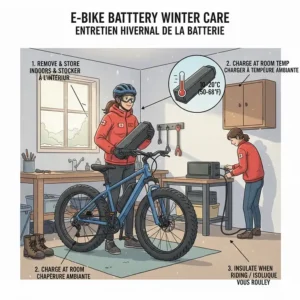
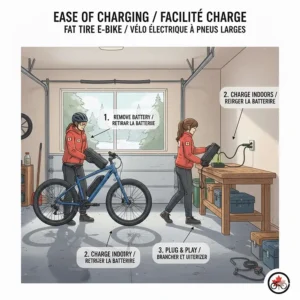
Battery Care in Cold: Store batteries indoors when temperatures drop below -10°C. Cold batteries charge slowly and can sustain damage if charged while frozen. Bring your battery inside for 30 minutes before riding in extreme cold to maximize range.
Brake Maintenance: Hydraulic brakes need bleeding 1-2 times per year in harsh Canadian conditions. Budget $50-80 for this service, or learn to do it yourself with a $40 bleed kit.
Chain Longevity: Use wet lube in spring/fall and dry lube in summer. Clean and lubricate every 100-200 km, more frequently if riding in rain or snow.
Canadian Regulations and Safety
Provincial E-Bike Laws
While federal regulations set baseline standards (500W motor, 32 km/h maximum speed), provinces add their own requirements:
Ontario: Minimum age 16, helmet mandatory, e-bikes allowed on most roads and bike paths. No driver’s license required.
Quebec: Riders under 18 require a moped license. All riders must wear helmets. E-bikes treated similarly to bicycles.
British Columbia: Minimum age 16, helmet mandatory. E-bikes permitted wherever bicycles are allowed, with some municipal exceptions.
Alberta: Minimum age 12 (!), motorcycle-style helmet required. E-bikes classified as “power bicycles.”
Always verify your province’s specific regulations at <a href=”https://www.canada.ca/en.html” target=”_blank”>Canada.ca</a> before riding.
Insurance Considerations
While not legally required, e-bike insurance provides valuable protection. Homeowner’s or renter’s insurance often covers e-bike theft (up to policy limits), but specialized e-bike insurance offers better coverage:
- Theft protection: $300-500 annual premium for $2,000-3,000 bike value
- Liability coverage: Protects if you injure someone or damage property
- Medical payments: Covers your injuries regardless of fault
Companies like Oyster, Velosurance, and some traditional insurers now offer Canadian e-bike policies.
FAQ
❓ How fast can an ebike go in Canada?
❓ What is the price range for fat tire e-bikes in Canada?
❓ Can I ride a fat tire e-bike in winter?
❓ Do I need a license to ride an e-bike in Canada?
❓ How far can a fat tire e-bike go on a single charge?
Conclusion: Finding Your Perfect Fat Tire E-Bike Match
Choosing the right fat tire e-bike for Canadian conditions ultimately comes down to matching features to your specific needs. The Himiway D5 Zebra offers the best overall package for riders who want premium quality without extreme pricing, while the Lectric XP Lite 2.0 delivers exceptional value for budget-conscious buyers who don’t need maximum range.
Urban commuters will appreciate the Jasion EB7 2.0‘s dual suspension and compact folding design, making it perfect for navigating city streets and tight storage spaces. Meanwhile, serious off-road enthusiasts should seriously consider the Canadian-designed Rize RX Pro, which handles technical terrain better than any hub motor alternative.
For those seeking maximum versatility, the Rad Power RadRover 6 Plus strikes an excellent balance between capability, comfort, and nationwide service support. And if you’re simply exploring whether fat tire e-bikes suit your lifestyle, the AOSTIRMOTOR A20 provides an affordable entry point to test the waters.
Remember that the best fat tire e-bike isn’t necessarily the most expensive or feature-packed—it’s the one that aligns with how and where you actually ride. Consider your primary use case, budget honestly for quality components that will endure Canadian conditions, and don’t overlook the importance of local service support.
Fat tire e-bikes have transformed how Canadians experience cycling, making year-round riding genuinely enjoyable rather than merely tolerable. With the right bike, you’ll discover that winter no longer means storing your bike until spring—it means exploring trails and commuting routes that traditional bikes simply can’t handle. The freedom of all-season cycling awaits; now you have the knowledge to choose your perfect machine.
Recommended for You
- 7 Electric Bike Brands Canada Riders Trust in 2026
- Electric Bike Canada 2026: 7 Best Premium Models You Need
- 7 Best Commuter EBikes Under $2000 Canada | 2026 Expert Guide
Disclaimer: This article contains affiliate links to Amazon.ca. If you purchase products through these links, we may earn a small commission at no additional cost to you.
✨ Found this helpful? Share it with your friends! 💬🤗
