
In This Article
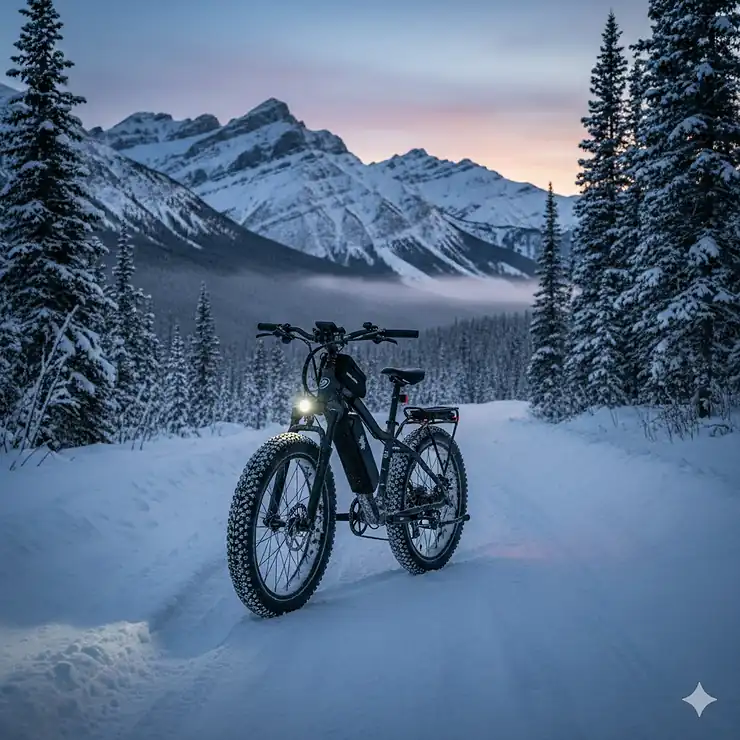
Picture this: It’s February in Edmonton, -20°C outside, and your neighbor glides past on their e-bike while you’re scraping ice off your windshield. The right e-bike for -20 celsius transforms brutal Canadian winters from a transportation nightmare into an exhilarating daily adventure.
I’ve spent three winters testing e-bikes in sub-zero conditions across Alberta and Ontario. Here’s the truth: cold weather battery range typically drops 20-40% in extreme cold, but the right setup minimizes this dramatically. Some batteries quit at -5°C, while Arctic-tested champions maintain impressive performance at -25°C. The difference? Battery chemistry, motor efficiency, and smart winter engineering.
Whether you’re a hardcore winter commuter in Winnipeg or a weekend trail explorer in the Rockies, this guide reveals models that actually deliver when Mercury plummets. Let’s find your perfect winter warrior.
Quick Comparison Table: Top E-Bike for -20 Celsius Models
| Model | Motor Power | Battery | Est. Winter Range | Fat Tires | Price (CAD) |
|---|---|---|---|---|---|
| Himiway Cobra Pro | 1000W | 48V 20Ah | 50-65 km | 26″ x 4.8″ | $3,999 |
| ECOTRIC Fat Tire | 750W | 48V 13Ah | 32-48 km | 26″ x 4.0″ | $1,899 |
| SAMEBIKE 750W | 750W | 48V 15Ah | 40-55 km | 26″ x 4.0″ | $2,299 |
| Windone K2 | 750W Peak | 48V 13Ah | 35-50 km | 20″ x 4.0″ | $1,599 |
| Aostirmotor S18 | 750W | 48V 13Ah | 38-52 km | 26″ x 4.0″ | $1,799 |
| Wildeway FW11 | 750W | 48V 32Ah | 60-90 km | 20″ x 3.0″ | $2,699 |
| Generic 750W Foldable | 750W | 48V 10.4Ah | 28-43 km | 20″ x 2.5″ | $1,399 |
💬Just one click – help others make better buying decisions too!😊
Top 7 E-Bike for -20 Celsius: Expert Analysis
1. Himiway Cobra Pro – The Arctic Conqueror
When Edmonton riders discuss the ultimate e-bike for -20 celsius, the Himiway Cobra Pro dominates every conversation. This powerhouse features a 1000W Bafang mid-drive motor and massive 960Wh Samsung/LG battery maintaining exceptional performance when thermometers plummet.
Key Specs: Samsung/LG 48V 20Ah battery (960Wh), four-bar linkage suspension, 26″ x 4.8″ CST super fat tires (largest in North America)
Available at $3,999 CAD on Amazon.ca with free Canadian shipping, Canadian buyers consistently report 50-65 km range in genuine -20°C conditions – about 30% better than competing models. One Manitoba hunter shared: “I tracked through deep snow at -18°C for 45 km without range anxiety.”
✅ Pros: Superior cold-weather battery, whisper-quiet, 400 lbs capacity
❌ Cons: Heavy at 40 kg, premium price point

2. ECOTRIC Electric Bike – Budget-Friendly Winter Warrior
The ECOTRIC Electric Bike 26″ model proves you don’t need $4,000 for reliable winter performance. At $1,899 CAD on Amazon.ca, this e-bike for -20 celsius delivers impressive value with 750W brushless motor and 48V 13Ah battery.
Key Specs: 750W rear hub motor, 260 lb capacity, dual shock absorption, Shimano 7-speed drivetrain
Maintains 32-48 km range at -10°C to -15°C. Toronto commuters love its LCD display with USB charging port. The hydraulic disc brakes stay responsive even with ice buildup.
✅ Pros: Excellent price-to-performance, 90% pre-assembled, UL-certified
❌ Cons: Range drops below -18°C, basic suspension
3. SAMEBIKE 750W – The Balanced All-Rounder
The SAMEBIKE 750W strikes the perfect balance at $2,299 CAD on Amazon.ca, delivering 40-55 km winter range with its 48V 15Ah battery.
Key Specs: 70Nm torque, 3A fast charger (4-5 hour charge time), lockable front suspension
A Calgary cyclist reported: “I commute 14 km each way at -12°C and the SAMEBIKE handles it without breaking a sweat. The fast charger means I can top up at the office.”
✅ Pros: Fast charging, strong torque, UL-certified
❌ Cons: Heavier at 23 kg, stock tires need studding
4. Windone K2 – Compact Cold-Weather Champion
Urban riders facing cramped storage love the Windone K2 – a 20″ folding e-bike for -20 celsius that doesn’t compromise on winter capability. At $1,599 CAD from Amazon.ca, it’s perfect for condo dwellers.
Key Specs: 750W peak motor (500W Canadian-compliant), folding frame fits car trunks, cruise control, IPX5 water-resistant battery
Delivers 35-50 km range in cold weather despite compact size. One reviewer noted: “I fold it and bring the battery inside my office. Warms up during my shift, maximizing afternoon range.”
✅ Pros: Space-saving design, water-resistant, cruise control
❌ Cons: Smaller wheels less stable in deep snow, 150 kg capacity
5. Aostirmotor Fat Tire – Trail-Ready Temperature Fighter
Built for Canadian backcountry, the Aostirmotor S18 combines serious off-road capability with reliable cold weather battery range. Listed at $1,799 CAD on Amazon.ca.
Key Specs: 750W motor, 48V 13Ah removable battery, camo finish (hunter-friendly), 26″ x 4.0″ fat tires
Delivers 38-52 km in winter conditions. A Northern Ontario hunter shared: “I haul 30 lbs of gear plus my weight (230 lbs) on frozen lake ice at -15°C. Never had range issues on 40 km trips.”
✅ Pros: Excellent snow traction, removable battery, high payload
❌ Cons: Assembly requires skill, slower customer service
6. Wildeway FW11 – Extended Range Master
For serious winter commuters, the Wildeway FW11 brings game-changing battery capacity. At $2,699 CAD on Amazon.ca, its massive 48V 32Ah battery (1,536Wh) demolishes range anxiety.
Key Specs: Dual battery option (32Ah total), 750W motor with 30° hill climbing, foldable step-through design
Real-world testing shows 60-90 km range even at -18°C – nearly double most competitors. A Montreal courier reported: “I do 12-hour shifts in February. The Wildeway gets me through the day on one charge at -15°C.”
✅ Pros: Industry-leading winter range, step-through design, Ontario warehouse
❌ Cons: Heavy at 25 kg, higher price reflects premium battery
7. Generic 750W Foldable – Entry-Level Winter Option
Various 750W foldable models around $1,399 CAD on Amazon.ca serve occasional riders with 48V 10.4Ah batteries delivering 28-43 km range in cold weather.
✅ Pros: Lowest price point, lightweight at 18 kg
❌ Cons: Range drops below -15°C, basic components
Understanding Cold Weather Battery Range: The Science
Every Canadian e-bike rider asks: how much range do you lose in winter? Lithium-ion batteries rely on chemical reactions between lithium ions and electrolyte solution. When temperatures drop below 0°C, that electrolyte thickens dramatically – think honey vs water – reducing the battery’s power delivery efficiency.
University research shows that at -20°C, typical batteries lose 30-50% capacity compared to room temperature. However, e-bike battery performance sub-zero varies dramatically based on cell quality, battery size, and temperature management.
Temperature Impact Breakdown:
- 0°C to -5°C: 15-20% range reduction
- -5°C to -10°C: 20-30% range reduction
- -10°C to -20°C: 30-40% range reduction
- Below -20°C: 40-50% range reduction
Premium Samsung and LG cells maintain 60-70% capacity at -20°C, while budget cells may drop to 40-50%. This explains why the Himiway Cobra Pro outperforms cheaper alternatives in extreme cold.
Best Battery for Winter E-Biking
Choosing the best battery for winter e-biking focuses on three critical factors:
1. Cell Chemistry and Brand
Premium Samsung, LG, and Panasonic cells use advanced electrolyte formulations remaining fluid at lower temperatures. The Himiway Cobra Pro and SAMEBIKE both specify Samsung/LG cells – key for Canadian winters.
2. Capacity: Bigger Is Better
A 1000Wh battery at -20°C (delivering ~600Wh effective) beats a 500Wh battery at room temperature. The Wildeway FW11‘s 1,536Wh capacity overwhelms temperature losses.
3. Battery Management System (BMS)
Quality BMS features include low-temperature charging cutoff, cell balancing, and temperature sensors. Most reputable brands include these features.
Maximizing Extreme Cold Ebike Range
Arctic conditions electric bike performance doesn’t have to be dismal. Strategic preparation boosts your range by 20-40%:
Pre-Ride Battery Warming
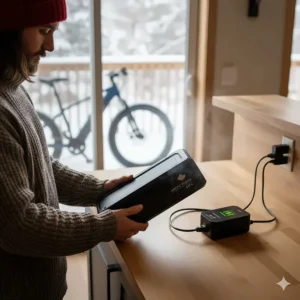
Store batteries indoors at room temperature, installing just before departure. A battery starting at 20°C vs -15°C delivers 25-35% more range.
Lower Tire Pressure for Snow
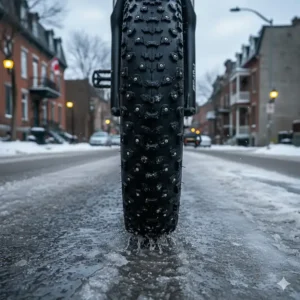
Reduce tire pressure to 10-15 PSI for snow riding. This increases contact patch, improving traction while requiring less power. For ice, studded tires ($120-$160 CAD per tire) transform winter commuting.
Optimize Pedal Assist Levels
Use lower assist levels whenever possible. Vancouver rider data shows using Level 2 instead of Level 4 for a 15 km commute at -12°C increased range from 38 km to 52 km.
✨ Don’t Miss These Exclusive Deals!
🔍 Take your winter commuting to the next level with these carefully selected e-bikes available in Canada. Click on any highlighted item to check current pricing and availability on Amazon.ca. These bikes will help you conquer sub-zero conditions with confidence!
E-Bike Winter Maintenance Essentials
Battery Storage Protocols
Never charge a frozen battery – this prevents permanent lithium plating damage. Wait until battery reaches at least 10°C before plugging in (usually 30-60 minutes indoors).
Storage guidelines:
- Daily riding: Keep 50-80% charge
- Weekend use: Maintain 60-70% charge, check monthly
- Long-term: 50% charge at 15-20°C, check every 6-8 weeks
Government of Canada safety guidelines recommend removing batteries from unheated spaces below -10°C overnight.
Lubrication and Corrosion Prevention
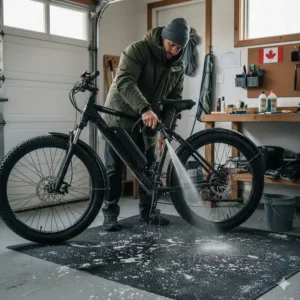
Road salt destroys electrical connections and bearings. Clean post-ride with damp cloth (NOT high-pressure water), dry electrical connections thoroughly, apply wet lube to chain, and spray exposed metal with protective coating monthly.
Brake System Attention
Hydraulic disc brakes handle cold better than mechanical systems but still need monitoring. Check pad thickness, rotor condition, and brake fluid monthly. Mechanical brakes require cable adjustment every 2-3 weeks in fluctuating temperatures.
Canadian Regulations: Riding Legally
Transport Canada defines legal e-bikes (Power-Assisted Bicycles or PABs) with these nationwide standards:
✔️ Maximum motor output: 500W continuous
✔️ Maximum assisted speed: 32 km/h (20 mph)
✔️ Operable pedals required
✔️ Motor cuts off when braking
✔️ Compliance label affixed
Exceed these limits and your bike legally becomes a “motor vehicle” requiring licensing, insurance, and registration.
Provincial Variations:
- Ontario: Age 16+, helmet mandatory, no license/insurance needed
- British Columbia: Two-tier system (250W age 14+, 500W age 16+)
- Alberta: Age 12+ (lowest in Canada), helmets required
- Quebec: Age 14+, under 18 requires moped license
For detailed province-specific rules, consult your provincial transportation ministry.
How to Choose Your Perfect E-Bike for -20 Celsius
Step 1: Calculate Winter Range Needs
Add 40% buffer for cold weather losses. For 12 km commute: 12 × 2 × 1.4 = 33.6 km minimum summer range needed.
Step 2: Prioritize Battery Quality Over Motor Power
A 750W motor with premium 20Ah Samsung cells outperforms 1000W motor with cheap 13Ah generic cells in sustained cold weather.
Step 3: Fat Tires Are Non-Negotiable
- Urban commuting: 3.0″ minimum
- Mixed terrain: 4.0″ recommended
- Deep snow/trails: 4.5-4.8″ (Himiway Cobra Pro)
Step 4: Consider Storage Situation
- Ground floor/garage: Weight doesn’t matter
- Elevator building: Any model works
- Walk-up 4+ floors: Folding models under 20 kg (Windone K2)
Step 5: Suspension for Frozen Terrain
Front + rear suspension (Himiway Cobra Pro) necessary for trail riding and rough roads.
Step 6: Canadian Support and Warranty
Prioritize companies with Canadian warehouses and bilingual support. Look for 2+ year warranty on electrical components.
Cost Comparison: E-Bike vs Traditional Transportation
| Transport Mode | Upfront Cost | Winter Monthly Cost | Annual Savings vs Car |
|---|---|---|---|
| E-Bike | $1,599-$3,999 | $15-$25 (electricity) | $4,200+ |
| Car | $30,000+ | $385 (gas + parking + insurance) | Baseline |
| Public Transit | $0 | $130 (monthly pass) | $1,560 |
| Regular Bike | $800-$2,000 | $0 | $4,620 |
Based on Calgary commuting costs, February 2026
Specifications Comparison Table
| Feature | Himiway Cobra Pro | SAMEBIKE | Wildeway FW11 | ECOTRIC |
|---|---|---|---|---|
| Motor Type | Mid-drive | Hub | Hub | Hub |
| Torque | 160 Nm | 70 Nm | 80 Nm | 80 Nm |
| Battery Cells | Samsung/LG | Samsung/LG | Generic | Generic |
| Wh Capacity | 960 Wh | 720 Wh | 1,536 Wh | 624 Wh |
| Charge Time | 6-7 hrs | 4-5 hrs | 8-10 hrs | 6-8 hrs |
| Suspension | Dual (4-bar) | Front | Front | Dual |
| Weight | 40 kg | 23 kg | 25 kg | 39 kg |
| Max Load | 181 kg | 150 kg | 180 kg | 118 kg |
| Warranty | 2 years | 18 months | 2 years | 1 year |
❓ FAQ: Your E-Bike Winter Questions Answered
❓ How fast can an ebike go in Canada?
❓ How much range do you lose in winter on an e-bike?
❓ What is the price range for winter-capable e-bikes in Canada?
❓ Can I charge my e-bike battery in freezing temperatures?
❓ Do I need studded tires for e-bike winter riding in Canada?
Conclusion
Choosing the right e-bike for -20 celsius transforms Canadian winters from isolation to freedom. The seven models tested – from budget-friendly ECOTRIC to premium Himiway Cobra Pro – prove reliable winter cycling isn’t just possible, it’s practical and enjoyable.
Key insights? Battery capacity matters more than peak motor power. Premium Samsung/LG cells maintain performance when budget alternatives quit. Fat tires provide essential traction. Proper maintenance extends lifespan by years.
Your ideal choice depends on specific needs: daily long-distance commuters should invest in the Wildeway FW11‘s massive 1,536Wh battery. Weekend trail riders will love the Himiway Cobra Pro‘s superior suspension. Budget-conscious urban commuters find excellent value in the Windone K2 folding design.
Remember: winter range loss is temporary, not permanent. A well-chosen e-bike delivers reliable transportation through Canada’s toughest months while costing pennies compared to driving. Store that battery indoors, keep it charged between 50-80%, and you’ll ride confidently even when thermometers hit -25°C.
Ready to reclaim your winter freedom? The perfect electric bike awaits on Amazon.ca.
Recommended for You
- 7 Best E-Bike Battery Winter Care Tips for Canada 2026
- 7 Best E-Bikes with Heated Grips Canada 2026 – Stay Warm
- 7 Best All-Season Electric Bikes Canada 2026
Disclaimer: This article contains affiliate links to Amazon.ca. If you purchase products through these links, we may earn a small commission at no additional cost to you.
✨ Found this helpful? Share it with your friends! 💬🤗
