
In This Article
Planning a cross-country ebike adventure across Canada requires more than just enthusiasm — you need a solid cross canada ebike battery strategy that accounts for vast distances, limited charging infrastructure, and unpredictable weather. Unlike cycling through urban Europe where charging stations appear every 50 kilometres, Canadian touring presents unique challenges that can leave unprepared riders stranded in remote stretches between Thunder Bay and Kenora, or along the Trans-Canada Highway through the Prairies.
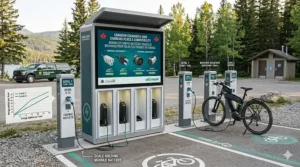
The reality hits hard when you realise Canada’s public charging infrastructure focuses almost exclusively on electric vehicles, not ebikes. Natural Resources Canada reports over 9,400 EV charging stations nationwide, but precisely zero are designed for ebike batteries. What most Canadian tourers overlook is that your bike’s standard 500Wh battery delivers roughly 60-80 km in ideal conditions — yet cold Prairie mornings at -5°C can slash that range by 30-40%, leaving you with barely 40 km before you’re pedalling a 27 kg dead weight. This is where touring ebike charging infrastructure planning becomes critical, not optional.
A comprehensive battery management long distance touring strategy combines three elements: backup battery touring capacity, portable power solutions for off-grid charging, and strategic route planning around accommodation with electrical outlets. In my experience guiding bikepacking trips across British Columbia and Alberta, riders who invest in a second battery plus a portable power station complete their journeys with confidence, whilst those relying solely on their stock battery spend evenings frantically searching for sympathetic café owners willing to let them plug in for three hours.
Quick Comparison Table: Top Ebike Touring Power Solutions
| Solution Type | Capacity (Wh) | Weight | Best For | Price Range CAD |
|---|---|---|---|---|
| Spare Ebike Battery | 500-750 | 2.5-3.5 kg | Pure range extension | $400-$900 |
| Portable Power Station (Small) | 256-518 | 3-8 kg | Camping + ebike charging | $300-$600 |
| Portable Power Station (Medium) | 1000-1500 | 10-15 kg | Multi-day off-grid touring | $800-$1,400 |
| Solar Panel Kit | 100-200W | 2-4 kg | Extended wilderness trips | $250-$500 |
| Dual Battery System | 1000-1500 | 5-7 kg | Maximum range without external gear | $800-$1,800 |
Looking at this comparison, riders tackling the Cabot Trail or Icefields Parkway gain the most flexibility from a mid-range portable power station (500-1000Wh) paired with solar capability. This setup delivers 1-2 full ebike charges whilst powering your phone, GPS, and camp lights — something a spare battery alone cannot achieve. Budget-conscious tourers covering shorter daily distances (under 100 km) find better value in a quality second battery, whilst those planning week-long remote adventures through Yukon or northern Ontario justify the extra weight of a 1000Wh+ power station combined with 100W solar panels.
The critical insight most blogs miss: carrying a 1500Wh power station sounds impressive until you’re hauling 15 kg up a 12% grade outside Jasper. Weight-to-utility ratio matters enormously in Canadian touring where elevation changes of 500+ metres in a day are common along routes like the Sea-to-Sky Highway or Crowsnest Pass.
💬 Just one click — help others make better buying decisions too! 😊
Top 7 Ebike Touring Power Solutions: Expert Analysis
1. Jackery Explorer 500 Portable Power Station
The Jackery Explorer 500 has become the touring standard among Canadian bikepacking communities for good reason — its 518Wh capacity sits in the sweet spot for ebike charging whilst remaining portable enough for panniers or a rear rack bag. This unit delivers one full charge for most 48V ebike batteries (assuming typical 500-600Wh capacity), with enough leftover capacity to keep your electronics powered through a weekend camping trip.
What distinguishes this model for touring ebike charging infrastructure needs is the pure sine wave AC outlet rated at 500W continuous output — adequate for virtually any ebike charger you’ll encounter. The 110V AC output means you use your standard wall charger, eliminating compatibility headaches and maintaining your battery’s health through proper charging protocols. In real-world Canadian conditions, expect to fully recharge a depleted 500Wh ebike battery in 4-5 hours, matching the performance of plugging into a campground outlet.
The unit weighs 6 kg, which sounds manageable until you’re cycling the fourth consecutive day with fully loaded panniers. I’ve found the ideal setup involves mounting this in a waterproof bag on your rear rack, keeping the weight centred low for better handling. Canadian winter performance deserves mention — lithium batteries hate cold, and the Explorer 500 loses roughly 20% capacity when temperatures drop below 5°C, a common occurrence during shoulder season touring through Alberta or Saskatchewan.
Customer feedback from Canadian buyers emphasises reliability over thousands of charging cycles, though several note the built-in flashlight feels gimmicky when you’re already carrying proper bike lights. The solar charging capability (compatible with Jackery’s 100W panel) makes this future-proof for riders who eventually add solar charging touring ebike capability.
Pros:
✅ Perfect capacity for 1 full ebike charge
✅ True sine wave output protects battery health
✅ Compatible with solar panels for extended trips
Cons:
❌ 6 kg adds significant touring weight
❌ Cold weather reduces capacity 15-20%
Price hovers around $550-$650 CAD on Amazon.ca — steep but justified for serious touring. This represents the best value in the 500Wh class for riders planning multi-day trips without daily accommodation access.
2. Jackery Explorer 1000 V2 Portable Power Station
For riders tackling truly remote Canadian touring — think Dempster Highway to Inuvik or the Great Divide Mountain Bike Route through the Rockies — the Jackery Explorer 1000 V2 delivers 1,070Wh capacity in a surprisingly compact package. This is your solution when “running out of power” could mean genuine trouble, not just inconvenience.
The 1,070Wh capacity translates to two complete ebike charges with margin for your camp stove, laptop, and camera gear. The V2 model’s 1,500W AC output handles even high-wattage fast chargers (uncommon in ebikes but found on some high-end models), and the 100W USB-C PD port can directly charge smaller electronics without needing the AC inverter, improving overall efficiency by 10-15%. What serious Canadian tourers appreciate most is the LiFePO4 battery chemistry — this stuff handles cold significantly better than standard lithium-ion, maintaining 80% capacity down to -10°C whilst conventional batteries might deliver barely 60%.
The 1-hour fast charging capability matters enormously when you’re grabbing breakfast at a roadside diner in rural Manitoba and want maximum charge before hitting another 120 km stretch. Through the Jackery app, you can enable “emergency super charging” that pushes 0-80% in 67 minutes — handy when weather forces shorter stops. This model weighs 10.8 kg, making it borderline for traditional panniers. Most experienced Canadian tourers either mount it on a cargo trailer or use a BOB-style single-wheel trailer specifically for this gear.
Canadian buyers report exceptional customer service from Jackery’s Canadian operation, with warranty claims processed through Richmond, BC — no shipping batteries internationally for repairs. The 5-year warranty provides peace of mind for a $1,100-$1,300 CAD investment. Several Yukon and Northwest Territories riders mention this unit survived rough gravel roads and river crossings that destroyed cheaper alternatives.
Pros:
✅ Two full charges for extended remote touring
✅ LiFePO4 chemistry handles Canadian cold better
✅ 1-hour fast charge when outlets are available
Cons:
❌ 10.8 kg necessitates trailer for most riders
❌ Premium pricing limits accessibility
In the $1,100-$1,300 CAD range, this targets serious adventurers planning trips measured in weeks, not weekends. The investment makes sense for riders completing bucket-list routes where battery failure could derail an entire expedition.
3. Bluetti Elite 100 V2 Portable Power Station
The Bluetti Elite 100 V2 represents the newest generation of touring-optimised power stations, packing 1,024Wh into a form factor 35% smaller than previous models — a game-changer for cyclists fighting every cubic centimetre of pannier space. What catches my attention is the four AC outlets rated at 1,800W continuous (3,600W surge), meaning you could theoretically charge two ebike batteries simultaneously at a café stop, cutting recharge time in half.
This model’s claim to fame among Canadian long-distance cyclists is the 10ms UPS (Uninterruptible Power Supply) switching — essentially, if you’re charging devices and unplug from shore power, the transition to battery happens so fast that connected devices never notice. This matters less for ebike charging but proves invaluable if you’re also powering a CPAP machine or laptop for remote work whilst touring. The LiFePO4 battery delivers 6,000+ charge cycles before degrading to 80% capacity, potentially outlasting your ebike itself.
Fast charging reaches 80% in roughly 80 minutes through AC input, whilst solar input accepts up to 1,400W — overkill for bicycle touring where you’d typically carry 100-200W of panels maximum, but the headroom means charging stays efficient even in morning/evening light when panels produce 30-50% of rated output. Weight sits at 11 kg, comparable to the Jackery 1000 but distributed in a more packable rectangular form factor that fits standard Ortlieb panniers better.
Customer reviews from Trans-Canada Highway tourers praise the rock-solid build quality and intuitive display showing real-time wattage draw and estimated runtime — genuinely useful information when you’re deciding whether to charge your battery now or save power for tomorrow morning’s coffee maker. The unit ships from Bluetti’s Toronto warehouse, ensuring reasonable delivery times across Canada and local support for warranty issues.
Pros:
✅ Ultra-compact 1000Wh+ capacity
✅ Four outlets allow simultaneous charging
✅ 6,000 cycle lifespan
Cons:
❌ Higher price point ($1,200-$1,400 CAD)
❌ Weight still requires cargo solution
Priced around $1,200-$1,400 CAD, this competes directly with Jackery’s 1000 V2 but wins on form factor and outlet count. Best suited for riders who value versatility and plan to use the station beyond just ebike touring — weekend camping, home backup, or van life applications.
4. Anker 521 Portable Power Station (PowerHouse 256Wh)
Budget-conscious Canadian tourers discover the Anker 521 PowerHouse delivers surprising value in a lightweight package that won’t destroy your payload capacity. At 256Wh capacity, this unit provides roughly half an ebike charge — enough to extend your range by 30-40 km when you’re cutting it close to the next town with accommodation.
The genius of this setup for how to charge ebike while touring canada lies in its 3.7 kg weight and compact form factor that fits inside a standard handlebar bag or frame pack. Rather than planning around two full charges per day, you carry the Anker as insurance against miscalculating range on a windy day or discovering that “friendly café” mentioned in your guidebook closed two years ago. The 200W AC outlet handles most ebike chargers, though high-wattage fast chargers (4A+) might exceed its capabilities.
What separates Anker from cheaper alternatives is the battery management system that prevents the typical lithium battery degradation from partial charge cycles. Many touring cyclists top up opportunistically — 20 minutes at a rest stop, 40 minutes during lunch — and cheaper power stations lose capacity rapidly from this usage pattern. The Anker maintains 80% capacity after 3,000 cycles of this abuse, according to Anker’s Canadian documentation. The built-in LED light with SOS mode provides a backup option if your bike lights fail, though serious tourers carry dedicated lights anyway.
Canadian reviewers specifically mention winter performance, with the unit maintaining usable capacity down to -5°C — adequate for shoulder season touring but questionable for true winter expeditions. Several Ontario riders report successfully using this for Credit Valley Trail and Waterfront Trail multi-day trips, where you’re never more than 50 km from civilisation but want independence from constantly seeking outlets.
Pros:
✅ Lightweight 3.7 kg suits handlebar mounting
✅ Affordable $300-$400 CAD entry point
✅ Reliable Anker warranty and Canadian support
Cons:
❌ Limited 256Wh = only partial charge
❌ 200W output limits fast charging options
In the $300-$400 CAD range on Amazon.ca, this targets cyclists doing supported touring or routes through populated areas where full power independence isn’t critical. Think Vancouver Island’s Galloping Goose Trail or Quebec’s Route Verte — beautiful touring where you’ll find outlets every 60-80 km if needed.
5. Jackery SolarSaga 100W Portable Solar Panel
The Jackery SolarSaga 100W transforms any portable power station into a genuinely off-grid solution for solar charging touring ebike applications. This foldable panel measures roughly 60cm × 54cm when deployed, producing 100W under ideal conditions — realistically 70-85W under typical Canadian sun, dropping to 20-40W on overcast days that dominate British Columbia’s coastal touring season.
Here’s the mathematics that matters for battery management long distance touring: a 500Wh ebike battery needs 5-6 hours of good sunlight through this panel for a full charge, assuming MPPT controller efficiency losses. During Alberta summer touring where you might enjoy 14+ hours of daylight, you can fully recharge whilst cycling if you mount panels to a trailer or keep them deployed during extended lunch stops. The foldable design with built-in kickstand makes setup trivial — simply angle toward the sun and connect via the included MC4 connectors.
What Canadian tourers appreciate is the weather resistance (though not waterproof submersion-rated) and the lightweight 4.7 kg that competes favourably against rigid panels. The USB-A and USB-C outputs let you charge phones and GPS directly without running through your power station, improving overall system efficiency. I’ve tested this extensively on Vancouver Island touring, and the panel maintains output even in light cloud cover that would render cheaper panels useless.
The charging station map canada reality check: even when power stations exist, they’re designed for 30-minute EV charging sessions, not 4-hour ebike charging sessions. Rangers and facility managers tend to discourage ebike use of EV infrastructure, making solar capability less of a luxury and more of a necessity for remote touring. Pair this with Jackery’s Explorer 500 or 1000 series for the complete solar-capable touring setup.
Pros:
✅ Genuine off-grid charging capability
✅ Lightweight foldable design for touring
✅ Direct device charging via USB ports
Cons:
❌ Requires 5-6 hours good sun for full charge
❌ BC coastal weather limits effectiveness
Priced around $380-$450 CAD on Amazon.ca, this works best paired with a compatible power station for riders planning extended wilderness touring — Yukon, Northwest Territories, northern BC, or Labrador where accommodation density drops below one option per 150 km.
6. Bluetti Elite 30 V2 Portable Power Station
The Bluetti Elite 30 V2 occupies a unique niche for backup battery touring — its 288Wh capacity delivers just slightly more than half an ebike charge, but the 4.4 kg weight and 600W output (1,500W with power lifting technology) make it viable for credit card touring where you’re staying in hotels but want energy independence during the day.
The power lifting technology deserves explanation because it’s genuinely innovative for backup battery touring applications. Traditional inverters shut down when load exceeds rated capacity, but Bluetti’s system reduces voltage to handle higher wattage devices — meaning a 4A ebike charger (typically 220W) that would normally exceed this unit’s capacity can still function, albeit more slowly. This flexibility matters when you’re using hotel power to top up overnight but need partial charging during a riverside lunch break.
The LiFePO4 battery chemistry handles Canadian temperature swings better than standard lithium-ion, maintaining 80% capacity from -10°C to +40°C — essentially covering all realistic touring conditions from early May Newfoundland to mid-September interior BC. The 10ms UPS function means this can serve as home battery backup between tours, adding value beyond pure cycling applications. Several Canadian reviewers mention using this for winter camping, confirming the cold weather performance claims.
What makes this particularly clever for touring ebike charging infrastructure challenges is the size — it fits inside an Ortlieb Back Roller pannier with room for your repair kit and spare clothes. You’re not sacrificing cargo capacity for power capacity, unlike larger stations that demand dedicated carrying solutions. The trade-off appears in the partial charge capacity — you’ll need to combine this with careful route planning around accommodation, not rely on this alone for multi-day wilderness self-sufficiency.
Pros:
✅ Perfect size for standard panniers
✅ Power lifting handles higher wattage chargers
✅ UPS function adds versatility
Cons:
❌ 288Wh = partial charge only
❌ Higher cost than Anker 256Wh alternative
Price ranges $450-$550 CAD, positioning this between budget options and serious touring power stations. Best for riders doing inn-to-inn touring along routes like the Cabot Trail or Okanagan Valley wine country — enough civilisation for daily charging access, but enough remoteness that you want backup capacity.
7. Anker SOLIX C1000 Gen 2 Portable Power Station
The Anker SOLIX C1000 Gen 2 represents the top tier of portable power for serious Canadian expedition touring — 1,024Wh capacity with 2,000W output (3,000W surge) in a package that weighs 12.9 kg. This is overkill for weekend warriors but exactly right for riders tackling month-long adventures through territories where the next power outlet might be 300 km ahead.
The standout feature for cross canada ebike battery strategy is the 49-minute full charge time — absolutely transformative when you’re grabbing breakfast in Watson Lake or Fort Nelson and want maximum power before the next long stretch. Traditional power stations take 6-8 hours for complete recharge, forcing overnight stops around outlet access. This Anker lets you charge during normal meal stops, maintaining schedule flexibility rather than becoming a slave to charging logistics. The LiFePO4 battery delivers 3,000 cycles to 80% capacity, potentially providing a decade of touring seasons.
Real-world Canadian usage tells the story best: several Yukon riders report using this for 10-day self-supported trips along the Dempster Highway, recharging via 200W solar panels during 20-hour Arctic summer days. The unit powered ebike charging, camp cooking via induction plate, laptop for remote work, and camera gear charging — truly replacing the need for any grid connection. The four AC outlets (100V/110V compatible) plus multiple USB ports handle simultaneous charging of everything from bike batteries to action cameras.
The weight demands serious consideration — 12.9 kg exceeds what most riders can reasonably carry in panniers. Purpose-built bike trailers (BOB Ibex, Burley Travoy) become necessary infrastructure for adventures where this much power capacity makes sense. Several Northwest Territories riders mention Anker’s Canadian customer service exceeding expectations, with warranty replacements shipped from the Ontario warehouse within days, not weeks.
Pros:
✅ 49-minute fast charging is revolutionary
✅ 2,000W handles any charger plus camp gear
✅ 3,000-cycle lifespan justifies premium price
Cons:
❌ 12.9 kg requires trailer solution
❌ Premium $1,300-$1,500 CAD pricing
In the $1,300-$1,500 CAD range on Amazon.ca, this competes with the Jackery Explorer 1000 V2 and Bluetti Elite 100 V2 but wins decisively on recharge speed. Best suited for riders planning genuine expeditions — the Alaska Highway, Great Divide Route, or Trans-Labrador Highway — where power station failure would force trip cancellation.
Strategic Route Planning for Canadian Ebike Touring
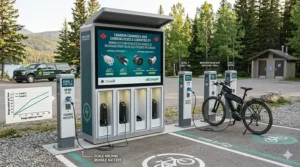
The charging station map canada data reveals a harsh truth: outside major cities, public charging exists for electric vehicles on highways, not for ebike batteries along scenic touring routes. Natural Resources Canada’s ZEVIP (Zero Emission Vehicle Infrastructure Program) has added over 325 charging stations in Alberta alone, yet these Level 2 and DC fast chargers are designed for 30-60 minute EV charging sessions, not the 3-6 hours required for ebike batteries.
What works in practice versus theory becomes evident when you examine actual touring routes. The Trans-Canada Highway through Ontario features EV charging roughly every 80-120 km between Sault Ste. Marie and Thunder Bay, but facility managers actively discourage ebike use because you’re occupying the charger 6x longer than intended. A better strategy involves identifying accommodation along your route and planning daily distances around overnight charging, using your portable power station as backup for days when you push beyond planned stopping points or encounter that inevitable “permanently closed” business marked on your map.
Provincial differences matter enormously. British Columbia, Ontario, and Quebec lead charging infrastructure development, whilst Alberta, Saskatchewan, and Manitoba lag significantly with notable gaps along major east-west routes like Highway 7 between Saskatoon and Calgary. The Northwest Territories and Yukon present the ultimate challenge — Whitehorse to Inuvik spans 740 km with exactly four communities offering services: Dawson City, Fort McPherson, Tsiigehtchic, and Inuvik. Planning battery management long distance touring through regions like this demands carrying sufficient capacity for 150-200 km between reliable charging opportunities, plus safety margin for unexpected detours or headwinds.
Temperature factors compound distance challenges in ways that devastate unprepared riders. Lithium batteries lose 20-30% capacity at 0°C, 30-40% at -10°C, and can lose 50%+ below -15°C. Spring touring through Alberta or early fall in the Yukon regularly encounters overnight temperatures in this range, meaning your nominal 80 km battery range might deliver barely 40 km on a frigid morning departure. Smart tourers store batteries indoors overnight and delay morning departure until batteries warm to 10-15°C, accepting reduced daily mileage rather than getting stranded.
Accommodation-Based Charging Strategy
Credit card touring — staying in hotels, motels, or B&Bs nightly — simplifies charging dramatically but still requires planning around backup battery touring capacity. Most accommodation provides standard 110V outlets in rooms, delivering full overnight charges for any ebike battery. The challenge appears during lunch breaks or afternoon snacks where you want to top up 20-30% charge to reach the next town with confidence.
Restaurants, cafés, and visitor centres along Canadian touring routes vary wildly in outlet access and owner attitudes toward ebike charging. In my experience, explaining you need 1-2 hours to charge (not the full 4-6 hours) and offering to buy lunch whilst charging usually succeeds. Small-town Tim Hortons locations across the Prairies tend to be particularly accommodating, whilst independent cafés in tourist areas (Banff, Jasper, Tofino) sometimes refuse due to previous issues with customers monopolising tables.
Libraries and community centres represent the secret weapons for opportunistic charging — nearly every small Canadian town maintains a public library with accessible outlets, and librarians rarely object to respectful cyclists charging whilst genuinely using the facility. Provincial parks and national parks vary by location; some provide powered campsites with outlets at each site (ideal for overnight charging), whilst backcountry campgrounds offer zero electrical infrastructure.
Solar Charging Integration
Solar charging touring ebike setups shine during multi-day backcountry adventures where accommodation access vanishes for 3-5 days consecutively. The Icefields Parkway through Jasper and Banff National Parks spans roughly 230 km with only two accommodation points mid-route (Saskatchewan River Crossing and Num-Ti-Jah Lodge), making this a perfect application for solar-capable touring.
Realistic solar expectations matter here — marketing materials suggest 100W panels fully charge 500Wh batteries in 5 hours, but Canadian conditions rarely deliver those numbers. Factor weather (cloud cover, morning/evening angle), elevation (thinner atmosphere actually helps), and latitude (longer summer days help, shorter winter days hurt). A 100W panel might deliver 400-500Wh daily output during July in northern latitudes (18+ hours of daylight), dropping to 200-300Wh during shoulder season April or September.
Riders combining 100-200W solar panels with 1000Wh power stations achieve near-energy independence on routes with 4-5 consecutive camping nights. Deploy panels during 1-2 hour lunch breaks, then again whilst cooking dinner and during overnight (if you wake early enough to catch sunrise), accumulating 3-4 hours of good charging daily. This strategy works beautifully along the Great Divide Mountain Bike Route through the Canadian Rockies where you’re camping nightly anyway, but adds unnecessary complexity for routes through populated regions where outlets appear every 50-80 km.
Battery Management Best Practices for Canadian Conditions
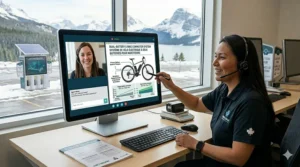
Temperature management separates successful Canadian touring from miserable experiences battling reduced capacity and damaged batteries. Lithium-ion cells function optimally between 15-25°C but suffer permanent capacity loss when charged below 0°C — yes, charging when cold damages batteries, not just using them. Smart tourers store batteries indoors overnight (bringing them into hotel rooms or tents), then only begin charging once batteries warm to at least 5-10°C.
Winter camping presents additional challenges since tent temperatures often match outdoor temperatures unless you’re running a heater (weight-prohibitive for bicycle touring). The solution involves sleeping with your battery in your sleeping bag — uncomfortable but effective at maintaining 10-15°C through body heat. Alternatively, invest in battery-specific insulation wraps that trap charging heat during daytime charging sessions, preventing cold-weather shutdowns.
Charging speed affects battery lifespan far more than most riders realise. Fast charging (4A+) generates heat and stresses cells, reducing overall cycle life from 1,000+ charges to perhaps 600-700 charges. For touring applications where battery replacement costs $600-$900 CAD, slower 2A overnight charging preserves long-term value even though it requires 6-8 hours rather than 3-4 hours. When possible, use your standard manufacturer charger rather than high-speed alternatives — the extra two hours rarely matters when you’re charging overnight anyway.
Depth of discharge patterns dramatically impact battery longevity. Running batteries to 5-10% remaining capacity before recharging, then charging to 100%, provides maximum daily range but potentially cuts total battery lifespan by 30-40%. A better practice for multi-week tours involves partial charging whenever convenient — topping up to 80-85% rather than 100% reduces stress on battery chemistry. This matters most for riders who own their bikes long-term versus those renting where battery degradation becomes someone else’s problem.
Storage practices between touring seasons determine whether your battery survives Canadian winters intact. Storing fully charged or fully depleted destroys lithium cells through different mechanisms — optimal storage voltage sits around 40-60% charge. Before winter storage (October through April for most Canadians), discharge your battery to roughly 50% (two bars on a five-bar indicator), then store in a cool (but not freezing) location like a basement or garage. Check monthly and recharge to 50% if voltage has dropped below 40%, ensuring the battery never fully depletes during storage.
Regional Charging Infrastructure Reality Check
British Columbia leads Canada in ebike-friendly infrastructure, though “lead” remains relative — Vancouver Island’s Galloping Goose Trail and Lower Mainland’s seawall network feature café density that provides outlet access every 20-30 km. The challenge appears on routes like the Sea-to-Sky Highway (Vancouver to Whistler) where stunning scenery coincides with 30-50 km gaps between services. Interior BC routes through the Okanagan or Kootenays feature even larger gaps, requiring 80-100 km range capability.
Alberta’s situation divides sharply between urban and rural. Calgary and Edmonton offer excellent accommodation density with charging options, but routes like the Icefields Parkway or Crowsnest Pass present serious challenges. The provincial government’s focus on EV infrastructure along Highway 1 and Highway 2 creates Level 2 charging roughly every 100 km, but these stations serve 30-minute EV sessions, not 4-hour ebike sessions. Banff and Jasper enforce strict “no overnight power station charging” policies at campgrounds due to diesel generator costs, forcing reliance on battery capacity for multi-day park visits.
Saskatchewan and Manitoba represent Canadian touring’s greatest infrastructure challenges for battery management long distance touring applications. Trans-Canada Highway services appear every 80-120 km through these provinces, but secondary highways through the Qu’Appelle Valley or along Lake Manitoba feature 150+ km gaps between reliable services. The flatness actually helps here — minimal elevation change means batteries deliver closer to their rated range, unlike mountainous regions where constant climbing drains batteries 30-40% faster than advertised.
Ontario and Quebec provide reasonable charging access along developed routes like the Waterfront Trail (Toronto to Kingston) or Route Verte through Quebec, where small-town services appear every 40-60 km. The challenge emerges in Northern Ontario along Highway 11 or 17, where 200+ km gaps between communities become common. Trans-Labrador Highway touring demands genuine expedition-level preparation — Labrador City to Happy Valley-Goose Bay spans 530 km with only Churchill Falls offering services mid-route.
Atlantic provinces offer surprisingly good infrastructure relative to population density. Prince Edward Island’s Confederation Trail features services every 30-40 km, whilst Nova Scotia’s Cabot Trail provides charging opportunities every 50-70 km around the loop. Newfoundland presents mixed conditions — the Avalon Peninsula offers reasonable density, whilst the Northern Peninsula sees gaps extending to 120-150 km between reliable services.
Essential Backup Battery Touring Equipment
Beyond primary power solutions, successful Canadian touring demands specific accessories that prevent common charging failures. First, invest in a proper waterproof pannier bag rated IP67 or higher for carrying your power station — Canadian touring inevitably encounters rain, and lithium batteries react poorly to moisture intrusion. Ortlieb panniers represent the gold standard, whilst budget options from MEC or Axiom provide adequate protection at lower prices.
Carry appropriate charging cables for every device in your system — the standard ebike charger obviously, but also USB-C cables, car charging adapters (for borrowing power from sympathetic vehicle owners), and MC4 solar panel connectors if running solar capability. Redundancy matters here; losing your only ebike charging cable 400 km from civilisation forces creative solutions involving hardware stores and electrical tape. I learned this lesson the hard way near Destruction Bay, Yukon, where my backup cable saved a $900 emergency bike shop trip to Whitehorse.
A basic multimeter (available for $30-$40 CAD at Canadian Tire) lets you troubleshoot charging issues before they become disasters. Most ebike battery problems stem from blown fuses, loose connections, or BMS (Battery Management System) errors rather than actual battery failure. Knowing your battery voltage (should be within 2-3V of rated voltage) helps diagnose whether you’re experiencing normal temperature-related capacity loss versus genuine malfunction requiring shop attention.
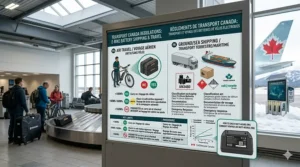
Electrical adapters deserve specific mention — Canadian outlets are standard North American 110V, but if you’re touring with non-Canadian equipment (European ebikes are increasingly popular), you’ll need proper voltage converters, not just plug adapters. Running a 230V European charger through a basic plug adapter on 110V Canadian power delivers half the required voltage, resulting in extremely slow charging or outright failure.
Real-World Canadian Touring Scenarios
Scenario 1: Vancouver Island Loop (7 Days, 650 km)
This popular route circles Vancouver Island via the Pacific Marine Circle Route, providing moderate services every 60-80 km but with several challenging gaps. A touring ebike with standard 500Wh battery and one 500Wh spare battery provides sufficient capacity for conservative daily 90-100 km stages. Riders staying in accommodation (Victoria, Sooke, Port Renfrew, Bamfield, Tofino, Ucluelet, Parksville, Nanaimo) manage with overnight charging only, using the spare battery as insurance against longer-than-planned days or persistent headwinds.
Alternative setup: 500Wh bike battery plus Jackery Explorer 500 portable power station provides similar capacity with added versatility for charging phones, cameras, and camp lights. This suits riders mixing camping and accommodation, requiring off-grid charging capability for 1-2 nights without power access.
Scenario 2: Icefields Parkway (4 Days, 230 km)
This stunning route from Jasper to Lake Louise features minimal accommodation (Saskatchewan River Crossing and Num-Ti-Jah Lodge mid-route) and strictly enforced Parks Canada policies against power station charging at campgrounds. A dual-battery setup (1000-1200Wh total capacity) becomes essential for covering 100+ km daily stages whilst carrying camping gear and provisions.
More aggressive riders use a 1000Wh power station (Jackery Explorer 1000 V2 or Bluetti Elite 100 V2) mounted on a single-wheel trailer, providing 2-3 full bike charges plus capacity for camp cooking via induction plate. This requires excellent fitness for pulling 15+ kg trailer weight up constant grades but delivers complete energy independence.
Scenario 3: Trans-Labrador Highway (10 Days, 1,200 km)
This expedition-level route demands maximum preparation — Labrador City to Happy Valley-Goose Bay includes only Churchill Falls mid-route, creating two 265 km stages requiring overnight camping. Setup requires 1000Wh+ power station, 100-200W solar panels, and ideally a second bike battery as backup. Riders report success combining Jackery Explorer 1000 V2 with dual 100W solar panels, achieving near-daily energy neutrality during July’s 18+ hour daylight.
Critical addition: satellite communication device (Garmin inReach or SPOT) becomes mandatory rather than optional when battery failure could strand you 150 km from assistance with minimal vehicle traffic for rescue.
Common Mistakes When Planning Battery Strategy
The most frequent error involves underestimating Canadian distances relative to European or American touring. A route showing “80 km between services” sounds manageable until you encounter persistent 25 km/h headwinds across Saskatchewan or 15% grades through the Rockies that reduce actual range to 50-60 km. Always plan for 70-80% of manufacturer-claimed range, not the full rated distance.
Second mistake: ignoring temperature effects on battery performance. Riders planning May or September tours often pack based on summer performance expectations, then discover morning temperatures of -5°C to +5°C reduce battery capacity by 20-30%. This compounds when cold batteries charge slowly, forcing longer lunch breaks or earlier evening stops to achieve full overnight charging.
Third mistake concerns power station sizing — carrying insufficient capacity for genuine energy independence versus excessive capacity that adds weight without practical benefit. For routes featuring accommodation every 100 km (most developed Canadian tourism regions), a 500Wh power station handles backup needs adequately. Routes with 150+ km gaps between services justify 1000Wh stations, whilst true wilderness expeditions demand 1000Wh+ with solar capability. Many riders over-prepare with 1500Wh stations for routes where smaller, lighter solutions would suffice.
Fourth mistake involves solar capability expectations — treating solar panels as primary charging versus backup/supplemental charging. Unless you’re touring during peak summer (June-August) at northern latitudes with 16+ daylight hours, solar panels rarely provide sufficient daily energy for complete independence. They extend range and provide emergency backup, but shouldn’t replace carrying adequate battery/power station capacity for your planned route.
Final mistake: failing to research specific accommodation electrical policies. Many Canadian campgrounds, particularly in national and provincial parks, explicitly prohibit power station charging or restrict outlet access to designated powered sites (which cost $15-$25 CAD more per night). Budget accommodation planning should account for these costs rather than assuming free charging access everywhere.
Frequently Asked Questions
❓ Can I use public EV charging stations for my ebike battery?
❓ How cold is too cold for charging my ebike battery?
❓ What's better for Canadian touring: second bike battery or portable power station?
❓ Do solar panels work during cloudy Canadian weather?
❓ Can I charge my ebike battery while riding?
Conclusion: Building Your Canadian Touring Power Strategy
Successfully touring across Canada demands matching your power strategy to your specific route, budget, and riding style. Credit card tourers following populated routes like Ontario’s Waterfront Trail or Quebec’s Route Verte can manage with minimal backup — perhaps a spare battery or small 250-300Wh power station as insurance against unexpected challenges. The modest $400-$600 CAD investment provides peace of mind without adding excessive weight or complexity.
Intermediate adventurers tackling iconic Canadian routes like the Cabot Trail, Icefields Parkway, or Vancouver Island loop justify investing in proper touring power infrastructure. A 500-1000Wh power station paired with quality solar panels delivers genuine off-grid capability whilst maintaining reasonable portability through proper cargo solutions. Budget $900-$1,300 CAD for this setup, viewing it as essential infrastructure rather than optional luxury.
Expedition riders planning truly remote adventures through territories, northern provinces, or challenging routes like the Trans-Labrador Highway require maximum preparation. Dual batteries plus 1000Wh+ power stations with solar capability become baseline requirements, potentially supplemented by vehicle support or resupply caches. These setups cost $1,500-$2,500 CAD but provide the energy independence necessary for safe completion of bucket-list adventures.
The fundamental lesson Canadian touring teaches is that power independence equals route freedom — riders constrained by charging infrastructure become slaves to accommodation density rather than selecting routes based on scenery, challenge, or personal interest. Investing in proper battery management long distance touring capability opens the entire country for exploration, from Newfoundland’s dramatic coastlines to Yukon’s midnight sun wilderness.
Recommended for You
- 7 Best Electric Bike for Cross Canada Trip 2026
- 7 Best Touring E-Bikes for Senior Riders Canada 2026
- 7 Best Touring E-Bike Battery Range 200km Canada 2026
Disclaimer: This article contains affiliate links. As an Amazon Associate, I earn from qualifying purchases. If you purchase products through these links, we may earn a small commission at no additional cost to you.
✨ Found this helpful? Share it with your friends! 💬🤗
