
In This Article
Somewhere between a bicycle and a Vespa sits a strange, wonderful little machine: the moped ebike with pedals. It has the bench seat, the fat tires, and the swagger of something you’d see puttering around a European seaside town in 1974 — but underneath the retro styling is a battery, a hub motor, and, crucially, a set of pedals that actually work. That last part matters more than most shoppers realize, and we’ll get to why in a minute.
If you’ve been scrolling listings wondering whether a moped ebike with pedals is even street legal here, whether it’s just a marketing gimmick, or whether it’s actually the smartest $1,000–$4,000 you could spend on transportation this year, you’re in the right place. This guide breaks down seven real, currently available models — from a $999 budget bruiser to a $3,699 Canadian-built cruiser — with honest analysis of who each one suits, what the spec sheets actually mean once you’re riding, and where Canadian law draws the line between “bicycle” and “you now need a licence.”
We’re not going to pretend we’ve personally put thousands of kilometres on all seven of these bikes. Instead, we’ve pulled real specifications, aggregated review sentiment from riders and independent testers, and cross-referenced Canadian regulatory sources so you get a genuinely useful comparison — not a repackaged spec sheet.
What Is a Moped Ebike With Pedals?
A moped ebike with pedals is an electric bicycle styled after a vintage moped or scooter — wide seat, upright riding position, fat tires — that retains fully functional pedals alongside its motor and throttle. Riders can pedal, use pedal assist, or twist the throttle, and in most of Canada, working pedals are what keeps the machine legally a bicycle rather than a motor vehicle.
That “styled after” distinction is important. According to Wikipedia’s overview of electric bicycles, e-bikes broadly split into pedelecs (motor assists only while you pedal, usually capped near 25 km/h) and more powerful “S-pedelecs” or throttle-controlled machines that can reach 45 km/h — the latter sometimes legally treated as mopeds depending on jurisdiction. A moped-style ebike borrows the S-pedelec’s attitude and the moped’s look, while manufacturers try to keep the pedals functional enough to keep it classified as a bicycle. Whether that classification actually holds up is a provincial question, and it’s the single most important thing to understand before you buy — covered in detail below.
Quick Comparison Table
| Product | Motor / Torque | Price Range (CAD) | Best For |
|---|---|---|---|
| Ridstar Q20 | 750–1,500W, dual suspension | around C$949–C$1,349 | Budget thrill-seekers, off-road use |
| Gotrax R7 | 750W, key-locked battery | around C$999–C$1,199 | First-time buyers, commuting |
| Samebike M20-II | 1,500W peak, 80 Nm, hydraulic | around C$1,349–C$1,599 | Braking-focused budget riders |
| Vtuvia Tiger Retro | 750W, NFC lock, dual suspension | around C$2,099–C$2,399 | Style-conscious commuters |
| Himiway C5 Ultra | 750W, 86 Nm, torque sensor | around C$2,299–C$2,699 | Throttle-first moto fans |
| Ride1UP Revv1 FS | 750W, 4-piston hydraulic, lighting kit | around C$3,000–C$3,300 | Riders who want road-legal signalling |
| Taubik Recon | 1,000W, 100 Nm, torque sensor | around C$3,600–C$3,900 | Canadian-built off-road cruiser fans |
Looking at the spread above, the split isn’t really about “cheap versus expensive” — it’s about how much of the moped fantasy you want versus how street-legal you need the bike to stay. The Gotrax R7 and Samebike M20-II sit closest to Canada’s federal power limits, while the Taubik Recon and Himiway C5 Ultra intentionally exceed them for private-property or off-road riding. That single fact will matter more to your day-to-day experience than any spec on this table.
💬 Just one click — help other Canadian golfers make a smarter bag choice too!😊
Top 7 Moped Ebikes With Pedals: Expert Analysis
1. Ridstar Q20 — biggest power-per-dollar, with a safety asterisk
The Ridstar Q20 is the bike that shows up on every “budget moped ebike” shortlist, and the spec sheet explains why. Depending on the exact variant, the motor is rated between 750W and 1,500W peak, paired with a 48V 20Ah battery and 20×4-inch fat tires riding on dual suspension. In practice, that means enough torque to climb moderate hills on throttle alone, plus enough battery capacity for a genuinely long pedal-assisted range — reviewers commonly log 50+ kilometres per charge in mixed riding.
Here’s what most bargain-hunters overlook: the Q20 comes in Lite, Standard, and Pro trims with different brakes (mechanical versus hydraulic) and motor outputs, so “the Q20” on one listing isn’t necessarily the same bike as “the Q20” on another — confirm the exact configuration before buying. Aggregated owner feedback is largely positive on ride comfort, dual suspension, and value, with recurring praise for how “moped-like” the throttle feel is. That said, in the interest of honesty: the U.S. Consumer Product Safety Commission issued public safety notices in 2026 concerning specific Ridstar model variants, and the manufacturer has not issued a formal recall as of this writing. If you’re considering this bike, verify the exact model and production date against current safety notices before purchasing.
Pros:
- ✅ Exceptional power and battery capacity for the price
- ✅ Dual suspension smooths rough Canadian pavement and trails
- ✅ Strong aggregated owner satisfaction on comfort and value
Cons:
- ❌ Variant confusion — specs differ meaningfully between trims
- ❌ Recent safety notices mean extra due diligence is required
At around C$949–C$1,349 depending on trim, the Ridstar Q20 is a legitimate budget standout — provided you do the variant homework the price tag doesn’t force you to do.
2. Gotrax R7 — the sensible first moped-style ebike
The Gotrax R7 takes a more restrained approach: a 750W rear hub motor, a 48V 10.4Ah (roughly 499Wh) UL2849-certified battery, and 20×4-inch fat tires on a front suspension fork. That’s a smaller battery than some rivals, but it’s paired with a lighter overall build and a key-activated battery lock — a small detail that matters if you’re parking outside a coffee shop instead of a garage.
What the spec sheet doesn’t tell you is how approachable this bike feels compared to punchier 1,500W competitors. The R7 tops out around 25 mph on paper, and independent reviewers consistently describe the power delivery as smooth and manageable rather than aggressive, making it a sensible pick for someone who’s never ridden anything moped-shaped before. The included front basket, frame bag, and 7-speed derailleur also signal this is meant for errands and commuting, not stunt riding. Aggregated feedback flags the ~82 lb weight as a real consideration for apartment dwellers without ground-floor storage, and a few owners note that full-throttle-only range drops closer to 20–25 km rather than the marketed maximum.
Pros:
- ✅ UL2849-certified battery with a lockable, removable pack
- ✅ Beginner-friendly power delivery and low learning curve
- ✅ Practical extras included: basket, bag, fenders, lighting
Cons:
- ❌ Heavy at roughly 82 lb for apartment or condo storage
- ❌ Throttle-only range falls well short of pedal-assist claims
At around C$999–C$1,199, the Gotrax R7 earns its spot as the moped-style ebike we’d point a nervous first-time buyer toward.
3. Samebike M20-II — hydraulic braking on a budget frame
The Samebike M20-II bumps things up with a 1,500W peak motor generating a claimed 80 Nm of torque, oil (hydraulic) disc brakes, dual adjustable suspension, and a 7-speed Shimano-style drivetrain, all wrapped around 4-inch fat tires. The headline upgrade here is genuinely meaningful: hydraulic brakes offer more consistent, fade-resistant stopping power than the mechanical discs found on cheaper rivals, which matters a lot once you’re regularly carrying groceries or a passenger on the extended saddle.
Reviewers and forum discussion around Samebike’s M-series consistently highlight the braking upgrade as the standout reason to pay more than an entry-level fat-tire ebike, alongside the extra low-end torque for hill starts. What’s less discussed: Samebike’s model naming is notoriously inconsistent across regional listings (M20, M20-II, M20-III, M20 Off Road all carry different battery and motor combinations), so cross-check the exact SKU against the seller’s spec sheet rather than assuming “M20” means one fixed configuration.
Pros:
- ✅ Hydraulic disc brakes rare at this price point
- ✅ 80 Nm torque handles hill starts confidently
- ✅ Dual suspension adds real comfort on rough surfaces
Cons:
- ❌ Confusing model-naming across M20 variants and regions
- ❌ Limited independent long-term durability data available
Priced around C$1,349–C$1,599, the Samebike M20-II is the value pick for anyone who considers braking performance non-negotiable.
4. Vtuvia Tiger Retro — the ’70s café-racer look, modernized
The Vtuvia Tiger Retro leans hardest into the moped aesthetic: a curved fuel-tank-style frame, a big round headlight, and a choice of loud retro colourways. Underneath the styling sits a 750W motor (1,100W peak) delivering roughly 80 Nm of torque, a 48V battery available in 15Ah or 35Ah capacities, dual-piston hydraulic disc brakes, and a claimed top speed in the 42–47 km/h range.
The standout practical feature is NFC-based unlocking — tap a card or phone to the frame instead of fumbling for a key, which is a small but genuinely useful anti-theft touch. Based on the spec comparison against similarly priced fat-tire competitors, the Tiger Retro’s single-speed drivetrain is the clearest trade-off: there’s no gearing to fall back on if the battery dies mid-ride, so pedaling home on a dead pack means fighting the fat tires’ rolling resistance the whole way. Aggregated buyer sentiment consistently praises the styling and NFC lock, while noting the single saddle height and lack of gears as the two most common nitpicks.
Pros:
- ✅ Genuinely distinctive retro styling, not just a marketing label
- ✅ NFC unlock adds convenience and theft deterrence
- ✅ 35Ah battery option gives serious real-world range
Cons:
- ❌ Single-speed drivetrain, no backup if power runs out
- ❌ Premium 35Ah battery pushes price toward mid-premium tier
Ranging from around C$2,099 to C$2,399 depending on battery size, the Vtuvia Tiger Retro rewards buyers who want their moped ebike to actually look like a moped.
5. Himiway C5 Ultra — throttle-first, with an honest caveat about pedaling
The Himiway C5 Ultra pairs a 750W geared hub motor with a substantial 86 Nm of torque and a 960Wh battery, wrapped in a moto-inspired aluminum frame with full suspension and 20×4-inch Kenda fat tires. On paper, that combination of torque and battery capacity is what lets Himiway advertise 60–80 miles of range and confident 15-degree hill climbs.
Here’s where honest analysis matters most: independent testers at Electric Bike Report specifically flagged that the C5 Ultra’s torque sensor — which measures pedaling force to modulate assist — works against the bike’s own moped-style geometry. The fixed, low bench seat makes it physically awkward to generate the pedal pressure a torque sensor wants, especially for taller riders, so pedal-assist performance underwhelms compared to the bike’s excellent throttle-only capability. Reviewers at BikeRide echoed similar concerns, adding that the drivetrain functions more as a legal formality than a genuine pedaling system, and noted the absence of turn signals as a practical gap for road use. None of this makes the C5 Ultra a bad bike — it makes it a throttle-first e-moped that happens to check the “operable pedals” box, which is precisely the audience it’s built for.
Pros:
- ✅ Massive 86 Nm torque and 960Wh battery for serious range
- ✅ Confident hill-climbing on throttle alone
- ✅ Dual battery compatibility for extended-range riders
Cons:
- ❌ Torque sensor pairs awkwardly with the fixed moped seating position
- ❌ No turn signals included despite the on-road styling
At roughly C$2,299–C$2,699, the Himiway C5 Ultra is best matched to riders who see pedaling as a legal technicality, not a workout.
6. Ride1UP Revv1 FS — the closest thing to a road-ready moped here
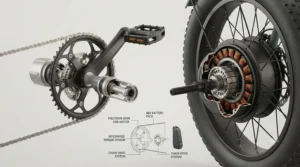
The Ride1UP Revv1 FS ships with a 750W Bafang hub motor (52V, 20Ah Samsung battery, roughly 1040Wh) capable of nearly 1,500W in unlocked off-road mode, full adjustable suspension, and — critically — an integrated headlight, brake-activated taillight, and factory turn signals on the full-suspension trim. That lighting package is a genuine differentiator: most moped-style ebikes in this guide either skip signalling entirely or bolt on aftermarket lights.
What most buyers overlook about the Revv1 is that it ships in a deliberately restrained Class 2 mode (20 mph throttle, 20–28+ mph pedal assist) out of the box, with a documented off-road unlock that pushes it toward 35 mph — a mode the manufacturer explicitly frames as private-property-only. Reviewers consistently rate the Revv1’s climbing ability and component quality (four-piston hydraulic brakes, chunky Inova tires) above its main rival, the Super73 RX, at a meaningfully lower price. Aggregated owner sentiment is enthusiastic overall, with the most common complaint being the roughly 90+ lb weight, which makes transporting the bike by car or elevator a two-person job.
Pros:
- ✅ Factory turn signals and full lighting — rare in this category
- ✅ Four-piston hydraulic brakes and 20×4 Inova tires
- ✅ Strong aggregated reviewer and owner satisfaction
Cons:
- ❌ Roughly 90+ lb, difficult to lift or transport solo
- ❌ Full unlocked speed mode is explicitly off-road-only
Landing around C$3,000–C$3,300 for the full-suspension build, the Ride1UP Revv1 FS is the pick for riders who want moped looks without giving up road-legal signalling.
7. Taubik Recon — Canadian-designed, and upfront about its off-road status
The Taubik Recon is a Canadian-designed fat-tire moto cruiser built around a 1,000W Bafang rear hub delivering 100 Nm of torque with a genuine torque sensor (not a cheaper cadence sensor), a 960Wh Samsung battery, full suspension, 20-inch mag wheels on 4-inch tires, and Zoom hydraulic disc brakes on 180mm rotors — all at a relatively light 85 lb.
What most spec sheets bury, Taubik’s own retailer states plainly: at 1,000W nominal, the Recon exceeds Transport Canada’s 500W ceiling for a power-assisted bicycle, so it isn’t federally street-legal as a bicycle. It ships capped to 32 km/h on-road by default with an off-road top speed closer to 50 km/h, positioning it explicitly as a private-property or off-road cruiser rather than a commuter bike for public roads. That transparency is refreshing in a category full of vague marketing, and it’s exactly the kind of detail this guide’s honesty standards require highlighting rather than glossing over. Aggregated buyer sentiment praises the torque sensor’s natural pedal feel — a genuine advantage over the Himiway’s mismatched setup — along with the light weight and Canadian retailer support, while noting the shorter 12-month warranty and the absence of listed UL2849/UL2271 certifications as the honest trade-offs of buying from a smaller, newer brand.
Pros:
- ✅ Genuine torque sensor delivers the most natural pedal feel here
- ✅ Lightest bike in this guide at 85 lb despite full suspension
- ✅ Transparent about exceeding federal PAB power limits
Cons:
- ❌ Not federally street-legal as a bicycle at 1,000W
- ❌ Shorter 12-month warranty, no listed UL2849/UL2271 certification
At around C$3,600–C$3,900, the Taubik Recon suits riders who want off-road moped performance and are comfortable treating it exactly that way — off-road.
How to Choose a Moped Ebike With Pedals
Shopping this category means weighing style against street-legal status against your actual riding terrain. Here’s a practical, step-by-step approach:
- Decide if road-legal matters to you. If you plan to ride on public streets and bike lanes, prioritize bikes at or under 500W nominal with a hard 32 km/h assist cutoff — like the Gotrax R7 or Samebike M20-II in their compliant configurations.
- Match torque to your terrain. Flat commuting needs less torque than hilly neighbourhoods; 80+ Nm (as on the Vtuvia Tiger Retro or Taubik Recon) makes a real difference on inclines.
- Weigh brake type honestly. Hydraulic brakes, found on the Samebike M20-II, Himiway C5 Ultra, and Ride1UP Revv1 FS, outperform mechanical discs in wet Canadian conditions.
- Check the battery certification. UL2849 or UL2271 listings, present on the Gotrax R7 and Ridstar Q20 trims, indicate independent electrical safety testing — worth confirming before you buy any lithium battery bike.
- Consider total weight versus your storage. A 90+ lb bike like the Ride1UP Revv1 FS is a serious commitment if you’re carrying it up stairs daily.
- Decide how much you actually intend to pedal. If pedaling is mostly symbolic, a torque-sensor mismatch like the Himiway C5 Ultra‘s matters less; if you want a natural pedaling feel, the Taubik Recon‘s sensor setup is the standout.
- Budget for accessories and insurance questions. Higher-wattage bikes may trigger provincial moped or insurance requirements — confirm before committing extra cash to a build that can’t legally do what you want on public roads.
Is a Moped Ebike With Pedals Legal in Canada?
This is the question that trips up more buyers than any spec comparison. Since February 2021, Transport Canada repealed the federal definition of a “power-assisted bicycle” for manufacturing and importation purposes, and now assesses electric bicycles based on their on-road versus off-road design characteristics rather than a single fixed formula — a shift explained on Transport Canada’s importing non-regulated vehicles page. In practice, though, every province still enforces its own version of the traditional benchmark: a motor of 500W or less, a maximum motor-assisted speed of 32 km/h, and — this is the part relevant to this whole article — fully operable pedals that can propel the bike on their own.
British Columbia’s rules are a useful illustration of how provinces implement this. Under the Motor Assisted Cycle Regulation described by the Government of British Columbia, an e-bike must have pedals or hand cranks that can propel the vehicle, and those pedals must remain usable even while the motor is engaged. Miss that pedal requirement, or exceed the wattage or speed cap, and depending on your province you may be looking at moped or limited-speed motorcycle classification instead — which typically brings licensing, registration, and insurance requirements with it. This is exactly the honest disclosure Taubik makes about the Recon above, and it’s worth taking seriously rather than assuming a bike is legal just because it has a bench seat and pedals bolted on.
Enforcement is also actively evolving. Toronto and Ontario have spent 2026 debating new e-bike classification rules specifically targeting “paneled frames like mopeds,” a distinction reported by CBC News that could require insurance and a motorcycle-class licence for bikes that visually resemble mopeds regardless of their exact wattage. If you’re buying a legal moped ebike canada shoppers can ride without a licence, stick to models confirmed at or under 500W with a hard-capped 32 km/h assist and confirm your specific province’s current rules before your first ride — this is a fast-moving regulatory area, not a settled one.
Ebike vs Moped Classification: What’s the Real Difference
The ebike vs moped classification question comes down to three things: motor output, top assisted speed, and whether pedals can genuinely move the bike unassisted. A traditional gas-powered moped is a motor vehicle by definition — it requires a driver’s licence, registration, and insurance in every Canadian province, full stop. A power-assisted bicycle, by contrast, is legally treated like a regular bicycle provided it stays within the wattage and speed limits discussed above and keeps its pedals functional.
Where things get murky is the “moped-style ebike” category this whole article covers. These bikes borrow a moped’s silhouette and riding position but are, mechanically, still bicycles with motors — at least when built to stay under 500W. The Ride1UP Revv1 FS and Gotrax R7, in their default shipping configurations, sit closer to the true bicycle side of that line. The Taubik Recon and higher-output Ridstar Q20 variants sit closer to the moped side, simply because their motors exceed what most provinces recognize as bicycle-legal. Neither approach is wrong, but they demand different riding contexts: one is built for public roads and bike lanes, the other for trails, farmland, or private property where the extra power actually gets used legally.
Pedal Assist Moped Electric: How the Motor and Pedals Actually Work Together
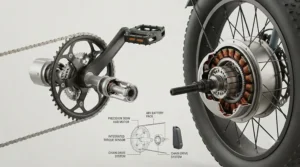
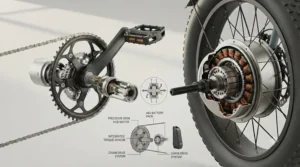
On a pedal assist moped electric setup, the motor doesn’t just run whenever you feel like it — it responds to either a cadence sensor (which detects that your pedals are turning) or a torque sensor (which measures how hard you’re actually pushing). Cadence sensors are cheaper and more common on budget bikes like the Gotrax R7; torque sensors, found on the Himiway C5 Ultra and Taubik Recon, are meant to deliver smoother, more proportional assistance.
Here’s what the spec sheet doesn’t tell you: a torque sensor is only an upgrade if the bike’s geometry lets you actually apply meaningful pedal force. As the Himiway C5 Ultra’s real-world testing showed, a low, fixed moped-style seat can make it physically awkward to generate the pressure a torque sensor is designed to read, especially for taller riders. That’s why the Taubik Recon’s lighter frame and more accessible seating earn it praise for “natural” pedal feel where the C5 Ultra draws criticism for the same underlying technology. The lesson: don’t assume torque sensor equals better pedaling experience without checking how the specific frame is built around it.
Hybrid Moped Bicycle Electric: Blending Bike DNA With Moped Attitude
Think of a hybrid moped bicycle electric build as sitting on a spectrum, not a fixed category. At one end are bikes like the Gotrax R7 — 7-speed derailleur, lighter frame, genuinely rideable on pedal power alone if the battery dies. At the other end sit machines like the Himiway C5 Ultra, where the drivetrain exists mostly to satisfy the legal definition of a bicycle while the throttle does the actual work.
What most buyers overlook is that gearing tells you a lot about which end of that spectrum a bike sits on. Single-speed drivetrains, like the one on the Vtuvia Tiger Retro, work fine if you’re relying on the motor for hills and just spinning the pedals for legal compliance and light assistance. Multi-speed drivetrains, like the 7-speed setups on the Gotrax R7 and Samebike M20-II, suggest the manufacturer expects you to occasionally pedal in earnest — up a hill, on a dead battery, or just for exercise. Neither is objectively better; it depends whether you want a hybrid moped bicycle electric machine you’ll genuinely pedal sometimes, or one that’s a moped in spirit with pedals as a formality.
Pedal Requirement Electric Moped Rules: Why It’s Non-Negotiable
Every provincial regulator that publishes e-bike rules lists the same non-negotiable item: pedals must remain operable, and in most provinces the motor must disengage the moment you stop pedaling and apply the brakes on cadence-triggered systems, or drop off entirely once you hit the speed cap on any system. This pedal requirement electric moped rule is the single legal thread separating a “moped-style ebike” from an actual moped that needs plates and insurance.
That’s not just bureaucratic trivia — it affects real purchasing decisions. If a listing brags about a bike hitting 45–50 km/h on motor power alone with pedals that are more decorative than functional, you’re likely looking at something that will be classified as a limited-speed motorcycle or moped in most provinces the moment an officer takes a close look, regardless of how the seller markets it. The Taubik Recon‘s honest disclosure about exceeding the 500W threshold is a model for how this should be communicated — buyers deserve to know before they buy, not after a roadside stop.
Practical Usage Guide: Setup, First 30 Days & Maintenance
Getting a new moped-style ebike dialed in takes more than charging the battery and riding off. Most models, including the Gotrax R7 and Ridstar Q20, arrive roughly 90% assembled — expect to attach pedals, the front wheel, handlebars, and seat, then torque bolts to spec before your first ride. Tire pressure matters more on 4-inch fat tires than most riders expect: street riding generally wants 20–30 PSI, mixed terrain 15–20 PSI, and snow or sand as low as 8–15 PSI, always within the range printed on the sidewall.
In the first 30 days, budget time for a post-shakedown bolt check — vibration loosens fasteners on any new bike, and fat-tire moped-style builds with heavier components are no exception. Hydraulic brakes on models like the Samebike M20-II and Ride1UP Revv1 FS typically need a short bedding-in period; expect slightly spongy lever feel for the first few rides before the pads seat properly. A common first-month mistake is fully draining the battery before every recharge — lithium packs, including those on the Himiway C5 Ultra and Vtuvia Tiger Retro, generally last longer with partial-charge cycles rather than habitual full discharges. Keep the charging port covered when not in use, especially through a Canadian winter, and store the bike above freezing whenever possible since cold meaningfully reduces both range and battery lifespan. Finally, check derailleur tension and brake alignment after the first 50 km — cable stretch on a new drivetrain is normal, not a defect.
Real-World Scenarios: Who Actually Rides These Bikes
The apartment-dwelling commuter: A 28-year-old riding 8 km each way to a downtown office needs something road-legal, not too heavy for a building elevator, and cheap enough to risk locking up outside. The Gotrax R7, at roughly 82 lb with a key-locked battery and included basket, fits this brief better than heavier off-road-leaning options.
The acreage owner with a long private driveway: Someone living rurally with a kilometre of private laneway between the house and the road wants maximum fun and doesn’t care about federal wattage caps, because the riding happens entirely on private property. The Taubik Recon or a higher-output Ridstar Q20 variant makes sense here — the extra torque and off-road top speed get used exactly as intended, with zero public-road legal exposure.
The weekend trail rider who also commutes: This buyer wants one bike that handles a Monday commute and a Saturday gravel-trail ride. The Himiway C5 Ultra‘s dual suspension and long range suit the trail half of that equation, though the honest trade-off is a pedaling experience that won’t feel as natural as a dedicated commuter bike — a fair compromise if throttle-first trail riding is the priority most weekends.
Common Mistakes When Buying a Moped-Style Ebike
The most frequent mistake is buying on looks alone and assuming every retro-styled bike is street-legal by default — as the Taubik Recon example shows, plenty of genuinely excellent moped-style bikes are intentionally built above the 500W bicycle threshold. A close second is skipping the exact model variant check; as the Ridstar Q20 and Samebike M20-II both illustrate, the same base model name can hide meaningfully different motors, brakes, and batteries depending on trim and region.
A third common error is underestimating bike weight relative to actual storage and transport needs — a 90+ lb bike like the Ride1UP Revv1 FS is fantastic to ride and miserable to carry up a walk-up apartment’s stairs daily. Finally, buyers frequently skip verifying battery certification (UL2849/UL2271) altogether, treating it as fine print rather than the meaningful fire-safety signal it actually is, particularly given ongoing Canadian news coverage of lithium battery incidents involving uncertified e-bike batteries.
Long-Term Cost & Maintenance: The Real Total Cost of Ownership
The purchase price is only the entry fee. Budget for a replacement battery every 500–800 charge cycles — roughly 2–4 years of regular use — and expect that cost to run a meaningful fraction of the bike’s original price, since batteries are the single most expensive individual component. Hydraulic brake systems, found on the Samebike M20-II, Himiway C5 Ultra, and Ride1UP Revv1 FS, cost more to service at a shop than mechanical discs but need less frequent adjustment, which can be a wash over several years of ownership.
Tire wear on 4-inch fat tires is typically slower than narrow road tires but replacements run higher per tire given the specialized sizing. Compare that against a traditional 50cc gas moped, which layers in provincial insurance, annual registration, and gas costs most compliant power-assisted bicycles entirely avoid — a difference that can total several thousand dollars over a five-year ownership window for bikes that stay within the 500W/32 km/h bicycle threshold. Where you lose that advantage is with bikes like the Taubik Recon, which, by exceeding federal power limits, may not carry the same blanket insurance exemption depending on how your specific province treats it, so factor that uncertainty into the true cost before assuming it’s insurance-free.
Buyer’s Decision Framework
- If you need daily road-legal commuting, choose a bike confirmed at or under 500W with a hard 32 km/h cutoff, like the Gotrax R7, because it keeps you inside every province’s bicycle definition without asterisks.
- If you have private property or acreage to ride on, choose a higher-output model like the Taubik Recon or Ridstar Q20, because the extra torque and speed get used exactly where they’re legal.
- If braking confidence in wet weather is your top priority, choose a hydraulic-braked model like the Samebike M20-II, because fade resistance matters more than raw motor output on slick Canadian roads.
- If you want the closest thing to a genuinely road-legal moped experience with lighting, choose the Ride1UP Revv1 FS, because factory turn signals are a rare and meaningful safety feature in this category.
- If natural pedaling feel matters to you, choose the Taubik Recon over torque-sensor bikes with poor ergonomics, because sensor technology alone doesn’t guarantee a comfortable pedaling experience.
Frequently Asked Questions
❓ Do moped ebikes with pedals need to be registered in Canada?
❓ Can you ride a moped-style ebike without ever pedaling?
❓ What's the difference between a moped ebike and a regular ebike?
❓ Are moped ebikes with pedals good for winter riding in Canada?
❓ How fast can a legal moped ebike go in Canada?
Conclusion
A moped ebike with pedals is genuinely one of the more interesting corners of the e-bike market right now — part nostalgia trip, part legitimate transportation upgrade, and, if you’re not careful about specs and provincial law, part legal grey area. The good news is that real, well-reviewed options exist at every price point we covered, from the approachable Gotrax R7 to the Canadian-built Taubik Recon.
The honest takeaway is that “moped-style” is a design language, not a legal guarantee, and the smartest buyers in this category check wattage, speed caps, and pedal functionality before they check paint colour. Match your riding context — public roads versus private property, commuting versus weekend fun — to the right bike from this list, confirm your province’s current rules, and you’ll end up with a ride that’s as fun to own as it looks.
✨ Don’t Miss These Exclusive Deals!
🔍 Take your moped-style riding to the next level with these carefully researched picks. Click on any highlighted model to check current pricing and availability on amazon.ca. These bikes deliver authentic retro cruising your commute — or your weekend trail rides — will genuinely thank you for!
Recommended for You
- Moped Style Electric Bike Canada: 7 Best Picks for 2026
- Electric Mountain Bike for Teenagers: 7 Top Picks in Canada 2026
- Best Electric Bike for Teenagers in Canada 2026: Top 7 Picks
Disclaimer: This article contains affiliate links. As an Amazon Associate, I earn from qualifying purchases. If you purchase products through these links, we may earn a small commission at no additional cost to you.
✨ Found this helpful? Share it with your friends! 💬🤗
