
In This Article
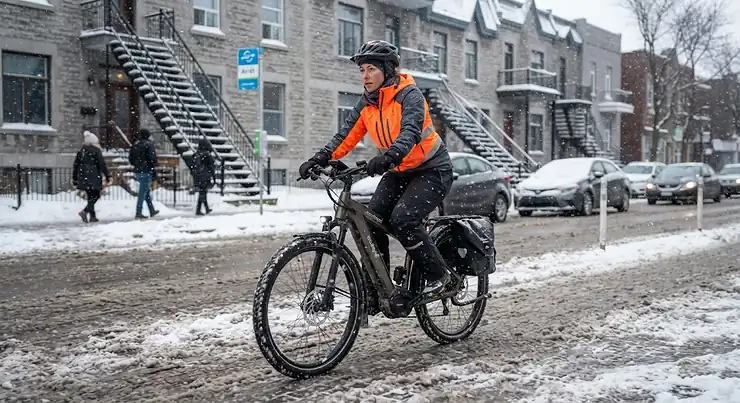
Riding down Rue Saint-Paul in Old Montreal on a regular bike feels a bit like being inside a paint mixer — every cobblestone sends a jolt through your wrists, and that’s before the first snowfall even shows up. Finding the right urban ebike for Montreal winters and cobblestones means solving two very different problems at once: staying upright on ice-glazed pavement in February, and staying comfortable over four centuries of uneven stone in July. Most buying guides treat these as separate categories. They shouldn’t be, because the same features — fat or wide tires, real suspension, hydraulic brakes, and a battery that tolerates the cold — do double duty on both fronts.
What is an urban ebike for Montreal winters and cobblestones? It’s a pedal-assist bicycle built with wide or fat tires, front (and ideally seatpost) suspension, hydraulic disc brakes, and a removable, cold-tolerant battery — specifically matched to Montreal’s mix of icy REV lanes and centuries-old stone streets.
This guide skips the marketing copy and gets into what actually matters: real torque numbers, honest trade-offs, and how each bike behaves once the temperature drops below minus ten. Montreal’s cycling network now covers more than a thousand kilometres, much of it cleared through the winter, so the bike you choose genuinely determines whether you keep riding in January or park it in November. We researched seven real, currently available models — from a C$1,100 full-suspension commuter to a C$4,500 Dutch tourer — and broke down exactly who each one suits.
Quick Comparison Table
| eBike | Motor / Torque | Tires | Price Range (CAD) | Best For |
|---|---|---|---|---|
| Samebike XD26-II | 500W (750W peak), 70Nm | 26″x2.1″ | C$1,100-C$1,600 | Tight budgets |
| ADO A20F+ Beast 20F | 250-350W class, torque sensor | 20″x4.0″ fat | C$1,100-C$1,500 | Condo storage |
| Taubik Blackburn 275T | 500W SUTTO, 65Nm | 27.5″x2.35″ | C$2,000-C$2,500 | REV commuting |
| Eunorau FAT-AWD 3.0 | Dual 500W, 110Nm combined | 26″x4.0″ fat | C$1,700-C$3,000 | Icy traction |
| ENVO D50 | 750W peak, 80Nm | 27.5″ convertible | C$2,400-C$3,200 | Year-round versatility |
| Aventon Aventure.3 | 750W, 1,440W peak | 26″x4.0″ fat | C$2,800-C$3,400 | Cobblestone comfort |
| Gazelle Ultimate C380 | Bosch mid-drive, 65-85Nm | 28″ | C$4,300-C$4,900 | Longevity and polish |
Reading across this table, the split between budget and premium isn’t really about brand snobbery — it’s about how much of the vibration and traction problem the hardware solves before your body has to absorb the rest. The Samebike XD26-II and ADO A20F+ Beast 20F hit an entry price by using a single motor and basic suspension, which is genuinely fine for someone testing whether year-round riding suits them at all. At the other end, the Gazelle Ultimate C380 and Aventon Aventure.3 justify their price with components — belt drives, dual suspension, connected security — that simply don’t exist at the lower tiers.
💬 One click helps other Canadian garage owners find the right heater too — thanks for sharing!😊
Top 7 Urban eBikes for Montreal: Expert Analysis
Coverage here spans budget, mid-range, and premium tiers, plus folding, fat-tire AWD, hybrid, and Dutch-style variants — because “best” depends heavily on whether you’re parking in a condo storage locker or a garage in Rosemont.
1. Samebike XD26-II — full suspension comfort for under C$1,600
The standout here is that a bike at this price has both a front fork and a rear shock, which is rare below C$2,000. The 720Wh removable battery and 70Nm hub motor are genuinely competitive specs — the kind you’d normally expect to pay C$400-C$600 more for. Zeus eBikes’ Canadian testing found the 26″x2.1″ all-terrain tires handle cracked pavement and streetcar-track-style seams without transmitting the jarring you’d get from a rigid budget frame, which matters directly for cobblestone streets. At 25.5 kg it’s also the lightest bike in this roundup, which counts for something if you’re hauling it up a triplex staircase every night.
Based on the spec comparison, this is the bike for someone who wants to try year-round commuting before committing serious money to it. Reviewers consistently note the cadence sensor (rather than a torque sensor) makes the power delivery feel a step less refined than the pricier picks here — you get a slight delay before assist kicks in, and it can feel abrupt compared to torque-sensing rivals. That’s a real trade-off, not a dealbreaker. What most buyers overlook is that the removable 48V battery still needs the same cold-weather babying as a C$4,000 bike’s battery — bring it inside overnight regardless of what you paid.
Pros:
- ✅ Front-and-rear suspension rare at this price point
- ✅ 720Wh battery beats many pricier competitors
- ✅ 160mm hydraulic disc brakes for confident icy stops
Cons:
- ❌ Cadence sensor feels less natural than torque sensing
- ❌ Stock tires aren’t studded for true ice conditions
Expect to pay somewhere in the C$1,100-C$1,600 range depending on retailer promotions; at that price, the Samebike XD26-II delivers more suspension and battery capacity than almost anything else on this list.
2. ADO A20F+ Beast 20F — folds flat for condo storage
The 20″x4.0″ fat tires on a folding frame are the headline feature — you get real cushioning against cobblestones and packed snow in a package that collapses to fit a closet or car trunk. That matters more in Montreal than most cities, where a huge share of downtown and Plateau housing is walk-up apartments with zero bike storage. The front fork shock absorber pairs with those fat tires to soak up an estimated 90% of surface bumps, according to the manufacturer’s testing, and the torque sensor plus dual hydraulic disc brakes are genuinely above-average for a sub-C$1,500 folder.
Here’s what to weigh: the 250-350W-class motor is tuned for European and UK regulatory limits, so climbing the steeper pitches toward Mont Royal or up from the Lachine Canal will ask more of your legs than a 500W Canadian-spec hub motor would. Aggregated buyer reviews are largely positive on ride comfort and build quality, with recurring praise for how the fat tires handle sand, snow, and rough pavement, though smaller 20-inch wheels can feel less planted over deep frost heaves than a 26 or 27.5-inch wheel would. Reviewers consistently point out this is a bike built first for foldability, second for outright power.
Pros:
- ✅ Folds compact enough for elevator and closet storage
- ✅ 4-inch fat tires cushion cobblestones and snow ruts
- ✅ Dual hydraulic disc brakes plus a responsive torque sensor
Cons:
- ❌ Lower-powered motor struggles on the Plateau’s steeper hills
- ❌ Smaller 20-inch wheels feel twitchier over deep ruts
Price sits around C$1,100-C$1,500 depending on version, making the ADO A20F+ Beast 20F the strongest pick for anyone whose real constraint is square footage, not budget.
3. Taubik Blackburn 275T — dual-sensor hybrid for REV lanes
What most buyers overlook about this model is the switchable torque-and-cadence sensor — you can toggle between a responsive, natural pedalling feel and smoother, steadier assistance depending on whether you’re navigating stop-and-go downtown traffic or cruising a long stretch of protected lane. The 27.5″x2.35″ hybrid tires and Zoom hydraulic disc brakes are tuned for exactly the kind of mixed pavement-and-path riding the REV network offers, and the UL2849-certified battery management system is a genuine safety differentiator in a market where cheap batteries have made headlines for the wrong reasons.
Based on the spec comparison, the 65Nm of torque from the 500W SUTTO motor sits comfortably mid-pack — enough for most Montreal grades without the aggressive punch (and battery drain) of a fat-tire AWD setup. The optional second 48V 15Ah battery is worth strong consideration for winter riders, since it directly offsets the 20-35% cold-weather range loss that’s typical of lithium cells in deep freezes. The step-through-only frame is a minor limitation if you specifically want a high-step diamond frame, though the lower standover height is genuinely useful for anyone riding in bulky winter clothing.
Pros:
- ✅ Switchable torque/cadence sensor adapts to conditions
- ✅ UL2849-certified battery with hydraulic Zoom brakes
- ✅ Optional dual-battery setup for cold-weather range
Cons:
- ❌ 2.35″ tires are narrower than true fat-tire winter rubber
- ❌ Only available as a step-through frame
Priced around C$2,000-C$2,500, the Taubik Blackburn 275T earns its spot as the most balanced hybrid pick for someone commuting primarily along REV corridors rather than through deep snow.
4. Eunorau FAT-AWD 3.0 — dual motors for packed snow traction
The spec sheet won’t tell you this outright, but the real story with the Eunorau FAT-AWD 3.0 is the independently switchable front and rear motors — a rocker switch lets you run front-only, rear-only, or both simultaneously, which is a meaningfully different traction strategy than any single-motor bike on this list. Combined with 26″x4.0″ Kenda fat tires and a max 110Nm of combined torque, this is the bike built specifically for slick, packed-snow mornings when a single driven wheel is prone to spinning out. The RST suspension fork with 95mm of travel is generous for this category, and hydraulic disc brakes with 180mm rotors give real stopping power on ice.
Reviewers consistently report the AWD system delivers genuinely noticeable extra grip on loose or slippery surfaces — sand, deep snow, wet mud — compared to single-motor fat-tire bikes, which lines up with the basic physics of powering both contact patches. What the spec sheet doesn’t flag is the missing suspension seatpost: without it, cobblestone vibration still reaches the saddle even though the fat tires and fork handle the bulk of it. The bike is also noticeably heavier than a standard single-motor fat-tire model, which is the trade-off for that extra traction hardware.
Pros:
- ✅ Independently switchable front/rear motors for icy grip
- ✅ 95mm RST suspension fork smooths rough pavement
- ✅ Hydraulic brakes and optional dual-battery range
Cons:
- ❌ No suspension seatpost, so cobblestone chatter reaches the saddle
- ❌ AWD hardware adds noticeable weight over single-motor rivals
Typically listed in the C$1,700-C$3,000 range depending on battery configuration, the Eunorau FAT-AWD 3.0 is the clearest answer for riders whose main fear is spinning out on an icy REV lane, not comfort on cobblestones.
5. ENVO D50 — Canadian-built and shop-serviced nationwide
The standout advantage here is straightforward: ENVO designs and supports the D50 domestically out of Burnaby, B.C., which means warranty claims and replacement parts don’t route through overseas distribution chains the way many direct-import brands do — a genuinely underrated factor once a bike has survived a Montreal winter or two. The 750W peak (500W rated) geared hub motor delivers 80Nm of torque with a torque sensor for proportional power delivery, and the frame accepts 27.5″x1.95″ commuter tires, 27.5″x3.0″ fat tires, or 29″x2.25″ mountain tires — meaning the same bike can be reconfigured seasonally rather than replaced.
Based on the spec comparison against other Canadian commuters, the D50’s rear rack capacity (up to 176 lbs with the cargo upgrade) stands out for anyone hauling groceries or a kid seat through slush. What most buyers overlook is that this versatility comes with a bit of DIY responsibility: swapping between tire configurations for the seasons isn’t a zero-effort process, and the premium cargo accessories are sold separately rather than bundled in. Aggregated owner feedback is largely positive on range and reliability, with several long-distance commuters reporting 60+ km round trips on a single charge at moderate assist levels.
Pros:
- ✅ Canadian-engineered with domestic parts and service support
- ✅ Convertible tire setup adapts the same bike by season
- ✅ 80Nm torque handles hills, cargo, and winter drag
Cons:
- ❌ Seasonal tire swaps require some hands-on effort
- ❌ Cargo and passenger accessories cost extra
Prices for the ENVO D50 generally land in the C$2,400-C$3,200 range at the time of research, positioning it as the most flexible year-round option for riders who want one bike that adapts rather than two bikes for two seasons.
6. Aventon Aventure.3 — double suspension smooths cobblestones
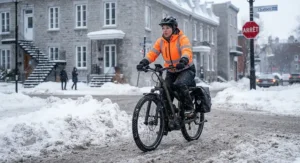
Combined with the 80mm front suspension fork and 50mm-travel suspension seatpost, the Aventon Aventure.3 handles rough surfaces noticeably better than a single-suspension fat-tire bike — reviewers specifically call out that the seatpost quietly absorbs the kind of road vibration and impact that would otherwise travel straight up your spine, which is exactly the cobblestone vibration resistance problem Old Montreal riders deal with daily. The 750W motor (1,440W peak in boost mode) and 26″x4″ Innova fat tires give it real hill-climbing and traction credentials, while the Aventon Control Unit adds 4G and GPS connectivity for remote locking and geofencing — genuinely useful in a city where bike theft is a real concern.
Here’s what to weigh: independent testers recorded real-world range around 34 miles at maximum assist and up to 62 miles at minimum, which tracks closely with Aventon’s own 65-mile claim — better real-world accuracy than many competitors offer. At 78 lbs, though, this is a heavy machine, and carrying it up a walk-up’s front steps every day will wear on you fast. The spec sheet won’t tell you this, but that weight is partly the price of the double-suspension comfort — lighter fat-tire bikes almost always cut the seatpost suspension first.
Pros:
- ✅ Front fork and suspension seatpost tackle cobblestones twice
- ✅ 4G/GPS-connected ACU adds real anti-theft protection
- ✅ 750W motor with 1,440W boost mode for hills
Cons:
- ❌ At 78 lbs, it’s genuinely heavy to carry up stairs
- ❌ Priced above what budget-focused commuters want to spend
Expect a price in the C$2,800-C$3,400 range; the Aventon Aventure.3 is the strongest single answer if cobblestone comfort is your top priority and you have secure ground-floor storage.
7. Gazelle Ultimate C380 — Bosch belt-drive built to last decades
The Bosch Performance Line mid-drive motor, delivering 65-85Nm of torque depending on configuration, is mounted at the pedals rather than the wheel hub — a placement that improves balance and keeps the centre of gravity low, which genuinely helps handling on uneven cobblestone surfaces. What most buyers overlook is the Gates carbon belt drive paired with an Enviolo stepless CVT hub: there’s no chain to rust from road salt and no derailleur to clog with slush, which is arguably the single best winter-durability feature on this entire list. A front suspension fork and suspension seatpost round out the comfort package, and the bike carries a ten-year frame warranty alongside a two-year Bosch-backed component warranty.
Based on the spec comparison, this is clearly the premium, buy-it-once option — reviewers across multiple independent outlets consistently praise the smoothness of the Bosch drive and the overall build quality, while flagging the high price as the main drawback. The bike is also on the heavier side (around 55-63 lbs depending on battery configuration), which is the trade-off for the durable, low-maintenance drivetrain. For a rider planning to keep one bike for a decade of Montreal winters rather than replacing components every season, the math starts to make sense.
Pros:
- ✅ Bosch mid-drive delivers smooth, near-silent power
- ✅ Belt drive and CVT hub need no chain maintenance
- ✅ Ten-year frame warranty backs long-term reliability
Cons:
- ❌ Highest price point of any bike in this roundup
- ❌ Heavier Dutch-style frame is less nimble in tight alleys
Priced around C$4,300-C$4,900 depending on battery size, the Gazelle Ultimate C380 is the pick for buyers who see winter durability as an investment, not an expense.
Practical Usage Guide: Setting Up Your eBike for Montreal Winters
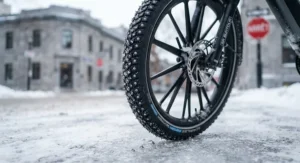
Getting a new urban ebike for Montreal winters and cobblestones ready for its first cold season takes more than unboxing it. Start by dropping tire pressure by roughly 5-10 PSI versus summer settings — a slightly softer fat or wide tire gains contact patch on ice and reduces the jarring transmitted through cobblestones, though you’ll want to check pressure weekly since cold air itself lowers PSI. If your model supports studded tires, as several fat-tire options here do, install them before the first real freeze rather than after your first slide.
Battery habits matter more than almost anything else. Bring the battery inside overnight whenever temperatures drop below about -10°C, since lithium-ion cells lose meaningful capacity in deep cold and never charge a battery that’s still cold from a ride — let it warm to room temperature first. In the first 30 days, the most common mistake new winter riders make is leaving a bike locked outside for days at a time; road salt and slush accelerate corrosion on chains, cables, and unprotected metal far faster than most owners expect. A quick wipe-down after slushy rides and a light chain lubricant application weekly go a long way. Finally, test your brakes gently and often in the first cold snap — hydraulic brakes, standard on most bikes in this guide, perform more consistently in freezing temperatures than mechanical disc brakes, but pad bite can still feel different than it did in August.
Real-World Scenarios: Who Should Ride What
Picture a Concordia student living in a fourth-floor walk-up near Rue Sainte-Catherine, commuting 6 km daily and needing to carry the bike upstairs every night. The ADO A20F+ Beast 20F or Samebike XD26-II fit that life far better than anything heavier — folding convenience or light weight wins over raw power when storage is the real constraint. Compare that with a family in Rosemont doing weekly grocery runs and school pickups on a mix of REV lanes and residential streets; the ENVO D50‘s cargo capacity and seasonal tire flexibility handle that workload without needing a second vehicle.
Now consider someone commuting daily from Verdun to downtown along the Lachine Canal path, riding year-round in essentially any weather, for whom reliability and low maintenance matter more than upfront price. The Gazelle Ultimate C380‘s belt drive and sealed hub start to look less like a luxury and more like a rational long-term choice — no chain to replace after a few salty winters, no derailleur to adjust every spring. And for someone specifically chasing Old Montreal’s uneven stone streets on the daily, whether for work or the sheer character of the neighbourhood, the Aventon Aventure.3‘s double suspension setup earns its higher price precisely where it matters most: at the saddle and the front wheel.
Buyer’s Decision Framework
If your single biggest constraint is apartment storage, choose a folding fat-tire bike like the ADO A20F+ Beast 20F, because floor space beats raw power for most downtown Montreal renters. If your priority is maximum traction on genuinely icy mornings, choose a dual-motor AWD bike like the Eunorau FAT-AWD 3.0, because powering both wheels independently reduces slip in a way single-motor bikes physically can’t match. If cobblestone comfort matters more than anything else, choose a bike with both front suspension and a suspension seatpost, like the Aventon Aventure.3, because a single suspension point only solves half the vibration problem. And if you’re planning to keep one bike for the next decade rather than replacing it every few winters, choose a belt-drive, sealed-hub design like the Gazelle Ultimate C380, because salt and slush are brutal on exposed chains over the long run.
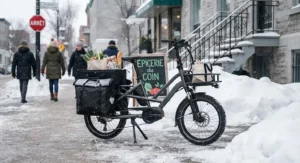
How to Choose an Urban eBike for Montreal Winters and Cobblestones
- Check the torque rating, not just wattage. A 500W motor with 65-80Nm of torque climbs Montreal’s hills far more comfortably than the same wattage with lower torque — torque, not peak power, is what you feel on an incline.
- Prioritize hydraulic over mechanical disc brakes. Hydraulic systems maintain more consistent stopping power as temperatures drop, which matters directly on icy pavement.
- Look for tire width of at least 2.3 inches, ideally fat (4-inch). Wider tires lower ground-pressure per square inch, which is exactly what smooths out both snow ruts and cobblestone gaps.
- Confirm the battery is removable. A removable pack lets you store it indoors overnight, which is the single most effective way to protect winter range and long-term battery health.
- Weigh suspension type against your actual streets. Front suspension alone helps with potholes; adding a suspension seatpost specifically targets the repetitive, lower-amplitude jolt that cobblestones produce.
- Match the frame style to your storage reality. A folding or lighter frame matters enormously if you’re carrying the bike up stairs daily; it matters far less if you have secure ground-floor parking.
- Factor in salt resistance, not just specs. Sealed hub gears and belt drives resist road-salt corrosion better than exposed chains and derailleurs, which affects your total cost of ownership more than the sticker price does.
Cobblestone Vibration Resistance: What Actually Absorbs the Bumps
Cobblestone vibration resistance comes down to three components working together, not any single feature. Tire volume does the first and biggest share of the work — a 4-inch fat tire run at lower pressure deforms around each stone edge rather than transmitting the shock upward, which is why every fat-tire bike in this guide rides noticeably calmer over Rue Saint-Paul than a narrow-tire hybrid would. Front suspension forks handle the second layer, smoothing out the front wheel’s impact before it reaches your hands and shoulders; the 80-95mm of travel found on the Aventon Aventure.3 and Eunorau FAT-AWD 3.0 sits in a genuinely effective range for urban riding without adding the weight or maintenance of a full mountain-bike fork.
The layer most bikes skip is the suspension seatpost, and it’s arguably the most underrated one. Cobblestones produce frequent, lower-amplitude jolts rather than occasional big hits, and that repetitive vibration is what riders actually feel as fatigue after twenty minutes on stone streets. A 50mm-travel suspension seatpost, as fitted on the Aventon Aventure.3 and available on the Gazelle Ultimate C380, specifically isolates the rider’s body from exactly that kind of repetitive input. Bikes without one, including otherwise well-equipped fat-tire models like the Eunorau FAT-AWD 3.0, still transmit meaningfully more chatter to the saddle — a trade-off worth knowing before you assume “fat tires” alone solve the problem.
Urban Transit eBike Montreal: Riding the REV Bike Network
For a lot of Montrealers, an urban transit ebike Montreal routine isn’t really about replacing a car — it’s about replacing a bus transfer or a long metro ride with something faster and more direct. The REV bike network — Réseau express vélo — is the backbone that makes this realistic in winter as well as summer. Announced in 2019 and first opened on rue Saint-Denis in November 2020, the REV is a planned 191 km of physically protected, bollard- or curb-separated bike lanes spread across 17 routes on the island. These lanes are plowed alongside regular roads, which is precisely why winter cycling has become genuinely practical here in a way it isn’t in most North American cities.
That infrastructure investment shows up in the ridership numbers. Reporting from CBC News on the city’s winter snow-clearing efforts found that keeping bike paths clear encourages meaningfully more people to commute by bike through the cold months, with officials estimating that winter cyclist counts have roughly doubled as clearing methods improved. If your commute runs anywhere near a REV corridor — Saint-Denis, Berri, or the growing western extensions toward Griffintown and Old Montreal — a bike with reliable hydraulic brakes and a torque sensor tuned for smooth stop-and-go power delivery, like the Taubik Blackburn 275T, is specifically well-matched to that riding style. Combine that with Montreal’s bike-friendly transit rules, which generally allow bikes on STM buses and select metro cars during off-peak hours, and an ebike stops being a summer toy and starts functioning as genuine year-round transportation.
Common Mistakes When Buying a Winter-Ready eBike
The most frequent mistake is buying based on wattage alone and ignoring torque, which leads to a bike that tops out on Montreal’s steeper grades even though the motor number “sounds” powerful. A close second is skipping hydraulic brakes to save a few hundred dollars — mechanical disc brakes work fine in summer but lose bite noticeably as cables stiffen in the cold, right when you need stopping power most. Buyers also frequently underestimate storage: a non-folding 26-inch fat-tire bike is a serious commitment if you live in a walk-up with no ground-floor parking, and that mismatch is a common reason bikes end up unused by January.
Another overlooked issue is battery capacity math. A battery rated for 60 km in summer conditions can realistically deliver closer to 40-45 km once the standard 20-35% cold-weather capacity loss is factored in, so buyers who cut it close on range in warm-weather test rides often get caught short in January. Finally, some buyers skip verifying Quebec’s power-assisted bicycle rules entirely, which is a real risk — a bike that exceeds 500W nominal output or fails to cut assist at 32 km/h is legally classified as a moped in Quebec, requiring licensing and insurance a standard ebike doesn’t need.
Safety, Regulations and SAAQ Compliance Guide
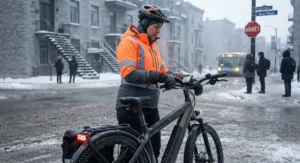
Quebec’s e-bike rules, overseen by the SAAQ, require that a power-assisted bicycle have functional pedals, a maximum continuous motor output of 500W, and motor assistance that cuts out once the bike reaches 32 km/h on flat ground. Every bike featured in this guide is built to meet that standard, which matters because exceeding it reclassifies the vehicle as a Class 6D moped requiring registration, insurance, and a licence. Quebec has also tightened enforcement around vehicles that resemble mopeds but are marketed as bikes, so it’s worth confirming a permanent power/speed label is affixed to any bike before you buy.
A CSA-, CPSC-, ASTM-, or EN-certified helmet is mandatory for all cyclists in Quebec, ebike riders included, and that requirement doesn’t relax in winter — if anything, a well-fitted helmet matters more when ice increases fall risk. It’s also worth knowing that SAAQ auto insurance does not automatically cover a solo ebike crash with no other vehicle involved, so riders relying on year-round commuting should look into separate cycling or ebike-specific coverage. None of this is meant to be alarming; it’s simply the compliance layer that sits underneath every spec sheet in this guide, and it’s worth five minutes of reading before your first ride.
Montreal Winter Maintenance: Protecting Your eBike from Salt, Slush and Cold
Montreal winter maintenance is less about the bike shop and more about a five-minute habit repeated consistently. Road salt is genuinely corrosive to exposed drivetrain components — chains, derailleurs, and cassette cogs — far faster than most riders expect, so a quick rinse or wipe-down after any slushy ride, followed by a light re-lubrication, meaningfully extends component life. This is exactly where the belt-drive and sealed-hub designs on bikes like the Gazelle Ultimate C380 earn their keep: there’s simply less exposed metal for salt to attack in the first place.
Tire pressure needs weekly attention through the winter, since cold air naturally reduces PSI and underinflated tires wear unevenly and handle less predictably on ice. Battery care follows the same logic discussed earlier — bring it inside between rides once temperatures drop meaningfully below freezing, and never plug in a battery that’s still cold from outdoor exposure. Finally, an annual spring tune-up focused specifically on brake pad wear and cable condition catches the accumulated toll of a full salt-and-slush season before it becomes a bigger repair, which is a smarter routine than waiting for something to fail mid-commute.
Long-Term Cost & Maintenance in a Salt-Heavy Climate
| Comparison | Traditional Bike | Urban eBike (this guide) | Car (Montreal average) |
|---|---|---|---|
| Winter usability | Low without studded tires | High with proper fat tires/suspension | High but subject to parking/snow bans |
| Annual maintenance in salt exposure | Low cost, frequent | Moderate, higher for exposed drivetrains | Higher (undercoating, brakes) |
| Approx. cost per km | Very low | Roughly C$0.10-0.15/km amortized | Often C$0.50+/km all-in |
| Storage footprint | Small | Small to moderate | Large (parking/garage) |
Looking at the comparison above, the ebikes in this guide land in a genuinely attractive middle ground: far cheaper per kilometre than car ownership once amortized over a few years, while offering winter capability that a standard bicycle simply can’t match without significant modification. The belt-drive and sealed-hub options, like the Gazelle Ultimate C380, shift more of that ongoing cost toward the upfront purchase price and less toward recurring chain and derailleur replacement — worth weighing against your own tolerance for either a bigger initial spend or more frequent small maintenance bills. Either way, the total cost of keeping any of these bikes running through a Montreal winter remains a fraction of the equivalent car ownership cost, even before accounting for parking and insurance.
Frequently Asked Questions
❓ Can regular ebikes handle Montreal winters?
❓ Do fat tire ebikes work well on cobblestones?
❓ What ebike motor power is legal in Quebec?
❓ How much range do ebikes lose in Montreal winter cold?
❓ Is the REV bike network cleared in winter?
Conclusion
There’s no single “best” urban ebike for Montreal winters and cobblestones — there’s a best match for your specific commute, storage situation, and budget. If you’re testing the waters, the Samebike XD26-II or ADO A20F+ Beast 20F get you riding for under C$1,600 without cutting every corner. If icy traction genuinely worries you, the Eunorau FAT-AWD 3.0‘s dual motors solve a problem single-motor bikes can’t. If Old Montreal’s stone streets are your daily reality, the Aventon Aventure.3‘s double suspension earns its price. And if you’re thinking in decades rather than seasons, the Gazelle Ultimate C380‘s belt drive and Bosch motor are built for exactly that.
What ties all seven together is that they solve the winter-and-cobblestone problem honestly, through real hardware — wide tires, genuine suspension, hydraulic brakes, and cold-tolerant batteries — rather than marketing language. Whichever one fits your life, check current pricing before you buy, since ebike prices shift often, and take the first ride slow until you know exactly how your new bike handles Montreal’s particular mix of stone and snow.
✨ Don’t Miss These Exclusive Deals! 🔍
Take your winter commute to the next level with these carefully selected picks. Click on any highlighted model to check current pricing and availability. These bikes will help you build a genuinely reliable year-round ride, no matter what Old Montreal’s streets throw at you!
Recommended for You
- Best Ebike for Toronto Commuting: 7 Top Picks for 2026
- Most Comfortable Commuter E-Bike: 7 Best Picks For 2026
- Fast Charging City Ebike: 7 Top Picks for Canada (2026)
Disclaimer: This article contains affiliate links. As an Amazon Associate, I earn from qualifying purchases. If you purchase products through these links, we may earn a small commission at no additional cost to you.
✨ Found this helpful? Share it with your friends! 💬🤗
