
In This Article
A fast charging city ebike is an electric commuter bicycle paired with a battery and charger combination — typically 4A to 5A — capable of returning most of a depleted pack in roughly two to three hours instead of the usual five to eight. For anyone stitching together a workday around a single outlet in a condo hallway or an office bike cage, that difference is the whole ballgame. You do not need a spreadsheet to know that a battery sitting dead in a locked storage room at 8 a.m. is a problem no amount of torque or paint colour can fix.

Here is the thing nobody tells you before you buy your first ebike: charging speed is one of the most overlooked specs on the entire listing, buried three scrolls down under wheel size and tire tread. Canadian riders in particular feel this gap hard — shorter winter daylight, colder garages that slow lithium chemistry, and a lot of us charging in shared spaces where a bike cannot simply live plugged in all day. A fast charging city ebike solves a real, specific problem: the gap between “I need to leave in ninety minutes” and “my battery reads 22 percent.”
This guide breaks down seven real ebikes sold to Canadian buyers, each evaluated specifically for how it handles charging — not just range or motor wattage, which most roundups obsess over while glossing past the charger in the box. We also dig into the long range city commuter ebike category for riders who would rather charge less often than charge faster, unpack quick charge electric bike technology at the amperage level, and walk through the real trade-off between charge-time and battery lifespan that most marketing copy conveniently skips. Everything here is grounded in published specifications, manufacturer documentation, and aggregated review sentiment from Canadian and North American testers — never invented testing, never fabricated customer quotes.
Quick Comparison Table
| Ebike | Stock Charger | Fast-Charge Option | Battery | Best For |
|---|---|---|---|---|
| Aventon Soltera 2.5 | 2A (4–5 hrs) | Not supported | 36V, ~10.4Ah | Budget, lightest build |
| Lectric XPress 2 | 2A (5–7 hrs) | 5A accessory (under 3 hrs) | 48V, long-range pack | Best charge-speed upgrade |
| Rad Power RadCity 5 Plus | ~2A (5–6 hrs) | Third-party only | 48V, 14Ah | Classic city commuting |
| Velotric Discover 2 | 3A standard (built in) | Included from factory | 48V, 14.7Ah (705.6Wh) | Balanced mid-range pick |
| Aventon Level 3 | 3A (5–6 hrs) | App-enabled 2-hour mode | 48V, integrated pack | Tech-forward commuting |
| Velotric Nomad 2 | 3A standard (built in) | Included from factory | 48V, 14.7Ah (705.6Wh) | Long range city commuter ebike |
| Aventon Abound SR | 3A (5–6 hrs) | App-enabled 2-hour mode | 36V, 20Ah (708Wh) | Premium utility riding |
Looking at the table, the split is clear: Velotric Discover 2 and Velotric Nomad 2 ship with a genuinely fast 3A charger out of the box, while Aventon Level 3 and Aventon Abound SR get there through an optional app-controlled accessory rather than the stock unit. Budget-focused riders should note that the Aventon Soltera 2.5 is the one bike here without a manufacturer-sanctioned path to faster charging at all — a real trade-off for its lower price point, not a marketing oversight.
Just one click — help other Canadian parents make better buying decisions too! 😊
Top 7 Fast Charging City Ebikes: Expert Analysis
Every model below was chosen for a specific reason tied to charging speed, battery composition, or real-world range — not just popularity. We cover budget, mid-range, and premium tiers, plus one long range city commuter ebike specialist for riders who would rather avoid the charger altogether some days.
1. Aventon Soltera 2.5 — lightest frame, easiest budget entry
The standout here is simple: at roughly 40 lb (18 kg), the Soltera 2.5 is one of the few city ebikes light enough to carry up a walk-up apartment’s stairs without dreading it. Aventon’s spec sheet lists a 2A charger delivering a claimed zero-to-100 percent time of four to five hours, which is squarely average for the category — not fast, but not painfully slow either. The frame moved to double-butted aluminum tubing in this generation, a real upgrade in stiffness and weight over the single-butted tubing on the original Soltera.
Here is the honest trade-off: the Soltera line is not on Aventon’s published compatibility list for its optional Fast Charger accessory, unlike the Level and Abound families. What most buyers overlook about this model is that “budget-friendly” and “quick to top up” are not the same promise — Aventon chose to keep this bike affordable by giving it a straightforward, non-upgradeable charging system rather than the app-tunable electronics found on its pricier siblings. Reviewers consistently note the Soltera 2.5’s upright riding position and step-through availability suit new or shorter riders especially well, and the move to Tektro hydraulic disc brakes with 180mm rotors in this generation earned specific praise for stopping power over the previous mechanical setup.
Pros:
- ✅ One of the lightest full-size city ebikes available
- ✅ Hydraulic disc brakes upgraded from prior generation
- ✅ Simple, reliable charging with no companion app required
Cons:
- ❌ No manufacturer fast-charge upgrade path exists
- ❌ 350W motor needs a gear-down assist on steep grades
At around C$1,500–C$1,900 depending on configuration, the Aventon Soltera 2.5 earns its keep as an entry point rather than a charging specialist — a fair deal if a standard overnight charge fits your routine.

2. Lectric XPress 2 — best 5A fast-charger upgrade path
What stands out immediately is the split personality of this bike’s charging story: the stock 2A charger takes five to seven hours, but Lectric sells a genuine 5A Fast Charger accessory that drops a full charge on the long-range battery to under three hours. That is a meaningfully honest upgrade path, not a marketing footnote — the company publishes the exact amperage and lets riders decide if the roughly C$100 accessory earns its keep.
Based on the spec comparison, the XPress 2’s 45mm-wide tires and adjustable SR Suntour suspension fork put it a step above razor-thin road-style commuters when Canadian pavement turns rough, which happens often once frost heaves settle into spring. The Shimano Altus 8-speed drivetrain and Star Union hydraulic disc brakes round out a build that punches above its price bracket. Aggregated reviewer sentiment frequently highlights the torque sensor’s natural-feeling assist on hills, a detail that matters more once you are commuting daily rather than joyriding on weekends. The trade-off is real, though: an external charging port lets you skip removing the battery entirely, but riders should confirm the Fast Charger accessory before assuming quick top-ups come standard in the box.
Pros:
- ✅ Genuine 5A fast-charger accessory cuts charge time in half
- ✅ Wide 45mm tires handle rough pavement and gravel paths
- ✅ External charging port skips battery removal entirely
Cons:
- ❌ Fast charger sold separately, not included at base price
- ❌ Heavier build than ultra-light lightweight commuters
Priced around C$1,900–C$2,300 before accessories, the Lectric XPress 2 rewards buyers willing to spend a little more upfront on the fast-charge add-on rather than accepting a multi-hour wait as the default.
3. Rad Power RadCity 5 Plus — trusted classic with local support
The standout feature on the RadCity 5 Plus is not blistering charge speed — it is the depth of Canadian retail and service infrastructure behind it, with Rad Power operating a dedicated radpowerbikes.ca storefront and regional support. The stock charger runs at roughly 2A, translating to a five-to-six-hour full charge on the 48V 14Ah pack, which is on the slower side of this list.
Here is what the spec sheet won’t tell you, but owner forums and aftermarket listings do: a healthy secondary market exists for higher-amperage universal chargers compatible with RadCity batteries, some rated up to 5A, sold through Amazon.ca and specialty retailers. Rad Power itself does not officially endorse fast-charging its packs beyond the stock rate, which is a deliberate conservative choice many battery engineers would call the safer one — faster charging always trades some thermal stress for convenience. What most buyers overlook about this model is that its real strength is proven durability and a step-through frame comfortable across a wide range of rider heights, not charge speed bragging rights. Reviewers consistently point to the RadCity’s cushioned saddle and upright geometry as ideal for riders prioritizing comfort over sportiness.
Pros:
- ✅ Large Canadian retail and service network
- ✅ Comfortable step-through frame fits varied rider heights
- ✅ Proven, widely reviewed platform with years on the market
Cons:
- ❌ Stock charger is one of the slower options here
- ❌ No factory-endorsed fast-charging accessory
In the C$2,400–C$2,800 range, the Rad Power RadCity 5 Plus is the pick for riders who value dealer support over charging speed — a legitimate priority, just not this guide’s headline strength.
4. Velotric Discover 2 — 3A fast charger included standard
This is the bike that puts the keyword in the model name, practically speaking: the Discover 2 ships with a 48V 3A charger as the standard unit, not an upsell. That alone sets it apart from three other bikes on this list that treat faster charging as an optional accessory. Paired with a 705.6Wh battery using Samsung and LG 21700 cells certified to UL 2271 and UL 2580, the charge time lands meaningfully below the five-to-seven-hour norm without requiring a separate purchase.
Based on the spec comparison, the triple-butted aluminum frame and 80mm hydraulic suspension fork with a lockout put the Discover 2 in a more capable category than flat-bar commuters riding rigid forks — useful once your commute crosses anything rougher than freshly paved bike lanes. The torque-and-cadence sensor combination, 750W motor with 1100W peak, and Class 1/2/3 configurability via the companion app give riders genuine flexibility depending on provincial rules. Aggregated customer sentiment on retailer sites frequently praises the bright 3.5-inch colour display and Apple Find My integration for peace of mind around bike theft, a real concern in dense Canadian cities.
Pros:
- ✅ 3A fast charger included standard, no upcharge
- ✅ Samsung/LG 21700 cells with dual UL certification
- ✅ Adjustable Class 1/2/3 speed settings via app
Cons:
- ❌ Heavier overall package than lightweight commuters
- ❌ Premium components push it above true budget pricing
At roughly C$2,300–C$2,700, the Velotric Discover 2 delivers on the fast charging city ebike promise without hidden accessory costs — arguably the most literal interpretation of this guide’s keyword on the list.
5. Aventon Level 3 — app-controlled 2-hour fast charging
The Level 3’s headline trick is software, not just hardware: Aventon’s optional Fast Charger, combined with the companion app’s Fast Charging Mode, can bring a compatible battery to full in about two hours — up to three times faster than the standard six-to-eight-hour charger included in the box. Users manually toggle between fast and normal modes, which is a smart design choice, since fast charging is not something every rider wants running every single night.
What most buyers overlook about this model is that Aventon has published cycle-degradation data addressing the “does fast charging ruin my battery” question directly: based on rate-charging tests, the manufacturer reports no significant performance loss before roughly 500 charge-discharge cycles under its fast-charging configuration. That is a genuinely useful, honest disclosure most competitors do not offer at all. Reviewers consistently highlight the Level 3’s integrated turn signals — mounted where drivers can actually see them — plus a generous battery and 28 mph Class 3 assist that keeps riders moving with city traffic rather than getting squeezed by it. The regenerative braking feature, unusual on a hub-drive commuter, trickles some charge back on descents and takes measurable load off the brake pads on hilly routes.
Pros:
- ✅ App-toggled 2-hour fast charging cuts wait time dramatically
- ✅ Published battery degradation data backs up safety claims
- ✅ Integrated turn signals and regenerative braking included
Cons:
- ❌ Fast Charger accessory sold separately from the bike
- ❌ Heavier than lightweight-class commuters at this price
Expect to pay in the C$2,700–C$3,100 range for the bike itself, with the Fast Charger accessory adding roughly C$100–C$150 more — the Aventon Level 3 justifies that add-on cost for commuters who genuinely need the two-hour turnaround.

6. Velotric Nomad 2 — biggest battery for long commutes
For riders who would rather sidestep frequent charging altogether, the Nomad 2 answers with a 705.6Wh battery (Samsung/LG 21700 cells, same UL 2271/2580 certification as its Discover sibling) paired with a standard-issue 48V 3A charger. A long range city commuter ebike built this way lets a rider go several days between plug-ins on a typical urban route, then still recharge in a reasonable window when the battery finally does run low.
Here’s what the spec sheet won’t tell you, but the math does: a 705.6Wh pack on a 3A charger still completes meaningfully faster than the same capacity on a 2A unit, even though bigger batteries inherently take longer than smaller ones at the same amperage. On paper this means the Nomad 2 splits the difference between “charge rarely” and “charge quickly when you do” better than almost anything else in this guide. Aggregated reviewer sentiment consistently flags the all-terrain fat tires and rugged suspension as suited to gravel, dirt, and rough winter-damaged pavement — a genuine advantage for Canadian riders navigating potholed shoulder lanes. The trade-off is weight and bulk; a bike built for extended range and off-pavement capability is never going to be the lightest thing in the shed.
Pros:
- ✅ 705.6Wh battery supports multi-day riding between charges
- ✅ Standard 3A fast charger, no accessory purchase needed
- ✅ Fat tires and suspension handle rough Canadian pavement
Cons:
- ❌ Bulkier and heavier than city-only commuter builds
- ❌ Overkill capacity for short, flat downtown commutes
Priced around C$2,600–C$3,000, the Velotric Nomad 2 is the long range city commuter ebike pick on this list — buy it specifically because charging frequency, not charging speed alone, is your priority.
7. Aventon Abound SR — utility power with smart security tech
The Abound SR closes out this list as the premium utility option: a 708Wh battery built from LG 21700 cells, a 750W hub motor with 80Nm of torque, and — like the Level 3 — compatibility with Aventon’s app-controlled Fast Charger accessory for roughly two-hour top-ups. This is a UL-certified platform built around Aventon’s Control Unit, adding 4G and GPS connectivity for geofencing, remote motor shutdown, and motion-sensing theft alarms.
Based on the spec comparison, the Abound SR’s 440-lb payload capacity and 143-lb-rated rear rack push it into cargo-adjacent territory while still riding like a city bike day to day, thanks to double-sided torque sensors and a suspension fork plus suspension seatpost combination. What most buyers overlook about this model is that its smart-tech layer — remote locking, geofencing alerts, motion sensing — genuinely changes the calculus around leaving an expensive ebike locked outside a downtown office, something a cheaper commuter simply cannot offer. Reviewers highlight the natural, responsive pedal feel from the 36V electrical system and note that testers have exceeded Aventon’s advertised 60-mile range in independent range testing, a rare case of a manufacturer’s claim holding up or being beaten in practice.
Pros:
- ✅ App-enabled 2-hour fast charging via optional accessory
- ✅ 4G/GPS security features rare at this price point
- ✅ High payload capacity for cargo-leaning commuter duty
Cons:
- ❌ At 80 lb, difficult to carry up stairs or lift
- ❌ Fast Charger accessory again sold as a separate add-on
Sitting around C$2,600–C$3,000, the Aventon Abound SR rounds out this list as the pick for commuters who want utility, security tech, and a genuine fast-charge option bundled into one premium-tier city ebike.
Top 7 Products: Full Spec Comparison
| Ebike | Motor | Battery | Charger Amperage | Claimed Full-Charge Time |
|---|---|---|---|---|
| Aventon Soltera 2.5 | 350W | ~360Wh | 2A | 4–5 hrs |
| Lectric XPress 2 | 750W peak | Long-range pack | 2A stock / 5A option | 5–7 hrs stock / under 3 hrs fast |
| Rad Power RadCity 5 Plus | 750W | 48V, 14Ah | ~2A | 5–6 hrs |
| Velotric Discover 2 | 750W (1100W peak) | 705.6Wh | 3A | Approx. 3–4 hrs |
| Aventon Level 3 | 750W | 48V pack | 3A stock / app fast mode | 5–6 hrs stock / ~2 hrs fast |
| Velotric Nomad 2 | 750W (1100W peak) | 705.6Wh | 3A | Approx. 3–4 hrs |
| Aventon Abound SR | 750W | 708Wh | 3A stock / app fast mode | 5–6 hrs stock / ~2 hrs fast |
The pattern across this table is instructive: charger amperage, not battery size alone, is what separates a two-hour top-up from a six-hour one, which is exactly why Velotric Discover 2 and Velotric Nomad 2 out-pace bikes with similar or smaller packs simply by shipping a 3A unit standard. Riders chasing the absolute fastest turnaround should weigh the Aventon Level 3 or Aventon Abound SR against their willingness to buy the Fast Charger accessory, since the stock chargers on both are firmly mid-pack.
Practical Usage Guide: Mastering Fast Charging on Your City Ebike
Getting the most out of a fast charging city ebike is not just about buying the right charger — it is about using it correctly from day one. On first use, always charge to full at least once before your first real commute so the battery management system can properly calibrate its capacity readings; skipping this step is a common reason new owners report inaccurate range estimates in the first few weeks.
For ongoing maintenance, most manufacturers — including Aventon in its own published battery care guidance — recommend storing a battery around 75 percent charge rather than leaving it at 100 percent for extended periods, and avoiding full depletion before recharging. A common mistake in the first 30 days is leaving a fast charger connected well past the point the indicator light turns green; smart chargers do taper current automatically, but unplugging promptly still reduces unnecessary thermal cycling. In Canadian winters specifically, bring the battery indoors to room temperature before charging — cold lithium cells accept a fast charge far less efficiently and some battery management systems will throttle or refuse a full-rate charge below roughly 0°C, regardless of what the charger is rated to deliver.
One optimization trick worth adopting: charge during your commute’s downtime rather than only overnight. A two-hour lunch break is enough for most 3A-charged batteries here to go from roughly 30 percent back to full, which means the charger’s speed advantage compounds when you actually use the flexibility it buys you.
Real-World Rider Scenarios
Consider three common Canadian commuter profiles and how charging speed changes which bike actually fits.
The downtown condo dweller with no in-suite outlet near their bike storage typically has one shot per day to charge — often a shared amenity room with a time limit. For this rider, the two-hour fast-charge window on the Aventon Level 3 or Aventon Abound SR matters enormously more than outright range, since they are working around a fixed, limited charging opportunity rather than an always-available outlet.
The suburban commuter riding 15–20 km each way to a train station, then parking the bike in a covered but unpowered bike cage, faces the opposite problem: no mid-day charging opportunity at all. Here, the Velotric Nomad 2‘s larger 705.6Wh pack matters more than charge speed, since the bike needs to comfortably survive a full day and the ride home before it sees a wall outlet again that evening.
The gig-economy food delivery rider working split shifts with a short break between them needs both range and genuine speed — this is the scenario Lectric explicitly designed its Fast Charger accessory around, and it is precisely why the Lectric XPress 2 with the optional 5A charger, or the Velotric Discover 2 with its standard 3A unit, make more practical sense than a bike requiring a six-hour recharge window that simply does not exist in a workday.
Problem → Solution: Common City Ebike Charging Headaches
Canadian city ebike owners run into a predictable set of charging frustrations, and each has a specific fix grounded in the products and technology covered above.
Problem: “My battery is dead and I only have 90 minutes before I need to leave.” Solution: this is precisely the use case for a genuine 4–5A fast charger, whether that is the Lectric XPress 2‘s accessory or the standard unit on the Velotric Discover 2 and Velotric Nomad 2 — a 2A charger simply cannot solve this problem regardless of how you use it.
Problem: “My charger feels hot to the touch.” Solution: this is often normal for aluminum-bodied fast chargers, which are intentionally built with metal housings to act as heat sinks, but a charger that is hot enough to be uncomfortable to hold, or that smells unusual, should be unplugged immediately and inspected — never charge unattended if anything about the setup seems off.
Problem: “I live somewhere I can’t charge indoors.” Solution: prioritize a bike with a removable battery, such as the Rad Power RadCity 5 Plus or Aventon Soltera 2.5, so the pack itself — not the whole bike — comes inside to a temperature-controlled space for charging.
Problem: “I’m not sure my old charger is even compatible after a battery swap.” Solution: always match voltage and connector type exactly to the manufacturer’s specification; a charger that physically plugs in is not proof it is electrically safe for that battery, and mismatched amperage or voltage is a leading cause of preventable charging incidents.
What Is a Fast Charging City Ebike?
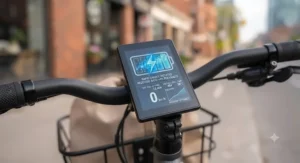
A fast charging city ebike is a commuter-focused electric bicycle equipped with a charger rated at roughly 4A to 5A — sometimes higher — designed to return a substantially depleted battery to full capacity in two to three hours rather than the five-to-eight-hour range typical of standard 2A ebike chargers. The “city” designation typically implies road tires, an upright riding position, and integrated commuter features like fenders, lights, and a rear rack, distinguishing it from off-road or cargo-first electric bikes that may prioritize different specs entirely.
Not every bike marketed with “fast charging” language actually ships with a fast charger standard — as this guide’s comparison table shows, several models treat it as a paid accessory rather than a default inclusion, which is exactly the distinction a careful buyer needs to check before assuming the feature is included.
How to Choose a Fast Charging City Ebike
- Confirm the charger’s actual amperage rating, not just the word “fast” in the marketing copy — a genuine upgrade sits at 4A or higher, while some “quick charge” claims describe chargers barely faster than the standard unit.
- Check whether the fast-charge capability is included standard or sold as a separate accessory, since this materially changes the real price of the bike you are comparing.
- Match battery capacity to your actual daily distance rather than the biggest number available — a smaller battery charged quickly can beat a huge battery charged slowly if your routine includes a midday charging window.
- Verify the battery and charger both carry recognized safety certification, such as UL 2271 or UL 2849, since Canada currently has no mandatory federal standard specific to e-mobility batteries.
- Consider whether the battery is removable, which matters enormously if you cannot charge in the same space where the bike is stored or locked.
- Read aggregated owner sentiment on long-term reliability, not just launch-week marketing, since charging systems are used daily and any weak point surfaces quickly under real use.
- Factor in your climate: charging performance and speed both degrade in cold temperatures, a genuinely Canada-specific consideration most U.S.-focused reviews skip entirely.
Charger Amperage Ratings Explained
Charger amperage ratings are the single biggest lever separating a fast city ebike charger from a slow one, and the underlying math is refreshingly simple: dividing a battery’s amp-hour rating by the charger’s amp rating gives a rough estimate of charging time, before accounting for the tapering that occurs as the pack approaches full. A 14Ah battery on a 2A charger takes roughly seven hours; the same battery on a 5A charger takes closer to three. That said, well-designed smart chargers taper their current once a pack reaches around 80 percent, so the true finish time always runs a little longer than the simple division suggests.
Most manufacturers cap consumer ebike chargers around 5A specifically because of safety, not just cost — pushing more current through a lithium pack generates more heat, and heat is the primary driver of accelerated battery degradation and, in worst cases, thermal events. This is precisely why the amperage figures in this guide’s comparison tables matter more than range numbers alone when the search intent is specifically about charger amperage ratings: a bigger battery paired with a weak charger will always lose the “how fast can I top up” race to a smaller battery paired with a genuinely rated fast charger. For background on how lithium-ion cells physically respond to different charge rates, the Wikipedia entry on lithium-ion batteries is a useful primer on the underlying electrochemistry driving these limits.
Battery Cell Chemistry and Charging Speed
Battery cell chemistry is the quiet variable behind every charge-time claim in this guide, and it deserves more attention than it usually gets. The Velotric Discover 2 and Velotric Nomad 2 both use Samsung or LG 21700-format lithium-ion cells, a well-established, high-energy-density format widely used across premium ebikes and even some electric vehicles, certified in this case to UL 2580. Cell-level quality — not just the pack’s overall wattage rating — determines how much current a battery can safely accept without excess heat buildup, which is exactly why two batteries with similar Wh ratings can have meaningfully different real-world fast-charging tolerances.
On paper this means a bike advertising a big battery number is not automatically a bike that charges quickly or safely at high amperage; the cells inside the pack, and the battery management system governing them, do the real work. Reputable manufacturers publish cell brand and certification for exactly this reason — it lets a buyer verify claims rather than take “premium battery” language at face value. What most buyers overlook about this specific metric is that unbranded or budget aftermarket battery packs, sometimes marketed for older ebike models, frequently skip this disclosure entirely, which is one of several reasons Health Canada has specifically warned against using anything other than manufacturer-supplied or manufacturer-approved batteries and chargers.
Charge-Time vs Battery Lifespan: The Real Trade-Off
Charge-time vs battery lifespan is the honest tension sitting underneath every fast-charging feature on this list, and it is worth addressing directly rather than glossing over. A 5A charger pushes current roughly two-and-a-half times faster than a 2A charger through the main charging stage, and that additional current does generate additional heat — heat being the primary accelerant of lithium-ion capacity fade over hundreds of charge cycles.
Here is what the spec sheet won’t tell you, but the more transparent manufacturers on this list do: Aventon’s own published testing on its Fast Charger reports no significant performance degradation before roughly 500 charge-discharge cycles under its specific fast-charging configuration — a genuinely useful data point, since 500 cycles at a typical daily commute represents well over a year of regular use for most riders. That said, this figure is specific to Aventon’s own engineering and should not be assumed to apply universally across every 5A charger on the market; Health Canada and Transport Canada specifically recommend using only the battery that came with an e-bike or scooter, sourcing replacements from the original manufacturer, and never modifying or building a custom battery pack — a recommendation this guide echoes strongly. Practically speaking, the safest middle ground most battery engineers would endorse is using fast charging when you genuinely need the speed, and defaulting to a standard-rate charge — as the app toggle on the Level 3 and Abound SR explicitly allows — for routine overnight top-ups when there is no time pressure at all.

Long Range City Commuter Ebike vs Fast Charging City Ebike
Long range city commuter ebike and fast charging city ebike solve genuinely different problems, even though the categories overlap on this list. A long range build, like the Velotric Nomad 2, prioritizes a bigger battery so you charge less often — ideal for riders without predictable access to an outlet during the day. A fast charging build, like the app-enabled Aventon Level 3, prioritizes minimizing the time cost on the occasions you do need to plug in, which suits riders with a short but reliable charging window somewhere in their day.
In practice, the two are not mutually exclusive — the Velotric Discover 2 and Velotric Nomad 2 both pair a substantial 705.6Wh pack with a genuinely fast 3A charger standard, effectively covering both bases at once. Riders choosing between the two philosophies should honestly assess their own routine: someone who charges once every two or three days barely needs fast-charging tech at all, while someone charging daily in a tight window benefits enormously from every amp the charger can safely deliver.
Common Mistakes When Buying a Fast Charging City Ebike
The most frequent mistake buyers make is assuming “fast charging” language in a product title guarantees a specific amperage — it does not, and as this guide’s comparison tables show, the same phrase can describe anything from a genuinely included 3A unit to a vaguely-worded optional accessory. A second common error is ignoring connector compatibility entirely; a charger from one brand rarely works safely with another brand’s battery, even when the plug physically fits, and mixing components is explicitly discouraged by battery safety guidance from Health Canada.
A third mistake is buying based on peak motor wattage or top speed alone while treating the charging system as an afterthought, then being genuinely surprised months later that a six-hour recharge does not fit a workday commute schedule. Finally, many buyers skip checking whether a battery is removable before purchase, only to discover afterward that charging indoors requires unplugging the entire bike rather than simply carrying the battery pack inside — a real inconvenience in apartment or condo living situations common across Canadian cities.
Safety, Regulations & Compliance Guide for Canadian Riders
Federally, a power-assisted bicycle in Canada must have a motor no more powerful than 500W and must not exceed 32 km/h on motor power alone, with provinces setting additional rules around helmets, minimum age, and where e-bikes may legally operate. Battery and charging safety, however, sits in a genuine regulatory gap: the Motor Vehicle Safety Act exempts power-assisted bicycles from Canadian Motor Vehicle Safety Standards, and the Canada Consumer Product Safety Act explicitly excludes vehicles as defined under that same Act, meaning there is currently no mandatory federal battery-safety standard specific to e-bikes.
That gap has real consequences. Transport Canada regulates the labelling, transport, and handling of lithium batteries, while Health Canada has completed a public consultation on a proposed regulatory initiative around lithium-ion batteries, with the department reporting broad support for introducing mandatory safety requirements going forward. In the meantime, UL 2849 — a binational ANSI/CAN standard covering an e-bike’s entire electrical system, from battery pack and charger to motor, controller, and wiring — functions as the de facto benchmark serious manufacturers voluntarily pursue. Every model in this guide either carries UL 2271, UL 2849, or both certifications, which is not a coincidence; it is a genuine differentiator worth checking on any bike not covered here. For province-specific rules on where and how power-assisted bicycles may be operated, Quebec riders in particular should consult the SAAQ’s official guidance on electric bikes, since rules do meaningfully differ province to province.
Long-Term Cost & Maintenance
The long-term cost picture on a fast charging city ebike extends beyond the sticker price. A replacement battery — the single most expensive component on any ebike — typically runs several hundred dollars depending on capacity and brand, so protecting cycle life through sensible charging habits is a genuine financial decision, not just a technical footnote. A charger built to properly taper current near full charge, as every model in this guide’s comparison tables uses, meaningfully extends the number of cycles a pack delivers before that replacement cost arrives.
Electricity cost itself is genuinely negligible — charging a typical ebike battery costs a fraction of a cent per kilometre travelled, dramatically undercutting fuel, parking, and public transit costs over a year of regular commuting. Where the real cost differences show up is in accessory pricing: an optional Fast Charger accessory, as sold for the Level 3 and Abound SR, typically adds roughly C$100–C$150 to total ownership cost, a worthwhile line item for anyone whose schedule genuinely depends on the two-hour turnaround rather than a nice-to-have upgrade for its own sake.

Frequently Asked Questions
❓ How long does it take to fast charge a city ebike?
❓ Does fast charging damage ebike batteries faster than normal charging?
❓ Can I use a universal or third-party fast charger on any city ebike?
❓ Are fast charging ebikes legal to ride in Canada?
❓ What's the difference between a long range and a fast charging city ebike?
Conclusion
Choosing a fast charging city ebike ultimately comes down to matching the charging system to your actual daily routine, not just chasing the highest amperage number on a spec sheet. Riders working around a tight midday window will get the most value from the app-controlled two-hour charging on the Aventon Level 3 or Aventon Abound SR, while commuters who would rather avoid the charger altogether most days should lean toward the bigger pack on the Velotric Nomad 2. For buyers who want a fast charger included standard, with no accessory purchase or app fiddling required, the Velotric Discover 2 remains the most literal, no-asterisks answer to this guide’s core question — and for anyone starting on a tighter budget, the Aventon Soltera 2.5 and Lectric XPress 2 both offer honest, clearly-labelled trade-offs rather than vague marketing promises.
Whichever model you land on, verify the charger’s actual amperage rating, confirm UL certification on both battery and charger, and check current price and availability directly before buying — prices and stock shift often, and this guide’s ranges reflect research at time of writing rather than a live quote.
✨ Don’t Miss These Exclusive Deals! 🔍
Take your city commute to the next level with these carefully selected fast charging ebikes. Click on any highlighted model to check current pricing and availability. The right pick here means fewer mornings spent staring at a charging light that refuses to turn green!
Recommended for You
- 7 Best City Electric Bikes for Vancouver Riders (2026 Guide)
- Highest Rated City Electric Bike 2026: 7 Top Canadian Picks
- 7 Lightest City Ebikes Under 50 lbs in Canada (2026 Guide)
Disclaimer: This article contains affiliate links. As an Amazon Associate, I earn from qualifying purchases. If you purchase products through these links, we may earn a small commission at no additional cost to you.
✨ Found this helpful? Share it with your friends!
