
In This Article
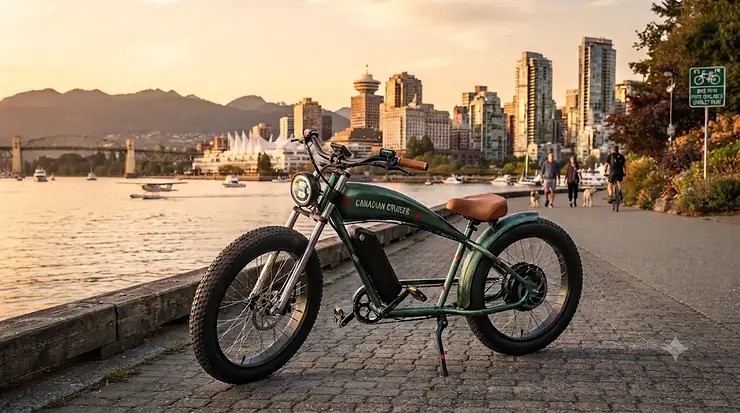
A chopper electric bike is a battery-powered bicycle built with a stretched, low-slung frame and extended fork that mimics the look of a classic custom motorcycle, typically paired with wide tires and a relaxed, feet-forward riding position. That’s the whole idea in one sentence — but living with one is a different story, and that’s what this guide is actually about.
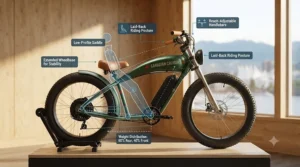
Here’s the thing nobody tells you before you fall down the YouTube rabbit hole of chopper builds: the silhouette that makes these bikes so photogenic is also the thing that changes how they ride, park, and fit in your garage. A stretched wheelbase feels glued to the road at 30 km/h and clumsy at 5 km/h in a parking lot. An extended fork looks incredible raked out at forty-five degrees and steers noticeably slower than a standard bike fork. None of that is a dealbreaker — it’s just the trade you’re making, and it’s worth understanding before your money’s committed.
We spent this guide digging through real specs, real owner feedback, and Canadian road rules to line up seven genuine chopper-style electric bikes — budget, mid-range, and full-send premium — so you can see what you’re actually buying instead of just what looks good in a product photo. We’ll walk through motor output and battery chemistry in plain English, compare a stretched frame against a standard e-bike frame, and get honest about where a chopper electric bike stops being a bicycle under Canadian law and starts being something you need a licence for. Grab a coffee; there’s a lot to cover, and all of it matters before you click “buy.”
Quick Comparison: Chopper Electric Bikes at a Glance
| Model | Motor | Battery / Range | Top Speed | Best For |
|---|---|---|---|---|
| Tracer Twenty5 GT | 500W hub | 48V 17.5Ah / 30–60 mi | ~40 km/h | Budget first-timers |
| Super73-S1 | 500W nom. / 1000W peak | ~768Wh removable / 25–50 mi | ~35–40 km/h | Iconic retro styling |
| Addmotor M-66 R7 | 750W Bafang | 48V, 12 lb pack | ~40 km/h | Two-up cruising |
| Tracer Signature Pro | 800W hub | 48V lithium-ion | ~40 km/h | Tech-loaded commuting |
| Addmotor MOTAN M-5500 | 750W-class | 48V lithium-ion | ~32–40 km/h | All-terrain fat-tire riding |
| Addmotor Herotank | 2000W | 48V high-capacity | 45+ km/h | Power-hungry cruisers |
| Eahora M1PS | 4000W hub | 72V 40Ah / 35–75 mi | ~80 km/h | Motorcycle-style riders (moped-class) |
Even a quick scan of this table tells you something the marketing photos won’t: there’s roughly an eightfold spread in motor output between the cheapest and most powerful bike here, and that gap changes everything from your provincial legal classification to your insurance obligations. The Tracer Twenty5 GT and Super73-S1 sit closest to what most provinces still recognize as a standard power-assisted bicycle, while the Eahora M1PS is, functionally, an electric moped wearing a bicycle’s clothing. Buyers chasing hill-climbing torque or two-up capacity should weight the Addmotor M-66 R7 and Addmotor Herotank more heavily, since their higher-output motors handle grades and passenger weight with far less strain than the 500W entry-level models.
💬 Just one click — help others make better buying decisions too!😊
Top 7 Chopper Electric Bikes: Expert Analysis
1. Tracer Twenty5 GT — best budget entry into chopper styling
The Twenty5 GT is where most riders discover chopper electric bikes actually exist in an affordable form, and its 26-inch stretched frame with a triple-tree twin-crown fork delivers the raked-out silhouette without the premium price tag. The 500W brushless rear hub motor and 48V 17.5Ah lithium-ion pack combine for a claimed 30 to 60 mile range, with three riding modes and five levels of pedal assist letting you dial in anything from a leisurely cruise to full-throttle commuting. What most first-time buyers overlook is that the battery is integrated directly into the frame rather than removable, which keeps the chopper’s clean lines intact but means you’re charging it in place near an outlet rather than pulling the pack inside overnight — a real consideration if you park outdoors or in a shared garage. Based on the spec sheet, the 25 mph top speed puts this bike above the 32 km/h motor-assist ceiling that most Canadian provinces still apply to power-assisted bicycles, so riders should confirm their local classification before treating it as a licence-free bicycle. Owner feedback collected on the manufacturer’s own product pages consistently praises the retro leather-look saddle, the head-turning look in person, and straightforward doorstep assembly, though some buyers note the bike’s substantial weight makes it awkward to lift onto a car rack alone.
Pros:
- ✅ Lowest cost of entry into true chopper styling
- ✅ Five PAS levels for flexible power delivery
- ✅ Distinctive retro looks that draw attention everywhere
Cons:
- ❌ Non-removable integrated battery limits charging flexibility
- ❌ Top speed may exceed provincial power-assisted bicycle limits
At the time of research, pricing for the Twenty5 GT typically lands in the C$2,000–C$2,900 range depending on colour and retailer promotions — always check current listings, since e-bike pricing shifts often. As a value proposition, it’s hard to beat if chopper aesthetics matter more to you than raw output.
2. Super73-S1 — the original mini-bike chopper that started the trend
If you’ve seen a chopper-style electric bike in a magazine or on Instagram, there’s a decent chance it was a Super73-S1, and the bare-bones steel frame with the fuel-tank-style battery mount is largely responsible for kicking off this entire product category. Its 500W nominal, 1,000W peak rear hub motor is paired with a removable battery pack (reported between roughly 696Wh and 768Wh depending on production run), giving an estimated 25 to 50-plus miles of range depending on whether you lean on the throttle or lean on the pedals. What the spec sheet won’t tell you, but independent testers consistently note, is that the S1’s governed 20 mph top speed reads more like 23 to 25 mph in the real world on flat ground under throttle alone — useful to know if you’re trying to stay inside a specific legal speed threshold. Reviewers who’ve compared the S1 directly against a 50cc gas scooter describe the riding experience as closer to a bicycle with a serious power boost than a true motorcycle, thanks to its Class 2 throttle-plus-pedal-assist design and cadence-based PAS sensor. The bike’s steel construction gives it a claimed weight around 60 pounds (27 kg), which owners describe as reassuringly solid but not something you’ll want to carry up an apartment stairwell often.
Pros:
- ✅ Removable battery simplifies indoor charging and storage
- ✅ Widely recognized, proven design with a large accessory ecosystem
- ✅ Tektro hydraulic disc brakes for confident stopping power
Cons:
- ❌ Real-world top speed runs faster than the advertised rating
- ❌ No suspension, so rough pavement transmits to the rider
Expect pricing in the C$3,000–C$4,200 range at Canadian retailers and marketplaces, with the exact figure shifting by battery size and accessory bundle — confirm current pricing before ordering. For riders who want the bike that basically invented this category, the S1 remains a defensible premium.
3. Addmotor M-66 R7 — best for two-up cruising and hill torque
The M-66 R7 leans harder into the “motorcycle” half of motorcycle-style electric bike than most of its rivals, largely thanks to a 750W geared Bafang rear hub motor and a wide, padded chopper saddle explicitly designed to carry a passenger, complete with foldable rear footpegs. That 750W motor, sitting comfortably above the 500W ceiling recognized in most provinces, translates in practice to noticeably stronger torque off the line and better hill-holding than the entry-level 500W bikes on this list — reviewers who logged extended rides report the throttle response as immediate even with a second rider aboard. On paper this is a Class 2 machine with a 25 mph assisted top speed, and aggregated review sentiment collected by independent bike-testing outlets describes the ride quality as comfortable and stable at speed, with the plush saddle repeatedly singled out for praise on longer rides. The trade-off is weight: Addmotor’s claimed curb weight sits around 74 pounds, but independent scale checks from reviewers have put the actual figure closer to 86 pounds once the battery and accessories are mounted, and that mass shows up as sluggish low-speed maneuvering, particularly for taller riders who find the frame geometry awkward to pedal manually. Reviewers are split on the claimed range, with several noting real-world figures fall well short of the marketing number unless you stay in the lowest pedal-assist tier the entire ride.
Pros:
- ✅ 750W motor delivers strong torque for hills and passengers
- ✅ Purpose-built passenger saddle and footpegs
- ✅ Praised throttle response from a dead stop
Cons:
- ❌ Actual weight runs well above the claimed spec
- ❌ Difficult to pedal manually if the battery runs low
The M-66 R7 typically sits in the C$2,900–C$3,700 range depending on configuration — as always, treat this as a starting point and check the current listing before buying. For riders who actually plan to carry a passenger regularly, this is one of the few chopper electric bikes purpose-built for that job.
4. Tracer Signature Pro — best tech-loaded commuter chopper
The Signature Pro takes the stretched chopper cruiser formula and bolts on genuinely useful commuter tech: a built-in cigarette-lighter-style 12V outlet and a USB charging port mounted where you can actually reach them while riding. Powered by an 800W rear hub motor, it sits in a power band above the entry-level Twenty5 but below the true high-output builds later on this list, giving it noticeably punchier acceleration from a stop without venturing into moped territory. What most buyers overlook about this model is that the onboard charging ports mean you can top up a phone or a portable speaker mid-ride, which sounds like a gimmick until you’re the rider whose phone dies twenty minutes into a group ride and everyone else’s doesn’t. Based on the spec comparison against its Tracer siblings, the Signature Pro’s frame geometry and stretched wheelbase deliver the same low-slung stability that defines this whole category, and the retro-styled bodywork keeps the vintage motorcycle cues intact. Aggregated customer sentiment collected from Tracer’s own storefront consistently flags the bike as easy to assemble out of the box and comfortable for extended rides, though as with most manufacturer-hosted reviews, that feedback should be weighed alongside independent sources rather than taken at face value alone.
Pros:
- ✅ Onboard USB and 12V charging ports for accessories
- ✅ 800W motor bridges budget and premium power tiers
- ✅ Classic stretched chopper bodywork and styling
Cons:
- ❌ Manufacturer-hosted reviews dominate available feedback
- ❌ Heavier than non-chopper commuter e-bikes in the same price band
Pricing at the time of research generally falls in the C$2,600–C$3,400 range — prices vary by retailer and season, so confirm the current figure before purchasing. If onboard charging genuinely matters to your commute, this is the most sensible pick on the list.
5. Addmotor MOTAN M-5500 — best all-terrain fat-tire chopper
Where most chopper electric bikes are built for pavement, the MOTAN M-5500 is engineered around versatility, wrapping its retro chopper silhouette around a set of aggressive fat tires rated for snow, sand, and loose gravel without sacrificing the smooth ride quality the category is known for on regular streets. The four-inch tire footprint does double duty here: it’s part of the styling, echoing the wide rear tire of a real chopper motorcycle, and it’s a genuine functional upgrade for riders whose commute includes unpaved trails, winter conditions, or beach access roads. Here’s what to weigh with a bike like this — that extra tire volume adds rolling resistance compared to a standard road tire, so expect somewhat shorter real-world range than the pavement-only models on this list even with a comparable battery. Reviewers who’ve tested the M-5500 alongside Addmotor’s other cruiser models describe it as one of the more comfortable all-terrain e-bikes in this class, citing the padded seat and upright riding position as easy on the back over multi-hour outings. The pedal-assist system layers on top of a standard throttle, giving riders the option to treat it as a true bicycle when they want the workout or lean on the motor when they don’t.
Pros:
- ✅ Genuinely capable on snow, sand, and gravel
- ✅ Comfortable seating position for long rides
- ✅ Retains classic chopper styling despite off-road capability
Cons:
- ❌ Fat tires add rolling resistance and reduce efficiency
- ❌ Heavier overall package than pavement-focused choppers
Expect a price point in the C$2,700–C$3,600 range depending on trim — check current availability, as fat-tire models often sell out seasonally ahead of winter. For Canadian riders who actually need to ride through snow or sand, the value case here is strong.
6. Addmotor Herotank — best high-power premium chopper
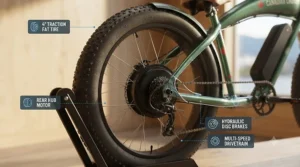
The Herotank is Addmotor’s answer to riders who want chopper styling without compromising on raw power, built around a 2,000W motor and an extended, motorbike-proportioned frame that pushes this bike closer to the moped end of the spectrum than a conventional bicycle. That output is roughly four times what a standard 500W power-assisted bicycle carries, and in practice it shows up as dramatically stronger acceleration and hill-climbing ability than anything else on this list short of the Eahora M1PS further down. Reviewers consistently note that bikes in this power class are built with reinforced frames and larger-diameter tires to handle the added stress, and the Herotank follows that pattern, prioritizing strength and durability alongside its speed. What most buyers overlook about a 2,000W chopper electric bike is the legal classification problem: at this wattage, the bike almost certainly falls outside every province’s power-assisted bicycle definition, meaning it may require licensing, registration, or insurance depending on where you live — treat this as a serious purchase decision, not just a spec upgrade. Aggregated feedback on high-output Addmotor models generally praises the confidence-inspiring stability at speed, crediting the extended wheelbase and lower center of gravity that define the chopper silhouette in the first place.
Pros:
- ✅ Class-leading acceleration and hill-climbing torque
- ✅ Reinforced frame built for sustained high power
- ✅ Stable, planted feel at higher speeds
Cons:
- ❌ Likely exceeds power-assisted bicycle limits in every province
- ❌ Heavier and pricier than pavement-cruiser alternatives
Pricing at the time of research typically runs C$3,800–C$5,200 depending on configuration — confirm current listings, and factor potential licensing or insurance costs into your total budget before buying.
7. Eahora M1PS — best for riders who want the full motorcycle-style experience
The M1PS is less a bicycle with a motor and more an electric moped wearing chopper bodywork, and its numbers back that up: a 4,000W hub motor producing roughly 178 N·m of torque, drawing from a 72V 40Ah battery pack that independent testing has clocked at 35 to 75 miles of range depending on riding mode. On paper this means acceleration that reviewers describe as an instant, silent surge rather than the more gradual power delivery of a traditional pedal-assist e-bike, and a top speed that independent test riders have recorded around 50 mph — territory that puts this firmly outside any Canadian province’s bicycle classification. A hydraulic front fork and twin rear shocks handle the extra weight and speed with genuine suspension travel, something none of the pavement-cruiser models on this list offer, and testers note the low center of gravity makes low-speed maneuvering in traffic feel more composed than the bike’s size suggests. The trade-off for all that power is a single-speed drivetrain with no engine braking to speak of, meaning riders lean entirely on the brakes to scrub speed, and the bike’s substantial curb weight makes it a poor fit for anyone hoping to pedal it unassisted. Reviewers who tested extended runs found eco mode stretched range meaningfully further than full-throttle riding, which matters if daily mileage is a priority.
Pros:
- ✅ Motorcycle-grade torque and genuine suspension travel
- ✅ Long real-world range in eco mode
- ✅ Composed low-speed handling despite its size
Cons:
- ❌ Almost certainly classified as a moped or motorcycle, not a bicycle
- ❌ No engine braking and heavy overall mass
Pricing generally lands in the C$5,500–C$7,500 range at the time of research — verify the current figure, and budget separately for whatever licensing or insurance your province requires. This is the pick for riders who’ve decided styling isn’t enough and want genuine motorcycle-adjacent performance.
How the Full Lineup Compares
| Model | Frame Style | Legal Category (typical) | Value Verdict |
|---|---|---|---|
| Tracer Twenty5 GT | Stretched chopper | Borderline PAB | Best entry price |
| Super73-S1 | Mini-bike chopper | Class 2 / PAB-adjacent | Strong resale, proven design |
| Addmotor M-66 R7 | Extended chopper | Class 2 | Best for passengers |
| Tracer Signature Pro | Stretched chopper | Borderline PAB | Best commuter extras |
| Addmotor MOTAN M-5500 | Fat-tire chopper | Class 2 | Best all-terrain |
| Addmotor Herotank | Motorbike-proportioned | Likely moped-class | Best raw power |
| Eahora M1PS | Full chopper motorcycle | Moped/motorcycle | Best motorcycle feel |
Laid out side by side, the pattern is obvious: as motor output climbs, so does the likelihood that a bike crosses out of standard power-assisted bicycle territory and into moped or motorcycle rules, and price scales right alongside it. Riders prioritizing a licence-free, insurance-free ride should stay closer to the Tracer Twenty5 GT and Super73-S1, while those chasing genuine motorcycle-style performance need to budget for the Eahora M1PS‘s higher price tag and likely licensing requirements. The middle of the table — the Addmotor M-66 R7, Tracer Signature Pro, and MOTAN M-5500 — represents the sweet spot where most Canadian buyers actually land, trading a bit of legal ambiguity for meaningfully stronger performance than the entry-level options.
Setting Up Your Chopper Electric Bike the Right Way
Most chopper electric bikes arrive somewhere between 80 and 90 percent assembled, which sounds convenient until you’re staring at a front wheel, handlebar, and a bag of hardware on your garage floor. Budget a genuine hour for first assembly even if the listing promises fifteen minutes, and torque bolts to spec rather than “bike shop tight” — the extended fork and stretched frame geometry on these bikes put more leverage on the head tube and stem bolts than a standard bicycle, so under-torquing here is a real safety issue, not just a maintenance nitpick.
Before your first ride, run through a proper pre-flight check: tire pressure matched to the sidewall rating (fat tires in particular are often shipped underinflated), brake lever travel and pad clearance, and a firm tug on the battery mount to confirm it’s seated and locked, especially on removable-battery models like the Super73-S1. The first thirty days are when most avoidable mistakes happen — riders new to the extended wheelbase consistently misjudge turning radius in tight spaces, clipping curbs or parked cars during U-turns they’d nail on a standard bike. Practice slow-speed figure-eights in an empty parking lot before you take a stretched frame into real traffic.
On the maintenance side, the wider tire contact patch and heavier overall mass on chopper-style bikes mean brake pads and drivetrain components wear faster than on a lightweight commuter e-bike — plan on inspecting pads roughly every 300 to 500 km rather than the 800 to 1,000 km interval typical of lighter bikes. Chain lubrication matters more here too, since these bikes are frequently ridden in the fat-tire, all-weather conditions models like the Addmotor MOTAN M-5500 are built for. A five-minute post-ride wipe-down after wet or gritty rides will do more for long-term reliability than almost any other habit you can build.
Real-World Scenarios: Which Chopper Electric Bike Actually Fits Your Life?
Picture a college student in Halifax who commutes 8 kilometres to campus daily and needs to lock the bike outside for six hours at a stretch. Budget matters, theft risk matters more than top speed, and a lighter, less conspicuous option like the Tracer Twenty5 GT makes more sense than a flashy premium build that draws attention in a bike rack. The relatively modest 500W motor is more than adequate for flat urban commuting, and the lower price point softens the blow if something does go wrong while it’s locked up outside a lecture hall.
Now picture a suburban parent in Calgary who wants to take a partner along on weekend rides and occasionally hits gravel trails along the river pathway system. That’s a two-variable problem — passenger capacity and surface versatility — and it points squarely at the Addmotor M-66 R7 for its purpose-built passenger saddle and footpegs, or the Addmotor MOTAN M-5500 if unpaved trail access matters more than carrying a second rider. Both handle the added weight and mixed terrain far better than the lighter, pavement-only models earlier on this list.
Finally, picture a rider in rural Ontario replacing a 50cc scooter for a 15-kilometre commute on roads without much bike infrastructure, who genuinely wants motorcycle-like performance and is prepared to deal with whatever provincial licensing that requires. The Eahora M1PS or Addmotor Herotank fit that use case far better than anything marketed as a conventional e-bike, since their power and range are built for that kind of distance and speed — just budget time to sort out the legal side before the first ride, not after.
Common Chopper Electric Bike Problems — and How to Actually Fix Them
Problem: The bike feels unstable at very low speeds. This is almost always a function of the extended fork’s steering geometry rather than a defect. Solution: keep more weight on your feet than your hands at parking-lot speeds, and practice slow-speed turns deliberately — it’s a learned skill, not something the bike will “grow out of.”
Problem: Range falls noticeably short of the advertised figure. Manufacturer range numbers are almost universally measured under ideal, lightest-mode conditions. Solution: track your actual range in your typical riding mode for a few weeks to establish a realistic baseline, and consider a mid-ride top-up habit rather than assuming you’ll get the marketing number.
Problem: The battery won’t hold a full charge like it did when new. Lithium-ion cells naturally degrade, but heat exposure accelerates it dramatically. Solution: avoid leaving the battery in direct sun or a hot garage, and don’t store it at 100 percent charge for long stretches between rides — partial charge storage extends cell life significantly.
Problem: Brakes feel spongy or take longer to stop than expected. Given the added weight of chopper-style frames and fat tires, standard brake setups get taxed harder. Solution: have pads and rotors inspected sooner than you would on a lighter bike, and consider upgrading to larger rotors if your model supports it and you ride frequently with a passenger.
Problem: The bike struggles to accelerate uphill even in top assist mode. This usually points to a motor genuinely undersized for the terrain or rider weight, rather than a fault. Solution: if hills are a regular part of your route, this is exactly why models like the Addmotor M-66 R7 or Addmotor Herotank exist — a 500W entry-level bike simply won’t deliver the same climbing torque, no matter how it’s tuned.
✨ Don’t Miss These Exclusive Deals!
🔍 Take your chopper electric bike search to the next level with these carefully selected models. Click on any highlighted pick to check current pricing and availability. The right bike here will help you build a ride your neighbourhood won’t forget! 🚴♂️⚡
How to Choose a Chopper Electric Bike: 7 Expert Criteria
- Confirm your provincial legal classification first, not last. Before you fall in love with a look, check whether the motor wattage and top speed keep the bike inside your province’s power-assisted bicycle definition, since that single detail determines whether you need a licence, insurance, or registration.
- Match motor output to your actual terrain, not your ideal terrain. A 500W motor is genuinely fine for flat city commuting; hills, passenger weight, or loose surfaces call for the 750W-plus tier.
- Decide whether a removable battery matters to your living situation. Riders without ground-floor or garage access to an outlet near their parking spot should prioritize models like the Super73-S1 over integrated-battery bikes.
- Weigh the bike — literally — before committing to a frame style. Extended forks and stretched frames add real mass; if you’ll be lifting it onto a car rack or up stairs regularly, that number matters as much as the range figure.
- Look past the retro paint job to the suspension setup. Chopper styling often means minimal or no suspension on budget models; if your roads are rough, prioritize the models with genuine front and rear travel.
- Read aggregated owner sentiment, not just the manufacturer’s hero shots. Independent reviews consistently surface issues — actual weight versus claimed weight, real-world range versus marketing range — that product pages won’t volunteer.
- Budget for accessories and insurance, not just the sticker price. Helmets, locks, and potentially provincial insurance for higher-power models add real cost on top of the bike itself, and skipping this step is the most common budgeting mistake first-time buyers make.
Riders who work through these seven criteria in order — legal classification first, terrain second — consistently end up happier with their purchase than those who shop on looks alone and back into the specs afterward. According to Wikipedia’s overview of electric bicycle regulation, jurisdictions worldwide draw the line between “bicycle” and “motor vehicle” using exactly these same motor-power and speed thresholds, which is a useful reminder that this isn’t a uniquely Canadian complication — it’s the defining question for this entire product category everywhere it’s sold.
Stretched Frame vs Standard E-Bike Frame: What the Difference Really Means
A stretched frame electric bike isn’t just a standard e-bike with a longer wheelbase bolted on — the whole geometry is redesigned around that extra length, and it changes the bike’s behaviour in ways that aren’t obvious from a spec sheet. Here’s what to weigh: a longer wheelbase lowers the bike’s center of gravity relative to its length, which is precisely why chopper-style bikes feel so planted and stable once you’re up to cruising speed on a straight road. That same stretched geometry, though, means a noticeably wider turning radius at low speed, so tight parking lots, narrow bike lanes, and crowded urban intersections all demand more forethought than they would on a standard-frame commuter e-bike.
Standard e-bike frames, by contrast, prioritize agility and predictable handling across a wider speed range, which is why they remain the better choice for riders navigating dense downtown grids with frequent stops, sharp turns, and unpredictable pedestrian traffic. What most buyers overlook is that a stretched frame’s stability advantage only really shows up above roughly 15 to 20 km/h — below that, riders often find the extended geometry works against them, requiring wider, more deliberate steering inputs just to hold a straight line at walking pace. Reviewers who’ve ridden both styles back to back consistently describe the stretched-frame experience as “learn it once, love it forever” — comfortable and confidence-inspiring once you’ve adapted, but genuinely awkward for the first few rides in a way standard frames simply aren’t.
Custom Chopper eBike Builds: What “Custom” Actually Buys You
The custom chopper ebike market splits cleanly into two categories, and conflating them is the single most common mistake new buyers make. The first is a factory bike, like the models covered above, that ships as a complete, warrantied unit with chopper styling built in from the factory floor. The second is a genuine custom chopper electric build — a bike assembled from a stretched or lowrider frame kit, paired with an aftermarket motor, battery, and controller sourced separately, then wired and tuned by the builder or a specialty shop.
Here’s the honest trade-off: a factory chopper electric bike gives you a warranty, tested compatibility between every component, and a straightforward return path if something’s wrong out of the box. A true custom build gives you exact control over every spec — motor size, battery capacity, tire choice, paint, seat style — but you’re assembling and troubleshooting compatibility yourself, and most manufacturers won’t warranty a frame once you’ve bolted on third-party electronics. Companies selling standalone stretched and lowrider frames explicitly market to this builder crowd, offering bare frames specifically so riders can source their own drivetrain and electrical components. If you’re mechanically confident and want a bike that’s genuinely one of one, a custom build delivers that in a way no factory model can match. If you’d rather ride than wrench, the factory options earlier in this guide get you 90 percent of the visual impact with a fraction of the risk and none of the compatibility troubleshooting.
Low Rider Electric Bicycle vs Chopper Cruiser: Same Thing?
Not quite, and the distinction actually matters when you’re comparing listings. A low rider electric bicycle emphasizes an exaggeratedly low seat height and ground clearance above everything else, drawing its design language from lowrider car and bicycle culture — think a dramatically dropped saddle position and a frame built to sit close to the pavement. A chopper cruiser, by contrast, prioritizes the stretched wheelbase and raked-out fork angle that define motorcycle chopper aesthetics, and while seat height is often lower than a standard bike, it’s not necessarily the defining feature the way it is on a true lowrider build.
In practice, plenty of models — including several covered in this guide — blend both design languages, since the visual overlap between “low and stretched” and “low and stylish” is significant enough that manufacturers rarely draw a hard line in their own marketing. What most buyers overlook is that a genuinely low seat height changes your sightlines in traffic, since you’re riding noticeably closer to bumper height among cars, which some riders find intimidating in mixed traffic and others find gives them a more connected, motorcycle-like sensation. If maximum visibility in traffic matters to you, prioritize models with a more upright, elevated seat position even within the chopper category; if the aesthetic and the low-slung feel are the whole point, lean into the lowrider-influenced builds instead.
Extended Fork Chopper eBikes: Handling, Stability, and Trade-offs
An extended fork chopper ebike takes the front fork — the component connecting the front wheel to the frame — and lengthens and rakes it out at a steeper angle than a standard bicycle, which is the single most visually distinctive element of the entire chopper category. Mechanically, that extra length and rake angle, technically called “trail,” increases straight-line stability at speed, which is exactly why these bikes feel so composed cruising down a straight stretch of road. The trade-off is direct and unavoidable: more trail means slower, heavier steering response, so quick direction changes require noticeably more deliberate handlebar input than a standard fork delivers.
Reviewers who’ve tested extended-fork models alongside conventional e-bikes consistently flag the same adjustment period — new riders instinctively try to steer these bikes the way they’d steer a regular bicycle, over-correcting at first before settling into the slower, more deliberate steering rhythm the geometry demands. What the spec sheet won’t tell you is that fork length also affects how the bike handles potholes and pavement seams; a longer fork travels through a wider arc when it hits an obstruction, which some riders describe as more forgiving and others describe as vague compared to a shorter, more direct fork. If your daily route includes frequent tight turns, sharp lane changes, or stop-and-go traffic, an extended-fork chopper is going to feel like more bike than you need — this style genuinely rewards open roads and longer, straighter rides over technical urban navigation.
Motorcycle-Style Electric Bikes and Canadian Law: What You Need to Know
This is the section that matters most and gets skipped most often. A motorcycle style electric bike that looks like a bicycle isn’t automatically treated like one under the law, and the consequences of getting this wrong range from a fine to being uninsured in a collision. Historically, Canada had a single federal definition of a power-assisted bicycle — a motor of 500 watts or less, a top motor-assisted speed of 32 km/h, and functional pedals — but Transport Canada repealed that federal definition in 2021, and the official Canada Gazette regulatory text confirms road-use classification now falls to individual provinces and territories rather than a single national standard.
In practice, nearly every province still converges on those same rough numbers — roughly 500W and 32 km/h — as the line between “bicycle” and “motor vehicle,” but the details differ enough between provinces that a bike legal in one place can require a licence in another. Ontario, for example, sets out its power-assisted bicycle requirements clearly on its official government site, and Ontario’s provincial guidance on riding an e-bike confirms riders must be 16 or older, must wear an approved helmet, and must not modify a motor to exceed 500 watts of power or 32 km/h of assisted speed to remain classified as a bicycle rather than a motor vehicle.
Here’s what this means for the bikes in this guide: the Tracer Twenty5 GT, Super73-S1, and Tracer Signature Pro sit closest to that provincial convention, though several exceed it in real-world top speed and should be confirmed against your specific province’s rules before you assume licence-free status. The Addmotor Herotank and Eahora M1PS, at 2,000W and 4,000W respectively, are almost certainly outside power-assisted bicycle territory everywhere in Canada and should be budgeted, insured, and licensed as the mopeds or motorcycles they functionally are. Riding one of these higher-power machines uninsured under the assumption it’s “just an e-bike” is a genuinely expensive mistake to make after an accident rather than before one.
| Category | Typical Legal Threshold | Bikes in This Guide | Licence/Insurance Likely? |
|---|---|---|---|
| Power-assisted bicycle | ≤500W, ≤32 km/h, working pedals | Tracer Twenty5 GT, Super73-S1 (borderline) | No, if compliant |
| Grey-zone chopper | 750–1000W, 40 km/h class | Addmotor M-66 R7, Tracer Signature Pro, MOTAN M-5500 | Check provincial rules |
| Moped/motorcycle-class | 2000W+, 45 km/h+ | Addmotor Herotank, Eahora M1PS | Very likely yes |
Interpreting that table honestly: the safest assumption for any chopper electric bike advertised above 500W or 32 km/h is that it may require registration somewhere in Canada, and confirming this with your provincial transportation ministry before purchase costs nothing compared to the cost of finding out the hard way.
Common Mistakes When Buying a Chopper Electric Bike
The single most common mistake is buying entirely on looks and only checking the legal classification after the bike arrives — a sequence that occasionally ends with a bike sitting unused in a garage because it turns out to require a licence the buyer doesn’t have and doesn’t want to get. A close second is underestimating weight: chopper-style frames routinely weigh 30 to 40 percent more than a standard commuter e-bike, and buyers who don’t account for that end up struggling to lift the bike onto a car rack, up a stairwell, or over a curb.
Reviewers and forum discussions also consistently flag range expectations as a recurring letdown — manufacturer figures are measured under best-case conditions, and buyers who don’t discount those numbers for their actual riding style are routinely disappointed within the first month. Another frequent misstep is skipping a test ride or in-person look at the extended-fork handling before committing, since the slower, more deliberate steering these bikes demand genuinely isn’t something you can evaluate from a spec sheet or a video. Finally, buyers frequently underestimate ongoing costs — brake pads, tires, and battery replacement on a heavier, higher-power bike wear faster and cost more than on a lightweight commuter model, and that recurring expense should be part of the initial budget conversation, not an afterthought eighteen months in.
Long-Term Cost & Maintenance: The Real Cost of Owning a Chopper eBike
The sticker price is only the entry fee. Battery replacement is the single largest recurring cost for any electric bike, typically needed somewhere between three and five years of regular use depending on charging habits and storage conditions, and higher-capacity packs like the 72V system on the Eahora M1PS cost meaningfully more to replace than the smaller packs on entry-level models. Brake pads and rotors wear faster on chopper-style bikes than on lightweight commuters, given the combined weight of the frame, fat tires, and rider, so budgeting for more frequent replacement intervals is realistic rather than pessimistic.
Tires are the other recurring line item worth planning for — fat tires like those on the Addmotor MOTAN M-5500 cost noticeably more to replace than standard bicycle tires, simply due to their size and specialized tread. On the value side of the ledger, a chopper electric bike genuinely can offset real transportation costs if it’s replacing car trips or a scooter commute; even accounting for maintenance, the total cost of ownership over several years typically comes in well below equivalent gasoline scooter or moped ownership once fuel, oil changes, and higher insurance premiums are factored in. The math tips further in the e-bike’s favour for models that stay within the power-assisted bicycle threshold and avoid licensing and insurance costs entirely — which is one more reason the legal classification conversation earlier in this guide isn’t just a compliance footnote, it’s a genuine long-term budgeting factor.
Battery Safety and Storage: What Every Chopper eBike Owner Should Know
Lithium-ion battery fires have become a serious enough concern in Canadian cities that they’re now a recurring subject of fire department warnings, and chopper electric bikes — with their larger, higher-capacity packs — deserve extra attention here rather than less. Canadian fire officials have specifically warned that damaged cells, incompatible aftermarket chargers, and modified batteries are common causes of thermal runaway, the chain reaction that turns a battery fault into an uncontrollable fire. CBC News reporting on e-bike battery fire risks quotes fire officials recommending riders never charge a battery that’s visibly damaged or still hot from recent use, and that batteries should always be unplugged once charging finishes rather than left connected overnight out of habit.
Practical habits that meaningfully reduce risk: charge on a hard, non-flammable surface rather than a mattress or carpeted floor; avoid charging unattended overnight in a space you’re sleeping in, particularly in an apartment; only use the charger that came with your specific battery, since mismatched chargers are a documented cause of failures; and store the battery at a partial charge rather than 100 percent if it’ll sit unused for more than a few days. For higher-capacity packs like the ones on the Addmotor Herotank and Eahora M1PS, these habits matter even more given the larger energy stored in a single pack. None of this should scare you away from owning a chopper electric bike — the vast majority of these fires trace back to damaged, modified, or mismatched components rather than a properly maintained factory battery — but treating your charging routine with the same seriousness you’d treat any other high-capacity electrical device is simply good practice.
FAQ
❓ Is a chopper electric bike legal to ride on Canadian roads?
❓ How much does a chopper electric bike cost in Canada?
❓ Do chopper electric bikes require a licence?
❓ What's the difference between a chopper ebike and a low rider electric bicycle?
❓ How far can a chopper electric bike go on one charge?
Conclusion
A chopper electric bike is genuinely one of the more personality-driven purchases you can make in the e-bike world — nobody buys a stretched, raked-out frame purely for efficiency, and that’s fine. What separates a happy owner from a frustrated one usually isn’t the bike itself; it’s whether the buyer matched motor output and legal classification to their actual riding needs before falling for the styling. The Tracer Twenty5 GT and Super73-S1 make sense for riders who want the look without stepping outside standard bicycle rules. The Addmotor M-66 R7, Tracer Signature Pro, and MOTAN M-5500 occupy the practical middle ground most Canadian buyers land in. And the Addmotor Herotank and Eahora M1PS are for riders who’ve decided they genuinely want motorcycle-adjacent performance and are willing to handle the licensing that comes with it.
Whichever tier fits your budget and commute, work through the seven-point checklist earlier in this guide before you buy, confirm your province’s current rules rather than assuming last year’s numbers still apply, and budget honestly for the battery, brake, and tire wear that comes with riding a heavier, more powerful bike than a standard commuter. Do that homework up front, and a chopper electric bike delivers exactly what it promises: a genuinely fun, head-turning ride that still gets you where you’re going.
✨ Don’t Miss These Exclusive Deals! ✨
🔍 Ready to find your ride? Click through to any of the picks above to check current pricing and availability before they’re gone — the right chopper electric bike is closer than you think! 🚴♂️⚡
Recommended for You
- 7 Best Vintage Electric Cruiser Bikes in Canada (2026 Guide)
- 7 Best Cruiser Electric Bike Picks for 2026: Comfort Wins
- Moped Ebike With Pedals: 7 Legit Picks for Canada in 2026
Disclaimer: This article contains affiliate links. As an Amazon Associate, I earn from qualifying purchases. If you purchase products through these links, we may earn a small commission at no additional cost to you.
✨ Found this helpful? Share it with your friends! 💬🤗
