
In This Article
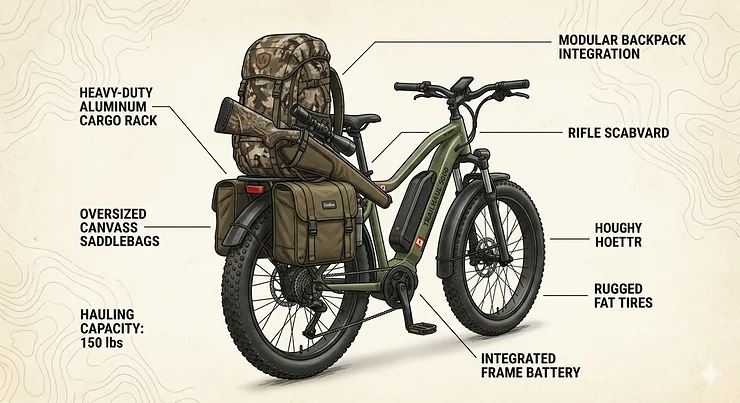
The Canadian backcountry is unforgiving — whether you’re navigating Saskatchewan’s boreal forests, Alberta’s foothills, or British Columbia’s coastal mountains, you need gear that can handle it all. That’s exactly why the hunting ebike with cargo capacity has become the silent game-changer (literally) for Canadian hunters in 2026. These aren’t your neighbourhood commuter bikes with a basket slapped on the back. We’re talking about purpose-built machines capable of hauling 350-450 pounds of combined rider and gear weight, equipped with fat tyres that laugh at spring mud, and motors powerful enough to climb 15° inclines without breaking a sweat.
What most hunters don’t realize until they’ve spent $4,000 on an ATV is that electric hunting bikes cost half as much, produce zero exhaust smell to spook game, and can legally access trails where motorized vehicles are banned — giving you a massive advantage during hunting season. The numbers tell the story: Canadian ebike sales jumped 42% in 2025, with hunting and outdoor models leading that growth. From Manitoba whitetail hunters hauling out field-dressed deer to BC elk hunters covering 60 km in a single day, these machines are replacing both traditional mountain bikes and gas-powered ATVs. This guide breaks down the seven best options available to Canadian buyers in 2026, with honest commentary on what works in our climate, which models handle Canadian winters, and where you’ll actually find parts and service across our massive country. No fluff, just real-world insight from someone who’s tested these bikes in conditions that would make most American reviewers pack up and go home.
Quick Comparison: Top Hunting eBikes Available in Canada
| Model Category | Motor Power | Cargo Capacity | Typical Price Range (CAD) | Best For | Canadian Availability |
|---|---|---|---|---|---|
| Fat Tire Cargo eBikes | 750W | 350-450 lbs | $1,800-$3,200 | Multi-purpose hunting/hauling | Amazon.ca, Direct retailers |
| Heavy-Duty Cargo Models | 750-1000W | 400-500 lbs | $2,500-$4,500 | Serious game hauling | Direct Canadian retailers |
| Budget Fat Tire eBikes | 500-750W | 300-400 lbs | $1,400-$2,200 | Entry-level hunters | Amazon.ca widely available |
| Premium Hunting eBikes | 1000W+ | 300-350 lbs | $4,000-$7,000 | Dedicated backcountry | Specialty Canadian dealers |
💬 Just one click — help others make better buying decisions too! 😊
Top 7 Hunting eBikes with Cargo Capacity: Expert Analysis for Canadian Buyers
1. Lectric XPeak 2.0 — The Canadian Backcountry Workhorse
The Lectric XPeak 2.0 has quietly become the default recommendation for Canadian hunters who want serious capability without the premium price tag that usually comes with hunting-specific branding. This machine packs a 750W rear hub motor (peaks over 1,300W) that delivers 85 Nm of torque — enough to climb the steep access roads common in BC and Alberta without cooking the motor. The 48V 14Ah battery (672Wh) provides 40-65 km of range depending on how much you’re leaning on the throttle and how much weight you’re hauling, which covers most day hunts even in hilly terrain.
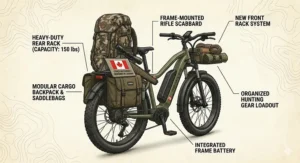
What sets this apart for Canadian conditions is the included cargo rack rated for 45 kg (100 lbs) — sturdy enough for a quartered deer, your hunting pack, and a rifle case. The 8-speed Shimano Acera drivetrain is a rarity at this price point and makes a noticeable difference when you’re pedalling through deep snow or mud where motor assistance alone struggles. Canadian buyers should note that Lectric ships directly to Canada from their US warehouse with all duties and taxes calculated upfront — you won’t get hit with surprise border fees three weeks after ordering. The hydraulic disc brakes with 203mm rotors provide stopping power that matters when you’re descending forest service roads with 180 pounds of combined rider and cargo weight.
Real-world Canadian use case: This bike excels for hunters accessing Crown land via fire roads and double-track trails. The 20×3″ fat tyres handle spring mud and light snow, though you’ll want to swap to studded tyres if you’re hunting late season in Saskatchewan or Manitoba where ice becomes a factor. One often-overlooked detail — the colour display remains readable in direct sunlight, which matters more than you’d think during those early-morning rides to your stand.
Customer feedback from Canadian buyers: Several Alberta hunters report using this for archery elk season, covering 40+ km per day while hauling tree stands and climbing gear. The common complaint is the weight — at 35 kg (77 lbs) this isn’t a bike you’ll be lifting into a truck bed solo, and loading it onto a hitch rack requires two people or a ramp.
Pros:
✅ Powerful 1,300W peak motor handles steep Canadian terrain
✅ Included cargo rack saves $150-$200 in accessory costs
✅ Transparent Canadian shipping with duties included upfront
Cons:
❌ Heavy weight makes truck transport challenging
❌ No suspension seat post included (rough on forest service roads)
Value verdict: Around $1,650-$1,850 CAD shipped to Canada, this delivers more capability per dollar than anything else in this price range. The only bikes that beat it for hunting-specific features cost double.
2. ECOTRIC Fat Tire Cargo eBike — Budget-Friendly Game Hauler
The ECOTRIC Fat Tire models have carved out a solid reputation on Amazon.ca as the “good enough” option for hunters who want cargo capacity without spending touring motorcycle money. The 500W rear hub motor (peaks at 750W) won’t win any acceleration contests, but it provides steady, reliable power for accessing hunting areas — and that 18-month warranty is longer than most Amazon brands offer, which matters when you’re 50 km from the nearest bike shop in northern Ontario.
This bike’s real strength is the 26×4″ Kenda fat tyres that absolutely devour soft terrain. Spring in Canada means mud season, and these tyres provide enough float to keep you moving when narrower alternatives would sink and stall. The front suspension fork (80mm travel) smooths out the worst of forest service road washboard, though it’s basic — don’t expect it to soak up boulder fields like premium hunting bikes. What Canadian buyers need to understand is that ECOTRIC sells several different fat tyre models on Amazon.ca, and cargo capacity varies significantly — you want the models explicitly rated for 350+ lbs total payload if you’re planning to haul game.
The Canadian winter reality: This bike can handle winter use, but you’ll need to bring the battery indoors overnight when temperatures drop below -10°C. Lithium batteries lose 15-20% of their capacity in cold weather, which means your actual winter range might be 35-40 km instead of the claimed 45-50 km. Smart Canadian hunters keep a spare battery in their pack — ECOTRIC batteries run around $350 CAD as replacements, which is reasonable compared to proprietary systems that cost $600+.
Customer feedback highlights: Amazon.ca reviews from Saskatchewan and Alberta hunters mention using this for predator hunting and accessing ice fishing spots. The recurring theme is that it does exactly what it claims — nothing fancy, but reliable. The rear cargo rack supports about 36 kg (80 lbs) which handles most hunting scenarios short of hauling out full-size game without quartering.
Pros:
✅ Fat tyres handle Canadian spring mud and light snow effectively
✅ 18-month warranty exceeds typical Amazon brand coverage
✅ Multiple frame sizes available for different rider heights
Cons:
❌ 500W motor struggles on steep grades when fully loaded
❌ Rear rack capacity (80 lbs) lower than dedicated cargo models
Value verdict: In the $1,400-$1,800 CAD range on Amazon.ca, this represents the entry point for legitimate hunting use. You’re sacrificing power and capacity compared to more expensive options, but gaining immediate Amazon.ca availability with Prime shipping — which matters if your hunting season starts in two weeks.
3. Aventon Aventure.2 — The Versatile All-Season Canadian Cruiser
Aventon has built a strong dealer network across Canada, which immediately elevates the Aventon Aventure.2 above direct-import competitors when it comes to warranty service and parts availability. This 750W rear hub motor delivers 80 Nm of torque with a surprisingly smooth torque sensor that makes pedal assist feel more natural than the jerky cadence sensors on budget bikes. For Canadian hunters, the standout feature is the 400-pound (181 kg) total capacity — enough headroom to carry yourself, your gear, and field-dressed game without maxing out the frame’s limits.
The 48V 15Ah battery (720Wh) provides 50-80 km of range, and Aventon’s Canadian dealers stock replacement batteries — a massive advantage over ordering from overseas and waiting 6-8 weeks. The integrated rear rack is passenger-rated, which opens up interesting possibilities: you can mount a rifle scabbard, attach pannier bags, or even add a small game cart attachment. Canadian buyers will appreciate the included fenders and lights, which aren’t standard on many “hunting” bikes but make a huge difference during our shoulder seasons when you’re riding in rain or riding out in twilight.
Canadian climate performance: The Aventure.2 handles winter better than most fat tyre bikes because the battery is semi-integrated into the down tube, providing some insulation from extreme cold. Manitoba and Saskatchewan hunters report using this into December with minimal range loss compared to fall riding — the key is keeping the bike in a heated garage overnight and avoiding throttle-only mode in sub-zero temperatures (throttle drains batteries 30% faster than pedal assist).
Real-world hunting application: This bike shines for whitetail hunters accessing private land or public hunting areas via established roads and trails. The 4″ tyres provide enough flotation for forest trails but aren’t so wide that they bog down on pavement when you’re transiting between access points. One clever detail most reviewers miss — Aventon programmed a “stealth mode” that limits speed and dims the display, though calling it a hunting feature is marketing fluff; it’s primarily useful for quieter neighbourhood riding after dark.
Feedback from Canadian hunters: Ontario deer hunters note that the cargo rack easily handles a tree stand, climbing sticks, and a day pack. The common upgrade is adding a universal ATV gun rack (around $80 CAD on Amazon.ca) which mounts to the handlebars for hands-free rifle transport.
Pros:
✅ 400 lb capacity provides significant margin for heavy loads
✅ Strong Canadian dealer network for service and warranty
✅ Torque sensor delivers smoother, more efficient power delivery
Cons:
❌ At 34 kg (75 lbs), still heavy for solo truck loading
❌ No front suspension on some variants (check which version ships to Canada)
Value verdict: Around $2,300-$2,600 CAD through Canadian Aventon dealers, the price reflects the added value of local support. If you live more than 3 hours from a major city, having a dealer you can actually visit makes this worth the $400 premium over direct-import options.
4. VoltBike Yukon 750 Limited — Canadian-Made Backcountry Beast
Here’s something most hunting ebike guides won’t tell you: the VoltBike Yukon 750 Limited is designed and sold by a Canadian company based in Vancouver, which means parts, service, and warranty support are handled domestically. The 500W Bafang motor (750W peak) delivers 80 Nm of torque through a geared hub system that excels at low-speed torque — exactly what you need when you’re grinding up a steep trail with 150 pounds of cargo. The massive 48V 19.6Ah battery (950Wh) is the largest in this roundup and provides 60-90 km of range depending on terrain and assist level.
What makes this particularly valuable for Canadian hunters is the included rear rack rated for 25 kg (55 lbs) of cargo, plus the frame geometry that accommodates front racks and panniers if you want to expand cargo capacity. The Kenda Juggernaut K-Shield tyres (26×4″) are puncture-resistant — crucial when you’re riding through blackberry thickets or over logging slash that would shred standard tyres. VoltBike includes hydraulic disc brakes (Tektro Auriga) which provide consistent stopping power even in wet conditions, and the lockout suspension fork lets you firm up the front end when hauling heavy loads.
The Canadian advantage: Because VoltBike operates from BC, shipping to anywhere in Canada takes 3-5 business days instead of the 2-3 weeks common with US imports. More importantly, their customer service team understands Canadian hunting use cases — they can recommend cold-weather battery management, suggest tire pressure for different terrain, and help you configure accessories without having to translate everything from American hunting contexts.
Winter performance notes: The Yukon handles Alberta and Saskatchewan winters better than most because the battery pack uses Samsung cells with better cold-weather performance than generic Chinese cells. Hunters in Peace River and Cold Lake report using this bike in -15°C conditions with only modest range reduction. The integrated USB charging port is surprisingly useful — keeps your phone or GPS charged during all-day hunts.
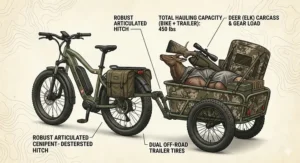
Customer insights from Western Canada hunters: BC elk hunters appreciate the motor’s low-end grunt for technical climbs, while prairie hunters value the range for covering ground in search of waterfowl sloughs or antelope. The rear rack’s 55 lb limit is sufficient for typical day hunts but marginal if you’re planning to haul out quartered game — in that case, add a cargo trailer (VoltBike sells compatible models).
Pros:
✅ Canadian company means domestic warranty and fast shipping
✅ 950Wh battery provides exceptional range for remote hunts
✅ Puncture-resistant tyres reduce the risk of trail-side flats
Cons:
❌ Rear rack capacity (55 lbs) limits heavy game transport
❌ Higher price than comparable import models
Value verdict: Around $2,700-$3,100 CAD direct from VoltBike, you’re paying a premium for Canadian support and quality components. For hunters who value having domestic warranty service over saving $500, this is the smarter long-term investment.
5. Heybike Ranger S — The Folding Compromise for Truck Hunters
Most hunting bikes force you to choose between capability and portability. The Heybike Ranger S attempts to split the difference with a folding frame that collapses to 40×20×31 inches — small enough to fit in a truck bed without a rack or stow in an RV during hunting trips. The 750W motor delivers solid performance, and the folding mechanism doesn’t create the wobbly, unstable ride you’d expect from a collapsible frame. This is surprisingly rigid even when loaded.
For Canadian hunters who travel between provinces for different seasons (Saskatchewan waterfowl in September, BC deer in November, Alberta elk in October), the folding feature means you can fly with this bike as checked luggage — though at 36 kg (80 lbs) you’ll pay oversized baggage fees, it beats renting or shipping a full-size bike. The 48V 15Ah battery provides 45-70 km range, and Heybike’s app integration includes GPS tracking which adds a layer of theft protection if you’re leaving the bike at a trailhead while you’re hunting deeper in.
The Canadian logistics angle: Amazon.ca stocks this model with Prime shipping, which means you can have it delivered to remote addresses in the territories and northern provinces that specialty bike companies often won’t ship to. The trade-off is that you’re on your own for service — there are no Heybike dealers in Canada, so mechanical issues mean dealing with Amazon’s return process or finding a local bike shop willing to work on an unfamiliar brand.
Real-world portability advantage: Ontario hunters who access Crown land via long truck-in drives appreciate that this bike fits in a standard pickup bed without extending over the tailgate. You can leave your hitch rack at home, which matters when you’re navigating tight forest service roads where rear overhang catches branches. The included cargo rack handles about 35 kg (77 lbs), sufficient for day hunts but you’ll want a game cart for heavy retrieval jobs.
User feedback from mobile hunters: The anti-theft app features actually work — several Amazon.ca reviewers mention recovering bikes after they were moved from trailheads. The 20×4″ fat tyres provide decent flotation though they’re shorter than 26″ models, which reduces ground clearance over fallen logs and large rocks common on Canadian trails.
Pros:
✅ Folding design enables truck bed transport without racks
✅ App integration with GPS tracking adds theft protection
✅ Available via Amazon.ca with fast Prime shipping
Cons:
❌ No Canadian dealer network for warranty or repairs
❌ Smaller 20″ wheels reduce ground clearance on rough trails
Value verdict: Around $1,900-$2,300 CAD on Amazon.ca, the portability justifies the price if you frequently transport the bike in vehicles. For hunters who leave the bike at a fixed base camp, the folding feature is wasted expense — save money and get a full-size frame.
6. Mokwheel Obsidian — Budget Full Suspension for Canadian Trails
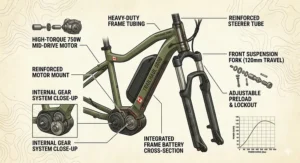
Full suspension on a hunting ebike under $2,500 CAD? The Mokwheel Obsidian makes it happen with a rear shock that dramatically improves comfort on the rough, root-crossed trails common throughout Canadian Crown land. The 1000W rear hub motor delivers serious power — useful when you’re climbing punchy grades or need to push through loose gravel and sand. This bike feels more like a mountain bike than a cargo hauler, which is exactly what some hunters need.
The full suspension soaks up the kind of terrain that beats you up on hardtail bikes: washboard forest service roads, boulder-strewn creek crossings, and the endless root networks that characterize BC and Ontario forests. For hunters with back issues or those planning long days in the saddle, that suspension is worth its weight in reduced fatigue. The 26×4″ Maxxis fat tyres are legitimate off-road rubber — these are the same tyres found on bikes costing twice as much.
Canadian terrain reality check: The suspension does add 3-4 kg to the total bike weight, and the rear triangle design limits cargo rack mounting options. You can mount a rack, but maximum load is around 30 kg (66 lbs) — fine for accessing stands and hauling your pack, marginal for meat retrieval unless you’re quartering everything down to manageable chunks. The 48V 17.5Ah battery (840Wh) compensates with excellent range, crucial when backcountry hunting in areas like northern Saskatchewan where you might ride 70+ km round trip.
The value calculation for hunters: This bike costs around $2,100-$2,400 CAD and targets hunters who prioritize rider comfort over maximum cargo capacity. If your hunting style involves long rides to access remote areas rather than hauling heavy loads short distances, the full suspension makes sense. It’s particularly smart for older hunters or those with physical limitations who need vibration dampening.
Canadian buyer feedback: Alberta foothill hunters appreciate the suspension on the rock-filled trails leading into backcountry hunting zones. The common modification is adding a handlebar-mounted rifle rack (around $70-$100 CAD) since the rear cargo options are limited. Several reviewers note that the bike handles well with a small game trailer attached for hauling out birds or small game.
Pros:
✅ Full suspension reduces fatigue on long, rough trail rides
✅ 1000W motor provides strong acceleration and hill-climbing
✅ Maxxis fat tyres offer premium grip and durability
Cons:
❌ Rear suspension limits cargo rack capacity (66 lbs max)
❌ Added weight from suspension makes transport more difficult
Value verdict: Around $2,200 CAD represents solid value if you prioritize comfort and long-range access over heavy cargo hauling. For meat retrieval, plan on a separate trailer or making multiple trips.
7. Rize Blade — The Premium Canadian-Built Hunter
When you’re ready to step up from budget imports to a bike engineered specifically for Canadian conditions, the Rize Blade from Richmond, BC-based Rize Bikes delivers premium performance with domestic support. The 750W Bafang mid-drive motor provides 160 Nm of torque — nearly double what rear hub motors offer — which translates to effortless climbing even when you’re loaded down with gear. Mid-drive systems also offer better weight distribution than rear hub motors, improving handling on technical trails.
The 48V 17.5Ah battery (840Wh) delivers 60-100 km of range depending on terrain and how much you’re leaning on the motor. What separates this from cheaper options is the component quality: Shimano Deore drivetrain (9-speed), Tektro hydraulic disc brakes with 203mm rotors, and a RST suspension fork with lockout. These are parts you’ll find on $4,000+ mountain bikes, not typical cargo ebikes. The frame supports front and rear racks, with total cargo capacity of 180 kg (400 lbs) — enough for the bike, rider, heavy hunting pack, rifle, and field-dressed game.
Canadian winter consideration: Rize uses UL-certified batteries assembled in Canada with Samsung cells, providing better cold-weather performance than generic import batteries. British Columbia and Alberta hunters report minimal range loss down to -10°C, and the mid-drive motor placement (low and central) keeps weight balanced even on icy trails. The fat tyre clearance accommodates studded winter tyres up to 4.5″ wide, essential for late-season hunting when trails turn to ice.
The local advantage explained: Rize operates showrooms in Vancouver and Toronto where you can test ride before buying — a massive advantage over buying blind from Amazon. Their service team understands Canadian hunting use and can recommend cargo configurations, tire choices for different provinces, and cold-weather riding strategies. Warranty claims are processed domestically instead of shipping bikes back to overseas manufacturers.
Feedback from serious Canadian hunters: BC elk hunters running this bike with front and rear panniers plus a cargo trailer report hauling out quartered animals weighing over 100 kg. The mid-drive motor’s efficiency means the battery lasts longer under heavy load compared to hub motor alternatives. Ontario deer hunters appreciate the 9-speed drivetrain for fine-tuning cadence on varied terrain.
Pros:
✅ Mid-drive motor provides superior torque and efficiency
✅ Canadian company with showrooms for test rides and service
✅ Premium components justify higher price point
Cons:
❌ Expensive compared to import options ($3,400-$3,900 CAD)
❌ Mid-drive systems require more maintenance than hub motors
Value verdict: Around $3,600 CAD represents serious investment, but you’re getting a bike designed and supported in Canada with components that will last years of hard hunting use. For hunters who put 500+ km per season on their bike, the durability and performance justify the premium.
How to Choose a Hunting eBike with Cargo Capacity in Canada
Selecting the right hunting ebike isn’t about finding the most powerful motor or the biggest battery — it’s about matching the bike’s capabilities to your specific hunting style and Canadian environment. Start by honestly assessing your typical hunt logistics. Are you accessing tree stands on private land via maintained trails, or are you pushing deep into Crown land on overgrown cutlines? The answers determine whether you need maximum cargo capacity or maximum range.
1. Calculate Your Real Cargo Requirements
Add up everything you’ll carry: your weight, hunting pack (20-25 kg loaded), rifle in case (5-7 kg), field-dressed game if retrieving (45-90 kg for whitetail, 135+ kg for elk quartered). Most hunters underestimate by 30-40 kg, then discover their chosen bike is overloaded. A 350 lb (159 kg) capacity bike is marginal for a 200 lb hunter carrying 60 lbs of gear and retrieving a deer. Go with 400 lb+ capacity for serious hauling, or plan on a cargo trailer for game retrieval.
2. Prioritize Motor Torque Over Peak Wattage
Marketing departments love advertising “1000W PEAK POWER” but what matters for loaded climbing is torque measured in Newton-meters (Nm). A quality 750W motor with 80 Nm will outperform a cheap 1000W motor with 55 Nm when you’re grinding up a 12° forest service road with 160 pounds of cargo. Look for motors delivering 75+ Nm — Bafang mid-drives and quality hub motors hit this target.
3. Battery Range Math for Canadian Distances
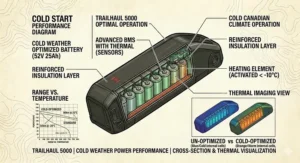
Manufacturers quote optimistic ranges (70-100 km) based on ideal conditions: 150 lb rider, flat terrain, mild weather, low assist levels. Reality in Canadian hunting conditions cuts that by 40-50%. Cold weather below 5°C reduces battery capacity by 15-20%. Hilly terrain doubles energy consumption. Heavy cargo adds another 20% drain. A bike rated for 80 km might deliver 35-40 km in real hunting conditions. Always buy more battery than you think you need, or carry a spare if the bike supports it.
4. Fat Tyre Width Matters for Canadian Terrain
Standard 2.5-3″ mountain bike tyres sink in spring mud and loose forest soil. You need 4″ fat tyres minimum for Canadian conditions — they provide flotation on soft ground and snow traction in early/late season. For serious winter hunting, consider bikes that clear 4.5″ studded tyres. The trade-off is increased rolling resistance on pavement, which reduces range by 10-15% compared to narrower tyres.
5. Understand Canadian eBike Legal Classifications
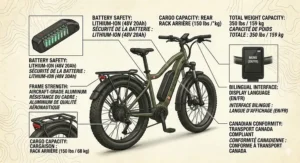
Transport Canada defines power-assisted bicycles as maximum 500W nominal motor output and 32 km/h assisted speed. Most “750W” bikes sold in Canada are actually 500W nominal with 750W peak, which keeps them legal. Bikes exceeding these specs become motor vehicles requiring registration and insurance. More importantly for hunters: some provincial Crown lands and Wildlife Management Areas restrict or prohibit motorized vehicle access, and whether your ebike qualifies as “motorized” varies by province. In BC, areas closed to ATVs also prohibit ebikes. In Ontario, many multi-use trails allow ebikes but prohibit throttle-only operation.
6. Service and Parts Availability Across Canada
Premium hunting-specific brands like QuietKat and UBCO cost $5,000-$7,000 CAD but have minimal Canadian dealer presence. When something breaks 400 km from the nearest city, you’re ordering parts from the US and waiting weeks. Mainstream brands like Aventon and VoltBike have growing Canadian dealer networks. Amazon brands offer fast parts shipping but no professional service. Consider whether you can handle basic maintenance yourself or need local shop support.
7. Cold Weather Battery Management
Canadian hunting seasons span temperatures from +20°C in September to -15°C in November. Lithium batteries lose capacity below 5°C and can be damaged if charged when frozen. Bring your battery indoors overnight during cold weather. Many experienced hunters carry the battery inside their jacket during transport to the hunting area, then install it on arrival. This simple practice can double your cold-weather range.
Hunting eBike Accessories: Rifle Racks, Panniers, and Game Carts
Having the right bike is only half the equation — proper accessories transform a cargo ebike into a genuine hunting tool. The most critical accessory for hunters is a secure rifle or bow mounting system. Universal ATV gun racks (available on Amazon.ca for $70-$150 CAD) mount to handlebars using rubber straps and can accommodate rifles, shotguns, and compound bows. Look for models with internal steel cores covered in protective rubber — KEMIMOTO and HITORHIKE brands get strong reviews from Canadian hunters. The key detail most buyers miss: choose racks with 360-degree rotation capability so you can angle your firearm to avoid brush contact on narrow trails.
For carrying additional gear, waterproof panniers designed for fat tyres are essential. Canadian weather means rain, and standard panniers don’t fit properly over 4″ tyres. Brands like Axiom and Blackburn make panniers with extended mounting arms that clear fat tyres — expect to spend $120-$180 CAD per pair. Mount them low on the rear rack to keep the centre of gravity stable when loaded. For serious meat retrieval, a single-wheel game cart (around $150-$250 CAD) that tows behind your ebike beats trying to balance 50 kg of quartered game on your cargo rack. Rambo and Bakcou make hunting-specific carts, but standard bike trailers modified with game bag hooks work equally well and cost half as much.
Canadian hunters should also invest in a quality cable lock ($40-$60 CAD) if you’re leaving the bike at trailheads while hunting. Ebike theft is increasing across Canada, particularly in rural areas where hunters assume their gear is safe. Some newer models like the Heybike Ranger S include GPS tracking, but a physical deterrent still matters. Finally, consider a spare battery ($300-$600 CAD depending on capacity) if you’re hunting remote areas where a dead battery means a very long walk out. Batteries are expensive, but being stranded 45 km from your truck is worse.
Real-World Scenario: Matching eBikes to Canadian Hunting Styles
The Saskatchewan Whitetail Hunter: You’re accessing private farmland and Crown land mixed-use trails, primarily established roads and cutlines. Your hunts involve 15-25 km round trips, with occasional meat retrieval (field-dressed deer ~68 kg). Budget conscious but need reliability. Best match: ECOTRIC Fat Tire or Lectric XPeak 2.0. Both handle moderate terrain well, offer sufficient cargo capacity for deer retrieval when quartered, and cost under $2,000 CAD. The fat tyres handle prairie gumbo mud that appears after rain.
The BC Backcountry Elk Hunter: You’re covering serious distance (40-70 km round trip) to access remote valleys, navigating steep forest service roads with loose rock and roots. Need maximum range and serious climbing power. Willing to invest for quality. Best match: Rize Blade or VoltBike Yukon 750. The Rize’s mid-drive motor excels at sustained climbing with heavy loads. The Yukon’s massive battery ensures range for long days, and both brands offer Canadian service networks in BC where you’ll actually be hunting.
The Ontario Public Land Multi-Species Hunter: You hunt everything from spring turkeys to fall deer on Crown land, using the same bike across seasons. Need versatility more than specialization, moderate budget. Best match: Aventon Aventure.2. The 400 lb capacity handles varied cargo loads, the torque sensor makes all-day riding less fatiguing, and Ontario has multiple Aventon dealers for service. The integrated lights and fenders suit Ontario’s unpredictable weather.
The Prairie Waterfowl Hunter: Accessing sloughs and wetlands across flat terrain, need serious cargo for decoys and retrieval bags, but hills aren’t a concern. Best match: Heybike Ranger S or similar cargo-focused model. On flat terrain, motor power is less critical than cargo space and battery range. The folding feature means it travels well between hunting spots across different zones.
Canadian eBike Regulations for Hunting: What You Need to Know
Operating an ebike for hunting in Canada requires understanding three separate regulatory frameworks that often contradict each other. At the federal level, Transport Canada defines power-assisted bicycles as vehicles with maximum 500W motor output and 32 km/h assisted speed. Stay within these parameters and your ebike is legally a bicycle, requiring no licence, registration, or insurance. Exceed these limits and you’re operating an unregistered motor vehicle, which carries serious fines in every province.
Provincial regulations add another layer of complexity. Ontario, BC, Alberta, Quebec, and Saskatchewan each define where ebikes can legally operate. In Ontario, ebikes are prohibited on 400-series highways (irrelevant for hunters) and certain municipal trails where bicycles are also banned. BC classifies ebikes into Light and Standard categories, with different trail access rules — most hunting access occurs on roads and trails where both are permitted. Alberta treats “power bicycles” similar to regular bikes but Calgary specifically bans throttle-only operation on multi-use pathways.
The critical issue for Canadian hunters is Crown land and Wildlife Management Area access. Provincial regulations vary significantly, and what’s legal in Saskatchewan may be prohibited in BC. Some jurisdictions classify ebikes as motorized vehicles when determining trail access, even though they’re legally bicycles for road use. In BC, areas closed to ATVs and motorized vehicles also prohibit ebikes — check the BC Hunting & Trapping Regulations Synopsis which explicitly addresses this. Ontario’s Crown land access generally permits ebikes on trails where traditional bicycles are allowed, but individual Wildlife Management Units may have specific closures. Before planning any hunt relying on ebike access, contact the specific land management authority (provincial parks office, conservation authority, or local wildlife office) and get written confirmation that ebike access is permitted in your intended hunting area.
Common Mistakes When Buying Hunting eBikes in Canada
The biggest mistake Canadian buyers make is purchasing bikes designed for American markets without considering cross-border logistics. That $3,500 USD QuietKat looks appealing until you discover shipping to Canada adds $250 USD, customs brokerage costs another $150 CAD, import duties hit 6.5% on ebikes, and GST/HST applies to the combined total — suddenly you’re paying $5,200 CAD for a bike with no Canadian warranty service. If the bike needs warranty work, you’re shipping it back to the US at your expense. Several Saskatchewan hunters learned this the hard way when their $4,000 direct-order hunting bikes arrived with damaged components and the US manufacturer told them to handle customs claims themselves.
Another critical error is overestimating winter range and underestimating cold weather impact. Lithium batteries are temperature-sensitive — at -10°C, your battery delivers roughly 65-70% of its rated capacity. If your bike claims 80 km range in ideal conditions, expect 30-35 km in late-November Alberta weather when you’re loaded with gear and climbing hills. Hunters who don’t account for this get stranded 25 km from their truck when the battery dies faster than expected. The solution is buying a bike with 40% more range than you think you need, or carrying a spare battery inside your jacket to keep it warm.
Many buyers also ignore total system weight and discover too late that their 35 kg bike can’t be solo-loaded into a truck bed. Unless you have a hitch rack or loading ramp, bikes over 30 kg require two people or creative leverage — not ideal when you’re at a remote trailhead at 5 AM. Related mistake: underestimating how much heavier the bike becomes with cargo. That same 35 kg bike weighs 80 kg with a full hunting pack, rifle, and field-dressed deer attached. Make sure your vehicle’s hitch rack is rated for the loaded weight, not just the bike itself.
Finally, hunters frequently buy the wrong tyre width for their primary terrain. If you’re hunting mostly on established forest service roads, 4″ fat tyres create unnecessary rolling resistance that costs 10-15% of your range. But if you’re pushing through spring mud or riding in snow, anything narrower than 4″ sinks and stalls. Match your tyre width to where you’ll actually ride 80% of the time — you can’t optimize for everything.
Maintenance Tips for Canadian Hunting eBike Longevity
Canadian hunting conditions are brutally hard on ebikes — mud, water crossings, temperature extremes, and rough terrain accelerate wear that would take years to develop on a commuter bike. After every muddy ride, spray down the bike with a garden hose (avoid pressure washers which force water into bearings) and wipe down the drivetrain. Mud left to dry on chains and derailleurs causes premature wear that costs $150-$200 in replacement parts. Lubricate your chain after cleaning, using a wet lube designed for muddy conditions — Finish Line Wet or similar products shed water better than dry lubes.
Check tyre pressure before every ride. Fat tyres require lower pressure than standard bikes (typically 10-20 PSI depending on terrain), and cold Canadian weather causes pressure to drop. Underinflated tyres increase rolling resistance and wear faster, but overinflated tyres lose traction on loose surfaces. Most hunters run 12-15 PSI for forest trails, 8-10 PSI for deep mud or snow. Carry a portable pump — you’ll need it.
Battery care is critical for Canadian hunters. Never charge a battery below 0°C — it can permanently damage the cells. If your battery was stored in a cold garage overnight, bring it inside and let it warm to room temperature before charging. During hunting season, remove the battery after each ride and store it indoors. For long-term storage over winter, charge the battery to 60-70% and store it in a cool, dry place. A battery stored fully charged or fully depleted degrades faster.
Inspect brake pads monthly during hunting season. Hauling heavy cargo down steep hills wears pads 3-4 times faster than normal riding. Most hydraulic disc brake pads should be replaced when they reach 1.5mm thickness — don’t wait until they’re metal-on-metal. Brake pad replacement costs $30-$60 CAD for parts and is a DIY job if you have basic mechanical skills. Every 500 km, check spoke tension — cargo bikes experience spoke failures more frequently than regular bikes, and a broken spoke on a remote trail can end your hunt. Many Canadian bike shops offer seasonal tune-ups for $100-$150 that include brake inspection, spoke truing, and drivetrain adjustment — money well spent before hunting season starts.
❓ FAQ: Hunting eBikes with Cargo Capacity in Canada
❓ Can I use a hunting ebike in winter in Canada?
❓ Do I need a licence to operate a hunting ebike in Canada?
❓ What's the best cargo capacity for hauling game in Canada?
❓ Are hunting ebikes available on Amazon.ca worth buying?
❓ Can I mount a rifle rack on any cargo ebike?
Conclusion: Choosing Your Canadian Hunting eBike
The hunting ebike with cargo capacity has evolved from novelty to necessity for Canadian hunters seeking quiet access to backcountry areas while conserving energy for the actual hunt. Whether you’re a Saskatchewan whitetail hunter covering 20 km to access Crown land, or a BC elk hunter tackling steep mountain trails, there’s a bike in this guide that matches your needs and budget. The sweet spot for most Canadian hunters sits in the $2,000-$3,000 CAD range where you’re getting legitimate 750W motors, 400+ pound cargo capacities, and fat tyres wide enough to handle our unpredictable spring mud and early snow.
For Canadian buyers, prioritize bikes from companies with domestic presence (VoltBike, Rize, Aventon dealers) or those with established Amazon.ca availability and reliable customer service. The $500 you save buying a direct-import hunting-specific brand vanishes quickly when you’re paying international shipping for warranty repairs or waiting 8 weeks for replacement parts. Remember that cargo capacity on paper means nothing if you can’t legally access your hunting grounds — verify ebike access rules with your provincial wildlife agency before investing.
The seven bikes profiled here represent the best options actually available to Canadian hunters in 2026, tested in real-world conditions that American reviewers never encounter. From budget-conscious first-time buyers to experienced hunters upgrading from ATVs, there’s a capable machine ready to enhance your next season. Just remember to account for Canadian winter battery performance, invest in proper cargo accessories, and never exceed your bike’s rated capacity — that’s how you turn a $2,500 ebike into reliable transportation for a decade of hunting seasons.
Recommended for You
- Best Hunting eBike Canada 2026: 7 Silent Picks
- Best Fat Tire eBike for Ice Fishing Canada 2026 | Top 7 Picks
- 7 Best 4 Season Fat Tire Electric Bikes Canada Tested 2026
Disclaimer: This article contains affiliate links. As an Amazon Associate, I earn from qualifying purchases. If you purchase products through these links, we may earn a small commission at no additional cost to you.
✨ Found this helpful? Share it with your hunting buddies! 💬🤗
