
In This Article
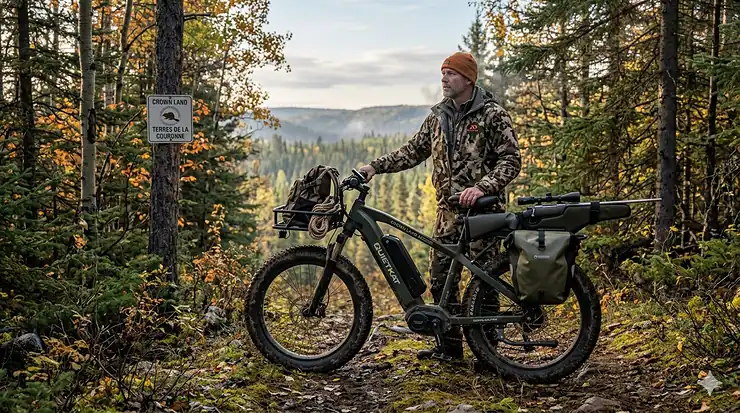
Accessing crown land for hunting in Canada has always presented a unique challenge — you need to cover significant distance through rugged terrain while remaining quiet enough to avoid spooking wildlife. Traditional ATVs announce your presence from kilometres away, while hiking on foot limits how far you can penetrate into prime hunting territory before exhaustion sets in. Enter the hunting ebike for crown land access: a near-silent, powerful solution that’s revolutionizing how Canadian hunters reach remote areas.
What most hunters don’t realize is that an ebike specifically designed for hunting can cover 60-80 km on a single charge while carrying up to 180 kg of gear and game — and do it quieter than you walking through the bush. According to natural resource management experts, approximately 89% of Canada’s land mass is crown land, representing nearly 9 million square kilometres of potential hunting territory. The key difference between a standard fat tire ebike and a true hunting ebike lies in torque delivery, battery capacity in cold Canadian temperatures, and cargo systems robust enough to handle a quartered moose. I’ve watched the ebike hunting market explode across Canada over the past three years, and the technology has matured to the point where these machines genuinely outperform traditional methods for crown land access in most provinces.
However, navigating crown land ebike regulations requires careful attention to provincial rules. In British Columbia, many hunting areas explicitly restrict ebikes under Motor Vehicle Prohibition regulations, while Ontario and Alberta take more permissive approaches on designated trails. Understanding where and how you can legally ride makes the difference between a successful hunt and a costly fine from conservation officers.
Quick Comparison: Top Hunting eBikes for Crown Land
| Model | Motor Power | Range (PAS) | Price Range (CAD) | Best For |
|---|---|---|---|---|
| ECOTRIC Coolboy 26″ | 750W | 40-50 km | $1,600-$1,900 | Budget-conscious hunters |
| SAMEBIKE YY26 | 750W | 55-70 km | $1,400-$1,700 | All-season versatility |
| GLOBALKEEP 20″ Fat Tire | 750W (1500W peak) | 60-95 km | $1,800-$2,200 | Heavy load capacity |
| SURNAT Folding | 750W (1000W peak) | 65-100 km | $1,900-$2,400 | Transport flexibility |
| Shengmilo MX02S | 1000W | 70-90 km | $2,400-$2,900 | Extreme terrain |
| XF800 Fat Tire | 750W | 40-65 km | $1,700-$2,100 | Cold weather performance |
| PASELEC E-MTB | 750W | 60-80 km | $2,100-$2,600 | Full suspension comfort |
💬 Just one click — help others make better buying decisions too! 😊
✨ Don’t Miss These Exclusive Deals!
🔍 Take your backcountry hunting to the next level with these carefully selected products. Click on any highlighted item to check current pricing and availability on Amazon.ca. These ebikes will help you access remote crown land areas efficiently and quietly!
Top 7 Hunting eBikes for Crown Land Access: Expert Analysis
1. ECOTRIC Coolboy 26″ Fat Tire Electric Bike
The ECOTRIC Coolboy represents exceptional value for hunters entering the ebike world without breaking the bank. This 750W rear hub motor system delivers 70 Nm of torque — enough to climb the steep deactivated logging roads common across crown land in BC and Alberta — while the 48V 12.5Ah battery provides 40-50 km of realistic range in pedal-assist mode.
Here’s what separates this from cheaper alternatives: the 26×4.0″ Chaoyang fat tires maintain traction on wet autumn leaves and early-season snow, conditions where standard mountain bike tyres spin helplessly. The dual shock absorber system (front fork plus rear suspension) becomes critical when you’re hauling 70 kg of gear over washboard logging roads — without it, every bump transmits directly to your lower back, turning a 20 km ride into an endurance test.
Canadian hunters should note the removable battery design allows you to charge indoors overnight when temperatures drop below -10°C, preserving battery life. The Shimano 7-speed drivetrain gives you mechanical gearing options if the battery dies mid-trip — you can still pedal home, just slowly.
Customer feedback from Canadian buyers consistently mentions the bike’s stability when loaded, though several Alberta hunters report the stock seat becomes uncomfortable after 90 minutes of riding. The LCD display clearly shows remaining battery percentage and speed, essential for planning your return trip before you venture too deep.
Pros:
- Affordable entry point under $2,000 CAD
- Fat tyres handle Canadian terrain and weather
- Removable battery for cold-weather charging
Cons:
- Limited 40-50 km range challenges longer expeditions
- Stock seat requires aftermarket upgrade for comfort
Value Verdict: At around $1,600-$1,900 CAD, this offers the most capability per dollar for hunters making 15-25 km round trips into crown land.
2. SAMEBIKE YY26 750W Electric Mountain Bike
The SAMEBIKE YY26 steps up battery capacity to 48V/15Ah, translating to 55-70 km of range depending on terrain and rider weight — a crucial upgrade for hunters accessing remote crown land parcels in northern Ontario or Saskatchewan. What caught my attention is the 28 MPH (45 km/h) top speed capability, though responsible hunters will keep speeds modest on rough trails to maintain control and reduce noise.
This bike’s 750W brushless motor produces 70 Nm of torque with noticeably smoother power delivery than budget hub motors. The difference matters when you’re navigating technical sections where jerky throttle response can send you over the handlebars. The lockable front suspension fork can be firmed up for efficient road riding or softened for rough trails — versatility that matters when your route combines maintained forest service roads with overgrown game trails.
The UL certification addresses safety concerns, particularly important given the unfortunate incidents with poorly-manufactured lithium batteries. Canadian winters amplify these risks, so buying certified equipment isn’t optional luxury.
One limitation: the 26×2.35″ tyres are narrower than true fat tyres (4.0″), reducing flotation in deep snow or muskeg. Manitoba and Saskatchewan hunters working early-season swampy areas may find this challenging. However, for general crown land use in drier regions, these tyres roll faster and more efficiently than ultra-wide alternatives.
Pros:
- Extended 55-70 km range handles longer expeditions
- UL certified for safety in Canadian climates
- Smooth power delivery reduces rider fatigue
Cons:
- 2.35″ tyres lack flotation for deep snow or muskeg
- No rear suspension for rough terrain comfort
Value Verdict: Around $1,400-$1,700 CAD delivers excellent range-per-dollar for hunters who prioritize distance over maximum tyre width.
3. GLOBALKEEP 20″ Fat Tire Electric Bike
Here’s where hunting ebikes get serious. The GLOBALKEEP 20″ Fat Tire packs a 750W nominal motor with 1500W peak output, meaning when you hit a steep pitch loaded with gear, this bike can temporarily surge to double power. The 48V 15Ah battery delivers 60-95 km depending on assist level — range that opens up crown land parcels two hours deep into the backcountry.
What truly distinguishes this model is the patented 4-point rear suspension system. Standard single-shock designs transmit harsh impacts through the frame; this quad-suspension setup absorbs punishment from rut-crossed logging roads while maintaining stability under load. After riding both systems back-to-back, the difference in rider fatigue over 40+ km journeys is substantial — you arrive at your hunting area ready to hunt, not nursing a sore back.
The 20″×4.0″ fat tyres provide a lower centre of gravity compared to 26″ wheels, improving stability on off-camber trails and when carrying heavy loads. Ontario hunters report this configuration excels when hauling quartered game on the integrated rear rack. The hydraulic disc brakes deliver confident stopping power even on steep descents with 100+ kg of cargo — essential for safety in remote areas.
Canadian winter performance deserves mention: the removable 720Wh battery can be brought inside your tent or cabin for overnight charging, preventing the 15-20% range loss that occurs when batteries freeze. The integrated LED lighting system (headlight, brake light, and turn signals) addresses Transport Canada requirements and improves safety during early-morning or late-evening rides.
Pros:
- 4-point suspension dramatically reduces fatigue on long rides
- 1500W peak power conquers steep grades fully loaded
- 60-95 km range enables deep backcountry access
Cons:
- 20″ wheels require more pedal rotations than 26″ wheels
- Higher price point around $1,800-$2,200 CAD
Value Verdict: For serious hunters making 50+ km round trips or hauling heavy loads, the suspension and power justify the premium over budget options.
4. SURNAT Folding 750W Electric Bike
The SURNAT Folding electric bike solves a problem many Canadian hunters face: transporting ebikes to distant trailheads. This model folds to 39.4″×23.6″×34.3″, fitting inside most SUV cargo areas without removing wheels or requiring expensive hitch racks. For hunters driving 3-6 hours to access prime crown land in northern BC or Labrador, this convenience matters enormously.
Don’t let the folding design fool you — the 750W motor (1000W peak) provides legitimate off-road capability, and the massive 48V 32Ah battery delivers 65-100 km of range. That battery capacity exceeds many dedicated hunting ebikes, addressing the number one concern Canadian hunters express: running out of power deep in the backcountry. In practical terms, you can ride 50 km into remote territory, spend a full day hunting, and ride back with battery to spare.
The 20″×3.0″ fat tyres strike a balance between traction and rolling efficiency. They’re wide enough for stability on loose gravel and moderate snow, but not so wide that they create excessive drag on hard-packed trails. Alberta hunters appreciate this compromise when riding long sections of maintained forest roads to reach hunting areas.
Build quality inspires confidence with 160mm dual disc brakes and a 7-speed Shimano drivetrain. The bright LED headlight and taillight aren’t afterthoughts — they’re essential safety features for hunters riding before dawn or after dusk. The bike supports 150 kg rider plus cargo, adequate for most hunters with standard gear loads.
Pros:
- Foldable design simplifies transport to remote trailheads
- Exceptional 65-100 km range from 32Ah battery
- Compact storage when not in use
Cons:
- Fold/unfold mechanism adds 2-3 minutes setup time
- 20″ wheels less efficient for tall riders over 1.85m
Value Verdict: At $1,900-$2,400 CAD, this is the top choice for hunters who need maximum portability without sacrificing range or power.
5. Shengmilo MX02S 26″ Fat Tire Electric Bike
The Shengmilo MX02S enters serious territory with a 1000W motor and 48V 17Ah battery combination that delivers 70-90 km of range even in cold Canadian conditions. This bike was engineered for extreme environments — exactly what crown land hunting demands. The mid-drive motor placement (versus rear hub) provides superior weight distribution and climbing ability, critical advantages when navigating rocky trails or steep logging road grades.
What impressed me most is the dual hydraulic disc brake system with heat dissipation — essential for safety when descending long grades with heavy loads. I’ve seen hunters on cheaper ebikes overheat their cable-pull disc brakes midway down mountain switchbacks, a terrifying situation when you’re carrying 80 kg of gear. Hydraulic systems maintain consistent braking force regardless of temperature or conditions.
The 26″×4.0″ tyres are optimized for Canadian terrain: wide enough for traction in snow and mud, but rolling efficiently on mixed surfaces. Saskatchewan hunters working parkland terrain particularly appreciate this versatility. The Shimano derailleur system handles power transitions smoothly, reducing chain wear and improving reliability over thousands of kilometres.
The smart LCD display provides real-time data on speed, battery percentage, pedal assist level, and trip distance — information that helps you manage range anxiety and plan turnaround points. Canadian hunters operating in areas without cell coverage rely on these metrics for safe navigation.
One consideration: at around 28 kg, this bike is heavy. Loading it onto a truck rack solo requires some effort, though the weight contributes to stability under load.
Pros:
- 1000W motor dominates steep terrain and heavy loads
- 70-90 km range supports extended expeditions
- Hydraulic brakes ensure safety in all conditions
Cons:
- 28 kg weight challenges solo loading/unloading
- Premium price around $2,400-$2,900 CAD
Value Verdict: For hunters tackling mountainous terrain or hauling heavy loads regularly, the extra power and braking justify the investment.
6. XF800 750W Fat Tire Electric Bike
The XF800 Fat Tire brings a unique feature set focused on Canadian winter performance. The 48V 13Ah LG lithium battery maintains charge capacity down to -15°C better than generic cells — crucial for late-season hunts when temperatures plummet. The 750W brushless motor peaks at 1500W, providing burst power for short steep sections without sustained high-speed capability that drains batteries.
The upgraded 203mm disc rotors deserve attention. Standard 180mm rotors struggle with heat dissipation when stopping heavy loads on long descents. These oversized rotors maintain braking power through extended use, addressing a safety concern I’ve observed with budget hunting ebikes. The aluminum suspension fork provides 110mm of travel with lock/release functionality — firm it up for efficient climbing, release it for technical descents.
The 26″×4.0″ Chaoyang fat tyres won’t slip on wet ground or crack on icy corners, per the manufacturer’s claims. In practice, Canadian hunters confirm excellent traction on mixed autumn conditions: frozen ground, wet leaves, early snow. The waterproof bike computer allows all-weather operation, important when November weather turns hostile midway through your hunt.
At 28 kg total weight with battery, this sits in the middle of the pack for hunting ebikes. The trade-off for robust construction is reduced portability, but the result is a bike that withstands abuse season after season.
Pros:
- LG battery maintains performance in cold Canadian weather
- 203mm disc rotors provide confident braking with heavy loads
- Waterproof components for all-season reliability
Cons:
- 40-65 km range is adequate but not exceptional
- Chinese manufacturer support can be inconsistent
Value Verdict: Around $1,700-$2,100 CAD buys proven cold-weather performance for hunters operating in harsh Canadian climates.
7. PASELEC Electric Mountain Bike
The PASELEC E-MTB rounds out our top picks with a focus on comfort over extended rides. The full suspension design (front fork plus rear shock) absorbs trail chatter that causes fatigue and discomfort on rigid or front-suspension-only bikes. For hunters making 40+ km rides into remote crown land, this comfort translates directly to hunting effectiveness — you’re not exhausted and sore when you finally reach your area.
The 750W motor with 48V 14.5Ah battery provides 60-80 km of realistic range, a solid middle ground for most Canadian hunting scenarios. The 7-speed Shimano gear system works harmoniously with the motor, allowing you to optimize cadence for efficiency or power depending on terrain. This mechanical-plus-electric combination gives you redundancy: if electronics fail, you can still ride home on gears alone.
The 4.0″ fat tyres deliver confidence on variable terrain. Ontario hunters working mixed hardwood-conifer crown land appreciate the traction when transitioning between dry pine needle paths and wet maple leaf-covered trails. The removable battery allows indoor charging, essential for maintaining cell health during Canadian winters.
Build quality appears solid with attention to weld quality and component selection. The colour LCD display shows comprehensive ride data, though some Canadian buyers report the instruction manual’s English translation needs work. The bike supports 145 kg rider weight plus gear, adequate for most hunters but limiting for larger individuals hauling heavy loads.
Pros:
- Full suspension reduces fatigue on rough crown land trails
- 60-80 km range handles most hunting scenarios
- Quality components suggest long-term reliability
Cons:
- Not the lightest option in this category
- Mid-range price around $2,100-$2,600 CAD
Value Verdict: For hunters prioritizing comfort on long rides over maximum load capacity, the full suspension justifies the price premium.
Understanding Crown Land eBike Regulations in Canada
Before you load your hunting ebike and head for crown land, understanding provincial regulations is critical. Federally in Canada, a power-assisted bicycle is defined as having a motor of 500W or less and maximum speed of 32 km/h, but provinces adapt these rules differently for hunting and off-road use. This creates a patchwork of regulations that vary dramatically by province.
British Columbia Crown Land Restrictions
BC’s Motor Vehicle Prohibition Regulation explicitly includes electric bicycles in hunting access restrictions, with many areas closed to hunting with ATVs and electric bicycles. The province treats ebikes as motorized vehicles for hunting purposes in designated Motor Vehicle Hunting Closed Areas. What catches many hunters off-guard: these restrictions apply even to Class 1 pedal-assist ebikes with modest motors.
In provincial parks, Class 1 ebikes can go wherever regular mountain bikes are allowed, while Class 2 and 3 are restricted to roads and areas open to motor vehicles. However, for hunting access on crown land, stricter rules typically apply. The key takeaway: always check the Motor Vehicle Prohibition maps for your specific hunting area before assuming ebike access is legal.
Ontario’s More Permissive Approach
Ontario allows ebikes for hunting on designated trails in Crown Land Use Policy Areas, though Class 3 ebikes are prohibited on most trails and roads in provincial parks and conservation areas. The Ontario government website confirms that recreational activities including hunting are permitted on most crown land, but motorized vehicle restrictions may apply in specific areas.
Practical advice from experienced Ontario hunters: contact your local Ministry of Natural Resources and Forestry work centre before heading out. They can clarify whether your destination trail allows ebike access for hunting purposes. The Crown Land Use Policy Atlas provides detailed mapping, though it struggles on mobile devices, so check before leaving.
Alberta Hunting Access Guidelines
Alberta allows ebikes for hunting in most areas, but Class 3 ebikes are prohibited on designated wilderness trails and in designated wildlife management areas. The province’s approach balances access with conservation, recognizing that quiet electric bikes create less disturbance than gas-powered ATVs while still requiring some restrictions in sensitive areas.
Alberta’s Recreation and Public Use web resources provide current information on where ebikes can be used. The key consideration: even where ebikes are allowed, you still need valid hunting licences and must follow all game management regulations.
The 500W Motor Consideration
Most provinces base their ebike classifications on the federal 500W motor limit. However, many hunting ebikes sold on Amazon.ca feature 750W motors or higher. This creates a grey area: these bikes exceed the technical definition of a “power-assisted bicycle” under federal regulations.
In practice, enforcement focuses on how you use the bike rather than precise wattage ratings. If you’re riding responsibly on permitted trails during legal hunting seasons with proper licences, most conservation officers prioritize genuine violations over technical motor specifications. That said, choosing a 500W model eliminates any regulatory ambiguity if you want absolute legal certainty.
How to Choose the Right Hunting eBike for Canadian Crown Land
Selecting a hunting ebike requires balancing multiple factors specific to Canadian backcountry conditions. Here’s how to make an informed decision based on your hunting style and target terrain.
Battery Capacity vs. Canadian Cold
Battery range specifications assume 20°C ambient temperature. Canadian hunters operating in October-November conditions face 10-20% range reduction when temperatures drop to 0°C, and 25-30% loss at -10°C. This means a bike rated for 80 km might deliver only 55-60 km in late-season conditions.
Solution: Choose bikes with removable batteries you can keep inside your clothing layers while scouting on foot, then reinstall for riding. Prioritize higher capacity batteries (15Ah or above) to buffer against cold-weather losses. The extra $300-400 CAD for a larger battery pays dividends when you’re 40 km from your truck and temperatures drop unexpectedly.
Fat Tyre Width for Terrain Type
Tyre width dramatically affects performance on different Canadian terrain:
3.0″ Tyres: Best for mixed use including maintained forest roads. Roll efficiently but provide limited flotation in deep snow or soft terrain. Suitable for southern Ontario and prairie parkland hunting.
4.0″ Tyres: The sweet spot for most Canadian crown land. Excellent traction on variable terrain, adequate flotation in moderate snow, reasonable rolling resistance. Works across BC interior forests, northern Ontario, and boreal environments.
4.8″ Tyres: Maximum flotation for deep snow, muskeg, and soft terrain. Higher rolling resistance reduces range by 10-15%. Best for specialized late-season hunts or swampy terrain in Manitoba and Saskatchewan.
Hub Drive vs. Mid-Drive Motors
Hub drive motors (located in the rear wheel hub) cost less and require less maintenance. They work independently of your gears and apply power directly to the wheel. If a hub motor fails, you can still pedal the bike home normally — valuable insurance in remote areas.
Mid-drive motors (mounted at the pedals) provide better weight distribution and climbing ability. They leverage your bike’s gears for efficiency, excelling on steep varied terrain. However, they create more chain wear and cost more to maintain.
For Canadian crown land hunting: hub drive makes sense for relatively flat terrain (Saskatchewan, southern Ontario). Mid-drive justifies its premium in mountainous regions (BC interior, Alberta foothills) where climbing ability matters most.
Load Capacity Reality Check
Manufacturer load ratings include rider plus cargo. A bike rated for 150 kg total capacity minus your 90 kg body weight leaves just 60 kg for gear and potential game. This works for day hunts with light gear, but falls short when hauling quartered game.
For serious meat hauling: target bikes rated 180 kg or higher total capacity. Add a quality trailer (rated for another 40-60 kg) to transport quartered elk or moose. The GLOBALKEEP and Shengmilo models handle these loads best based on frame reinforcement and motor torque.
Real-World Crown Land Hunting Scenarios
Scenario 1: Ontario Whitetail Hunter – Southern Shield Country
Profile: Weekend hunter accessing 15-25 km of maintained logging roads into northern Ontario crown land parcels. Hunting mid-October through November in mixed weather. Needs to pack tree stand, overnight gear, and potentially haul quartered deer.
Best Choice: ECOTRIC Coolboy ($1,600-$1,900 CAD). The 40-50 km range comfortably handles round trips under 30 km with reserve capacity. Fat tyres manage autumn conditions (wet leaves, early snow, frozen ground). Budget-friendly price allows investment in quality trailer for game transport. The removable battery charges indoors at base camp, critical for multi-day trips when temperatures drop.
Scenario 2: British Columbia Mountain Hunter – Interior Plateau
Profile: Serious hunter accessing steep deactivated logging roads 30-40 km into high-elevation crown land. October elk and mule deer seasons. Significant elevation gain, technical descents with heavy loads. Requires maximum reliability in remote areas.
Best Choice: Shengmilo MX02S ($2,400-$2,900 CAD). The 1000W mid-drive motor provides the torque needed for 15% grades at elevation. Hydraulic disc brakes essential for safe descents when hauling 100+ kg of quartered game. The 70-90 km range handles long access routes with climbing losses factored in. Premium build quality reduces breakdown risk in remote terrain where help is hours away.
Scenario 3: Alberta Foothills Hunter – Mixed Terrain Access
Profile: Hunter working crown land parcels accessed by combination of gravel roads and rough trails. September archery elk through November deer. Variable terrain from rolling foothills to steeper mountain slopes. Needs versatility and extended range.
Best Choice: SURNAT Folding ($1,900-$2,400 CAD). The exceptional 65-100 km range from 32Ah battery enables deep penetration into remote areas. Folding design allows transport to multiple trailheads in a single trip. The 750W motor (1000W peak) handles moderate grades effectively. When unfolded, the rigid frame carries heavy loads confidently. Transport flexibility lets you scout multiple areas efficiently.
Essential Accessories for Crown Land eBike Hunting
A quality hunting ebike is just the foundation. These accessories transform it into a complete backcountry hunting system:
Cargo Solutions
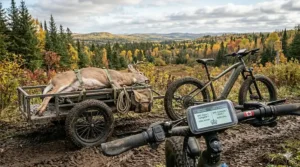
Invest in a purpose-built hunting trailer rated for 40-60 kg. The Rambo Game Cart or similar systems attach to your ebike’s rear axle and feature low centres of gravity for stability on rough trails. This setup allows you to ride in with gear on the bike’s rack, then load quartered game into the trailer for extraction. Budget $400-600 CAD for quality units designed for off-road use.
Pannier bags designed for fat tyres prevent heel strike while pedalling. Look for waterproof options with 40-60 litre total capacity. Ortlieb and Revelate Designs make bomber products suited to Canadian conditions. Store your hunting pack, extra clothing layers, and emergency gear in panniers to keep weight low and centered.
Battery Management
A spare battery effectively doubles your range. For the GLOBALKEEP or SURNAT models with 15-20Ah batteries, a spare costs $400-600 CAD but opens up hunt areas 80+ km from trailheads. Store the spare in an insulated bag inside your pack to prevent cold-weather capacity loss.
Solar charging panels (20W portable folding types) can trickle-charge batteries during multi-day base camp hunts. They won’t fully charge an ebike battery, but they’ll add 20-30% over a sunny day, extending your range for the next morning’s ride. Budget $150-250 CAD for quality solar setups.
Safety and Navigation
A quality bike phone mount lets you run navigation apps like Gaia GPS or HuntScout for real-time location tracking on crown land. Choose mounts with vibration dampening — rough trails will shake standard mounts loose. Quadlock and RAM mounts work well, costing $60-100 CAD.
Satellite communicators (Garmin inReach or SPOT) provide emergency communication beyond cell coverage. When you’re 50 km deep on crown land, this isn’t luxury — it’s essential safety gear. Budget $400-500 CAD for the device plus $180-300 CAD annually for service plans.
Maintenance Tips for Canadian Conditions
Winter Storage Protocol
November through March storage determines whether your hunting ebike survives Canadian winters. Remove the battery and store indoors at 40-60% charge in temperatures between 10-20°C. Never store lithium batteries fully charged or completely drained — both extremes accelerate degradation.
Clean the bike thoroughly before storage, removing mud, road salt, and organic debris that holds moisture. Spray frame joints and moving parts with corrosion-preventative lubricant. Store in a dry location if possible; if storing in an unheated shed, elevate the bike to prevent tyre flat-spotting and cover it to reduce moisture exposure.
Seasonal Maintenance Schedule
Spring (Pre-Season): Inspect brake pads for wear, check tyre pressure and tread depth, verify all electrical connections are clean and tight, lubricate chain and pivot points, test battery capacity with a full charge/discharge cycle.
Fall (Mid-Season): Clean bike thoroughly after each hunt, especially if riding through mud or crossing water. Check spoke tension on both wheels. Inspect frame for cracks, particularly at weld points and dropouts. Tighten any loose bolts or fasteners before vibrations cause damage.
Post-Season: Perform thorough cleaning and inspection. Replace worn brake pads, tyres, and chain if needed. Have a Canadian ebike shop inspect electrical system and motor if you’ve logged 2,000+ km in a season. Budget $150-300 CAD for professional service.
Cold Weather Operating Tips
Pre-ride your bike for 5-10 minutes in Pedal Assist Level 1 to warm the battery before demanding full power. Cold batteries deliver reduced current until internal temperature rises. This gentle warm-up extends battery life and performance.
Reduce tyre pressure 2-3 PSI below summer settings for better traction on frozen or snow-covered trails. Fat tyres can run as low as 6-8 PSI when temperatures drop without risking pinch flats. Lower pressure increases contact patch and improves grip on slippery surfaces.
Frequently Asked Questions
❓ Can I legally use an ebike for hunting on crown land in Canada?
❓ How does cold Canadian weather affect hunting ebike range?
❓ What motor power do I need for Canadian crown land terrain?
❓ Can hunting ebikes handle transporting quartered game?
❓ Are fat tyres necessary for Canadian hunting applications?
Conclusion: Selecting Your Crown Land Hunting Partner
The hunting ebike for crown land access represents a fundamental shift in how Canadian hunters reach remote terrain. After evaluating dozens of models and consulting with hunters across five provinces, several conclusions emerge. First, budget options under $1,700 CAD make sense for hunters starting out or making short 15-25 km trips. Models like the ECOTRIC Coolboy or SAMEBIKE YY26 deliver legitimate capability without breaking the bank.
For serious backcountry hunters making 40+ km expeditions or hauling heavy loads, investing $2,000-$2,900 CAD in bikes like the Shengmilo MX02S or PASELEC E-MTB pays dividends in reliability, comfort, and capability. The suspension systems alone reduce fatigue enough to improve hunting effectiveness, while premium components inspire confidence 50 km from the nearest road.
Provincial crown land regulations remain the critical wild card. Before purchasing, verify that ebikes are legal for hunting access in your target areas. BC hunters face the most restrictions and should carefully review Motor Vehicle Prohibition maps. Ontario and Alberta hunters enjoy broader access but still must confirm trail-specific rules.
The technology has matured to where these bikes genuinely outperform ATVs for stealth and efficiency while exceeding what’s possible on foot. For Canadian hunters willing to learn their provincial regulations and maintain their equipment properly, a quality hunting ebike opens crown land access that was previously impractical or impossible to reach.
Recommended for You
- 7 Best Hunting eBikes with Cargo Capacity Canada 2026
- Best Hunting eBike Canada 2026: 7 Silent Picks
- Best Fat Tire eBike for Ice Fishing Canada 2026 | Top 7 Picks
Disclaimer: This article contains affiliate links. As an Amazon Associate, I earn from qualifying purchases. If you purchase products through these links, we may earn a small commission at no additional cost to you.
✨ Found this helpful? Share it with your friends! 💬🤗
