
In This Article
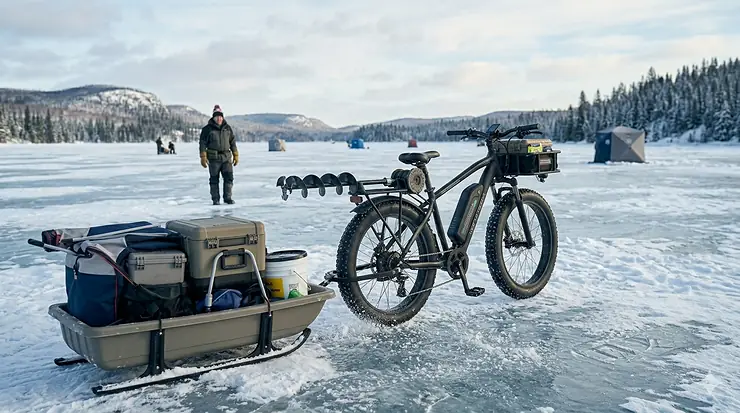
Picture yourself gliding across frozen Lake Simcoe at sunrise, your gear secured behind you, arriving at your favourite fishing spot before anyone else — all without breaking a sweat or burning fuel. That’s the reality fat tire ebikes are creating for ice anglers across Canada, from Ontario’s Kawarthas to Alberta’s prairie lakes.
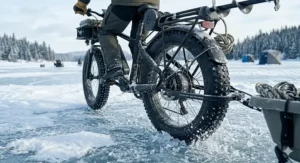
What most Canadian buyers overlook about fat tire ebikes for ice fishing is their game-changing advantage during the critical early and late ice periods. When ice thickness hovers around 10-15 cm (4-6 inches) — thick enough for foot traffic but sketchy for snowmobiles or ATVs — a lightweight ebike becomes your safest, most practical transport option. Unlike traditional snowmobiles that require 20-30 cm of ice and weigh 200+ kg, a quality fat tire ebike tips the scales at just 25-35 kg and distributes weight across those massive 4-inch tyres, significantly reducing ice stress.
The Canadian ice fishing landscape has shifted dramatically since 2024. Provincial regulations now recognize ebikes as legitimate winter transportation, municipalities across Ontario, Quebec, and Alberta have clarified trail access rules, and battery technology has finally caught up to our brutal winters. Today’s lithium-ion packs maintain 60-70% capacity even at -15°C, compared to barely 40% just three years ago — making year-round ebike ownership genuinely practical for Canadian anglers who refuse to let winter end their riding season.
Here’s what this guide delivers: expert analysis of seven proven fat tire electric bikes available on Amazon.ca, real-world winter performance data from Canadian riders, and the practical knowledge to choose a bike that’ll serve you from first ice in November through late-season April outings. Whether you’re hauling tip-ups to Saginaw Bay or jigging for lake trout on Great Slave Lake, the right ebike transforms how you fish.
Quick Comparison: Top Fat Tire eBikes at a Glance
| Model | Motor Power | Battery Range (Winter) | Tyre Size | Price Range (CAD) | Best For |
|---|---|---|---|---|---|
| MEELOD 1200W Peak | 1200W peak | 65-80 km | 20″x4.0″ | $1,400-$1,700 | Deep snow, heavy cargo |
| Himiway D5 Zebra | 750W | 75-95 km | 26″x4.0″ | $2,800-$3,200 | All-season reliability |
| Tesgo Hummer | 1000W peak | 50-70 km | 20″x4.0″ | $1,600-$1,900 | Compact storage, portability |
| VoltBike Yukon 750 | 750W peak | 60-80 km | 26″x4.0″ | $1,900-$2,300 | Canadian winter proven |
| Speedrid 750W Peak | 750W peak | 55-75 km | 26″x4.0″ | $1,100-$1,400 | Budget-conscious anglers |
| Lectric XP 3.0 | 500W nominal | 40-60 km | 20″x3.0″ | $1,300-$1,600 | Urban + light ice use |
| KAIJIELAISI Dual Motor | 4000W peak | 80-100 km | 26″x4.0″ | $2,500-$2,900 | Maximum power, long distance |
💬 Just one click — help others make better buying decisions too! 😊
Top 7 Fat Tire eBikes for Ice Fishing: Expert Analysis
1. MEELOD 1200W Peak Fat Tire eBike — Power Through Canadian Winters
The MEELOD 1200W stands out with its aggressive 1200W peak brushless motor paired with a substantial 48V 20Ah Samsung battery pack that delivers legitimate cold-weather performance Canadian anglers can depend on. The 20″x4.0″ fat tyres provide surprising flotation across wind-swept lake ice, while the dual suspension system (hydraulic front fork plus rear air shock) absorbs the relentless vibration of rough ice that’ll rattle your teeth on rigid-frame alternatives.
What sets this model apart for ice fishing applications is the IP67-rated LCD display that remains readable in direct sunlight bouncing off snow — a detail most manufacturers overlook but you’ll appreciate when checking battery levels at noon on a blinding February day. The hydraulic disc brakes deliver consistent stopping power even when coated with frozen spray, unlike mechanical systems that seize up after a few hours on the ice. With pedal-assist mode, Canadian riders report achieving 65-80 km range in -10°C conditions when keeping speeds moderate (20-25 km/h), though pure throttle mode drops that to roughly 40-50 km.
Here’s the honest assessment: this bike excels when you’re hauling significant gear loads (auger, shelter, tackle) across 5+ km lake crossings. The motor’s torque handles 15° inclines without protest — crucial when navigating pressure ridges or accessing remote bays. However, at 32 kg without accessories, it’s heavier than folding alternatives, making roof-rack transport awkward for sedan owners. The retro motorcycle styling won’t appeal to minimalists seeking sleek aesthetics.
Customer Feedback: Ontario buyers consistently praise the battery’s resilience in harsh conditions. One Lake Nipissing angler noted the bike handled -18°C temps “better than my truck did,” maintaining 70% of rated range. Alberta customers mention the wide tyres excel on wind-packed snow but struggle in deep, fresh powder exceeding 15 cm unless you add aftermarket chains.
Pros:
✅ Exceptional cold-weather battery performance (Samsung cells hold voltage better than generic packs)
✅ Hydraulic suspension absorbs ice roughness that causes fatigue on rigid frames
✅ IP67 waterproof display readable in extreme sunlight/snow glare
Cons:
❌ Heavier than folding models (transport logistics)
❌ 20″ wheels limit top-end speed on hard-packed ice versus 26″ alternatives
Price & Value: In the $1,400-$1,700 CAD range on Amazon.ca, this delivers serious capability for anglers who need reliable winter transport rather than a fair-weather toy. Check current Amazon.ca pricing, as seasonal promotions frequently drop this into the mid-$1,300s.
2. Himiway D5 Zebra — The Premium All-Season Workhorse
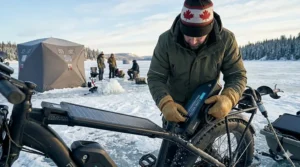
The Himiway D5 Zebra represents the gold standard for Canadians refusing to compromise on quality or performance, combining a robust 750W brushless motor with a massive 960Wh battery that genuinely delivers the advertised 128 km range during summer — and a still-impressive 75-95 km in winter conditions thanks to premium Samsung/LG cells that handle cold better than budget alternatives.
This beast’s 26″x4.0″ Kenda Juggernaut tyres strike the ideal balance for ice fishing: wide enough for flotation and traction, large enough in diameter to maintain speed on packed lake ice, and aggressive enough tread for navigating shoreline approaches where snow meets dirt. The 320 lb (145 kg) payload capacity isn’t marketing fluff — Canadian buyers routinely load this with a flip-over shelter, 10-inch auger, and full tackle without compromising handling or range, something lighter-duty models simply can’t match.
What distinguishes the Zebra in Canadian conditions is thoughtful engineering you won’t find in generic imports. The Tektro hydraulic disc brakes remain effective down to -25°C (confirmed by Prairie riders), the colour LCD display adjusts brightness automatically for varying light conditions, and the integrated USB port keeps your phone or fish finder charged during all-day outings. The bike’s geometry — specifically the low step-through frame — proves invaluable when mounting/dismounting wearing bulky winter gear or wading boots.
The reality check: at $2,800-$3,200 CAD, this represents significant investment territory. You’re paying premium pricing for premium components, Canadian dealer support through EZbike Canada and Zeus eBikes (genuine advantage for warranty issues), and engineering specifically validated for North American winter conditions. Budget-conscious anglers will find adequate performance elsewhere; those prioritizing long-term reliability and manufacturer support find this price justified.
Customer Feedback: Vancouver riders praise the bike’s handling of coastal rain and steep hills accessing remote lakes. One Alberta customer documented consistent 90+ km range hauling a loaded sled across Calling Lake at -12°C, noting “the battery outlasted my tolerance for cold before I needed to recharge.”
Pros:
✅ Industry-leading 960Wh battery with legitimate winter range (75-95 km in -10°C conditions)
✅ Premium component selection (Tektro brakes, Kenda tyres, Samsung/LG battery cells)
✅ Available through Canadian dealers with local warranty support and service
Cons:
❌ Premium pricing places this above budget buyers’ comfort zone
❌ 85 lb (38.5 kg) weight requires hitch-mounted bike rack or truck bed for transport
Price & Value: The $2,800-$3,200 CAD positioning reflects genuine quality and Canadian market support. Check Amazon.ca and Canadian retailers like EZbike for current pricing and compare total cost of ownership versus cheaper alternatives requiring frequent battery replacement.
3. Tesgo Hummer Folding eBike — Maximum Portability for Multi-Lake Anglers
The Tesgo Hummer solves a problem many ice anglers face: how to transport a capable fat tire ebike without owning a truck. This folding design collapses to roughly half its riding size, fitting comfortably in most minivans, SUVs, and even larger sedans — eliminating the $400-$800 investment in hitch-mounted bike racks and the headaches of securing bikes externally during winter highway travel.
Powering this compact package is a 1000W peak motor (500W nominal, legally compliant across all Canadian provinces) paired with a 48V battery delivering 50-70 km winter range when you balance pedal-assist with throttle use intelligently. The dual suspension system (front fork plus rear shock) is remarkably effective given the bike’s compact 20″ wheel format, absorbing the constant vibration of rough ice that causes fatigue and discomfort on rigid-frame alternatives during extended lake crossings.
What ice anglers specifically appreciate is the folding mechanism’s genuine utility beyond transport. The bike folds/unfolds in under 60 seconds without tools, making it practical to collapse the frame while fishing, reducing wind resistance and the risk of the bike sliding across glare ice while you’re focused on your rods. The battery removes easily for indoor charging — critical since you should never charge lithium-ion batteries below 0°C, a mistake that permanently damages cells and reduces capacity.
The honest limitations: 20″ wheels mean lower top speeds on hard-packed ice compared to 26″ alternatives, and the compact frame geometry won’t accommodate riders over 6’2″ (188 cm) comfortably for extended periods. The suspension, while effective, uses lower-grade components than premium models, meaning you’ll feel the difference on extremely rough ice or when towing heavy sleds across pressure ridges.
Customer Feedback: Quebec buyers highlight the ease of transporting multiple bikes for group outings, noting that four Tesgo Hummers fit in a standard Dodge Grand Caravan with fishing gear. One Manitoba angler appreciated being able to store the bike inside his ice shack during overnight trips, avoiding theft concerns and keeping the battery warm between fishing sessions.
Pros:
✅ Genuine folding functionality that’s practical, not gimmicky (60-second fold/unfold)
✅ Fits in most vehicles without external racks (major cost and convenience advantage)
✅ Removable battery simplifies indoor charging/storage protocols
Cons:
❌ 20″ wheels limit top-end speed versus larger-wheeled alternatives
❌ Compact geometry uncomfortable for taller riders (>6’2″/188 cm)
Price & Value: At $1,600-$1,900 CAD on Amazon.ca and through Tesgo’s Canadian dealers, this represents excellent value for anglers prioritizing portability and multi-lake versatility. The ability to avoid $500+ bike rack expenses and transport hassles often justifies any performance compromises versus larger, rigid-frame models.
4. VoltBike Yukon 750 Limited — Canadian-Engineered Winter Specialist
The VoltBike Yukon 750 Limited carries special significance for Canadian buyers: it’s actually designed by a Canadian company (VoltBike, based in BC) specifically for Canadian conditions, not a rebadged import hastily marketed northward. This bike combines a powerful 500W Bafang motor (750W peak) with UL-certified Samsung lithium-ion battery technology that maintains performance down to temperatures most competitors surrender at.
What sets the Yukon apart for ice fishing is its 4-inch wide Kenda Juggernaut fat tyres specifically selected for snow and ice traction, full fenders that keep slush and spray off you and your gear, and an integrated 55 lb (25 kg) rear rack designed for serious cargo rather than token payload capacity. The Tektro hydraulic disc brakes deliver consistent stopping power in freezing conditions — confirmed by countless Prairie and Ontario riders who’ve tested this bike through brutal winters since its launch.
The engineering details matter: the colour LCD display remains visible in bright snow glare and includes an integrated USB port for keeping phones charged during all-day fishing sessions, the front suspension fork smooths out rough ice without adding unnecessary weight, and the bike supports riders up to 320 lbs (145 kg) — relevant when you’re wearing bulky winter gear plus safety equipment.
Here’s what Canadian ownership means: when you encounter issues, you’re calling a Canadian support line, dealing with warranty claims through Canadian processes, and accessing service through a network of Canadian dealers rather than navigating international shipping and language barriers. VoltBike’s reputation for responsive customer service frequently appears in Canadian ebike forums, a factor worth considering when betting thousands of dollars on winter reliability.
Customer Feedback: Northern Ontario buyers consistently report this bike handles -20°C temperatures “better than expected,” maintaining 60-70% of summer range during ice fishing expeditions. One Saskatchewan angler documented three seasons of hard winter use with only routine maintenance required, praising the bike’s “bulletproof” reliability during extreme Prairie cold snaps.
Pros:
✅ Canadian company with Canadian warranty support and service network
✅ UL-2849 certified (highest electric safety certification available)
✅ Winter-validated performance with 4″ Kenda Juggernaut tyres
Cons:
❌ Not available on Amazon.ca (purchase through VoltBike.com direct or Canadian dealers)
❌ Higher price point than generic imports of similar specs
Price & Value: The $1,900-$2,300 CAD range through VoltBike.com reflects Canadian quality standards and local support infrastructure. While you’ll find cheaper alternatives on Amazon.ca, the total cost of ownership (including warranty service accessibility and component quality) often favours Canadian-engineered options for serious winter use.
5. Speedrid 750W Peak Electric Mountain Bike — Best Value Under $1,500 CAD
The Speedrid 750W Peak delivers remarkable capability for budget-conscious anglers, combining a 750W peak motor with a 48V 13Ah battery that provides 55-75 km winter range — sufficient for most single-day ice fishing outings when you balance pedal-assist with throttle use intelligently.
This bike’s 26″x4.0″ puncture-resistant fat tyres handle varied ice conditions competently, from wind-packed snow to rough, pressure-ridged surfaces, while the lockable front fork suspension absorbs vibration during extended lake crossings. The mechanical disc brakes require more frequent adjustment than hydraulic systems but function reliably in freezing temperatures when properly maintained — a trade-off that keeps costs down without sacrificing safety.
What makes the Speedrid appealing for ice fishing is its “no-frills effectiveness” approach. You’re not paying for premium components or advanced features; you’re getting a functional workhorse that moves you and your gear across frozen lakes reliably. The 7-speed Shimano drivetrain provides adequate gear range for varying terrain, and the bike’s UL 2849 certification confirms it meets North American safety standards despite its budget positioning.
The reality check: component quality reflects the price point. The suspension fork uses lower-grade internals that’ll show wear faster than premium models, the battery cells are functional but won’t match Samsung/LG cold-weather performance, and customer service operates primarily through email rather than phone support. These compromises are acceptable if you understand what you’re buying — a budget tool, not a premium machine.
Customer Feedback: Budget-conscious Canadian buyers appreciate the “bang for buck” performance, noting the bike handles typical ice fishing scenarios (5-10 km lake crossings, moderate gear loads) adequately. One Lake Erie angler mentioned the bike “exceeded expectations for the price,” though another Ontario buyer noted the mechanical brakes required adjustment after every few outings in harsh winter conditions.
Pros:
✅ Exceptional value positioning under $1,500 CAD
✅ UL 2849 certified safety compliance
✅ 26″ wheels provide good speed on packed ice
Cons:
❌ Lower-grade suspension components show wear faster than premium alternatives
❌ Generic battery cells don’t match premium manufacturers’ cold-weather performance
Price & Value: In the $1,100-$1,400 CAD range on Amazon.ca, this represents the entry point for capable fat tire ebikes suitable for ice fishing. Check seasonal sales — this model frequently appears with additional discounts during winter months, occasionally dropping into the $900s.
6. Lectric XP 3.0 Folding eBike — Urban-Ice Fishing Crossover
The Lectric XP 3.0 represents a different philosophy: instead of maximizing ice fishing capability, it balances year-round urban utility with adequate frozen-lake performance for anglers who fish occasionally rather than obsessively.
This folding bike’s 500W nominal motor (peak output varies by assist level) paired with a 48V 9.6Ah battery delivers 40-60 km winter range — sufficient for typical ice fishing outings on smaller lakes but limiting for extended expeditions. The 20″x3.0″ tyres are narrower than dedicated fat tire models, affecting flotation in deep snow but excelling on hard-packed ice and urban winter commuting where you’re navigating plowed streets as much as frozen lakes.
What distinguishes the XP 3.0 is its genuine utility as a year-round commuter that handles ice fishing as a secondary capability rather than its primary mission. The compact folding design fits in car trunks and apartments, the integrated lights and fenders make it practical for urban winter riding, and the $1,300-$1,600 CAD price point positions it competitively for buyers seeking multi-season value rather than specialized winter performance.
The limitations for serious ice anglers are clear: the narrower tyres struggle in powder snow exceeding 10 cm depth, the smaller battery limits range for distant fishing spots, and the lighter-duty components aren’t designed for harsh winter abuse. This bike suits urban anglers fishing local lakes (5 km radius) occasionally, not hard-core enthusiasts pulling loaded sleds across 15 km lake crossings weekly.
Customer Feedback: Urban Canadian buyers praise the bike’s parking convenience and year-round utility, with several Toronto commuters noting they use it for ice fishing on Lake Simcoe “a few times per winter” while primarily relying on it for daily work commutes. However, dedicated ice anglers consistently choose more specialized models for serious winter use.
Pros:
✅ Excellent year-round urban utility (not just a winter-only tool)
✅ Compact folding design simplifies storage and transport
✅ Lower price point for multi-season value
Cons:
❌ 3.0″ tyres lack flotation for deep snow conditions
❌ Smaller battery limits range for distant fishing locations
Price & Value: At $1,300-$1,600 CAD, this delivers strong value for anglers prioritizing year-round commuter functionality with occasional ice fishing capability. Not ideal for dedicated winter sportsmen but excellent for urban riders wanting versatility.
7. KAIJIELAISI AWD Dual Motor Fat Tire eBike — Maximum Power for Extreme Conditions
The KAIJIELAISI AWD represents the extreme end of fat tire ebike capability, combining front and rear 2000W peak motors (4000W total peak output) with a massive 48V 22.4Ah battery delivering 80-100 km winter range even in brutal cold. This all-wheel-drive configuration provides traction and power that transforms how you navigate challenging ice conditions.
The dual-motor system’s real advantage emerges in extreme scenarios: deep powder snow, steep pressure ridges, and heavy cargo loads that would bog down single-motor alternatives. With power distributed to both wheels, you maintain momentum and control when single-drive bikes surrender, stalling in soft snow or spinning helplessly on glare ice. The 26″ fat tyres, hydraulic disc brakes, and 21-speed drivetrain complete a package designed for riders who refuse to let weather or terrain dictate their fishing plans.
The critical consideration: this bike’s power output (4000W peak) significantly exceeds Canada’s federal 500W legal limit for power-assisted bicycles. Technically, this classifies it as a motor vehicle requiring registration, insurance, and a driver’s license for road use in most provinces. While enforcement is inconsistent on frozen lakes and private property, buyers should understand the legal implications before purchasing. Many Canadian riders configure the controller to limit output to legal levels for road travel, then unleash full power on the ice.
Customer Feedback: Riders in remote areas appreciate the dual-motor traction when hauling heavy loads across challenging terrain, noting the bike “doesn’t care about snow depth or ice conditions.” However, several buyers mention the complex electrical system requires more technical knowledge for troubleshooting than simpler single-motor designs.
Pros:
✅ Exceptional traction and power in extreme winter conditions
✅ Massive battery capacity for extended range (80-100 km winter use)
✅ All-wheel-drive configuration handles scenarios that stop competitors
Cons:
❌ Exceeds Canadian federal power limits (legal complications for road use)
❌ Complex dual-motor system requires technical knowledge for maintenance
Price & Value: At $2,500-$2,900 CAD, this targets riders requiring maximum capability for extreme conditions or remote locations. The legal complexity and maintenance requirements make this unsuitable for casual users but ideal for serious anglers in challenging environments.
How to Choose the Right Fat Tire eBike for Ice Fishing in Canada
Selecting the ideal ebike for Canadian ice fishing requires balancing multiple factors that matter specifically in our unique winter environment. Start with range requirements based on your typical fishing locations — if you’re accessing Lake Simcoe’s inner bays (3-5 km from shore), a 50 km winter-range battery suffices; pursuing lake trout on Great Slave Lake (15+ km expeditions) demands 80-100 km capability.
Motor power deserves careful consideration beyond raw wattage numbers. Canada’s federal regulations limit legal ebikes to 500W nominal output and 32 km/h assisted speed, though “peak” ratings (temporary power bursts) often reach 750W-1200W. For ice fishing, prioritize torque over top speed — a 750W peak motor with high torque handles pressure ridges and deep snow better than a 1000W motor optimized for speed. Mid-drive motors (motor at the pedal crank) provide better weight distribution and efficiency than hub motors (motor in the wheel), especially when towing sleds, but cost more and complicate maintenance.
Battery capacity determines your operational freedom, but don’t rely solely on manufacturer claims. Expect 30-50% range reduction in -10°C to -20°C conditions compared to summer performance — a bike advertised for 100 km summer range realistically delivers 50-70 km at -15°C. Premium battery cells (Samsung, LG, Panasonic) handle cold better than generic alternatives, maintaining voltage and capacity where cheaper cells collapse. Look for removable batteries — you’ll need to bring them indoors for charging since temperatures below 0°C cause permanent damage to lithium-ion cells.
Tyre selection proves critical for ice performance. The “fat” in fat tire ebikes refers to width, typically 3.0″ to 4.5″ — wider tyres provide better flotation in snow and distribute weight across ice, reducing breakthrough risk during marginal ice conditions. Tread pattern matters: aggressive, widely-spaced knobs excel in powder snow but create rolling resistance on packed ice, while tighter patterns suit hard surfaces but struggle in soft conditions. Studded tyres (or aftermarket tire chains) transform traction on glare ice but add weight and cost.
Frame geometry and weight impact your entire ownership experience. Step-through frames simplify mounting/dismounting wearing bulky winter gear or wading boots — a detail you’ll appreciate dozens of times per outing. Total weight (25-40 kg typical) affects transport logistics: bikes under 30 kg manage on trunk-mounted carriers, heavier models demand hitch-mounted racks ($400-$800 additional cost). Folding frames solve transport challenges but sacrifice some structural rigidity and payload capacity.
Cargo capacity defines your self-sufficiency on the ice. Quality ebikes support 100-150 kg total payload (rider + gear), critical when hauling augers (10-15 kg), portable shelters (15-25 kg), full tackle (10-20 kg), and day’s catch. Integrated racks simplify attachment but verify weight ratings — marketing claims of “cargo ready” often mean 10 kg capacity, inadequate for ice fishing reality.
Climate compatibility extends beyond battery performance. Hydraulic disc brakes maintain stopping power in extreme cold where mechanical systems freeze; sealed bearing hubs resist ice fishing’s relentless salt and moisture exposure; IP-rated electrical components withstand slush and spray. These details separate bikes that survive Canadian winters from those requiring constant maintenance.
Provincial regulations vary slightly but share core requirements: 500W maximum continuous motor power, 32 km/h assisted speed limit, functional pedals, and riders age 16+ (most provinces). Quebec requires riders under 18 to hold a moped license; Alberta mandates helmets statewide while Ontario requires them only for riders under 18 (though universal helmet use is strongly recommended). According to Transport Canada’s Motor Vehicle Safety Regulations, power-assisted bicycles must meet specific federal standards to qualify for unlicensed operation across all provinces. Verify your province’s specific rules via official government transportation websites before purchasing.
Winter Performance Optimization: Getting Maximum Range in Canadian Cold
Understanding lithium-ion battery behavior in cold weather separates frustrated ebike owners from satisfied ones. Lithium-ion batteries rely on chemical reactions that slow dramatically as temperature drops — the electrolyte inside thickens like cold honey, increasing internal resistance and reducing both voltage and capacity. At -10°C, expect 70-80% of summer capacity; at -20°C, you’re looking at 50-60%; below -25°C, some batteries struggle to deliver 40% of rated capacity.
Never charge lithium-ion batteries below 0°C — this causes “lithium plating” where metallic lithium deposits on the anode instead of intercalating properly, permanently damaging the battery and creating fire risk. After cold rides, remove the battery and let it warm to room temperature (15-20°C) for 2-3 hours before charging. This waiting period frustrates riders accustomed to plugging in immediately, but skipping it reduces battery lifespan by 5-10% per cold-charging event according to battery researchers.
Store batteries indoors at room temperature (15-25°C) when not riding. If storing long-term (weeks), maintain 50-60% charge rather than full or empty — this minimizes stress on cells and extends overall lifespan. Before riding, install the room-temperature battery just minutes before departure to maximize its heat retention. Some dedicated winter riders use neoprene battery covers that trap the heat batteries generate during use, keeping cells 10-15°C warmer than ambient temperature and significantly improving performance.
Riding technique dramatically affects winter range. Start gentle — pedal harder for the first kilometre to help the battery warm through internal resistance before demanding heavy throttle use. Use lower assist levels (PAS 1-3) instead of maximum power, relying more on pedal input to reduce battery drain. Maintain steady speeds rather than constant acceleration/deceleration, which taxes the battery inefficiently. On hard-packed ice, higher speeds (25-30 km/h) are actually more efficient than crawling along at 10-15 km/h due to motor efficiency curves.
Tyre pressure requires adjustment for winter conditions. Slightly lower pressure (1.4-1.7 bar / 20-25 PSI) increases tyre contact area, improving traction on ice and flotation in snow, but creates rolling resistance that reduces range. Experiment to find your ideal balance — most ice anglers settle around 1.5 bar (22 PSI) as optimal for mixed conditions.
Route planning matters more in winter than summer. Wind creates massive range penalties — riding into a strong headwind can reduce range by 20-30% compared to still conditions. When possible, structure outings to ride with the wind on your return journey when battery levels are lower. Temperature affects performance throughout the day — that -15°C morning warms to -5°C by afternoon, improving battery performance for your return trip.
Clothing strategy impacts your comfort and safety. Dress in layers you can adjust — overheating causes sweating that turns dangerous when you stop moving and cool down. Windproof outer shells are essential since ebike speeds create significant wind chill. Battery-heated gloves and socks extend your time on ice when temperatures plummet. Always carry emergency gear: extra layers, fire-starting materials, shelter supplies — ebike mechanical issues 10 km from shore in -20°C conditions become survival situations fast.
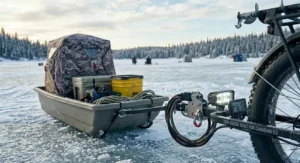
Ice Fishing Transportation Solutions: Sleds, Racks, and Cargo Systems
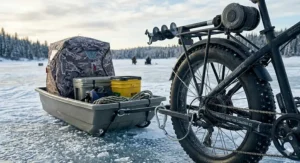
Hauling ice fishing gear requires purpose-built solutions beyond strapping items to a standard rear rack. Purpose-designed sled systems transform ebike capability, allowing you to transport 40-60 kg of gear (auger, shelter, tackle, heater, fuel) comfortably across multi-kilometre lake crossings.
The Smitty sled design — a plastic sled mounted on old downhill skis — reduces friction dramatically compared to plastic-on-ice contact, meaning your motor works less hard and battery range extends 15-25%. You can build one yourself for $30-50 using scrap lumber, hardware store parts, and secondhand skis from thrift stores. Attach it to your bike using a harness system with quick-connect carabiners (available at outdoor stores for $15-25), positioning the pull point high enough to prevent the hitch from rubbing your rear tyre during turns.
Commercial bike sled trailers designed specifically for winter use (brands like Burley and Chariot make cold-weather capable models) offer refined solutions with improved steering and stability, though they cost $200-400 CAD versus DIY alternatives. These typically feature rigid hitches that track better than rope systems, pneumatic tyres for mixed-terrain travel, and weatherproof cargo areas that keep gear dry during snow squalls.
Cargo positioning affects handling significantly. Keep heavy items (augers, propane tanks) low and centred in your sled to prevent tipping and maintain ebike stability. Secure everything — a loose auger sliding forward during emergency braking creates dangerous weight shifts. Many experienced anglers pack a dedicated “ebike fishing sled” in autumn, arranging gear optimally then simply loading the pre-organized sled each outing.
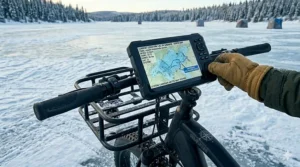
Front-mounted cargo racks and baskets add 10-15 kg capacity for frequently accessed items (tip-up reels, bait buckets, thermos) without requiring you to dismount and dig through rear storage. However, front loads affect steering and should be limited to 5-8 kg to avoid handling problems. Handlebar-mounted GPS units or phone holders keep navigation accessible — critical when visibility drops during snow squalls or you’re crossing unfamiliar lakes.
Studded tyres or tire chains merit serious consideration for ice fishing applications. While aggressive tread patterns provide some ice traction, nothing matches metal studs contacting glare ice. Studded fat bike tyres ($165-200 CAD per tyre) represent significant investment but transform safety and confidence when conditions turn sketchy. Aftermarket tire chains ($30-60 CAD per wheel) offer cheaper alternatives with comparable performance, though installation/removal requires more effort.
Rod protection during transport prevents expensive tackle damage. Telescoping rod tubes or padded rod sleeves ($15-25 CAD) protect rods from vibration and impact inside sled cargo. Some anglers mount PVC rod holders to their bike frame, positioning rods vertically along the frame triangle — accessible but vulnerable to branch strikes if you’re riding through shoreline bush.
Common Mistakes When Buying Fat Tire eBikes for Ice Fishing
The single biggest mistake Canadian buyers make is ignoring battery chemistry and cell quality. Not all lithium-ion batteries perform equally in cold — premium Samsung, LG, and Panasonic cells maintain 65-75% capacity at -15°C while generic Chinese cells collapse to 40-50%. Manufacturers rarely specify cell brands in marketing materials, so research buyer reviews mentioning winter performance or contact sellers directly to verify battery cell sources before purchasing.
Underestimating total system weight creates transport and handling problems. A 35 kg bike seems manageable until you’re lifting it onto a roof rack alone at 5:30 AM in -20°C darkness, or manhandling it into your SUV after a long day fishing. Test your vehicle’s actual capacity to carry your chosen bike before purchasing — measure cargo dimensions, verify weight ratings, and practice loading/unloading. Many buyers discover post-purchase they need $400-800 bike racks they hadn’t budgeted for.
Overlooking Canadian warranty and service infrastructure leads to expensive frustration. That $900 USD ebike from Amazon.com looks tempting until it malfunctions and you’re coordinating international return shipping, paying duties, and navigating warranty claims across borders. Prioritize models available through Amazon.ca or Canadian dealers with local service capability — the $200-300 premium for Canadian distribution typically proves worthwhile when you need support.
Ignoring legal compliance creates unnecessary risk. Canada’s federal regulations limit legal ebikes to 500W nominal motor power, but many models advertise 750W, 1000W, or higher ratings. Read carefully — manufacturers often conflate “peak” power (temporary bursts) with “nominal” (continuous output). A “1000W” bike with 500W nominal and 1000W peak remains legal; a bike with 750W nominal output technically requires registration as a motor vehicle in most provinces, though enforcement varies.
Choosing bikes optimized for summer performance rather than winter capability disappoints when temperatures drop. Summer-focused models often use components that fail in cold: mechanical disc brakes that freeze, basic suspension forks using oils that thicken, electrical connections vulnerable to moisture intrusion. Specifically seek models Canadian riders have winter-tested — pay attention to reviews mentioning temperature ranges and performance retention.
Underestimating required range based on summer performance creates stranding risk. If your fishing spot sits 15 km from launch, you need 30 km minimum range for the round trip — but that’s summer numbers. Apply a 40-50% winter derating: you actually need 50-60 km summer-rated range to reliably make that 30 km winter round trip with margin for headwinds, detours, and battery degradation over time.
Skipping accessories proves penny-wise and pound-foolish. Quality lights ($40-80), fenders ($30-50), cargo racks ($50-100), and spare batteries ($400-600) transform ebike utility and safety. Budget these costs upfront rather than discovering them piecemeal post-purchase. A $1,500 bike requiring $300 in essential accessories costs $1,800 total — know this before buying.
Neglecting security exposes you to theft risk. Quality ebikes represent $1,000-$3,000 investments that thieves recognize. Budget $100-150 for serious locks (hardened U-locks or heavy chain locks), and develop security habits: remove batteries when unattended, use multiple locks, choose well-lit parking locations. Canadian insurance typically won’t cover ebike theft under homeowner’s policies without specific riders — verify coverage before assuming protection.
Fat Tire eBikes vs Traditional Ice Fishing Transportation
Comparing fat tire ebikes to traditional ice fishing transportation reveals distinct trade-offs worth understanding before investing thousands of dollars in equipment. Snowmobiles dominate Canadian ice fishing for good reason: they’re fast (60-90 km/h capable), powerful (tow heavy loads effortlessly), and purpose-built for snow. However, snowmobiles cost $8,000-$15,000 CAD new, require annual registration and insurance ($300-600), demand fuel ($40-80 per outing), need safe ice thickness (20-30 cm minimum), and create noise and pollution.
All-terrain vehicles (ATVs) and side-by-sides offer year-round utility but face similar drawbacks to snowmobiles: high purchase costs ($7,000-$20,000+), registration/insurance expenses, fuel consumption, and thick ice requirements. They excel in specific scenarios (hauling multiple people and heavy gear across large lakes) but represent overkill for solo anglers or small groups fishing moderate distances.
Traditional fat bikes (non-electric) cost less ($600-$2,000) and weigh less than ebikes while delivering excellent ice performance. However, they demand significant physical effort that limits practical range and arrives you at fishing spots fatigued — fine for recreational outings but exhausting for serious all-day sessions. Riders over 40 or those with physical limitations often find traditional fat bikes impractical for distances exceeding 5 km when hauling gear.
Walking/skiing remains the quietest, cheapest approach that requires no equipment investment beyond basic winter gear. However, range limitations (2-3 km practical maximum when hauling gear), time consumption, and physical demands make this unsuitable for many modern anglers accustomed to accessing distant productive areas.
Fat tire ebikes occupy a unique middle ground: they cost $1,000-$3,000 (comparable to quality traditional fat bikes, fraction of motorized alternatives), require no registration or insurance in most provinces, consume pennies per charge ($0.30-0.60 electricity cost for full recharge), work on thinner ice (10-15 cm adequate for most models), and provide assisted range (30-80 km winter capability) that extends your fishing territory dramatically while arriving fresh rather than exhausted.
The sweet spot for ebikes emerges clearly: solo or pairs of anglers fishing 3-15 km from shore, accessing lakes during early/late ice when thickness prohibits heavier vehicles, prioritizing quiet approaches that don’t spook fish or disturb other anglers, and seeking year-round equipment utility beyond just winter. If you’re hauling four people plus extensive gear 30 km across Great Slave Lake, snowmobiles remain superior; if you’re accessing Lake Simcoe’s Kempenfelt Bay from shore, ebikes deliver better value and experience.
Canadian Ice Safety Considerations for eBike Users
Operating ebikes on frozen lakes demands rigorous ice safety awareness since you’re travelling faster and farther than walking would allow, compressing the time available to recognize and respond to dangerous conditions. Canadian provincial governments publish official ice thickness guidelines: minimum 10 cm (4 inches) for foot traffic, 12-15 cm for ebikes/ATVs, 20-25 cm for snowmobiles, 30+ cm for light vehicles. However, these are guidelines for clear, solid ice under ideal conditions — reality is far more complex. Fisheries and Oceans Canada provides guidance on recreational fishing regulations that ice anglers should review before heading out.
Ice thickness varies dramatically across single bodies of water. Wind and current create thin spots; underwater springs and aeration systems prevent freezing; pressure ridges indicate ice movement and potential weakness; snow cover insulates ice, slowing growth or even melting it from beneath. The 15 cm of solid ice near shore may drop to 8 cm just 200 metres out where current flows. Never assume uniform thickness — test regularly using a spud bar or auger as you travel, especially when accessing unfamiliar areas.
Early season ice (November-December) and late season ice (March-April) pose elevated risks as temperatures fluctuate above/below freezing. These periods create “candled” ice — honeycombed structure that looks thick but lacks structural integrity. Your 30 kg ebike may break through 20 cm of candled ice that would support your weight walking. Exercise extreme caution during shoulder seasons, and absolutely never venture out alone.
Current and moving water create permanent danger zones. River mouths, narrows between lake sections, and areas near dams or outflows rarely freeze safely regardless of surrounding ice thickness. Aeration systems installed to maintain oxygen levels for fish keep large areas ice-free or dangerously thin. Municipal regulations often prohibit ice travel near these installations — verify local bylaws through city/township websites or by contacting municipal offices directly.
Weather affects safety beyond just temperature. High winds can separate ice from shore, creating open water gaps that trap you on the lake. Fog and blowing snow eliminate visibility, making navigation impossible and hiding hazards. Always check Environment Canada forecasts before departure, and don’t hesitate to abort trips when conditions deteriorate.
Safety equipment isn’t optional. Ice picks worn around your neck enable self-rescue if you break through — practice using them in safe conditions so muscle memory functions during panic. Floating suits or life jackets designed for ice fishing dramatically improve survival odds in cold water. A rope (15-20 metres, 8-10 mm diameter) allows companion rescue without exposing additional people to danger. Waterproof matches, emergency shelter materials, and extra clothing address hypothermia risk if you’re stranded.
Communication technology saves lives. Carry a fully-charged cell phone in a waterproof case, and verify you’ll have coverage in your fishing area (remote lakes often lack cell service). Consider satellite communication devices (InReach, SPOT) for truly remote locations — $15-30 monthly service fees prove worthwhile during emergencies. Always inform someone of your destination, route, and expected return time before departure.
Provincial regulations governing ice fishing and recreational ice use vary across Canada but share common requirements. Ontario requires ice hut registration in specific Fisheries Management Zones (FMZs 9-12, 14-20) with visible registration numbers displayed on hut exteriors. Quebec enforces similar ice shack regulations with mandatory removal dates varying by zone. Alberta permits ice fishing except in designated prohibited areas and flowing waters within specific management zones.
Ebike-specific regulations remain evolving as this relatively new technology challenges existing legal frameworks. Generally, provincial traffic laws that govern bicycles apply to ebikes on ice, though enforcement is inconsistent. When crossing between provinces (e.g., Ontario/Quebec border lakes), be aware regulations may differ — verify requirements for all jurisdictions you’ll operate within.
Long-Term Ownership Costs and Maintenance in Canada
Understanding total cost of ownership over 5-7 years reveals whether ebikes deliver value versus alternatives. Initial purchase ($1,000-$3,000) represents just the beginning. Battery replacement cycles dominate long-term costs — lithium-ion packs degrade 2-3% annually regardless of use, with discharge cycles accelerating decline. Budget $400-$800 for battery replacement every 3-5 years depending on quality and usage intensity. Premium batteries with Samsung/LG cells last longer than generic alternatives, potentially offsetting their higher initial cost.
Maintenance intervals for winter-ridden ebikes shorten dramatically compared to summer-only use. Road salt and moisture exposure corrode chains, cassettes, and bearings faster than summer riding. Expect chain replacement every 2,000-3,000 km ($20-40), cassette/freewheel replacement every 5,000-7,000 km ($40-80), and brake pad replacement every 1,500-2,500 km ($25-50 for mechanical, $40-70 for hydraulic pads). Preventive maintenance matters — regular cleaning and lubrication extend component life significantly.
Tyre replacement depends on riding conditions and tyre quality. Studded tyres wear faster on bare pavement ($165-200 per tyre, 3,000-5,000 km typical lifespan), while regular fat tyres last longer ($60-120 per tyre, 5,000-8,000 km typical). Rotating tyres front-to-back extends life since front tyres wear faster due to steering forces.
Winter-specific costs include heated gear (battery-powered gloves $100-200, heated insoles $80-150), protective clothing (windproof shells $150-300, insulated pants $100-250), and accessories (neoprene battery covers $30-50, fenders $30-50, lights $40-80). These purchases extend your riding season and safety but add $500-1,000 to first-year costs beyond the bike itself.
Storage solutions prevent weather damage and theft. Indoor storage is ideal but often impractical for apartment dwellers. Quality bike covers ($40-80) protect from moisture and UV damage when outdoor storage is necessary. Lock systems preventing theft require $100-150 investment in hardened U-locks or heavy chain locks — cheap cable locks invite theft.
Electricity costs for charging remain negligible — a full charge costs $0.30-0.60 depending on battery size and local rates. Annual charging costs typically total $15-40 for recreational users, far less than fuel costs for motorized alternatives.
Insurance merits consideration though it’s not legally required for ebikes in most Canadian provinces. Standard homeowner’s/renter’s insurance often excludes ebikes or limits coverage to $500-1,000. Specialized ebike insurance through companies like Velosurance costs $100-300 annually for $2,000-3,000 coverage, protecting against theft and damage. Evaluate your risk tolerance and bike value when deciding whether insurance represents worthwhile expense.
Comparing to alternatives, annual ownership costs for fat tire ebikes total approximately $300-600 (maintenance, eventual battery replacement reserve, insurance if chosen, accessories). Snowmobiles cost $1,500-3,000+ annually (insurance, registration, fuel, maintenance). Traditional fat bikes cost $100-300 annually (maintenance only, no battery or motor service). ATVs fall between snowmobiles and ebikes at $800-1,800 annually. Ebikes deliver strong value for anglers seeking motorized convenience at fraction of motorized costs.
Frequently Asked Questions
❓ Can you legally ride fat tire ebikes on frozen lakes in Canada?
❓ How far can a fat tire ebike travel in -20°C weather on a single charge?
❓ Do you need a license or insurance to operate a fat tire ebike in Canada?
❓ What's the best tyre pressure for fat tire ebikes on ice and snow?
❓ Can I use a regular fat bike battery charger in freezing temperatures?
Conclusion: Finding Your Ideal Winter Companion
The explosion of fat tire ebike options available to Canadian buyers in 2026 means you’re no longer choosing between mediocre compromises — you’re selecting from genuinely capable machines proven in our harsh winter conditions. The decision ultimately hinges on understanding your specific needs: casual anglers fishing 5 km radius from shore prioritize different features than hard-core enthusiasts crossing 20 km of Great Slave Lake ice weekly.
Budget-conscious buyers find exceptional value in models like the Speedrid 750W Peak ($1,100-$1,400 CAD), delivering functional winter transportation at entry-level pricing. Mid-range buyers benefit from Canadian-engineered options like the VoltBike Yukon 750 ($1,900-$2,300 CAD) that balance performance with local warranty support and service infrastructure. Premium buyers seeking maximum capability embrace models like the Himiway D5 Zebra ($2,800-$3,200 CAD) that justify their cost through superior components, extended range, and proven Canadian winter reliability.
The technology has matured sufficiently that ebikes now represent legitimate ice fishing transportation for Canadian conditions, not experimental toys requiring constant compromise. Battery chemistry improvements maintain performance down to -20°C where earlier generations failed completely. Motor controllers deliver consistent power across temperature ranges. Frame materials and component selection reflect winter-specific engineering rather than summer bikes hastily marketed northward.
Your next step depends on your situation. Buyers prioritizing immediate purchasing should focus on Amazon.ca availability and current seasonal promotions — winter months often feature discounts as retailers clear inventory. Those planning 2026-2027 season purchases benefit from researching Canadian dealer networks for brands like VoltBike, Himiway, and Tesgo that offer local service support. Either way, prioritize models with documented Canadian winter performance from actual buyers rather than manufacturer claims.
Remember that the bike itself represents roughly 60-70% of total investment. Budget another 30-40% for essential accessories (quality locks, lights, fenders, cargo systems, winter clothing, safety equipment) that transform your ebike from basic transportation to capable ice fishing platform. The anglers achieving best results treat their ebike as integrated winter fishing system, not isolated purchase.
Recommended for You
- 7 Best 4 Season Fat Tire Electric Bikes Canada Tested 2026
- 7 Best Fat Tire Ebike Canada 2026: Winter Warriors Under $2,500
- 7 Best XC Electric Mountain Bikes Under $4000 Canada 2026
Disclaimer: This article contains affiliate links. As an Amazon Associate, I earn from qualifying purchases. If you purchase products through these links, we may earn a small commission at no additional cost to you.
✨ Found this helpful? Share it with your friends! 💬🤗
