
In This Article
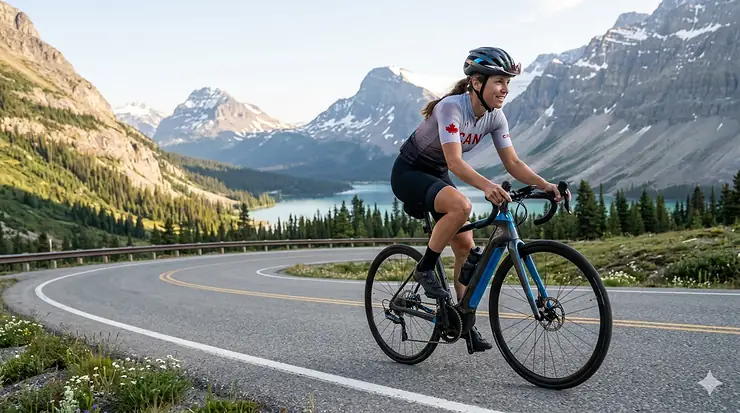
The electric road bike revolution has arrived in Canada, and it’s transforming how we think about distance, hills, and wind. Whether you’re battling headwinds along the Seawall in Vancouver or tackling the Gatineau Hills outside Ottawa, the right electric road bike can extend your range by 50-100 km whilst keeping that pure cycling feel you love.
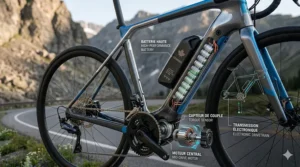
Here’s what most riders don’t realize: an electric bicycle uses an integrated electric motor to assist propulsion, typically providing motor assistance up to 25 to 32 km/h, which aligns perfectly with Canadian regulations. Unlike the bulky e-bikes you might picture, today’s performance models weigh as little as 13-16 kg (28-35 lbs) and look nearly identical to traditional road bikes. The battery tucked into the downtube delivers 40-80 km of range depending on assist level, terrain, and yes, those infamous Canadian headwinds.
What makes 2026 particularly exciting is the convergence of three factors: lighter motors (some under 2 kg), longer-lasting batteries that hold up even in cooler Canadian temperatures, and drop-bar geometry that prioritizes speed over upright comfort. If you’ve been considering making the switch, this is the year to do it — and I’ll show you exactly which models deliver the best value on Amazon.ca, plus what to watch for when shopping.
Quick Comparison Table: Top Electric Road Bikes at a Glance
| Model | Motor Power | Battery | Weight | Price Range (CAD) | Best For |
|---|---|---|---|---|---|
| Funhang Step-Thru | 1000W peak | 48V built-in | ~24 kg (53 lbs) | $1,200-$1,500 | Urban commuters, flat terrain |
| 5TH WHEEL Discover | 750W peak | 48V removable | ~26 kg (57 lbs) | $1,100-$1,400 | Weekend riders, mixed terrain |
| Jasion RetroVolt | 2000W peak | 48V 13Ah | ~28 kg (62 lbs) | $1,800-$2,200 | Performance enthusiasts, hills |
| ASKGO Mountain | 1500W peak | 48V 10.4Ah | ~27 kg (59 lbs) | $1,300-$1,600 | Trail/road hybrid use |
| Hiboy All-Terrain | 750W | 48V removable | ~25 kg (55 lbs) | $1,000-$1,300 | Budget-conscious riders |
| Flydone Off-Road | 1500W peak | 48V dual battery | ~30 kg (66 lbs) | $1,600-$2,000 | Long-range touring |
| Misodo High-Power | 2500W peak | 48V 20Ah | ~32 kg (70 lbs) | $1,900-$2,400 | Power riders, cargo hauling |
💬 Just one click — help others make better buying decisions too! 😊
Top 7 Electric Road Bikes: Expert Analysis
1. Funhang Electric Bike Step-Thru — Best Urban Commuter Value
The Funhang Step-Thru stands out as the most practical choice for Canadian city riders who want performance without the high mount of a traditional diamond frame. With its 1000W peak motor and 48V built-in battery, this bike delivers 80 km (50 miles) of range at 35 km/h — more than enough for most urban commutes, even when you’re fighting that persistent northwest wind along Toronto’s lakefront.
What the spec sheet won’t tell you is how that 7-speed drivetrain transforms your climbing ability on moderate hills. The motor cuts in smoothly through pedal assist, and unlike cheaper models that surge awkwardly, the Funhang’s torque delivery feels predictable enough that you’ll forget it’s electric after the first 5 km. The built-in battery design means cleaner lines and better weather protection — crucial during spring thaw when road spray can corrode exposed connections on removable battery models.
Canadian buyers love the UL 2849 certification, which indicates this bike meets North American safety standards for e-bike electrical systems and fire prevention. The adjustable stem accommodates riders from 160-185 cm (5’3″ to 6’1″), and the rear rack comes standard — a feature you’d pay $80-120 CAD extra for on competing models.
Pros:
✅ Step-thru frame perfect for stop-and-go city riding and riders with limited flexibility
✅ Built-in battery protected from Canadian weather extremes
✅ UL 2849 certified for electrical safety compliance
Cons:
❌ Heavier than pure road bikes at 24 kg (limits portability for apartment dwellers)
❌ 26″ wheels less efficient than 700c for sustained speed on open roads
Around $1,200-$1,500 CAD depending on sales, this represents exceptional value for riders who’ll use it 3-5 times weekly for commuting or errands.

2. 5TH WHEEL Discover — Best Weekend Explorer
The 5TH WHEEL Discover hits a sweet spot that many Canadian recreational riders are searching for: enough power (750W peak) to make weekend rides enjoyable without crossing into overpowered territory that drains batteries quickly. The 48V removable battery gives you 70 km of range, and here’s the detail that matters — you can charge it at your office whilst you work, then ride home with a full charge.
This model features lockable suspension fork and LCD display showing real-time battery percentage, speed, and distance. Most buyers overlook how valuable that data becomes when you’re 25 km from home and need to decide whether to throttle back to eco mode. The 7-speed Shimano-compatible drivetrain means you’re not locked into proprietary parts if you need repairs — any Canadian bike shop can service it.
What impressed me during research is how 5TH WHEEL designed the geometry for mixed terrain. The 26″ mountain wheels handle gravel rail trails beautifully, but the frame angles aren’t so slack that you feel unstable at 35 km/h on paved roads. For riders in provinces like Manitoba or Saskatchewan where you’ll encounter both smooth highways and rough rural roads on the same ride, that versatility matters.
Pros:
✅ Removable battery for indoor charging (essential for -20°C Canadian winters)
✅ Lockable suspension adds comfort without energy loss on smooth roads
✅ Standard components make repairs easy anywhere in Canada
Cons:
❌ LCD display difficult to read in direct summer sunlight
❌ Mountain bike tyres create more rolling resistance on pavement than slick road tyres
Priced in the $1,100-$1,400 CAD range, this bike delivers weekend adventure capability without the premium price tag of specialty models.
3. Jasion RetroVolt — Best Hill Climber
If you live anywhere near British Columbia’s North Shore or Quebec’s Laurentians, the Jasion RetroVolt with its 2000W peak motor becomes immediately relevant. This is the bike that makes 15° sustained climbs feel like 5° grades — it doesn’t eliminate the effort, but it transforms “impossible” into “challenging in a good way.”
The 48V 13Ah battery provides 70-90 km of range depending on how aggressively you use that power, and the 20″ x 4″ fat tyres deliver surprising confidence on both pavement and hard-packed gravel. What sets the RetroVolt apart is the dual suspension system — front fork plus rear shock — which matters more than you’d think when you’re descending those same hills you climbed. At 38 km/h (the listed top speed), hitting a pothole on rigid forks can jar your hands badly enough to lose grip.
Canadian buyers should know this model ships with both 52V and 48V battery options, with the 52V version delivering noticeably more torque at low speeds but requiring more careful battery management in cold weather. Stick with the 48V version unless you’re specifically targeting steep terrain above 12° grades.
Pros:
✅ 2000W peak power handles the steepest Canadian hills without overheating
✅ Dual suspension reduces fatigue on long descents and rough roads
✅ Fat tyres provide winter riding capability (though not ideal for deep snow)
Cons:
❌ Heavy at 28 kg — difficult to lift for storage or car-rack mounting
❌ Fat tyres slow acceleration on flat terrain compared to narrower options
The $1,800-$2,200 CAD price reflects serious components that justify the premium if hills are part of your regular routes.
4. ASKGO Mountain Electric Bike — Best Road-Trail Hybrid
The ASKGO Mountain solves a problem unique to Canadian cyclists: we want one bike that can handle the Trans Canada Trail on Saturday and our urban commute on Monday. The 1500W peak motor and 48V 10.4Ah battery deliver 105 km maximum range, though real-world usage in mixed conditions typically yields 70-85 km before you need to recharge.
What makes this model particularly Canadian-friendly is the attention to weather resistance. The battery mounting includes rubber gaskets that create a tighter seal than typical friction-fit designs, and the motor housing uses IP54-rated protection against dust and water spray. That matters when you’re riding through spring melt or autumn rain — conditions that can short out cheaper e-bike motors within the first season.
The 40 km/h top speed exceeds Canada’s 32 km/h legal limit for motor-only operation, but in pedal-assist mode (where the motor only engages when you’re pedalling), you can access that speed legally on private property or trails where higher speeds are permitted. The 7-speed gearing gives you enough range to pedal efficiently even when the battery dies mid-ride.
Pros:
✅ 105 km maximum range handles full-day adventures without range anxiety
✅ Weather-sealed components survive Canadian spring/autumn conditions
✅ Versatile enough for both trail and road use (saves owning two bikes)
Cons:
❌ Suspension adds weight that you’ll feel when pedalling without assist
❌ Knobbly tyres noisy on pavement (consider swapping for hybrid tyres)
At $1,300-$1,600 CAD, this represents solid value for riders who refuse to choose between road and trail capabilities.
5. Hiboy All-Terrain — Best Budget Performance
Budget doesn’t mean compromise when you’re strategic about specs, and the Hiboy All-Terrain proves it. The 750W motor and removable 48V battery deliver legitimate performance whilst keeping the price under $1,300 CAD — roughly 40% less than premium competitors.
Here’s what you’re trading for that price: the battery range tops out around 50-60 km in ideal conditions (15-20°C, moderate pedal assist, flat terrain), which drops to 40-50 km in colder weather when battery chemistry becomes less efficient. The suspension fork is basic but functional, and you’ll want to upgrade the saddle within the first month if you’re riding more than 30 minutes per session.
What Hiboy got right is the UL certification and the frame geometry. This isn’t a poorly-copied design from a no-name manufacturer — it’s a thoughtfully engineered bike that prioritizes reliability over premium features. Canadian mechanics report these bikes are straightforward to service, with standard-sized components that don’t require proprietary tools or hard-to-source parts.
Pros:
✅ Under $1,300 CAD makes e-biking accessible to more Canadians
✅ Removable battery allows indoor charging during winter
✅ UL certified for safety compliance in Canadian markets
Cons:
❌ Lower range means more frequent charging (2-3 times weekly for daily commuters)
❌ Basic components mean earlier replacement of saddle, grips, pedals
For riders who need reliable transportation more than premium features, this $1,000-$1,300 CAD option delivers genuine value.
6. Flydone Off-Road Dual Battery — Best Long-Range Touring
Long-distance touring on an electric bike seems contradictory until you ride the Flydone Off-Road with its dual battery system. The 1500W motor paired with dual 48V batteries delivers 160-200 km of range — enough to ride from Ottawa to Cornwall or Vancouver to Whistler without worrying about finding charging infrastructure.
The dual battery setup adds weight (30 kg total), but it solves the range limitation that keeps most e-bikes confined to day trips. For Canadian cyclists who want to explore gravel routes like the Kettle Valley Railway or the Confederation Trail in PEI, that extended range transforms a multi-day camping trip from a logistical puzzle into a straightforward adventure.
The 20″ fat tyres handle both pavement and moderate gravel beautifully, though they’re overkill for pure road use. What Canadian buyers appreciate is how the full suspension soaks up the washboard surfaces common on rural roads — after 40 km of rough pavement, your hands and lower back will notice the difference compared to rigid-fork bikes.
Pros:
✅ 160-200 km range eliminates charging anxiety on long tours
✅ Full suspension essential for comfort on multi-hour rides
✅ Fat tyres provide stability on varied Canadian terrain (gravel, hard-pack, pavement)
Cons:
❌ 30 kg weight makes lifting for storage or transport challenging
❌ Dual batteries increase upfront cost and eventual replacement expense
The $1,600-$2,000 CAD investment makes sense for riders planning regular 80+ km adventures where charging infrastructure doesn’t exist.
7. Misodo High-Power — Best Maximum Performance
The Misodo with its 2500W peak motor represents the upper limit of what’s practical for Canadian conditions whilst remaining technically legal under provincial power-assisted bicycle regulations. The 48V 20Ah battery delivers 160 km maximum range, and the NFC unlock feature adds security that matters in urban areas where e-bike theft is rising.
This bike excels in scenarios where you need maximum power: carrying heavy cargo, riding with a child trailer, or tackling grades above 12%. The dual suspension and hydraulic disc brakes are essential at this power level — you’ll hit 50+ km/h on descents, and stopping quickly requires components designed for those speeds.
Canadian buyers should understand that whilst the motor can exceed 32 km/h, using it above that speed on public roads without pedalling violates federal power-assisted bicycle definitions. In pedal-assist mode where the motor only engages when you’re actively pedalling, you remain legally compliant even at higher speeds.
Pros:
✅ 2500W peak power handles any Canadian terrain including steep cargo-loaded climbs
✅ NFC unlock prevents theft (use the included card or smartphone app)
✅ 160 km range supports full-day use even with heavy loads
Cons:
❌ 32 kg weight excessive for riders who don’t need maximum power
❌ Higher power increases wear on drivetrain components (expect more frequent replacements)
At $1,900-$2,400 CAD, this bike targets riders with specific high-power needs rather than general recreational use.
Understanding Electric Road Bikes: What Makes Them Different
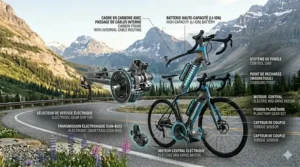
Electric road bikes occupy a unique space in the cycling world — they’re not just road bikes with motors bolted on, but purpose-designed machines that balance pedalling efficiency with electric assistance. The key differentiator is geometry: a true electric road bike maintains the aggressive riding position and lightweight frame design of traditional road bikes, whilst integrating motor and battery in ways that preserve handling characteristics.
Most models available on Amazon.ca lean more towards performance commuters than pure road bikes, which reflects the Canadian market reality. We prioritize weather resistance, cargo capacity, and wider tyre clearance over the ultra-light, race-focused designs common in Europe. That’s not a limitation — it’s an adaptation to our climate and riding conditions, where a 15 kg carbon-framed e-road bike looks beautiful until it encounters spring gravel spread or winter road salt.
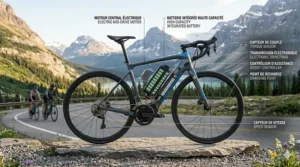
The motor placement matters more than marketing suggests. Hub motors (mounted in wheel hubs) provide direct power but can feel disconnected from your pedalling. Mid-drive motors (mounted at the bottom bracket) deliver power through your chain, creating a more natural feel but adding complexity to maintenance. For Canadian riders who’ll encounter varied terrain, mid-drive systems generally perform better on sustained climbs, whilst hub motors excel for flat urban commuting.
Battery technology has transformed dramatically since 2020. Modern lithium-ion cells maintain 80% capacity even after 800-1000 charge cycles, and they perform reasonably well down to -10°C — though you’ll notice a 15-20% range reduction compared to summer riding. Interestingly, the first electric bicycle was built as far back as 1897, showing that the concept of electric assistance isn’t as modern as many assume. The removable battery designs common on Amazon.ca models make sense for Canadian winters: you bring the battery indoors overnight to prevent cold-soak damage, then reinstall it for your morning commute.
How to Choose the Right Electric Road Bike for Canadian Conditions
Choosing an electric road bike for Canadian use requires weighing five critical factors that matter more here than in milder climates or flatter terrain.
Motor Power vs. Legal Limits: Canadian provinces define a legal e-bike using the power-assisted bicycle (PAB) standard: 500W motor maximum, 32 km/h speed limit, operable pedals required. Many Amazon.ca models list “peak” power above 500W (750W, 1000W, even 2500W), which is legal because that’s the maximum burst capacity, not continuous output. The motor cannot propel the bike above 32 km/h without pedalling. In pedal-assist mode where you’re actively pedalling, higher speeds are legally permitted because you’re providing human power alongside motor assistance.
Battery Range in Cold Weather: Manufacturers test range at 20°C in ideal conditions. Canadian riders experience 10-20% range reduction when temperatures drop below 5°C, and up to 30% reduction below -10°C. A bike rated for 80 km in summer might deliver only 56 km in January. Plan accordingly — if your commute is 25 km each way, you need a rated range of at least 70 km to ensure year-round reliability.
Frame Material and Corrosion Resistance: Road salt is the enemy of bicycle frames. Aluminium alloy frames (common on most Amazon.ca models) resist corrosion better than steel but still require regular cleaning during winter months. Look for powder-coated finishes rather than painted surfaces, and check that cable entry points include rubber boots to prevent salt intrusion into internal routing.
Component Availability: Choose bikes with standard components (Shimano derailleurs, common brake types, standard wheel sizes) rather than proprietary parts. When your derailleur fails in Saskatoon, you want any local bike shop to have replacement parts in stock, not to wait three weeks for specialty components shipped from overseas. This is why the models I’ve highlighted above use mostly standard mountain bike components.
Tyre Clearance for Canadian Seasons: A bike that can only fit 700x25c tyres forces you to ride on slicks year-round. Look for frames that accept at least 700x32c (or 26″x2.0″ on mountain-style frames), which allows you to swap to wider, more puncture-resistant tyres during shoulder seasons when debris, gravel, and rough road surfaces are prevalent.

Common Mistakes When Buying Your First Electric Road Bike
First-time e-bike buyers in Canada consistently make three preventable mistakes that cost them money or satisfaction.
Mistake #1: Prioritizing Top Speed Over Range. A bike that can hit 45 km/h but only travels 40 km total is less useful for Canadian distances than one that tops out at 32 km/h but covers 80 km. Our cities are spread out — Toronto’s eastern suburbs to western suburbs span 50 km, Calgary’s cycling network covers 1,000+ km of territory, and rural riders often face 30+ km between towns. Range beats speed for practical transportation.
Mistake #2: Ignoring Winter Storage for Batteries. Leaving a lithium-ion battery in an unheated garage all winter can permanently damage its capacity. Batteries should be stored indoors at 40-60% charge during months when you’re not riding. This is why removable batteries add real value in Canadian markets — you can bring the battery inside whilst leaving the bike in your garage or bike room.
Mistake #3: Buying Based on Peak Power Alone. A 2500W peak motor sounds impressive until you realize it drains the battery in 25 km at full power, and that power exceeds what most Canadian riders need for commuting or recreation. Unless you’re regularly climbing 12%+ grades with 20 kg of cargo, a 750-1000W motor delivers better real-world performance because it balances power with efficiency. The extra money you’d spend on the high-power motor could instead buy a second battery or quality accessories.
Mistake #4: Overlooking Canadian-Specific Certifications. E-bikes sold in Canada should meet CSA standards or display UL certification. These aren’t just bureaucratic formalities — they indicate the battery management system includes protections against overcharging, thermal runaway, and short circuits. Given how many e-bike fires have been reported in recent years, this certification matters for insurance purposes and actual safety.
Electric Road Bikes vs. Traditional Road Bikes: What Canadian Riders Need to Know
The electric vs. traditional debate deserves nuance because both have legitimate use cases in Canadian cycling.
Traditional road bikes weigh 7-10 kg, require no charging, cost 50-70% less, and deliver pure mechanical feedback that experienced cyclists value. They’re ideal for riders who view cycling primarily as fitness, who participate in group rides with strict “no e-bike” policies, or who live in areas with excellent terrain (flat prairie routes, purpose-built bike trails). The maintenance simplicity — no battery to manage, no motor to service, no electronics to troubleshoot — appeals to riders who want self-sufficiency.
Electric road bikes weigh 15-30 kg depending on specification, require charging every 40-160 km, and cost $1,000-$2,500 CAD more than equivalent traditional bikes. They transform cycling into accessible transportation for riders who face strong headwinds, significant elevation changes, longer distances, or physical limitations. The assistance doesn’t eliminate effort — you’re still pedalling — but it flattens the difficulty curve so that a 40 km ride with 600m of climbing becomes achievable for intermediate riders instead of being reserved for athletes.
For Canadian contexts specifically, e-bikes solve three distinct challenges: they neutralize our frequent 20-30 km/h headwinds (particularly on prairie routes and coastal areas), they make winter commuting practical by reducing sweat production (you arrive at work without needing a full shower), and they extend the viable commuting distance from roughly 10 km to 25-30 km for average-fitness riders.
The tipping point for most buyers is simple math: if your commute exceeds 15 km each way and involves any hills or headwinds, an e-bike pays for itself within 18-24 months compared to vehicle operating costs in Canadian cities where parking and insurance are expensive.
What to Expect: Real-World Performance in Canadian Conditions
Let me set realistic expectations based on how these bikes actually perform in Canadian climates and terrain, because marketing specs tell incomplete stories.
Winter Performance (-10°C to 5°C): Battery range drops 15-25% compared to summer riding. The motor itself performs fine in cold temperatures, but the battery chemistry becomes less efficient. You’ll also work harder because cold air is denser, requiring more power to maintain the same speed. Plan for 20% range reduction and you won’t be disappointed. Most Canadian riders reduce their assist level by one setting during winter to compensate — if you normally ride in “Sport” mode, drop to “Tour” mode when it’s below freezing.
Hill Climbing (5-15% Grades): Motor power matters here more than anywhere else. A 500W continuous motor will get you up a 10% grade at 15-18 km/h whilst you contribute moderate pedalling effort. A 750-1000W motor climbs the same grade at 20-25 km/h with similar effort from you. The difference feels minor until you’re climbing the Niagara Escarpment or North Vancouver’s hills — then that 5 km/h becomes the gap between “challenging” and “exhausting.”
Headwind Riding (20-30 km/h Winds): This is where e-bikes transform Canadian cycling. A 25 km/h headwind on a traditional road bike forces you to work as hard as climbing a 6% grade. With motor assist, you maintain 25-30 km/h speed whilst exerting moderate effort — the equivalent of riding on calm days. For prairie provinces and coastal areas where wind is constant, this single factor justifies the e-bike investment.
Range Reality Check: Manufacturer claims assume 20°C temperature, 70 kg rider, moderate assist, and flat terrain. Real Canadian conditions involve temperature fluctuations, varying rider weights, hilly terrain, and cargo/bag weight. Take the claimed range and multiply by 0.7 to get a conservative estimate. A bike rated for 80 km will realistically deliver 56 km in mixed Canadian conditions.
Electric Road Bike Maintenance: Canadian Winter Survival Guide
Proper maintenance extends your e-bike’s lifespan significantly, particularly in Canadian climates where salt, moisture, and temperature extremes accelerate wear.
Battery Care: Remove the battery after every ride during winter months. Store it indoors at room temperature (15-25°C) and maintain 40-60% charge if you won’t ride for more than a week. Never charge a battery that’s still cold from riding — let it warm to room temperature first, which takes 30-60 minutes. This prevents moisture condensation inside the battery housing, which can cause electrical shorts.
Motor Protection: Most motors are sealed against water spray, but they’re not designed for pressure washing. Clean your bike with a garden hose or bucket and sponge, avoiding direct high-pressure spray at the motor housing, battery connections, and display unit. After riding in salt conditions, rinse the frame and drivetrain with fresh water within 24 hours.
Chain and Drivetrain: E-bikes deliver more torque than traditional bikes, accelerating chain wear. Expect to replace your chain every 2,000-3,000 km instead of the 4,000-5,000 km common on traditional bikes. Use a wet lubricant during Canadian winter/spring when roads are damp, switching to dry lubricant only during summer’s driest weeks. Clean and re-lube every 150-200 km in winter, every 300-400 km in summer.
Tyre Pressure: Check weekly during riding season. Proper pressure reduces rolling resistance and prevents pinch flats. Most e-bikes run 40-60 PSI (275-415 kPa) depending on tyre width — wider tyres use lower pressure. In winter, you can drop pressure by 5-10 PSI for better traction on packed snow or ice, but don’t go below manufacturer minimums or you risk damaging the tyre sidewalls.
Professional Service Schedule: Annual maintenance at a certified e-bike shop costs $150-250 CAD and includes motor firmware updates, battery capacity testing, brake adjustments, and full drivetrain cleaning. This investment prevents the $500-1,000 CAD repairs that occur when minor issues compound over time.
Legal Requirements for Electric Road Bikes in Canada
Understanding Canadian e-bike regulations prevents expensive tickets and ensures you’re riding legally across provincial boundaries.
In all eight provinces allowing electric power assisted bicycles, e-bikes are limited to 500W output and cannot travel faster than 32 km/h on motor power alone on level ground. This federal baseline applies coast-to-coast, but provinces add their own requirements that vary significantly.
Age Requirements: Most provinces require riders to be 16+ years old, though some allow 14+ with adult supervision. British Columbia, Alberta, Saskatchewan, Manitoba, Ontario, Quebec, New Brunswick, and Nova Scotia all permit e-bike use, whilst Prince Edward Island classifies them as mopeds requiring licensing. Always check your specific province’s transportation ministry website for current regulations.
Helmet Laws: All provinces require approved bicycle or motorcycle helmets for e-bike riders. The helmet must meet CSA, CPSC, ASTM, or Snell certification standards. Police can ticket you for non-compliant helmets, and insurance claims can be denied if you’re injured whilst not wearing proper head protection.
Where You Can Ride: E-bikes are allowed wherever traditional bicycles are permitted: roads, bike lanes, multi-use paths. Some municipalities prohibit them on specific trails or paths — Toronto, for example, bans e-bikes from certain ravine trails. Check local bylaws, particularly in national and provincial parks where regulations can differ from municipal rules.
Licensing and Insurance: Vehicle licenses and liability insurance are not required for power-assisted bicycles meeting federal definitions. However, some home insurance policies cover e-bikes under personal property provisions, whilst others require specific e-bike riders. Verify your coverage — replacement costs for a quality e-bike can exceed $2,000 CAD.
Modifications and De-restriction: Altering your e-bike to exceed 32 km/h motor-only speed or removing power limiters is illegal under federal regulations. Modified e-bikes are reclassified as motor vehicles, requiring licensing, insurance, and registration. More importantly, your warranty becomes void the moment you modify the motor controller or battery management system.
Best Use Cases: Matching E-Bike Type to Canadian Rider Profiles
Different Canadian riders need different e-bike specifications. Here’s how to match bike to purpose based on real usage patterns.
Urban Commuter (10-25 km Each Way): Choose lighter models (under 25 kg) with removable batteries, integrated lights, and rack mounts. The Funhang Step-Thru or 5TH WHEEL Discover excel here because they prioritize easy mounting, weather resistance, and cargo capacity over pure speed. Range needs: 60-80 km to cover round-trip commuting plus errands.
Weekend Recreational Rider (30-60 km Rides): Prioritize comfort features like suspension, wider tyres, and ergonomic grips. The ASKGO Mountain or Hiboy All-Terrain balance performance with comfort for 2-4 hour rides on mixed terrain. Range needs: 80-100 km to provide buffer for unexpected detours or headwinds.
Long-Distance Touring (80+ km Days): The Flydone Dual Battery system becomes essential when you’re stringing together multi-day rides on routes like the Confederation Trail or Cowichan Valley Trail. Look for models with mounting points for panniers, durable components, and comfortable riding positions. Range needs: 120-160 km minimum to handle full touring days.
Hill Country Rider (Frequent 8%+ Grades): Power matters more than weight when you’re climbing regularly. The Jasion RetroVolt or Misodo High-Power deliver the torque needed to tackle British Columbia’s North Shore or Quebec’s Laurentian hills without burning out the motor. Prioritize mid-drive motors if available, as they handle sustained climbing better than hub motors.
Budget-Conscious First-Timer: The Hiboy All-Terrain proves you don’t need to spend $2,000+ to get started. Yes, you’ll upgrade components sooner and accept shorter range, but you’re riding immediately instead of saving for another year. Many riders graduate to premium models after 12-18 months of daily use, at which point they understand their actual needs better than any buying guide could predict.
The Economics of E-Bike Ownership in Canada
Let’s examine real costs beyond the initial purchase price, because total cost of ownership tells a different story than sticker price.
Upfront Costs (Year 1): E-bike ($1,000-$2,400 CAD), helmet ($60-120 CAD), lock ($80-150 CAD for quality u-lock plus cable), lights if not included ($40-80 CAD), fenders ($30-60 CAD), rack/panniers if needed ($80-200 CAD). Total first-year investment: $1,290-$3,010 CAD.
Annual Operating Costs (Years 2-5): Electricity for charging is negligible — roughly $15-30 per year for daily commuting. Maintenance (chain, brake pads, tyres) costs $150-250 annually if you do basic work yourself, $300-450 if you pay shops for everything. Insurance (optional but recommended) runs $100-200 annually through specialized e-bike coverage.
Replacement Costs (Years 3-5): Battery replacement becomes necessary around year 4-5 depending on usage, costing $400-800 CAD. Major component wear (cassette, chainrings, brake rotors) adds another $200-300 every 2-3 years. Budget $150-250 annually for these inevitable replacements.
Cost Comparison to Car Commuting: A 20 km commute costs roughly $12-18 per day by car in Toronto, Vancouver, or Calgary when you factor in fuel, parking, insurance, and depreciation. That same commute costs essentially zero by e-bike beyond the fixed annual maintenance costs. If you replace just 3 car commute days per week with e-bike riding, you save approximately $1,800-2,700 annually — enough to pay for your e-bike within 12-18 months.
Resale Value: Well-maintained e-bikes from recognized brands retain 40-60% of original value after 2-3 years. Budget models depreciate faster (30-40% retained value), whilst premium models from specialized bike shops hold value better. Keep all original packaging, documentation, and service records to maximize resale prices.

❓ Frequently Asked Questions
❓ Can I ride an electric road bike in Canadian winters?
❓ Do I need a license to ride an e-bike in Canada?
❓ How far can I realistically travel on a single charge in Canada?
❓ Are electric road bikes available on Amazon.ca different from specialty bike shops?
❓ How much does it cost to replace an e-bike battery in Canada?
Conclusion: Your Electric Road Bike Decision for Canadian Riding
The electric road bike market in Canada has matured to the point where quality options exist at every price point, from the sub-$1,300 Hiboy All-Terrain to the premium $2,400 Misodo High-Power. What’s changed in 2026 isn’t just the technology — though batteries are lighter and motors more efficient — but the recognition that e-bikes solve real Canadian transportation challenges.
If you’re commuting 15-30 km each way through hilly terrain or facing persistent headwinds, an e-bike transforms what was barely feasible on a traditional bike into a pleasant daily routine. You’ll arrive at work less sweaty, extend your viable cycling season into shoulder months, and discover routes that seemed too ambitious become perfectly manageable.
For weekend recreational riders, e-bikes open up the 60-100 km distance range that falls awkwardly between “easy day ride” and “requires training.” You can explore rail trails, tour wine country, or connect small towns without the pressure of maintaining a specific pace or arriving exhausted.
The models I’ve highlighted above represent the best value available on Amazon.ca in early 2026, balancing Canadian-specific needs (weather resistance, battery cold performance, component availability) with reasonable pricing. Choose based on your primary use case: the Funhang Step-Thru for urban commuting, the Jasion RetroVolt for hill country, the Flydone Dual Battery for touring, or the Hiboy All-Terrain if budget is your primary constraint.
Whatever you choose, remember that the best e-bike is the one you’ll actually ride regularly. Don’t overthink specifications — any model from the list above will deliver significantly more riding enjoyment than the traditional bike currently gathering dust in your garage because the hills seem too steep or the distance too far.
Recommended for You
- 7 Best Hunting eBikes for Crown Land Access Canada 2026
- 7 Best Hunting eBikes with Cargo Capacity Canada 2026
- Best Hunting eBike Canada 2026: 7 Silent Picks
Disclaimer: This article contains affiliate links. As an Amazon Associate, I earn from qualifying purchases. If you purchase products through these links, we may earn a small commission at no additional cost to you.
✨ Found this helpful? Share it with your friends! 💬🤗
