
In This Article
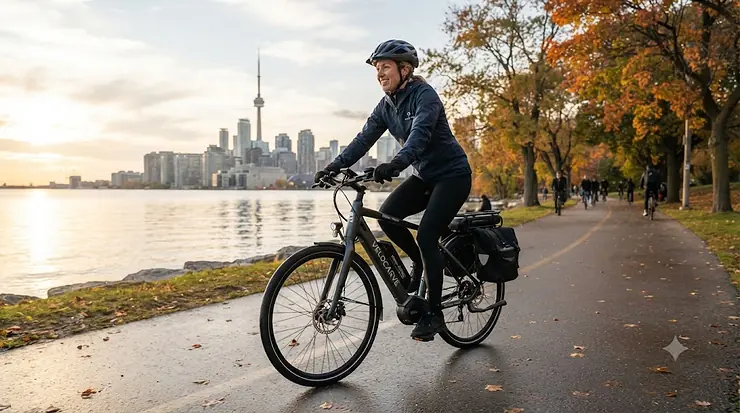
Range anxiety on a bicycle sounds a little silly until you’re 40 km from home on a dying battery, legs burning, wondering why the spec sheet lied to you. That’s the gap this guide is built to close. An electric bike 100km range isn’t a marketing number you should take on faith — it’s a function of battery capacity, motor efficiency, rider weight, terrain, and temperature, all stacked together. Some bikes hit their claimed electric bike 100km range only in the gentlest eco mode with a featherweight rider; others get there with room to spare even loaded down with groceries.

We researched seven real, currently available e-bikes spanning budget mid-drive commuters to premium Canadian-built trail bikes, cross-referencing manufacturer specs against independent range tests wherever they existed. You’ll get honest analysis of what each battery-and-motor combination actually delivers, how Canadian winters change the math, and a framework for matching range to how you actually ride — not how a listing photo makes you wish you rode. Whether you’re commuting across a sprawling city, running weekend errands without recharging, or planning multi-day rides through cottage country, the goal here is the same: help you buy the right battery the first time, not the second one.
Quick Comparison Table: 7 Long-Range Electric Bikes at a Glance
| # | Bike | Battery | Real-World Range | Best For |
|---|---|---|---|---|
| 1 | Ride1Up Prodigy V2 | 504 Wh | ~65-80 km | Hilly commutes, mid-drive efficiency |
| 2 | Aventon Aventure.2 | 720 Wh | ~50-95 km | Verified real-world range on fat tires |
| 3 | Velotric Discover 2 | 705.6 Wh | ~55-100 km | Flexible torque/cadence commuting |
| 4 | Rad Power Bikes RadRover 6 Plus | 672 Wh | ~35-60 km | Budget fat-tire with Canadian service |
| 5 | Magicycle Cruiser Pro | 1,040 Wh | ~65-130 km | Maximum capacity per dollar |
| 6 | Lectric XPedition 2.0 Dual Battery | 1,680 Wh | ~120-220 km | Cargo hauling, family transport |
| 7 | Biktrix Juggernaut Ultra FS Pro 3 | 884 Wh (+ extender) | ~40-100 km | Canadian-built trail performance |
Looking at the spread above, the pattern that jumps out is that watt-hours alone don’t predict range — a 500 Wh mid-drive like the Ride1Up Prodigy V2 can outperform a heavier 700+ Wh hub-motor fat bike simply because mid-drive motors use the bike’s own gearing more efficiently. Riders chasing a true electric bike 100km range in Canadian conditions should treat every manufacturer figure as a best-case ceiling, then plan around the real-world column instead. Weight, tire width, and terrain all pull those numbers down before winter even enters the equation.
💬 Just one click — help others make better buying decisions too!😊
Top 7 Long-Range Electric Bikes: Expert Analysis
1. Ride1Up Prodigy V2 — best mid-drive efficiency for hilly commutes
The Prodigy V2 punches above its 504 Wh battery because a Brose mid-drive motor pulls power through the bike’s own gears instead of a fixed-ratio hub, which is a meaningfully different way to stretch a watt-hour. That 250W nominal, 90Nm-torque German motor pairs with a torque sensor, so power output tracks your pedal effort rather than firing at a flat rate. Ride1Up itself rates the bike at 30-50 miles (48-80 km), and independent reviewers note that the efficiency gain from the mid-drive layout makes the battery feel closer to a 750 Wh pack than its actual 504 Wh capacity suggests. That’s a real engineering advantage, not marketing spin — mid-drives are simply better at converting stored energy into forward motion on rolling terrain.
Riders who spend more time climbing than cruising flat ground get the most from this setup; commuters in hillier cities like Halifax or parts of Ottawa will notice the difference immediately compared to a hub-motor bike of similar capacity. Reviewers consistently note the belt-drive option as a standout for reducing maintenance, since there’s no chain to lubricate or rust in salted winter conditions. On the downside, the bike gained roughly 8-11 lb over the previous Prodigy generation, and the 504 Wh capacity is genuinely on the smaller side if your round trip regularly exceeds 60 km before a recharge is possible.
Pros:
- ✅ Torque-sensing Brose mid-drive stretches every watt-hour further
- ✅ Optional Gates belt drive nearly eliminates chain maintenance
- ✅ Roughly half the price of comparable European mid-drive commuters
Cons:
- ❌ 504 Wh battery is modest next to hub-motor rivals here
- ❌ Gained 8-11 lb over the prior Prodigy generation
At the time of research, the Prodigy V2 sat in the C$2,600-C$3,500 range depending on drivetrain and frame options; always check current pricing before buying, as availability and configuration shift often. For riders prioritizing hill-climbing efficiency over raw battery size, this is hard to beat.
2. Aventon Aventure.2 — best-verified real-world range on fat tires
Aventon built its reputation on realistic range claims rather than inflated lab numbers, and the Aventure.2 backs that up. The 720 Wh battery (48V, 15Ah) pairs with a 750W hub motor rated at 1,130W peak, and the company’s own PAS1 estimate of roughly 60 miles (97 km) came remarkably close to what independent testers actually recorded — one review measured 59 miles in eco mode against a 60-mile claim, a gap tight enough to trust. On the higher end of assist, expect that number to drop to around 31 miles (50 km), which is the honest trade-off of running a torque sensor at full power on 26×4-inch fat tires.
What most buyers overlook about fat-tire e-bikes is that tire width itself is a range tax: those knobby 4-inch tires that make the Aventure.2 so capable in sand and snow also create significant rolling resistance on pavement. Reviewers consistently flag the bike’s 77 lb curb weight as the price of that stability and traction. For someone commuting on mixed terrain — some pavement, some gravel, occasional snow — this is one of the few fat-tire bikes where the manufacturer’s range figure and the tested figure nearly agree, which says as much about Aventon’s honesty as it does about the bike’s efficiency.
Pros:
- ✅ Real-world PAS1 testing landed within a few miles of Aventon’s claim
- ✅ TÜV Rheinland and UL 2271/2849 certified battery and electronics
- ✅ App-adjustable assist levels and speed unlock for off-road use
Cons:
- ❌ 77 lb weight makes lifting or transporting it a two-person job
- ❌ Throttle-only range drops sharply to roughly 48 km
Price at the time of research generally falls in the C$2,800-C$3,200 range for the standard configuration; prices may vary by retailer and colour option. If range accuracy matters more to you than raw numbers, the Aventure.2’s honesty is arguably its best feature.
3. Velotric Discover 2 — most flexible commuter with SensorSwap tech
The Discover 2’s standout feature isn’t just its 705.6 Wh battery — it’s SensorSwap, a genuinely useful bit of engineering that lets a rider toggle between a torque sensor (natural, effort-matched power) and a cadence sensor (instant engagement the moment pedals turn) without opening a settings menu mid-ride. Paired with a 750W motor producing 75Nm of torque, Velotric’s official claim tops out at 75 miles (120 km), and one long-form review recorded a staffer covering 85.6 miles on a single charge, roughly 13% over the manufacturer estimate.
Here’s what the spec sheet won’t tell you, but reviewers note: that headline figure assumes low-assist, favourable terrain, and a lighter rider, so a more conservative everyday expectation sits closer to 55-70 km in mixed city riding at moderate assist. What most buyers overlook is that the IPX7-rated, UL 2271-certified battery is genuinely built for Canadian weather — one manufacturer test even ran it through a washing machine cycle without damage, which is a strong signal for anyone commuting through slush and road spray. The 8-speed drivetrain and 180mm hydraulic brakes round out a bike clearly aimed at year-round daily use rather than weekend joyrides.
Pros:
- ✅ SensorSwap toggles torque and cadence sensing on the fly
- ✅ IPX7 battery rating survives submersion and pressure-washing
- ✅ 180mm hydraulic disc brakes with automatic motor cutoff
Cons:
- ❌ Suspension fork specifications are thin on official documentation
- ❌ Claimed 120 km range assumes best-case eco conditions
Expect a price in the C$2,000-C$2,300 range at the time of research, making this one of the better value-per-watt-hour options in the lineup. For daily commuters who want flexibility without micromanaging assist settings, SensorSwap alone justifies a closer look.
4. Rad Power Bikes RadRover 6 Plus — budget fat-tire pick backed by Canadian service
Rad Power Bikes built one of North America’s largest direct-to-consumer e-bike networks, and the RadRover 6 Plus is the brand’s flagship fat-tire model — now on its sixth generation with a semi-integrated 672 Wh battery (48V, 14Ah) that pops out with a single key turn instead of wrestling with straps or velcro. The 750W motor delivers dependable torque for hills, and the bike ships as a Class 2 e-bike with throttle and pedal assist, though Canadian riders should note this exceeds the federal 500W PAB baseline most provinces still enforce on public roads.
Based on the spec comparison against its rivals here, the RadRover 6 Plus trades outright range for accessibility and support: Rad maintains retail storefronts and mobile service vans in Vancouver and other major cities, a rarity among direct-to-consumer e-bike brands. Realistic range at higher assist levels lands around 35-45 km, stretching to 50-60 km in eco mode on flat pavement — solid for errands and moderate commutes, but noticeably behind the bigger-battery options in this lineup. The bike’s near-74 lb curb weight with the battery installed is worth factoring in if you’ll be carrying it up stairs regularly.
Pros:
- ✅ Established Canadian storefronts and mobile service vans
- ✅ Semi-integrated battery removes with a single key turn
- ✅ Puncture-resistant, reflective 4-inch tires standard
Cons:
- ❌ Nearly 74 lb with the battery installed
- ❌ 672 Wh capacity trails newer 700+ Wh rivals in this class
At the time of research, pricing generally sat in the C$2,700-C$2,900 range. For buyers who value in-person support over maximum range, the RadRover 6 Plus remains a sensible entry point.
5. Magicycle Cruiser Pro — largest usable battery capacity per dollar
The Cruiser Pro takes a different approach to range: instead of a common 48V pack, it runs a 52V, 20Ah battery totalling 1,040 Wh — noticeably larger than every other bike in this roundup except the dual-battery cargo option. Magicycle’s own figures put pedal-assist range at up to 100 miles (roughly 160 km) with pure throttle range around 50-60 miles (80-96 km), and while independent third-party range tests are harder to verify for this newer brand, the underlying math checks out: 1,040 Wh at a typical 12-15 Wh/km consumption rate on mixed terrain comfortably supports triple-digit kilometre claims in the most efficient assist modes.
On paper this means Magicycle is offering more stored energy per dollar than better-known competitors, though what most buyers overlook is that higher voltage (52V vs. the more common 48V) draws proportionally lower current for the same power output, which is part of why Magicycle can hit big range numbers without a physically larger battery case. The trade-off, as reviewers note, is that higher-voltage packs can see accelerated long-term cell degradation compared to lower-voltage equivalents, and Magicycle simply doesn’t have the multi-year track record or dealer network that Aventon or Rad Power Bikes have built.
Pros:
- ✅ 1,040 Wh capacity is the largest single battery in this lineup
- ✅ 52V architecture draws less current for equivalent power output
- ✅ Two-year battery warranty included standard
Cons:
- ❌ Higher voltage may accelerate long-term cell wear versus 48V packs
- ❌ Smaller brand footprint means fewer independent long-term reviews
Price ranged from roughly C$1,800 to C$2,700 depending on promotions at the time of research — genuinely aggressive for the battery capacity on offer. Riders chasing maximum range on a budget should put this on the shortlist.

6. Lectric XPedition 2.0 Long-Range Dual Battery — biggest battery pack for cargo and family hauling
This is the range outlier of the group, and deliberately so. The XPedition 2.0’s Long-Range Dual Battery configuration runs two 840 Wh packs — 1,680 Wh combined — managed by a battery isolator that drains both cells evenly rather than depleting one before switching to the other. Lectric’s advertised ceiling is 170 miles (274 km), and independent testing came in lower but still enormous: roughly 136 miles (219 km) in the lowest assist setting and about 76 miles (122 km) at maximum assist, a gap that’s completely expected once you factor in the bike’s substantial cargo capacity and 80.7 lb curb weight.
What the spec sheet won’t tell you, but user reports suggest, is that this bike is built around hauling, not speed — a 450 lb total payload rating means it’s designed for kids, groceries, or delivery loads riding on top of that huge battery reserve, and real-world range drops meaningfully once you actually load it up. Reviewers consistently note the torque sensor and 1,310W peak motor handle steep grades confidently even under load, which matters more for cargo use than outright top speed. If your household is replacing short car trips with an e-bike, this is the closest thing in this roundup to a genuine electric bike 100km range with margin to spare, even after accounting for cargo weight.
Pros:
- ✅ 1,680 Wh combined capacity dwarfs every single-battery rival here
- ✅ 450 lb payload rating suits family and delivery use
- ✅ Battery isolator drains both packs evenly for consistent power
Cons:
- ❌ 80.7 lb bike is unwieldy to lift or transport
- ❌ Real-world PAS5 range falls to roughly half the advertised claim
Expect pricing around C$2,700-C$2,900 for the long-range dual-battery configuration at the time of research. For genuine all-day, all-cargo range, nothing else here comes close.
7. Biktrix Juggernaut Ultra FS Pro 3 — Canadian-built trail bike with a range-extender option
Biktrix is a Canadian company that builds its bikes to order out of a Canadian warehouse, which matters for buyers who want local support and faster resolution on warranty claims. The Juggernaut Ultra FS Pro 3 pairs a full-suspension frame with a 1,000W Bafang Ultra M620 mid-drive motor producing 160Nm of torque — genuinely mountain-bike-grade power — and a 52V, 17Ah (884 Wh) battery that can be paired with an optional range-extender pack to substantially increase total capacity for longer backcountry days.
Here’s what’s important to flag honestly: at 1,000W, this motor exceeds the 500W nominal limit that every Canadian province currently enforces for street-legal power-assisted bicycles, so this bike is best suited to off-road trails and private property rather than public roads. On the range side, owner reports describe real-world results anywhere from 35-50 km off-road in demanding conditions up to 100 km when the range extender is fitted and terrain is friendlier — a wide band that reflects just how much elevation gain and trail difficulty affect a mid-drive’s consumption. Based on the spec comparison against hub-motor competitors, the torque-sensing mid-drive here should be dramatically more efficient on climbs, but the extra power on tap also tempts riders into higher-consumption riding styles that eat into that efficiency advantage.
Pros:
- ✅ Built and supported from a Canadian warehouse with local service
- ✅ Optional range-extender battery meaningfully increases total capacity
- ✅ 160Nm mid-drive torque handles steep, technical singletrack
Cons:
- ❌ 1,000W motor exceeds provincial PAB limits for public road use
- ❌ Among the heaviest and most expensive bikes in this roundup
At the time of research, base configurations started around C$3,800, with upgraded suspension, battery, and brake options pushing well past C$4,800. For serious off-road riders who want Canadian-built quality and don’t need street legality, this is a standout — just plan your riding accordingly.
Top 7 Products: Full Spec Comparison
| Bike | Motor | Battery | Claimed Range | Price Range (CAD) | Best For |
|---|---|---|---|---|---|
| Ride1Up Prodigy V2 | 250W mid-drive, 90Nm | 504 Wh | Up to 80 km | C$2,600-C$3,500 | Hilly commuting |
| Aventon Aventure.2 | 750W hub, 1,130W peak | 720 Wh | Up to 97 km | C$2,800-C$3,200 | Verified real-world range |
| Velotric Discover 2 | 750W hub, 75Nm | 705.6 Wh | Up to 120 km | C$2,000-C$2,300 | Flexible daily commuting |
| RadRover 6 Plus | 750W hub | 672 Wh | Up to 60 km | C$2,700-C$2,900 | Budget + Canadian service |
| Magicycle Cruiser Pro | 750W hub, 1,000W peak | 1,040 Wh | Up to 160 km | C$1,800-C$2,700 | Max capacity per dollar |
| Lectric XPedition 2.0 | 750W hub, 1,310W peak | 1,680 Wh | Up to 274 km | C$2,700-C$2,900 | Cargo and family hauling |
| Biktrix Juggernaut Ultra FS Pro 3 | 1,000W mid-drive, 160Nm | 884 Wh (+extender) | Up to 100 km (off-road) | C$3,800-C$4,800+ | Canadian-built trail riding |
The clearest takeaway from this table is that claimed range correlates more tightly with battery capacity than with motor power — the two biggest packs (Lectric XPedition 2.0 and Magicycle Cruiser Pro) post the highest ceilings almost regardless of motor size. That said, the Ride1Up Prodigy V2 proves a well-engineered mid-drive can close much of that gap on a fraction of the watt-hours, which matters if total bike weight and price are bigger concerns than headline range. Budget-focused riders should note that the Magicycle Cruiser Pro currently offers the best watt-hour-to-dollar ratio here, while families and delivery riders will find the extra cost of the Lectric XPedition 2.0 justified purely by cargo capacity.
What Is an Electric Bike With 100km Range?
An electric bike 100km range is a bike whose battery, motor, and drivetrain combine to travel roughly 100 kilometres on a single charge under favourable conditions — typically a battery of at least 700-900 Wh, a moderate assist level, a lighter rider, and mostly flat terrain. Manufacturers usually quote this as a best-case figure in eco or low pedal-assist mode, not an average across all riding styles.
It’s worth separating the marketing number from the practical one. A bike rated for 100 km will rarely deliver that distance if you ride in the highest assist tier, carry cargo, climb hills, or ride through a Canadian winter. As covered in Transport Canada’s power-assisted bicycle guidance, power-assisted bicycles are treated as a distinct, lightly regulated vehicle class precisely because their performance — including range — varies so much with real-world conditions rather than fixed specifications.
How Battery Capacity Actually Creates 100km of Range
Battery capacity for an e-bike is measured in watt-hours (Wh), calculated by multiplying voltage by amp-hours — a 48V, 15Ah battery, for instance, stores 720 Wh. What most buyers overlook is that watt-hours alone don’t determine range; consumption rate (Wh per kilometre) does the real work, and that figure swings enormously based on motor type, tire width, rider weight, and terrain.
A reasonable mixed-terrain baseline sits around 12-18 Wh per kilometre at moderate assist. Do that math and a 700 Wh battery lands you somewhere between 39 and 58 km realistically, not the 90-100 km some listings imply — those higher figures generally assume the lowest assist level and a light rider on flat pavement. Mid-drive motors like the one on the Ride1Up Prodigy V2 tend to sit at the efficient end of that range because they leverage the bike’s gearing, while fat-tire hub motors like those on the Aventon Aventure.2 and RadRover 6 Plus sit closer to the higher-consumption end due to rolling resistance. Reviewers consistently note that the single biggest lever a rider controls isn’t the battery — it’s assist level, since dropping from turbo to eco mode can nearly double effective range on the same charge.
Long Range eBike vs Standard Range eBike
The difference between a long range ebike 100 kilometers class bike and a standard-range commuter isn’t just a bigger battery bolted on — it changes the entire ownership equation, from weight and price to how often you think about charging at all.
| Factor | Standard-Range eBike (~400-500 Wh) | Long-Range eBike (~700-1,680 Wh) |
|---|---|---|
| Typical real-world distance | 25-45 km | 50-220 km |
| Bike weight impact | Lighter, easier to carry | Heavier battery adds 3-8 kg |
| Upfront price premium | Lower | C$300-C$1,500+ higher |
| Charging frequency | Every 1-2 rides | Every 3-7+ rides for most commuters |
| Best fit | Short urban commutes, errands | Long commutes, touring, cargo, all-day riding |
Interpreting that table honestly: a standard-range e-bike is genuinely the smarter buy for most short urban commutes, since you’re paying for capacity you’ll rarely use and carrying extra weight on every ride. Where a long-range setup earns its cost is multi-day riding, unpredictable routes, or Canadian winters that quietly eat 20-30% of your usable range before you’ve pedaled a single kilometre. Riders splitting the difference — a 15-25 km one-way commute with occasional longer weekend rides — often find a 700-900 Wh bike like the Velotric Discover 2 or Aventon Aventure.2 hits the sweet spot without the weight and cost penalty of the biggest packs.
How to Choose an Electric Bike With 100km Range
- Calculate your real round-trip distance first. Add your daily commute, errands, and a buffer for detours before shopping by battery size — most riders overestimate how far they actually need to go.
- Prioritize motor type over raw wattage. A torque-sensing mid-drive like the one on the Ride1Up Prodigy V2 typically stretches range further than a higher-wattage hub motor of similar capacity.
- Subtract 20-30% for Canadian winter riding. Cold weather measurably reduces lithium-ion output, so a summer-rated 100 km bike may deliver closer to 70-80 km in January.
- Factor in your actual body weight and cargo habits. Heavier riders and loaded panniers or cargo racks both increase Wh-per-km consumption noticeably.
- Check the battery’s certification, not just its size. Look for UL 2271/2849 or equivalent certification — a large, uncertified battery is a bigger liability than a smaller certified one.
- Confirm PAB legality for your province. A 1,000W mid-drive like the Biktrix Juggernaut Ultra FS Pro 3 offers huge range and torque but isn’t street-legal in most Canadian provinces without modification.
- Test-ride at the assist level you’ll actually use daily. Manufacturer range claims are usually eco-mode best cases; ride in your realistic mode before trusting the number.
Common Mistakes When Buying a Long Range Electric Bike
The single most common mistake is buying to the manufacturer’s headline range number instead of the realistic, mode-adjusted figure — a bike advertised at “up to 100 km” almost always means that number only in the lowest assist tier with a light rider. A close second is ignoring total bike weight: bigger batteries add real kilograms, and a heavier bike is harder to carry up stairs, load onto a car rack, or maneuver at low speed in a parking lot.
Buyers also frequently overlook winter performance entirely, assuming their summer test ride reflects year-round reality — it doesn’t, and Canadian winters routinely cut range by a quarter or more. Another frequent misstep is prioritizing battery size over motor efficiency; as covered earlier, a smaller, well-matched mid-drive battery can outperform a larger hub-motor pack in real-world kilometres. Finally, some riders skip checking provincial PAB rules altogether, only to discover their high-powered trail bike technically isn’t street-legal for the commute they bought it for.
Eco Mode Range Extension: Getting the Most From Every Watt-Hour
Eco mode range extension is the single cheapest upgrade available on any e-bike, because it costs nothing and can be toggled instantly from the display. Dropping from a bike’s highest assist level to its lowest can extend range by 40-80%, since motor draw scales roughly with assist percentage rather than staying flat — the same 720 Wh battery on the Aventon Aventure.2, for instance, tested at roughly double the range in eco mode compared to full-power assist.
Based on the spec comparison across this lineup, torque-sensor bikes tend to reward eco-mode riding more than cadence-sensor bikes, because torque sensors scale power output to how hard you’re actually pedalling — put in more effort yourself, and the motor contributes proportionally less. Practical eco-mode habits include starting climbs in a lower gear before engaging higher assist, using throttle sparingly since throttle-only riding is consistently the least efficient mode across every bike tested here, and reserving turbo or sport modes for headwinds or steep grades rather than default cruising. Riders chasing a genuine electric bike 100km range should expect to spend most of their trip in eco or the second-lowest assist tier — turbo mode alone will rarely get you there.
Range Test Real World Conditions: What Actually Changes the Number
Range test real world conditions consistently diverge from lab-style manufacturer claims for a handful of predictable reasons: rider weight, wind, elevation gain, tire pressure, temperature, and stop-and-go traffic all draw down a battery faster than the smooth, flat, single-rider conditions most range claims are calculated under. Independent testers who ran the Lectric XPedition 2.0 through both a minimum-assist and maximum-assist test recorded a nearly two-to-one gap between the two results on the exact same battery, which illustrates just how much rider behaviour — not hardware — drives real-world outcomes.
Elevation is a particularly underrated factor. Climbing draws dramatically more current than flat riding, and that energy generally isn’t recovered on the descent unless the bike has regenerative braking, which almost none of the models in this roundup do. Tire pressure matters more than most riders realize too — underinflated tires on a fat-tire bike like the RadRover 6 Plus or Magicycle Cruiser Pro can measurably increase rolling resistance and cut into range before the rider even notices anything feels different.
All-Day Riding eBike Canada: A Practical Usage Guide
All day riding ebike canada trips — think a full day of sightseeing, a cottage-to-town supply run, or a long weekend tour — demand more planning than a daily commute because there’s no guaranteed outlet waiting at the far end. Start by charging to 100% the night before rather than topping off a partial charge, and carry a portable charger if your route includes a café, campground, or friend’s house with an accessible outlet partway through the day.
In the first 30 days of ownership, the most common mistake new long-range riders make is ignoring their display’s range estimate until it’s too low to trust — most e-bike computers recalculate remaining range based on recent consumption, so checking it periodically after climbs or headwinds gives a far more accurate picture than trusting the number from the start of the ride. Pack a compact repair kit and a spare tube, since a flat tire on a heavy fat-tire bike like the Aventon Aventure.2 or Magicycle Cruiser Pro is a bigger inconvenience mid-route than on a lighter commuter. Finally, plan your route with elevation in mind — front-loading the climbing portion of a long ride while the battery is freshest is a simple habit that measurably extends how far you’ll get before running low.
Extended Battery Electric Bike: Range Extenders and Dual-Battery Setups
An extended battery electric bike setup — whether a genuine dual-battery system like the Lectric XPedition 2.0 or a bolt-on range-extender pack like the optional add-on for the Biktrix Juggernaut Ultra FS Pro 3 — solves the range problem by brute-force capacity rather than efficiency gains, and for certain riders that’s exactly the right trade-off. Dual-battery systems typically use a battery isolator to draw both packs down evenly, which the Lectric XPedition 2.0 implements to combine two 840 Wh batteries into a genuine 1,680 Wh reserve.
What most buyers overlook about extended battery setups is the weight penalty: doubling capacity roughly doubles the battery’s physical weight too, which is part of why the Lectric XPedition 2.0 tips the scales at over 80 lb. Reviewers consistently note that this trade-off makes the most sense for cargo bikes and touring setups where the bike is already built to carry substantial loads, rather than for lightweight commuters where every extra kilogram works against daily convenience. For riders who only occasionally need extra range — a monthly long ride rather than a daily habit — a portable backup battery or charger is often the more practical choice than committing to a permanently heavier bike.
Buyer’s Decision Framework: Matching Range to Your Riding Life
If your daily round trip is under 30 km on mostly flat ground, choose a standard-capacity bike like the Velotric Discover 2 because you’ll rarely draw down even half of a larger battery, and the lighter weight pays off every single ride. If you’re commuting 30-60 km daily or riding through hilly terrain, choose a 700-900 Wh bike with a torque sensor, such as the Aventon Aventure.2 or Ride1Up Prodigy V2, because the added efficiency and capacity give you a comfortable margin without excess weight.
If you’re hauling cargo, kids, or groceries regularly, choose the Lectric XPedition 2.0 because its combination of payload rating and battery capacity is purpose-built for that use case, not adapted from a commuter frame. If you’re riding technical off-road trails and don’t need street legality, choose the Biktrix Juggernaut Ultra FS Pro 3 because its mid-drive torque and range-extender option are engineered for elevation gain, not pavement efficiency. And if budget is your primary constraint but you still want triple-digit range potential, choose the Magicycle Cruiser Pro, because its 1,040 Wh battery delivers the highest raw capacity per dollar in this entire roundup.
Long-Term Cost & Maintenance of a Long Range eBike
Sticker price is only the entry cost of a long-range e-bike; battery replacement is the biggest long-term expense, typically running C$500-C$900 for a quality pack after 500-1,000 charge cycles, or roughly 3-5 years of regular use. Larger batteries like the 1,680 Wh pack on the Lectric XPedition 2.0 cost proportionally more to replace, though they also tend to last longer in absolute kilometres before hitting that cycle count, which partially offsets the higher upfront cost.
Total cost of ownership should also account for tires, brake pads, and drivetrain wear — fat-tire bikes like the RadRover 6 Plus and Magicycle Cruiser Pro generally need pricier replacement tires than standard commuter models, while belt-drive options like those available on the Ride1Up Prodigy V2 meaningfully reduce chain and cassette replacement costs over several years. Charging cost itself is negligible, typically pennies per full charge at Canadian residential electricity rates, so the real long-term math comes down to battery longevity and how gently you treat it — storing a battery at partial charge over winter, as covered in the safety section below, measurably extends its usable lifespan.
Safety, Regulations & Compliance Guide for Long Range eBikes in Canada
Canadian e-bike law is set provincially, but nearly every province converges on the same baseline: a 500W nominal motor limit and a 32 km/h motor-assisted speed cap, with operable pedals required for a bike to qualify as a power-assisted bicycle rather than a motor vehicle. Several bikes in this roundup, including the Biktrix Juggernaut Ultra FS Pro 3 at 1,000W, exceed that threshold and are best treated as off-road or private-property vehicles rather than street-legal commuters — always verify your specific province’s rules, since enforcement and definitions have shifted in recent years, as Wikipedia’s overview of electric bicycle laws explains in more detail across jurisdictions.
Battery safety matters just as much as legal compliance. Look for UL 2271 (battery cell) and UL 2849 (whole-system electrical) certification, both of which several bikes here — including the Aventon Aventure.2 and Velotric Discover 2 — carry. Cold weather adds another layer of consideration: lithium-ion chemistry loses meaningful capacity below freezing, a pattern well documented even outside the e-bike world — CBC News reported that electric vehicles can lose significant range in frigid temperatures, and the same underlying battery chemistry applies to e-bike packs. Storing your battery indoors between 10-20°C and avoiding charging immediately after a freezing-cold ride both help preserve both range and long-term battery health. Trail and park riders should also confirm local access rules — Parks Canada’s e-bike guidance for Banff National Park is a useful example of how national park regulations can differ from provincial road rules entirely.
✨ Ready to Find Your Perfect Long-Range eBike?
🔍 Compare the seven models above against your own commute, cargo needs, and province’s rules before you buy. Click through on any bike above to check current pricing and availability — the right battery size now saves you range anxiety (and a second purchase) later!
Frequently Asked Questions
❓ How far can an electric bike with 100km range actually go in real conditions?
❓ What battery size do I need for a 100km electric bike range?
❓ Does cold weather reduce electric bike range in Canada?
❓ Are 750W or 1000W long-range electric bikes legal on Canadian roads?
❓ Is a dual-battery electric bike worth the extra weight for daily commuting?
Conclusion
Chasing an electric bike 100km range comes down to matching honest math to your actual riding life, not chasing the biggest number on a spec sheet. The seven bikes covered here — from the efficient mid-drive Ride1Up Prodigy V2 to the cargo-ready Lectric XPedition 2.0 and the Canadian-built Biktrix Juggernaut Ultra FS Pro 3 — each hit that range differently, through battery size, motor efficiency, or some combination of both.
The honest takeaway is that no single bike here is universally “best”: a commuter riding 20 km a day gains little from a 1,680 Wh battery, while a family hauling cargo across town would find a 500 Wh mid-drive frustrating within a week. Use the comparison tables, the decision framework, and the Canadian-specific winter and regulation notes above to narrow your shortlist, then test-ride at the assist level you’ll genuinely use every day. Range claims are a starting point for research, not a purchase guarantee — the right bike is the one whose real-world number, not its marketing number, matches how far you actually need to go.
✨ Found Your Shortlist?
🔍 Take another look at the comparison table above, weigh your commute against each bike’s real-world range, and click through to check current pricing before you commit. The right battery size makes every ride easier — choose wisely!
Recommended for You
- 7 Best Chopper Electric Bike Picks for 2026: Bold, Street-Ready Rides
- 7 Best Vintage Electric Cruiser Bikes in Canada (2026 Guide)
- 7 Best Cruiser Electric Bike Picks for 2026: Comfort Wins
Disclaimer: This article contains affiliate links. As an Amazon Associate, I earn from qualifying purchases. If you purchase products through these links, we may earn a small commission at no additional cost to you.
✨ Found this helpful? Share it with your friends! 💬🤗
