

In This Article
Here’s something most people don’t expect to hear: one of the best things you can do for arthritic joints is ride a bike. Not push through the pain on a stiff, heavy traditional bike — but genuinely move them, gently, consistently, with the kind of low-impact motion that your knees and hips have been begging for.

Arthritis Society Canada reports that arthritis now affects more than six million Canadians, making it the country’s leading cause of disability. And with projections suggesting that number could hit 24% of the Canadian population by 2040, the need for accessible, joint-friendly exercise options has never been more urgent.
That’s where the electric bike for arthritis sufferers changes the conversation entirely.
An e-bike for arthritis isn’t just a regular bike with a battery strapped on. The right model is designed around the reality of living with stiff mornings, unpredictable flare-ups, reduced grip strength, and the psychological toll of giving up activities you once loved. A proper arthritis friendly ebike gives you a step-through frame so you don’t have to swing a protesting hip over a high crossbar. It gives you a thumb throttle so your wrists stay neutral. It gives you pedal assist so your knees get the movement without the strain. And it gives you the confidence — and the energy — to actually get outside during Canada’s all-too-short summers.
In this guide, I’ve researched seven real e-bikes available on Amazon.ca, evaluated them through the lens of arthritis management, and matched each one to specific Canadian user profiles. Whether you’re in Victoria dealing with damp Pacific winters or in Winnipeg nursing joints that took a beating from decades of cold-weather activities, there’s a joint-friendly cycling electric option here for you.
Quick Comparison: Top 7 Electric Bikes for Arthritis Sufferers in Canada
| Model | Motor | Battery | Frame | Throttle Type | Approx. Price (CAD) | Best For |
|---|---|---|---|---|---|---|
| Heybike Cityrun | 500W (1000W peak) | 720Wh | Step-through cruiser | Thumb | $1,100–$1,300 | Urban commuters, wrist arthritis |
| TESWAY 27.5″ BAFANG Step-Thru | 500W/750W | 48V 12Ah | Step-through | Thumb | $900–$1,100 | Hill climbing, adjustable fit |
| Wildeway Step-Through Fat Tire | 750W | 48V 17.5Ah | Step-through | Thumb | $1,200–$1,500 | Rough roads, heavier riders |
| Gotrax Dolphin 26″ | 500W peak | 36V 7.8Ah | Low-step | Thumb | $600–$750 | Budget buyers, light use |
| GoBike SOLEIL (kiraz) Step-Thru | 500W | 48V 7.8Ah | Step-through | Thumb | $500–$700 | Beginners, lightweight needs |
| 3-Wheel Electric Trike (350W) | 350W (500W peak) | 48V 15.6Ah | Step-through trike | Twist + PAS | $900–$1,100 | Balance issues, severe hip/knee arthritis |
| HITWAY Fat Tire Ebike | 500W/750W | 48V 12–15Ah | Standard/Low-step | Thumb | $800–$1,000 | Mixed terrain, all-season riding |
Table analysis: The Heybike Cityrun and TESWAY BAFANG models dominate the $900–$1,300 CAD mid-range for a reason — their combination of step-through access, thumb throttle, and quality hydraulic brakes hits the sweet spot for most Canadian arthritis riders. The 3-wheel trike is the standout for anyone dealing with balance concerns on top of joint pain, which is more common than many guides acknowledge. Budget buyers shouldn’t automatically default to the cheapest option: the GoBike SOLEIL’s limited 30-mile range becomes a real constraint in Canada, where a round-trip errand run can easily exceed that on cool days when battery efficiency drops.
💬 Just one click — help others make better buying decisions too! 😊
✨ Don’t Miss These Exclusive Deals!
🔍 Take your mobility and independence to the next level with these carefully selected electric bikes for arthritis sufferers. Click on any highlighted product name to check current pricing and availability on Amazon.ca. These bikes are helping Canadians stay active and pain-free — and they could do the same for you!
Top 7 Electric Bikes for Arthritis Sufferers: Expert Analysis
1. Heybike Cityrun Electric Bike — Best Overall for Urban Arthritis Riders
The Heybike Cityrun is what happens when a bike designer actually thinks about how real people with joint pain ride. Its low-slung, cruiser-style step-through frame lets you swing on from the side like getting into a chair — no raised leg, no hip twist, no moment of instability that sends a jolt through an inflamed knee.
Here’s what the spec sheet is actually telling you: the 500W motor (peaking at 1000W) provides enough torque to handle the modest hills of cities like Ottawa or Halifax without you having to push through them on your own joints. The 720Wh battery is genuinely large for this price range — in practical terms, you’re looking at 50–70 km of combined pedal assist riding, which is enough for 3–4 days of Canadian urban errands before you need to plug in. In cooler weather — say, a crisp October morning in Quebec City — expect a 10–15% range reduction, still leaving you well-covered.
The hydraulic disc brakes deserve special mention. For anyone with reduced hand strength due to arthritis, hydraulic brakes require dramatically less finger force to stop than mechanical cable brakes. On a wet autumn road in Toronto, that difference is not academic. The upright riding position means your weight sits through your seat, not your wrists — a design feature that directly reduces pressure on inflamed wrist and elbow joints.
Canadian riders have noted the palm rests on each side of the handlebars provide genuine wrist support, not just styling. One Vancouver rider mentioned she specifically chose this model over competitors because of how her wrists sat in a neutral position on longer rides.
✅ Step-through cruiser frame, easy low mount
✅ Hydraulic disc brakes, minimal hand pressure needed
✅ Large 720Wh battery for long Canadian range
❌ Heavier than entry-level bikes — approximately 28 kg (61 lbs), which can challenge lifting to a car rack
❌ Upright position may feel unfamiliar to riders used to traditional bike posture
Price range: Around $1,100–$1,300 CAD on Amazon.ca. For this motor-battery combination with hydraulic brakes, it’s excellent value in the Canadian market.
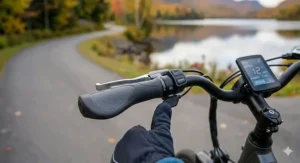
2. TESWAY 27.5″ BAFANG Motor Step-Thru Electric Bike — Best for Riders Who Need a Custom Fit
The TESWAY BAFANG Step-Thru is built around a motor brand — BAFANG — that has earned serious credibility among experienced e-bike riders worldwide. The 500W rated motor (with 750W burst capability) is what you want for Canada’s variable terrain: it doesn’t hesitate on a short steep rise or struggle on a headwind day.
What most buyers overlook about this model is the 60° adjustable stem. For arthritis sufferers, handlebar height is everything. Too low and you’re hunching forward, loading your wrists and shoulders. Too upright and you lose control sensitivity. The TESWAY’s adjustable stem lets you dial in the exact position that keeps your back neutral and your wrists unloaded — something you genuinely cannot do on most competitors in this price range.
The 48V 12Ah battery provides solid range — around 40–60 km in mixed-assist Canadian use — and the BAFANG motor’s efficiency means it doesn’t waste charge fighting against itself. The Shimano 7-speed gearing is well-matched to Canadian urban terrain, giving you mechanical gearing options on days when you want more movement and less motor.
Canadian reviewers consistently praise the build quality and the fact that it ships from a Toronto warehouse, meaning 3–5 day delivery to most provinces rather than the 2–3 week waits common with international e-bike shipments.
✅ BAFANG motor — proven reliability, smooth power delivery
✅ 60° adjustable stem for arthritis-friendly positioning
✅ Ships from Toronto warehouse, fast Canada-wide delivery
❌ 12Ah battery is mid-range — may feel limiting in cold prairie winters
❌ Fewer colour options than some competitors
Price range: Around $900–$1,100 CAD on Amazon.ca — one of the better value BAFANG-powered step-throughs currently available to Canadian buyers.
3. Wildeway Step-Through Fat Tire Ebike — Best for Rough Surfaces and Heavier Riders
Canada’s roads after winter are not kind. Frost heaving, pothole season, and gravel shoulders are a fact of life from March through May in most provinces — and every road imperfection that travels through the bike frame is a micro-shock to arthritic joints. The Wildeway Step-Through Fat Tire Ebike addresses this with 26″ fat tyres that act like built-in suspension for your knees.
The 750W motor on this bike is the real story. Heavier riders — and the Canadian average rider weight tends to be higher than manufacturer test conditions — will notice immediately that the 750W pulls confidently rather than straining. The 17.5Ah battery is the largest in this roundup, translating to consistent 70–90 km range even in cooler conditions. For a Canadian in a suburban area who wants to combine errands and recreation without range anxiety, this is the battery you want.
Fat tyres also provide meaningfully more stability at low speeds, which matters for riders who may have inner ear or balance concerns alongside their joint issues. The step-through frame keeps mounting safe. On Canadian trails or unsealed paths — popular in many rural communities across Alberta and BC — this bike handles surfaces that would rattle a standard 26″ wheel.
The trade-off is weight: fat-tyre e-bikes are heavier, typically in the 30–33 kg (66–73 lb) range. If you’re storing it in a basement or lifting to a rack, you’ll want to plan for this. Keep it near your door, or invest in a simple bike stand to avoid lifting.
✅ Fat tyres absorb road shock, protecting arthritic joints
✅ 750W motor + 17.5Ah battery — best range in this guide
✅ Enhanced low-speed stability
❌ Heavier build — challenging to lift or transport
❌ Slightly less nimble in tight urban spaces
Price range: Around $1,200–$1,500 CAD on Amazon.ca. The battery-to-price ratio is strong for Canadian buyers who prioritize range.
4. Gotrax Dolphin 26″ Electric Bike — Best Budget Pick for Light Arthritis and Casual Riding
The Gotrax Dolphin is the entry point that doesn’t feel like a compromise — for the right rider. Its 500W peak motor handles flat urban riding confidently, the front suspension fork absorbs bumps that would otherwise jar inflamed joints, and Gotrax’s brand reputation for consistent quality control gives you better peace of mind than many unknown budget competitors.
The practical reality: the 36V 7.8Ah battery delivers approximately 30 miles (about 48 km) under ideal conditions. In Canada — cooler temperatures, stop-and-go city riding, moderate hills — budget 25–35 km realistically. That’s fine for a retired Canadian in Kingston doing a 10 km loop through the neighbourhood three days a week. It becomes limiting for someone in suburban Calgary commuting 20 km each way.
The 7-speed Shimano gearing and boost mode make it versatile. For someone new to e-bikes who isn’t sure how much they’ll use it, the Gotrax Dolphin is a low-financial-risk way to discover whether e-cycling genuinely helps your arthritis before investing in a premium model. Gotrax is available and serviced on Amazon.ca, with reasonable parts availability.
✅ Accessible price point — lowest barrier to entry
✅ Front suspension fork for bump absorption
✅ Boost mode for extra power when needed
❌ Battery range is limited for Canadian use cases
❌ Mechanical disc brakes require more hand force than hydraulic
Price range: Around $600–$750 CAD on Amazon.ca. Solid value for occasional use; may frustrate daily riders who push its battery limits.
5. GoBike SOLEIL (kiraz Soleil) Step-Through Electric Bike — Best Lightweight Option for Wrist and Elbow Arthritis
The GoBike SOLEIL by kiraz is a genuine sleeper pick for one specific reason: it’s lightweight. In a category where most e-bikes come in at 25–33 kg, the SOLEIL’s emphasis on a lighter build matters enormously for riders who need to manoeuvre the bike in tight spaces, lift it over a threshold, or simply deal with the psychological fatigue of fighting a heavy machine.
The 500W rear hub motor provides standard Class 2 assist (up to 32 km/h), and the thumb throttle design is specifically well-suited to riders with wrist or forearm arthritis. As Zeus Ebikes Canada’s clinical research notes, a thumb throttle requires minimal wrist rotation and lower sustained force compared to a twist throttle — clinically relevant for anyone with carpal tunnel, wrist OA, or forearm inflammation alongside their arthritis.
The integrated battery design (rather than a removable rear rack battery) keeps the centre of gravity low and the profile clean. For Canadian condo or apartment dwellers who need to bring the bike inside, the cleaner build is a practical advantage. The SOLEIL’s 30-mile (48 km) range is its main limitation, and in Canadian winters the real-world range drops further. But for three-season urban riding — spring through autumn — it performs well above its price.
✅ Lighter build than most competitors
✅ Thumb throttle ideal for wrist and forearm arthritis
✅ Integrated battery, clean low centre of gravity
❌ Range is limited for longer Canadian routes
❌ Non-removable battery means charging requires bringing the whole bike indoors
Price range: Around $500–$700 CAD on Amazon.ca — the most accessible step-through thumb throttle model currently available to Canadian buyers.
6. 3-Wheel Folding Electric Trike (350W Step-Thru) — Best for Balance Issues or Severe Lower-Body Arthritis
No balance required. None. That single fact is what makes the 3-Wheel Folding Electric Trike transformational for a specific subset of arthritis sufferers — those whose joint pain is severe enough, or whose confidence on two wheels has eroded enough, that a conventional e-bike simply isn’t a realistic option.
The 350W motor (500W peak) drives this trike to a comfortable 25 km/h, with the 48V 15.6Ah battery providing up to 72 km (45 miles) of pedal-assist range. The step-through frame sits so low that mounting is closer to sitting down than stepping up. The three-wheel structure means you can stop at a red light, let go of the handlebars, and not fall over — something that matters enormously to someone managing hip arthritis, a recent knee replacement, or neurological issues alongside their joint condition.
For Canadian seniors managing multiple conditions — which is statistically very common — the trike eliminates the balance calculation entirely. The folding design is a genuine advantage for Canadian condo dwellers or those with small storage spaces. It fits in a car boot, which means it can travel to trails in Gatineau Park or along the Rideau River without needing a bike rack.
The twist throttle on this model is a trade-off worth noting. For riders with severe wrist arthritis, a twist throttle can be uncomfortable. If this is a concern, use the pedal-assist mode exclusively and treat the throttle as a backup.
✅ Three wheels — no balance required, ideal for hip/knee replacement recovery
✅ Foldable design for condo storage or car transport
✅ Lowest step-over height of any model in this guide
❌ Twist throttle is less ideal for wrist arthritis — rely on PAS mode
❌ Wider footprint than two-wheel bikes — needs more storage space and manoeuvrability consideration
Price range: Around $900–$1,100 CAD on Amazon.ca. For the stability and accessibility it provides, this price point is justified.
7. HITWAY Fat Tire Electric Bike — Best All-Season Performer for Canadian Conditions
Canada’s seasons are not gentle, and the HITWAY Fat Tire Ebike is built like it knows that. The 500W/750W motor configuration (choose based on your typical terrain), combined with fat tyres in either 2.125″, 3.0″, or 4.0″ widths, creates a bike that handles the spring slush season that dismantles lesser models.
The removable 12Ah or 15Ah battery is a key feature for Canadian winters: you take it indoors when temperatures drop below -10°C, preventing the lithium-ion capacity loss that plagues riders who leave their battery in an unheated garage. This is one of those Canada-specific tips that the spec sheet won’t mention but that makes a real difference to your riding season and battery longevity.
For arthritis sufferers, the fat tyre shock absorption is the primary benefit — less road vibration means less joint irritation on long rides. HITWAY’s 7-speed gearing gives you enough mechanical range to keep your pedalling cadence comfortable regardless of terrain, and maintaining a comfortable cadence (rather than grinding slow pedal strokes at high resistance) is specifically recommended by physiotherapists for arthritis management.
HITWAY has built a solid reputation on Amazon.ca with strong Canadian review numbers and consistent quality control. The IP54 weather resistance rating means it handles Canadian rain and light snow without issue.
✅ Fat tyres — exceptional all-season, all-surface joint protection
✅ Removable battery for indoor storage in Canadian winters
✅ Strong Canadian Amazon.ca review base, reliable quality
❌ Heavier build due to fat tyre configuration
❌ Less stylish than some competitors — purely functional aesthetic
Price range: Around $800–$1,000 CAD on Amazon.ca depending on battery size. The 15Ah version is worth the extra CAD for Canadian winters.
Thumb Throttle vs Twist Throttle: What Arthritis Sufferers Really Need to Know
This is the comparison that most e-bike guides gloss over, and it’s the one that matters most if your arthritis affects your hands, wrists, or forearms.
A twist throttle works like a motorcycle grip — you rotate your wrist forward to accelerate. For someone with healthy wrists, it’s intuitive. For someone with wrist osteoarthritis, carpal tunnel syndrome, or rheumatoid arthritis affecting the forearm joints, sustained wrist rotation under grip pressure is exactly the movement that triggers pain and inflammation. Twist throttles feel fine for the first 10 minutes and cause a flare-up by the time you get home.
A thumb throttle is operated by pressing forward with your thumb, keeping your wrist completely neutral and your grip relaxed. The force required is minimal. Your forearm stays in a neutral position throughout. For wrist and forearm arthritis, this is not a preference — it’s a clinical recommendation. Zeus Ebikes Canada’s clinically-referenced guide confirms that thumb throttles require “minimal wrist rotation and lower sustained force,” explicitly recommending them for wrist and forearm arthritis over twist designs.
The practical takeaway for Canadian buyers:
- If you have wrist, forearm, or elbow arthritis → prioritise a thumb throttle. The Heybike Cityrun, TESWAY BAFANG, Wildeway, Gotrax Dolphin, and GoBike SOLEIL all use thumb throttles.
- If your arthritis is primarily in your knees, hips, or ankles with no upper-body involvement → a twist throttle is acceptable, though thumb is still generally more comfortable.
- If you’re unsure → choose thumb throttle. You can always adapt to it; you cannot adapt a twist throttle when your wrists are inflamed.
One important note on pedal assist vs. full throttle: on days when your joints are manageable, use pedal assist and keep moving — the research is clear that gentle cycling motion increases synovial fluid production in your joints, improving lubrication and reducing stiffness through the rest of the day. On difficult days, let the throttle carry you entirely. The beauty of an e-bike is that it gives you this choice.
How to Choose an Electric Bike for Arthritis Sufferers in Canada: 6 Key Criteria
Choosing an electric bike for arthritis sufferers in Canada involves different priorities than a standard e-bike purchase. Here’s a numbered framework I use when evaluating any model for joint-condition riders:
1. Step-through frame height — measure before you buy. The lower the step-over height, the better. A true step-through should allow you to swing your leg through from the side without any hip abduction or knee lift. If you can’t mount the bike at a standstill without gripping something, the frame is too high for someone with hip or knee involvement.
2. Handlebar adjustability — your posture is non-negotiable. You need handlebars that come to you, not a posture that contorts to reach them. Look for adjustable stems (the TESWAY’s 60° range is ideal), or riser handlebars that bring the grips into a natural forearm-neutral position. Leaning forward even slightly transfers your body weight to your wrists — exactly what you’re trying to avoid.
3. Brake type — hydraulic over mechanical, always. For reduced grip strength, hydraulic disc brakes are the single most meaningful safety upgrade available. They stop the bike with significantly less hand force than mechanical cable brakes. In wet Canadian autumn conditions, this is also a safety issue, not just a comfort one.
4. Battery placement and removability — consider Canadian winters. A battery that can be removed and brought indoors is essential for year-round Canadian riding. Lithium-ion batteries lose significant capacity below 0°C and can be permanently damaged below -20°C — temperatures that occur routinely across most of Canada between November and March. Removable batteries also reduce bike weight when you need to lift or carry the frame.
5. Motor size and terrain match. 500W is sufficient for flat urban Canadian cities (Toronto, Winnipeg, Saskatoon). 750W earns its keep in hilly cities (Vancouver, Halifax, Victoria) or for heavier riders. A more powerful motor means you rely less on pedalling effort, which protects your joints on challenging days without having to stop and walk.
6. Weight and storage logistics. Many Canadian arthritis riders live in apartments or condos. A bike you can’t reasonably manoeuvre through a hallway or lift into a car will get used less, undermining the entire investment. Weigh every option against your actual storage reality, not the ideal scenario.
Real-World Canadian Scenarios: Which E-Bike Fits Your Life?
Theory is fine. Matching the right bike to the right person is better. Here are three Canadian profiles that capture most arthritis e-bike buyers:
Margaret, 68, Ottawa: Retired teacher, osteoarthritis in both knees and her right wrist. Lives in a second-floor condo, stores her bike in a ground-floor storage locker. She rides 3–4 times per week for 20–30 minutes along the Rideau River pathway, April through October. Margaret’s priorities: lightweight enough to roll to the elevator, step-through frame, thumb throttle, upright position.
Best match: GoBike SOLEIL or Heybike Cityrun. The SOLEIL’s lighter weight suits her storage situation; the Cityrun’s larger battery gives her more riding freedom as she gains confidence.
Robert, 72, Vancouver: Retired contractor, rheumatoid arthritis affecting his hips and ankles. Balance is becoming a concern after a recent stumble. He wants to ride the Stanley Park seawall and do errands in his neighbourhood. Robert needs no balance compromise on stops, something stable, and a motor that handles Burnaby hills when he visits his daughter.
Best match: 3-Wheel Electric Trike. The stability factor is non-negotiable given his balance history, and the motor handles Vancouver’s moderate hills. The folding design means it fits in his truck when he wants to try a new route.
Diane, 61, Calgary: Still working part-time, rheumatoid arthritis managed with medication but unpredictable. She rides suburban pathways with occasional gravel sections and wants something that handles Calgary’s spring road destruction season. She also wants something that survives a full Alberta riding season, not just summer.
Best match: Wildeway Fat Tire or HITWAY. Fat tyres absorb the frost-heave potholes that define April in Calgary, and both bikes’ removable batteries survive Alberta winters without battery degradation when stored properly.
What the Science Says: Why Cycling Is One of the Best Things You Can Do for Arthritic Joints
The gut instinct of many people newly diagnosed with arthritis is to stop moving — to protect their joints through rest. The research says the opposite is true, and it’s been saying so consistently for decades.
The Arthritis Foundation confirms that cycling promotes continuous joint motion that increases synovial fluid production — the lubricant that protects your joint surfaces. As Dr. Joseph Garry, MD, former medical director of the Sports Medicine Clinic at the University of Minnesota explains, “the more the joint moves through its full range of motion, the more synovial fluid is produced. This lubricates the joint so you move more easily the rest of the day.”
A landmark study published by The BMJ — reviewing 217 randomised trials involving over 15,600 participants — found that aerobic activities including cycling consistently showed the highest effectiveness for improving pain, function, gait performance, and quality of life in knee osteoarthritis patients. Cycling wasn’t just “okay” for arthritis — it was among the best-evidenced options available.
For e-bikes specifically, research cited by Zeus Ebikes Canada indicates that e-bikes reduce knee impact force by an estimated 60–80% compared to conventional cycling because the motor shares the load. You get the joint movement benefits without the impact and effort that can trigger flare-ups.
The Government of Canada’s Public Health Agency has documented arthritis as affecting Canadians across all age groups and provinces — and has consistently identified exercise as central to management. An electric bike makes that exercise accessible on the days when unassisted cycling simply isn’t realistic.
Common Mistakes Canadians Make When Buying an E-Bike for Arthritis
Buying an e-bike for arthritis is not the same as buying a general e-bike. Here are the mistakes I see Canadian buyers make most often:
Choosing based on looks rather than frame geometry. A beautiful bike that requires you to throw your leg over a 90 cm top tube is useless to someone with hip arthritis. Always check the step-over height specification, not just the frame style description.
Ignoring battery removability for Canadian winters. A built-in battery that you can’t remove is a liability in any province with real winters — which is most of Canada. If you can’t bring the battery indoors between November and March, plan on 20–30% permanent capacity loss within two seasons.
Buying from Amazon.com instead of Amazon.ca and ignoring warranty implications. Products imported from Amazon.com may lack Canadian warranty support and can face customs delays or duties. All seven models in this guide are available on Amazon.ca, which provides buyer protections under Canadian consumer law and avoids cross-border complications.
Choosing a twist throttle without testing it first. If your arthritis affects your wrists or forearms, a twist throttle will hurt you. It feels fine in a quick test ride but causes real problems on longer rides. Insist on a thumb throttle, or commit to pedal-assist-only riding.
Underestimating the importance of Canadian climate on range. Every Canadian e-bike rider should apply a 70% rule to manufacturer range claims in autumn and spring, and a 60% rule in temperatures below 0°C. A bike advertised at 60 km range delivers about 36–40 km in a typical Canadian October. Factor this into your purchase decision.
Skipping the test of braking force. Many buyers test the motor and ignore the brakes. For someone with reduced grip strength from arthritis, mechanical brakes that require strong hand force are a genuine safety issue on wet roads. Hydraulic disc brakes are worth paying more for — they’re not a luxury feature for arthritis riders.
Long-Term Cost and Maintenance of an E-Bike in Canada
An e-bike for arthritis sufferers represents a meaningful investment in Canadian dollars, and understanding the total cost of ownership helps justify — or refine — that investment.
Purchase cost: The models in this guide range from about $500 to $1,500 CAD. Canadian pricing runs roughly 10–20% higher than comparable US models due to exchange rates and import logistics — but you avoid cross-border shipping costs, customs delays, and the headache of US-centric warranty service.
Battery replacement (typically after 3–5 years): Budget $200–$400 CAD for a replacement battery when capacity degrades. Proper winter storage (indoors, above freezing, charged to 50–70%) can extend this to 5–7 years. This is the single biggest long-term cost variable.
Annual maintenance: Brake pads, tyre replacement (fat tyres cost more — budget $50–$80 CAD per tyre), chain lubrication, and cable checks run $100–$200 CAD annually if you use a local bike shop. Many Amazon.ca-purchased e-bikes have compatible Shimano parts available at Canadian cycling shops, which keeps service costs reasonable outside of major centres.
Health economics: This is the number that often gets forgotten. A single physiotherapy session in Ontario costs $80–$150 CAD. Regular cycling has been clinically shown to reduce arthritis symptom severity and slow progression. If your e-bike replaces even four physiotherapy sessions per year, it has paid for itself in two seasons. The mental health benefits — outdoor time, independence, social connection on group rides — don’t show up in any ledger but are real and documented.
✨ Don’t Miss These Exclusive Deals!
🔍 Ready to reclaim your mobility and independence? Click on any highlighted product in this guide to check current pricing and availability on Amazon.ca. Free shipping is available for Prime members, and many of these models qualify for standard Amazon.ca free shipping thresholds. Your joints will thank you for it!

FAQ: Electric Bikes for Arthritis Sufferers in Canada
❓ Is an electric bike good for arthritis sufferers in Canada?
❓ What is the best throttle type on an electric bike for arthritis in the wrists?
❓ Can I ride my e-bike in Canadian winter with arthritis?
❓ Do e-bikes available on Amazon.ca ship across Canada, including remote areas?
❓ How much should a Canadian arthritis rider budget for an e-bike in 2026?
Conclusion: Your Joints Deserve Better Than Sitting Still
Arthritis doesn’t have to mean the end of cycling — and in 2026, it doesn’t have to mean struggling through every ride on willpower alone. An electric bike for arthritis sufferers is genuinely different from a standard e-bike: it’s designed around how arthritic bodies actually work, with step-through frames that respect hip and knee limitations, thumb throttles that protect inflamed wrists, hydraulic brakes that don’t demand grip strength, and pedal assist that scales to however good or bad your joints feel that day.
For the six million Canadians living with arthritis — a number that’s still growing — this technology represents a practical, evidence-supported path back to outdoor movement, independence, and the kind of low-impact exercise that clinical research consistently identifies as one of the most effective arthritis management tools available.
Start with your most limiting joint and work outward from there. Hip and balance issues? Look at the trike. Wrist and forearm arthritis? Prioritise the thumb throttle models. Severe knee involvement? The fat-tyre options that absorb road shock deserve your attention. Every one of the seven models in this guide is available on Amazon.ca, ships with Canadian consumer protections, and represents a genuine investment in your mobility.
Canada’s summers are short and beautiful. Spend more of them outside.
✨ Ready to Ride Pain-Free?
🔍 Check current pricing and availability for all seven models on Amazon.ca by clicking any highlighted product name in this guide. Prime members get free shipping — and all it takes is one good ride to remind your joints what they’ve been missing.
Recommended for You
- 7 Most Comfortable Electric Bikes for Seniors Canada 2026
- Best Womens Step Through Electric Bike Seniors: 7 Top Picks Canada 2026
- 7 Best Step Through Electric Bike Seniors Canada 2026 – Easy Ride
Disclaimer: This article contains affiliate links. As an Amazon Associate, I earn from qualifying purchases. If you purchase products through these links, we may earn a small commission at no additional cost to you.
✨ Found this helpful? Share it with your friends! 💬🤗
