
In This Article
Let’s be direct: most e-bike listings are written for a 75 kg (165 lb) rider gliding along a smooth bike path on a sunny Tuesday. If you weigh 136–225 kg (300–500 lbs), you live in a completely different world — one where motor torque, frame geometry, spoke gauge, and battery drain all behave differently. Add a Canadian climate that throws slush, frost heaves, and -20°C commutes into the mix, and the stakes get even higher.
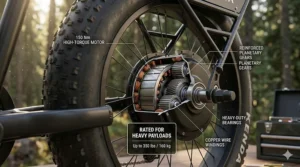
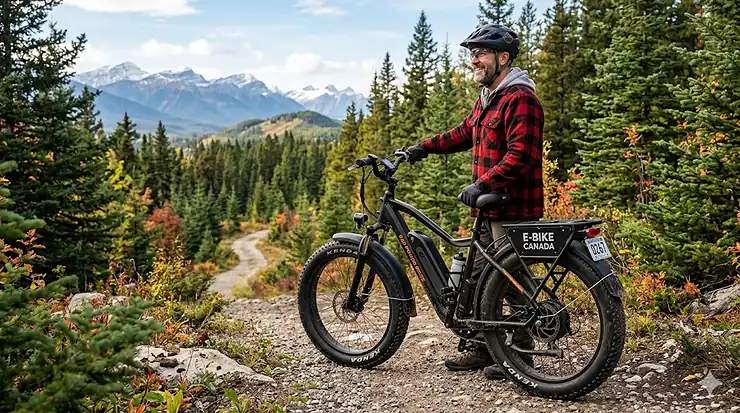
A fat tire electric bike for heavy riders isn’t just a marketing category — it’s a fundamentally different machine. The right one combines reinforced aluminium frames tested for hundreds of thousands of vibration cycles, motors with enough torque to haul real weight uphill without overheating, and 4.0-inch or wider tyres that distribute your mass over a broader contact patch, reducing the punishing pressure-per-square-centimetre that leads to rim strikes and pinch flats.
What makes the fat tire format ideal? Think of it this way: a standard narrow tyre under a heavy rider is like balancing a bowling ball on a pencil tip. A fat tyre turns that pencil into a thick marker — the load spreads out, grip improves, and the ride smooths out considerably. For Canadian riders navigating spring thaw gravel, urban slush, or off-road trails in Ontario’s cottage country or BC’s Gulf Islands, that physics advantage is very real.
In this guide, I’ve researched seven real fat tire e-bikes available to Canadian buyers, with an honest look at who each one is best for, what the specs actually mean in practice, and how they hold up when the temperature drops below zero. All prices are in CAD (Canadian dollars). Let’s find the right ride for you. 🇨🇦
Quick Comparison: 7 Fat Tire E-Bikes for Heavy Riders at a Glance
| Model | Motor | Payload Capacity | Tyre Width | Price Range (CAD) | Best For |
|---|---|---|---|---|---|
| Velotric Nomad 2X | 750W / 105 Nm torque | 254 kg (560 lbs) | 4.0″ | $2,800–$3,200 | Maximum capacity riders |
| VTUVIA SN100 | 750W / 80–85 Nm | 181 kg (400 lbs) | 4.0″ | $2,100–$2,500 | Off-road & all-terrain |
| Himiway Cobra D7 | 750W | 181 kg (400 lbs) | 4.8″ | $2,500–$3,000 | Adventure & long range |
| Aventon Aventure 3 | 750W | 160 kg (350 lbs) | 4.0″ | $2,200–$2,600 | Urban & trail versatility |
| YinZhiBoo 26″ Fat Ebike | 1,000W / 1,500W peak | 150 kg (330 lbs) | 4.0″ | $1,100–$1,500 | Budget-conscious buyers |
| KEQJSK 26″ Fat Tire Ebike | 750W / 1,000W peak | 136 kg (300 lbs) | 4.0″ | $900–$1,200 | Entry-level, urban use |
| Eunorau FAT-AWD 3.0 | Dual 750W (AWD) | 170 kg (375 lbs) | 4.0″ | $3,400–$4,000 | Winter & serious off-road |
All prices approximate in CAD. Check current pricing on Amazon.ca as prices change frequently.
Looking at this table, the Velotric Nomad 2X is the clear winner for very large riders (250 kg+) needing absolute confidence, while the VTUVIA SN100 offers the best combination of payload capacity and trail performance in the mid-price range. Budget riders at the 136 kg (300 lb) mark will find the KEQJSK and YinZhiBoo deliver real value on Amazon.ca without compromising on essentials.
💬 Just one click — help others make better buying decisions too! 😊
✨ Don’t Miss These Exclusive Deals!
🔍 Ready to find your perfect ride? Click any highlighted product below to check current pricing and availability on Amazon.ca. These bikes are hand-picked for Canadian riders who want power, durability, and year-round performance!
Top 7 Fat Tire E-Bikes for Heavy Riders: Expert Analysis
1. Velotric Nomad 2X — The Heavy Rider’s Champion
The Nomad 2X is genuinely in a class of its own when it comes to payload, boasting the highest quoted capacity we’ve seen on a consumer fat tire e-bike at a staggering 254 kg (560 lbs). That’s not a typo.
Here’s why that number matters: payload ratings on cheaper bikes are often optimistic estimates based on static load tests. Velotric’s 105 Nm of motor torque — higher than most competing models’ peak outputs — suggests the drivetrain is engineered for continuous operation under real heavy-rider stress, not just a marketing maximum. The 48V system with a large-capacity battery delivers a realistic 80–100 km range under normal conditions, though heavy Canadian riders should budget for roughly 30–40% reduction in winter temperatures. The 26″ × 4.0″ fat tyres give excellent surface contact and the hydraulic disc brakes provide the stopping power that heavier riders genuinely need.
Who is this for? Any Canadian rider over 160 kg (350 lbs) who wants to stop worrying about whether their bike is “handling” their weight. It’s also excellent for riders who carry cargo — a full set of grocery bags or camping gear barely registers on a platform built for 560 lbs.
Canadian buyers appreciate the brand’s North American service network and the bike’s sealed components, which handle salt residue from post-winter roads much better than exposed hardware on budget alternatives.
Pros:
✅ Highest payload capacity available (254 kg / 560 lbs)
✅ 105 Nm torque handles steep hills under heavy load
✅ Hydraulic disc brakes for safe heavy-rider stopping
Cons:
❌ Premium price point (around $3,000 CAD range)
❌ Heavy bike weight can challenge apartment storage
Price range: $2,800–$3,200 CAD. Exceptional value for its payload class.
2. VTUVIA SN100 — The All-Terrain Workhorse
The SN100 is one of the most talked-about fat tire e-bikes for heavy riders in North America, and Canadian buyers are increasingly discovering it. The 750W brushless motor with a torque sensor — not just a cadence sensor — is what separates this bike from most Amazon.ca competitors in its price range.
Why does the torque sensor matter? A cadence sensor activates the motor when you pedal, regardless of effort. A torque sensor activates proportionally to how hard you’re pushing. For a 180 kg (400 lb) rider, that means natural-feeling assistance that scales to real terrain instead of jerky on/off motor behaviour. The 48V 14Ah LG-certified battery (UL2849 certified system) delivers a realistic 80–110 km on pedal assist in moderate temperatures, dropping to roughly 60–75 km in Canadian winter conditions. The 26″ × 4.0″ fat tyres with IP67-rated construction means light creek crossings and spring mud are no issue.
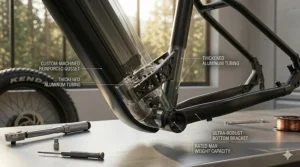
The 181 kg (400 lbs) payload capacity paired with a frame tested for 400,000 vibration cycles makes this a genuine long-term investment for heavy Canadian riders rather than a “ride it till it breaks” budget pick. For Vancouver riders navigating the North Shore’s mixed terrain, or Ottawa commuters dealing with transitional freeze-thaw seasons, the SN100’s all-terrain balance is hard to beat.
Customer feedback from North American users highlights the smooth torque-sensor assist and solid frame quality, with a few noting the bike’s weight (around 30 kg) makes it a two-person lift into a truck bed.
Pros:
✅ Torque sensor = natural riding feel under heavy load
✅ UL-certified battery with LG cells for safety & reliability
✅ 400 lb payload with a frame built for serious vibration stress
Cons:
❌ Heavy bike at ~30 kg (not ideal for daily stair carries)
❌ Available primarily direct from VTUVIA; check Amazon.ca availability
Price range: $2,100–$2,500 CAD. Exceptional mid-range value for its payload class.
3. Himiway Cobra D7 — The Long-Range Fat Tank
Himiway has built one of the strongest brand communities in North American fat tire e-biking, and the Cobra D7 represents the brand’s most capable offering for heavy riders. The 26″ × 4.8″ CST all-terrain fat tyres are wider than most competitors’ 4.0″ offerings — and that extra width is meaningful.
At 4.8 inches, the Cobra D7’s tyres create a genuinely large contact patch that’s noticeably more forgiving on loose gravel, packed snow, and the uneven bike-path patchwork of Canadian cities. The 750W motor rated for 181 kg (400 lbs) payload drives through Himiway’s large battery configuration (typically 960Wh), which is one of the main reasons this bike earns such strong marks for long-distance riders. In Canadian conditions, even at 250+ lbs of rider weight and -10°C temperatures, you’re likely looking at 60–80 km of realistic range — enough for most full-day commutes or recreational rides.
The Cobra D7 is best suited for Canadian riders who plan year-round riding through mixed terrain: the massive battery compensates for the range loss that cold weather inflicts on all lithium systems, and the ultra-wide tyres thrive in the exact conditions — sandy cottage trails, slushy urban streets, snow-covered paths — that Canadian riders face across eight months of challenging weather. Himiway Canada ships directly with free delivery to most provinces.
Canadian customers consistently mention the impressive range and tyre stability as standout features, though some note the stock saddle could use an upgrade for longer rides.
Pros:
✅ 4.8″ ultra-wide tyres for superior stability and winter traction
✅ Large battery (960Wh) compensates for cold-weather range loss
✅ Strong brand support with Canadian distribution
Cons:
❌ Very heavy at ~35 kg — storage is a consideration
❌ Premium price tier
Price range: $2,500–$3,000 CAD. Best choice for serious year-round Canadian riders.
4. Aventon Aventure 3 — The Urban-Trail All-Rounder
Aventon has earned a reputation for producing well-engineered e-bikes that feel like finished products rather than assembled components, and the Aventure 3 continues that tradition. For heavy riders in the 120–160 kg (265–350 lbs) range who split time between city streets and weekend trails, this is arguably the most polished option on the list.
The 750W motor ships the bike as a Class 2 e-bike but can be unlocked to Class 3 speeds via the Aventon app — useful context for Canadian riders, since our federal 32 km/h PAB limit applies to Class 2 operation and using the higher Class 3 setting may affect your legal status under provincial e-bike rules (always verify locally). The 4.0″ tyres, solid front suspension, and hydraulic disc brakes combine to create a ride that feels “SUV-like” in versatility — confident on gravel, smooth on pavement, and genuinely fun on light trails.
For an Edmonton or Calgary rider who commutes on mixed pavement and occasional crushed-gravel paths, the Aventure 3 is a strong choice. The app integration for speed management is also handy: you can dial back to a fully compliant PAB setting when riding in regulated zones. Aventon has Canadian dealer support in major cities, which is worth factoring in if you prefer in-person service over mail-in warranty claims.
Canadian buyers praise the overall build quality and the intuitive Aventon app, with a few noting the weight limit of 350 lbs means it’s not the right call for very heavy riders.
Pros:
✅ Polished, finished-product feel with app integration
✅ Excellent balance of urban and light trail performance
✅ Canadian dealer network for in-person service
Cons:
❌ 350 lbs capacity — not for very heavy riders
❌ App-dependent features require smartphone pairing
Price range: $2,200–$2,600 CAD. Best all-rounder for 120–160 kg Canadian riders.
5. YinZhiBoo 26″ Fat Tire Ebike — Budget Powerhouse on Amazon.ca
Available directly on Amazon.ca, the YinZhiBoo 26″ fat tire e-bike is the kind of product that surprises you. The 1,000W rated motor (peaking at 1,500W) is more power than many bikes twice the price, and the 48V 17.5Ah battery is a genuinely large pack for a bike in this price tier — delivering realistic ranges of 55–75 km depending on terrain and rider weight.
Here’s the practical context for a 136–150 kg (300–330 lbs) Canadian rider: the 1,500W peak power means the motor doesn’t need to work hard on hills. A motor running at 60% capacity runs cooler, lasts longer, and performs more consistently than a cheaper 500W motor screaming at full output to move your weight uphill. The 21-speed Shimano drivetrain adds another layer of efficiency — you can keep the motor assist at a moderate level and use gear selection to manage hills, extending battery life significantly. The 330 lb (150 kg) payload capacity covers most riders in this category comfortably.
Canadian buyers on Amazon.ca note the bike arrived well-packaged, approximately 90% pre-assembled, and that first-ride impressions were positive on hill-climbing. A few reviewers noted minor assembly fit issues (standard for this price tier) but nothing that affected long-term performance. For a new rider in the 100–150 kg range who wants a capable fat tire e-bike without a $2,500 CAD commitment, this is a smart entry point.
Pros:
✅ 1,000W (1,500W peak) — serious power for the price
✅ 48V 17.5Ah battery — large pack for extended range
✅ 21-speed Shimano for efficient hill management
Cons:
❌ 330 lb payload — not suitable for very heavy riders
❌ Some minor assembly fit tolerances typical at this price point
Price range: $1,100–$1,500 CAD. Exceptional value for first-time buyers under 150 kg.
6. KEQJSK 26″ Fat Tire Ebike (48V 13Ah) — Entry-Level Reliable
If budget is your primary constraint and you’re in the 100–136 kg (220–300 lbs) range, the KEQJSK 26″ × 4.0″ fat tire e-bike on Amazon.ca is worth serious consideration. The 750W (1,000W peak) motor paired with a 48V 13Ah removable waterproof battery represents a solid spec sheet at a price well under most Canadian competitors.
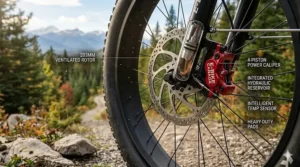
What the KEQJSK gets right for heavy riders is the fundamentals: 26″ fat tyres for stability, a 21-speed Shimano drivetrain for varied terrain management, mechanical disc brakes, and a battery that’s removable for indoor charging — crucial in Canadian winters when leaving a battery in a -15°C garage overnight will visibly shorten its lifespan. The waterproof battery housing is a practical feature often overlooked in this price range.
The top speed of 50 km/h (30 mph) on full throttle — confirmed by Canadian buyers on Amazon.ca — technically exceeds the 32 km/h PAB limit for street-legal e-bikes in Canada. This means the KEQJSK operates as a PAB-compliant bike only when motor assist is limited to 32 km/h; full-throttle use at higher speeds would require the bike to be treated as a motor vehicle under most provincial regulations. Riders should adjust settings accordingly and check provincial rules. As a trail or off-road bike where speed regulations apply differently, its performance is excellent.
Canadian Amazon.ca reviewers highlight the strong motor torque, good lights, and Shimano shifter quality, with a few noting the rear fender fit isn’t perfect — a common minor issue at this price point.
Pros:
✅ Removable waterproof battery — essential for Canadian winter storage
✅ 750W / 1,000W peak at an accessible price point
✅ Available on Amazon.ca with Prime shipping to most provinces
Cons:
❌ 300 lb capacity — not suitable for heavier riders
❌ Top speed exceeds PAB limit; riders must manage settings for street compliance
Price range: $900–$1,200 CAD. Best entry-level option for riders under 136 kg (300 lbs).
7. Eunorau FAT-AWD 3.0 — The Dual-Motor Winter Beast
The Eunorau FAT-AWD 3.0 is the outlier on this list — and for a specific group of Canadian heavy riders, it’s the only bike worth considering. With dual 750W hub motors delivering all-wheel drive, a 170 kg (375 lbs) payload, and 26″ × 4.0″ fat tyres, this bike was essentially designed for Canadian winter conditions.
Here’s why AWD matters more than almost any other spec for heavy riders in winter: a single rear-wheel drive e-bike under a heavy rider on packed snow will spin out. The rear wheel receives the majority of motor torque, and when traction is marginal — think glazed ice on a bike path, or compressed snow on a residential street in Winnipeg or Saskatoon in January — that single-wheel power delivery can cause sudden loss of control. Distributing power across both wheels using the FAT-AWD 3.0’s front and rear motors dramatically reduces that spin-out risk, especially on inclines.
The dual-motor setup also delivers a combined torque figure that handles heavy riders on steep grades without the overheating that plagues single-motor bikes pushed hard. In a practical Canadian scenario: a 160 kg (350 lbs) rider climbing a 12° grade in January conditions will stress most single-motor bikes visibly. The FAT-AWD 3.0 handles this comfortably. Available through select Canadian e-bike retailers and Amazon.ca; check current availability as stock varies.
Canadian buyers in colder provinces — Manitoba, Saskatchewan, Alberta — consistently cite the AWD traction as the decisive factor in their purchase, often after experiencing spin-out issues with previous single-motor bikes.
Pros:
✅ All-wheel drive — best traction for Canadian winter conditions
✅ 375 lbs payload with dual-motor reliability
✅ Excellent on ice and packed snow where single-drive bikes struggle
Cons:
❌ Premium price (~$3,400–$4,000 CAD range)
❌ Heavier than most at nearly 40 kg — storage and transport considerations
Price range: $3,400–$4,000 CAD. The definitive choice for serious winter riders.
Real-World Canadian Rider Profiles: Which Bike is Right for You?
Matching a bike spec sheet to your actual life is different from reading a spec sheet. Here are three Canadian rider profiles that illustrate how to choose.
Profile 1 — The Toronto Condo Commuter (weight: 120 kg / 265 lbs): Marcus lives in a Yonge Street condo in Toronto, commutes 14 km each way to his Midtown office, and needs to carry the bike up one flight of stairs when the elevator is busy. His priority is a manageable weight combined with enough motor power to handle the Bloor Street hill with confidence. The Aventon Aventure 3 is his match: it’s the lightest genuinely capable option on this list, has Canadian dealer service in Toronto, and its app-managed speed settings keep him PAB-compliant on all city routes.
Profile 2 — The Calgary Weekend Trail Rider (weight: 160 kg / 350 lbs): Diane rides recreational trails near Fish Creek Park in spring and summer, and wants to extend into November riding when conditions allow. She needs real payload capacity, rugged tyres, and a battery that doesn’t give up after 40 km. The Himiway Cobra D7 with its 4.8″ ultra-wide tyres and 960Wh battery is the match: the extra tyre width provides the edge-case stability she needs on loose gravel and early-season frost, and the large battery ensures she’s never cutting a ride short to nurse the power bar home.
Profile 3 — The Winnipeg Year-Round Heavy Rider (weight: 200 kg / 440 lbs): Dave commutes 8 km each way in Winnipeg, where January temperatures regularly hit -25°C and bike paths alternate between packed ice and wet slush through November. He needs the highest possible payload capacity and the best winter traction available. His answer is the Velotric Nomad 2X for its 254 kg (560 lbs) payload capacity — or the Eunorau FAT-AWD 3.0 if he prioritises AWD winter traction over maximum payload. Both are valid; the choice comes down to whether he values absolute weight margin (Nomad 2X) or absolute winter grip (FAT-AWD 3.0).
How to Choose the Right Fat Tire E-Bike for Heavy Riders in Canada
Choosing isn’t complicated once you know what actually matters. Here’s a numbered decision framework.
1. Start with payload capacity — not motor wattage. Motor watts get the marketing headlines, but payload capacity is the foundational number for heavy riders. Choose a bike rated for at least 10–15% above your actual weight, accounting for any cargo (panniers, backpack, groceries). A 150 kg (330 lbs) rider shouldn’t be on a 150 kg rated bike — they should be on a 170–180 kg rated machine.
2. Check tyre width: 4.0″ minimum, 4.8″ ideal for heavy riders. Fat tyres distribute weight over a larger contact area, which directly reduces the per-centimetre pressure that causes rim strikes and pinch flats. For heavy riders over 150 kg (330 lbs), a 4.0″ tyre is the minimum acceptable width. If your riding includes off-road, mixed terrain, or Canadian winter conditions, 4.8″ tyres like those on the Himiway Cobra D7 are worth the premium.
3. Prioritise torque over wattage. Torque (measured in Nm) is what actually moves heavy loads uphill. A 750W motor with 105 Nm of torque (like the Velotric Nomad 2X) will out-climb a 1,000W motor with only 60 Nm. Look for at least 80 Nm for riders over 150 kg — and 100+ Nm if your commute includes hills.
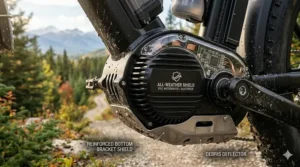
4. Verify frame certification and construction quality. Look for alloy frames with reinforced welds, 12-gauge spokes (not the standard 13-gauge), and ideally a frame that’s been tested for repetitive stress (like the VTUVIA SN100’s 400,000-vibration-cycle rating). On Amazon.ca, check the listing specs carefully — the weight capacity number is only as reliable as the frame construction behind it.
5. Factor in Canadian winter performance for the battery. Canadian riders should assume 20–40% battery range reduction below -10°C, with larger losses at -20°C and below. Heavier riders drain batteries faster at baseline. Practically: if a bike is rated for 80 km range for an average rider in summer, a 160 kg (350 lbs) rider in a -15°C Winnipeg January might see 35–50 km. Choose a battery capacity (Wh) accordingly.
6. Plan for PAB compliance with your provincial rules. Under Canadian federal law, a Power-Assisted Bicycle (PAB) must have a maximum motor output of 500W continuous and stop providing motor assistance at 32 km/h. Many bikes on this list have 750W+ motors — they may still comply if the motor is rated at 500W continuous (with peak power higher) and speed is limited. Always verify your specific bike’s settings match your provincial requirements. Transport Canada’s PAB guidelines are the reference point, and Ontario’s regulations are currently under active revision (as of mid-2026).
Tire Pressure for Heavy Riders: The Guide Amazon Listings Won’t Give You
This is the practical advice that makes a real difference — and you won’t find it in any product listing. Correct tyre pressure for a heavy rider on a fat tyre e-bike is not the same as the pressure listed on the tyre sidewall.
Fat tyre e-bikes typically run at 5–30 PSI, and the right pressure for you depends on three factors: your weight, the terrain, and the outdoor temperature.
For heavy riders (150+ kg / 330+ lbs):
- Pavement/mixed urban: 18–22 PSI front, 20–25 PSI rear (rear carries more weight — about 58–60% of total load on a rear-hub-drive bike)
- Gravel/mixed trail: 14–18 PSI front, 16–20 PSI rear
- Snow/packed ice: 10–14 PSI front, 12–15 PSI rear (lower than average rider; you still need some resistance to prevent rim contact)
The Canadian winter PSI trap: tire pressure drops approximately 1 PSI for every 10°C temperature decrease. A fat tyre inflated to 18 PSI in your heated garage will read closer to 12–13 PSI outside at -30°C. Check and adjust tyre pressure every 3–4 days in winter (not once a week like a fair-weather rider) — heavy riders have less margin before rim strikes become a risk.
Why lower PSI improves traction on snow: When you lower the pressure, the fat tyre spreads out and flattens slightly, increasing the contact patch with the snow surface and improving flotation — the tyre “floats” rather than cutting through and losing traction. For deep snow riding, 8–10 PSI is an appropriate target for heavy riders. For packed ice, slightly higher (12–15 PSI) gives a firmer casing that tracks better on hard surfaces.
Invest in a quality floor pump with a gauge — the tiny hand pumps included with most e-bikes are frustrating to use accurately. A floor pump with a large-face gauge costs $25–$40 CAD and will pay for itself in fewer flat tyres within one Canadian winter.
Weight Distribution and Stability: What Every Heavy Rider Should Know
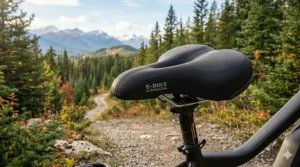
Weight distribution is something that experienced cyclists understand intuitively but rarely articulate. For heavy riders on fat tyre e-bikes, getting it right actively improves safety — particularly on challenging Canadian terrain.
The 58/42 rule: Rear-hub-drive e-bikes (which covers most models on this list) naturally concentrate motor weight at the rear. Add a heavy rider and the rear-weight bias becomes significant — typically around 58% rear, 42% front. This is why heavy riders experience more front-wheel lift on steep climbs and more rear-wheel spin on slick surfaces.
Practical adjustments:
- On uphill climbs, consciously shift your weight forward — slide towards the nose of the saddle and keep your upper body low. This loads the front wheel and improves traction on the rear drive wheel simultaneously.
- On downhill sections, shift slightly rearward to prevent the front wheel from washing out and to improve braking effectiveness (your weight loads the front brake more evenly).
- On flat straight sections, sit centred with weight evenly distributed across both feet on the pedals — not resting on one side.
- Avoid riding with your weight shifted to one side habitually. Over time, asymmetric loading accelerates spoke fatigue on one side of the rear wheel — a real concern for heavy riders.
Why wheelbase length matters for heavy riders: Longer-wheelbase bikes (most 26″ fat tyre e-bikes have a wheelbase of 115–125 cm) are inherently more stable under heavy loads than shorter alternatives. The longer the wheelbase, the less the bike “tips” longitudinally when you shift weight — especially relevant when starting from a stop on a slope, where many heavy riders experience their first unsettling moments on an e-bike.
Fat tyre width also contributes to lateral (side-to-side) stability. A 4.8″ tyre has a noticeably wider stance than a 4.0″ tyre, and that extra contact width prevents the slight lean-on-edge feeling that heavy riders sometimes experience on skinnier fat tyres at lower speeds.
Canadian Regulations and Safety Standards for Heavy Rider E-Bikes
Understanding the regulatory landscape protects your investment and keeps you riding legally across Canada’s diverse provincial frameworks.
The federal baseline: Transport Canada classifies legal e-bikes as Power-Assisted Bicycles (PABs) requiring: maximum 500W continuous motor output, motor assistance that ceases at 32 km/h, and fully operable pedals. PABs don’t require a driver’s licence, registration, or insurance in most provinces — a significant practical advantage.
The 750W reality: Many bikes on this list have 750W rated motors. These can still qualify as PABs if the continuous (nominal) output meets the 500W limit — many 750W motors are rated at the peak figure, with continuous output lower. However, this area is complex, and enforcement can vary. Always verify with your provincial transportation ministry. Ontario is actively revising its e-bike classification framework in 2026; rules may change mid-year.
Key provincial notes:
- British Columbia: The only province with a formal two-class system. Standard e-bikes (500W, age 16+, throttle permitted) cover most fat tyre models. BC modernised its rules effective April 2024.
- Ontario: No licence, registration, or insurance required for PAB-compliant bikes. Prohibited on 400-series highways and the QEW. Under active regulatory review in mid-2026.
- Quebec: Riders aged 14–17 require a Class 6D moped licence. Important for families purchasing for younger riders.
- Manitoba: Helmet required only for riders under 18 (adults can technically ride helmetless, though it’s not recommended — especially for heavy riders where impact forces are greater).
For comprehensive current information, visit the Transport Canada website or your provincial transportation authority’s official site — always the authoritative source over third-party guides.
✨ Don’t Miss These Exclusive Deals!
🔍 Ready to ride? Click any highlighted e-bike above to check current pricing and availability on Amazon.ca. Whether you’re a budget buyer or looking for the ultimate Canadian winter warrior, there’s a fat tire e-bike on this list built for your weight and your province!
Common Mistakes When Buying a Fat Tire E-Bike as a Heavy Rider
After reviewing the landscape of heavy-rider e-bike purchases, a few patterns emerge in what goes wrong. Here are the most common mistakes — and how to avoid them.
Mistake 1: Buying at your exact weight limit. A bike rated for 300 lbs should not be purchased by a 300-lbs rider. The weight rating represents a maximum engineering threshold, not a comfortable operating range. At exactly the limit, you’re stressing every component — frame, spokes, bearings, battery drain rate — at maximum design load with no safety margin. Add a backpack, grocery bags, or winter gear and you’re over spec before you’ve left the driveway. Choose a bike rated for at least 10–15% above your current weight.
Mistake 2: Prioritising motor watts over torque (Nm). “1,500W peak power!” reads the marketing headline. What that doesn’t tell you is that peak power is a momentary burst figure, and sustained torque is what keeps a heavy rider moving up a 10° hill for three minutes. Look for Nm torque ratings alongside wattage. For riders over 150 kg, 80+ Nm sustained is the relevant threshold.
Mistake 3: Ignoring Canadian warranty and service reality. A bike with a great spec sheet and zero Canadian service support is a liability. When the rear derailleur cable snaps or the display unit fails 14 months in, you need either a Canadian service centre, a brand with responsive warranty support to Canada, or the mechanical confidence to DIY. Check the brand’s Canadian warranty terms before purchasing — some American-listed bikes on Amazon.ca ship with US-only warranties, creating a cross-border repair headache.
Mistake 4: Not accounting for winter battery range. The spec sheet says 80 km range. A Canadian rider at 175 kg in -15°C conditions is likely looking at 40–50 km. This isn’t a defect — it’s physics: lithium-ion batteries lose 20–40% capacity below -10°C, and heavier riders draw more power at baseline. The solution is either to choose a bike with a significantly larger battery than you think you need, or to keep realistic range expectations for winter riding.
Mistake 5: Overlooking spoke gauge and wheel construction. This is the most overlooked heavy-rider consideration on Amazon.ca listings. Standard e-bike spokes are 13-gauge. Heavy-rider bikes should use 12-gauge (thicker) spokes. The difference in failure rate under repeated heavy load is significant. Look for this spec in the listing details or contact the seller directly — it’s a meaningful quality indicator for long-term durability.
FAQ
❓ What is the best fat tire electric bike for a 300-lb rider in Canada?
❓ Can fat tire e-bikes be used in Canadian winters?
❓ What PSI should heavy riders use for fat tyre e-bikes?
❓ Are 750W e-bikes legal in Canada?
❓ Which fat tire e-bikes available in Canada support over 400 lbs (181 kg)?
Conclusion: The Right Fat Tire E-Bike Changes Everything
There’s a particular kind of freedom that a well-matched fat tire electric bike delivers to a heavy rider — one that lighter riders rarely appreciate because they’ve never been without it. The confidence of knowing your bike isn’t being stressed to its limit. The stability of 4.0–4.8″ tyres on a February morning when the bike path looks like a skating rink. The satisfaction of climbing a hill that would have left you walking two years ago.
Canada’s terrain and climate make fat tyre e-bikes especially relevant here: from Halifax’s coastal wind and slush to Edmonton’s -30°C January commutes to Vancouver Island’s year-round mixed-surface trails, the versatility and stability of a well-built fat tyre e-bike is practically unmatched as a single-bike solution.
The key takeaways: buy above your weight limit (not at it), prioritise torque over peak watts, choose 4.0″ tyres minimum (4.8″ for serious off-road or winter use), and factor Canadian winter battery loss into your range expectations. For very heavy riders over 200 kg, the Velotric Nomad 2X is the responsible first recommendation. For the 140–180 kg range, the VTUVIA SN100 and Himiway Cobra D7 offer the best payload-to-value ratio available on the Canadian market today.
Check current pricing and availability on Amazon.ca, confirm your provincial PAB regulations, and ride confidently. 🇨🇦⚡
✨ Don’t Miss These Exclusive Deals!
🔍 Ready to find your perfect Canadian ride? Click any highlighted fat tire e-bike in this guide to check current pricing and availability on Amazon.ca. Your most capable, confident, and comfortable ride is one click away!
Recommended for You
- Best Electric Bike 300 lbs Capacity in Canada 2026 (Top 7 Picks)
- Best Electric Bike for Arthritis Sufferers Canada 2026 (Top 7)
- 7 Most Comfortable Electric Bikes for Seniors Canada 2026
Disclaimer: This article contains affiliate links. As an Amazon Associate, I earn from qualifying purchases. If you purchase products through these links, we may earn a small commission at no additional cost to you. All prices are approximate in Canadian dollars (CAD) and are subject to change — check current pricing on Amazon.ca.
✨ Found this helpful? Share it with your friends! 💬🤗
