

In This Article
The foldable electric trike market has exploded across Canada in 2026, and it’s easy to see why. If you’re living in a downtown Toronto condo with zero storage space, or you’re an RV enthusiast traveling from Vancouver to Halifax, or simply someone who wants stable three-wheel riding without sacrificing precious garage real estate—you need portability without compromise.
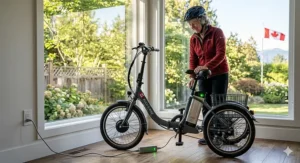
What most buyers overlook about the foldable electric trike category is this: folding capability doesn’t mean sacrificing power or range. Modern models pack 500-750W motors into frames that collapse to fit in your car trunk, deliver 50-80 km per charge even in Canadian winters when cold temperatures typically reduce battery efficiency by 10-20%, and support payload capacities up to 200 kg (440 lbs). The key difference between a standard e-trike and its foldable cousin isn’t just the hinge mechanism—it’s the engineering philosophy. Compact storage electric trike designs prioritize quick-release components, tool-free folding, and modular construction that makes transport friendly three wheeler models genuinely practical for Canadian urban dwellers and seasonal travelers alike.
According to Transport Canada regulations, power-assisted bicycles and tricycles designed for speeds under 32 km/h with motors rated at 500W or less fall outside federal vehicle safety standards, placing them under provincial jurisdiction. This creates a sweet spot for Canadian riders: you get electric assistance without motorcycle licensing requirements, but you need to verify your provincial bylaws before riding on public paths or roads.
Quick Comparison: Top Foldable Electric Trikes at a Glance
| Model | Motor Power | Battery/Range | Weight | Folded Dimensions | Price Range (CAD) | Best For |
|---|---|---|---|---|---|---|
| Lectric XP Trike2 | 500W | 624Wh / 50-80 km | 36 kg | 98 × 64 × 71 cm | $2,700-$2,900 | Budget-conscious buyers |
| VICTRIP T1 | 1000W peak | 960Wh / 80+ km | 42 kg | 99 × 64 × 122 cm | $1,700-$1,900 | Value seekers |
| Addmotor M-330F | 750W | 48V 20Ah / 95 km | 51 kg | 102 × 66 × 76 cm | $3,200-$3,600 | Premium features |
| Sixthreezero EZ Transit | 750W | 48V 15.6Ah / 65 km | 39 kg | 96 × 61 × 74 cm | $2,400-$2,700 | Urban commuters |
| TopMate ES32 Mobility | 270Wh | 270Wh / 25-30 km | 16 kg | 89 × 51 × 76 cm | $900-$1,200 | Light errands/seniors |
| NARRAK Fat Tire | 1350W peak | 48V 20Ah / 70 km | 48 kg | 104 × 68 × 81 cm | $2,200-$2,500 | All-terrain |
| Demon Electric Trinity | 500W | 48V 14Ah / 55 km | 37 kg | 94 × 63 × 73 cm | $2,600-$2,900 | Canadian warranty |
Looking at this comparison, three patterns emerge for Canadian buyers. First, weight matters more than you’d think—anything above 45 kg becomes challenging for solo loading into an SUV or van, even when folded. The TopMate ES32 at 16 kg offers exceptional portability, but you’re sacrificing range and power for that convenience. Second, battery capacity directly correlates with Canadian winter viability. Models with 624Wh or higher maintain usable range even when November temperatures drop performance 15-20%. Third, folded dimensions tell only half the story—the process of folding varies wildly. Some models require removing the front wheel and battery (5-7 minutes), others fold with a simple latch system (under 2 minutes).
💬 Just one click — help others make better buying decisions too!😊
Top 7 Foldable Electric Trikes: Expert Analysis for Canadian Buyers
1. Lectric XP Trike2 — Best-Selling American Import
The Lectric XP Trike2 has dominated North American sales, and Canadian buyers frequently ask whether it’s worth importing. The answer depends on your tolerance for cross-border complications. This portable electric tricycle features a 500W rear hub motor with differential axle engineering that powers both rear wheels independently—crucial for smooth cornering on wet Vancouver streets or icy Calgary bike paths. The 48V 13Ah (624Wh) battery delivers 50-80 km range depending on pedal assist level, terrain, and temperature.
What the spec sheet won’t tell you: the differential axle isn’t just about turning radius; it prevents the rear-wheel skipping and juddering you’ll experience on cheaper single-motor trikes when making tight turns while carrying cargo. The hydroformed aluminum frame folds at two points (handlebar stem and main frame hinge), reducing dimensions to roughly 98 × 64 × 71 cm when collapsed. However, you’ll need to remove the front wheel and battery for the most compact configuration—a 5-minute process that’s manageable but not spontaneous.
Canadian buyers face USD pricing around $1,999 US (approximately $2,740 CAD at May 2026 exchange rates), plus potential import duties and shipping. Customer feedback from American users consistently praises reliability and value, though some Canadian reviewers on specialty forums note that warranty service requires shipping back to US facilities. For Ottawa-area riders or those near the US border, this might be manageable; for someone in remote Saskatchewan, it’s a significant consideration.
Pros:
✅ Differential drive delivers smooth, stable turns under load
✅ UL 2849 certified (industry-standard safety for e-bikes)
✅ Cloud 50 suspension fork handles Canadian pothole season better than rigid forks
Cons:
❌ Cross-border warranty support complicates repairs in Canada
❌ Folding process requires wheel removal—not quick-deploy convenience
The XP Trike2 makes sense if you’re buying from a US retailer that ships to Canada and you accept the service trade-offs. At around $2,700-$2,900 CAD all-in, it’s competitively priced but not the value leader it appears at first glance.

2. VICTRIP T1 Folding Electric Trike — Best Value Under $2,000 CAD
The VICTRIP T1 consistently appears on Amazon.ca and represents the budget end of serious performance. Don’t confuse “budget” with “compromised”—this rv electric trike foldable model packs a 1000W peak motor (750W continuous) and an LG-sourced 48V 20Ah battery (960Wh) that delivers 80+ km range in optimal conditions. What impresses experienced riders is the hydraulic disc brakes—a feature typically reserved for trikes costing $3,000+ CAD. Those hydraulic brakes transform wet-weather stopping power, which matters significantly during Canadian spring when roads alternate between dry, wet, and slushy within single commutes.
The frame folds via center hinge, and VICTRIP claims a folded footprint of 99 × 64 × 122 cm. Real-world feedback suggests the trike is best suited for garage storage or pickup truck transport rather than sedan trunks—the 42 kg weight and vertical height when folded make it awkward for smaller vehicles. The T1’s standout feature for Canadian buyers is the reverse mode and parking brake. If you’ve ever tried to back up a loaded trike on a slope (think exiting a Vancouver SkyTrain station platform), you’ll immediately understand why this matters.
Customer reviews on Amazon.ca and specialty e-bike forums highlight two consistent themes: assembly arrives 92% complete (expect 30-45 minutes setup), and the twist throttle design reduces accidental acceleration—particularly valuable for older riders or those new to electric three-wheelers. Some reviewers in Alberta and Manitoba note that extreme cold (-20°C to -30°C) reduces the claimed 80 km range to approximately 55-60 km, which aligns with standard lithium-ion temperature performance curves.
Pros:
✅ Hydraulic brakes deliver confident stopping in Canadian rain and slush
✅ 960Wh battery maintains usable winter range even with 20% cold-weather loss
✅ Reverse mode solves the awkward backing-up problem
Cons:
❌ 42 kg weight challenges solo loading without ramps or assistance
❌ Customer service responsiveness varies (check recent Amazon.ca reviews)
Price typically ranges $1,700-$1,900 CAD on Amazon.ca. At that price point, the T1 delivers premium features (hydraulic brakes, high-capacity battery) without the premium price tag. Best suited for buyers prioritizing value and willing to handle assembly themselves.
3. Addmotor M-330F Triketan — Premium Engineering Worth the Investment
When you step up to the Addmotor M-330F, you’re paying for refined engineering that shows in the details. This folding mechanism electric tricycle features a 750W front hub motor, 48V 20Ah battery, and a build quality that feels noticeably more substantial than budget alternatives. The M-330F’s distinguishing characteristic is payload capacity—it’s rated for 180 kg (397 lbs) rider weight plus significant cargo, making it viable for grocery runs or equipment transport that would overwhelm lighter-duty trikes.
The foldable design uses a center hinge with quick-release levers, achieving folded dimensions around 102 × 66 × 76 cm. At 51 kg, this isn’t a trike you’ll casually lift—plan on using vehicle ramps or two-person loading. What you gain for that weight is durability. Addmotor constructs the frame from reinforced aluminum alloy with thicker tubing than competing models, and customer feedback consistently notes that after 1,000+ km, components show minimal wear compared to lighter-built alternatives.
For Canadian conditions specifically, the M-330F’s front hub motor placement offers an advantage: weight distribution places more load on the front wheel, improving traction on slippery surfaces. When you’re navigating Edmonton’s spring ice patches or Halifax’s November rain, that front-wheel drive bias helps prevent rear-wheel spin-out that plagues rear-hub designs. The 20Ah battery (approximately 960Wh) delivers advertised 95 km range in warm weather; Canadian reviewers report 65-75 km in winter conditions (5°C to -10°C), which remains class-leading.
Availability on Amazon.ca can be spotty—Addmotor primarily sells through their own website and select Canadian dealers. Expect pricing in the $3,200-$3,600 CAD range. While that’s premium territory, you’re receiving premium components: Shimano Tourney 7-speed drivetrain, dual mechanical disc brakes, and an LCD display with USB charging port.
Pros:
✅ 180 kg payload capacity handles serious cargo and larger riders
✅ Front hub motor improves winter traction on slippery Canadian roads
✅ Proven durability—customer reviews consistently report 1,000+ km with minimal maintenance
Cons:
❌ 51 kg weight requires ramps or assistance for vehicle loading
❌ Premium pricing pushes it beyond many buyers’ budgets
The M-330F makes sense for riders who plan to keep the trike 3-5+ years and want something that won’t require constant part replacements. The higher upfront cost distributes across extended ownership.
4. Sixthreezero EZ Transit 750W — Urban Commuter’s Dream
The Sixthreezero EZ Transit targets a specific niche: urban professionals who need daily commute capability plus weekend flexibility. This compact storage electric trike weighs just 39 kg—light enough for most adults to manage solo loading into a Honda CR-V or Toyota RAV4. The 750W motor provides ample power for Toronto’s hills or Montreal’s bridges, and the 48V 15.6Ah battery (approximately 750Wh) delivers 60-65 km range in mixed city riding.
What distinguishes the EZ Transit is thoughtful design touches that matter for daily use. The step-through frame geometry allows mounting/dismounting without swinging your leg over the saddle—crucial if you’re wearing office attire or dealing with mobility limitations. The foldable design collapses to 96 × 61 × 74 cm via a center hinge plus folding handlebar stem, and the entire process takes under 3 minutes without tool requirements. For commuters catching the GO Train or storing in downtown Toronto office parking, that sub-3-minute fold time makes the difference between “convenient” and “actually usable.”
Sixthreezero, a California-based company, ships to Canada but pricing reflects import considerations—expect around $2,400-$2,700 CAD depending on retailer and current exchange rates. Customer reviews highlight comfort as a standout feature. The wide saddle, ergonomic grips, and upright riding position reduce strain on wrists and lower back—valuable for 30-40 minute commutes. Canadian buyers in Vancouver and Victoria particularly appreciate the EZ Transit’s performance in rain. The mechanical disc brakes (not hydraulic, a cost-saving measure) still provide reliable stopping power on wet pavement, though they require more hand force than hydraulic systems.
One consideration for winter riders: the 750Wh battery provides adequate range in mild temperatures (5°C to 15°C) but drops to approximately 45-50 km in colder conditions (-5°C to 5°C). If your commute exceeds 20 km each way, winter range might be marginal without mid-day charging access.
Pros:
✅ 39 kg weight enables solo loading without assistance
✅ Sub-3-minute folding without tools—genuinely convenient
✅ Step-through frame accommodates business attire and mobility needs
Cons:
❌ Mechanical disc brakes require more hand pressure than hydraulic alternatives
❌ 750Wh battery provides limited winter range margin for longer commutes
The EZ Transit excels for urban professionals with 10-20 km commutes who value convenience and comfort over maximum range or cargo capacity. Pricing sits comfortably mid-range at $2,400-$2,700 CAD.
5. TopMate ES32 Foldable Mobility Scooter — Ultra-Lightweight Solution
The TopMate ES32 occupies a unique category—it’s technically classified as a mobility scooter but functions as a lightweight transport friendly three wheeler for errands and short trips. At just 16 kg, this is by far the lightest option reviewed here, folding to a compact 89 × 51 × 76 cm that genuinely fits in car trunks, closets, and even under transit seats where permitted. The three-wheel configuration with seat provides stable, effortless mobility for seniors or anyone preferring not to pedal.
Don’t expect sports car performance: the 270Wh battery delivers 25-30 km range at speeds up to 15 km/h (three selectable speed modes). The brushless motor is rated around 250W continuous—adequate for flat urban environments but challenged by hills steeper than 5-7 degrees. For Canadian buyers living in flat areas (southern Ontario, Saskatchewan prairies, some coastal regions), the ES32 handles daily errands perfectly. Those in hilly cities like Quebec City, Vancouver’s North Shore, or St. John’s should consider more powerful alternatives.
The key advantage here is portability. You can fold the ES32 in approximately 30 seconds, carry it up stairs (16 kg is manageable for most adults), and store it in spaces where full-size e-trikes simply won’t fit. The reverse function and key-switch ignition add practical safety features. Customer reviews on Amazon.ca consistently praise the device for giving independence to older adults who’ve stopped driving but need grocery store and pharmacy access within 5-10 km radius.
Winter performance becomes the limiting factor. The 270Wh battery in -5°C conditions might deliver only 15-18 km range—barely enough for round-trip errands with any detours. This positions the ES32 as a three-season vehicle for most Canadian buyers (spring through fall) unless you have very short trip distances or willingness to charge mid-day.
Pros:
✅ 16 kg weight—truly portable; most adults can carry it
✅ Genuinely fits in standard car trunks and small storage spaces
✅ Ideal for seniors needing independent mobility for short trips
Cons:
❌ 270Wh battery limits Canadian winter range to 15-18 km
❌ 250W motor struggles with hills steeper than 5-7 degrees
Available on Amazon.ca in the $900-$1,200 CAD range. This isn’t a replacement for serious e-trikes, but for specific use cases—short urban trips, senior mobility, space-constrained storage—it’s perfectly suited and remarkably affordable.
6. NARRAK Fat Tire Folding Electric Trike — All-Terrain Capability
The NARRAK Fat Tire distinguishes itself with 4-inch wide fat tires designed for loose surfaces, sand, snow, and gravel that would stop standard e-trikes cold. The 1350W peak motor (actual continuous rating around 750-850W) provides aggressive acceleration and hill-climbing that feels noticeably more powerful than 500W alternatives. The 48V 20Ah battery delivers approximately 70 km range in mixed terrain—expect 50-60 km if you’re frequently tackling steep trails or riding in deep snow.
For Canadian buyers specifically, those fat tires transform winter capability. Standard 2-inch tires sink into snow and ice, requiring you to walk the trike through unplowed sections. The NARRAK’s 4-inch tires float on top of packed snow (not deep powder, but the compressed snow typical of plowed bike paths) and provide dramatically better traction on icy pavement. If you live in rural Manitoba, northern Ontario, or anywhere that doesn’t immediately plow bike infrastructure, this capability matters significantly.
The hydraulic parking brake system deserves specific mention—it locks the rear wheels mechanically, not through motor braking. This prevents the trike from rolling on slopes when parked and provides genuine emergency stopping capability if electronic systems fail. The frame folds at the center to approximately 104 × 68 × 81 cm, though at 48 kg, you’ll want vehicle ramps for loading.
Customer feedback reveals mixed experiences with NARRAK’s customer service—some Canadian buyers report excellent support from the US-based team, others note slow response times for parts and technical questions. The company is relatively new compared to established brands like Addmotor or Sixthreezero, which introduces some uncertainty around long-term support. However, the components themselves (motor, battery, brakes) use standard specifications that any e-bike mechanic can service.
Pros:
✅ 4-inch fat tires handle Canadian winter conditions significantly better than standard tires
✅ 1350W peak motor delivers confident hill climbing with cargo
✅ Hydraulic parking brake provides mechanical safety backup
Cons:
❌ Customer service quality varies based on recent Amazon.ca reviews
❌ Fat tire width increases rolling resistance—efficiency suffers on smooth pavement
Pricing on Amazon.ca typically ranges $2,200-$2,500 CAD. The NARRAK makes sense for buyers who need genuine all-season, all-terrain capability and live in areas where conventional e-trikes can’t operate year-round.
7. Demon Electric Trinity — Canadian Brand Advantage
The Demon Electric Trinity represents Canadian manufacturing and warranty support—increasingly important as more buyers experience the frustration of dealing with international returns and service. Based in Canada, Demon Electric provides bilingual customer service, ships from Canadian warehouses (avoiding customs delays), and honors warranty claims under Canadian consumer protection law. The Trinity features a 500W rear hub motor, 48V 14Ah battery (approximately 670Wh), and a storage space electric trike design that prioritizes practical daily use over maximum performance.
The foldable frame uses a center hinge system achieving 94 × 63 × 73 cm when collapsed, and the 37 kg weight makes it manageable for solo vehicle loading. Demon Electric equips the Trinity with hydraulic disc brakes—a premium feature at this price point that immediately improves stopping power and control, especially critical during Canadian weather transitions when roads alternate between wet and icy conditions.
Range performance sits around 55 km in optimal conditions (15°C to 20°C), dropping to 40-45 km in winter temperatures (-5°C to 5°C). This positions the Trinity as suitable for most urban and suburban commutes but marginal for longer rural routes. The motor provides adequate power for hills up to 12-15 degrees, though steeper grades will require pedal assistance—which the Trinity accommodates through its 7-speed Shimano drivetrain.
What you’re really paying for with the Trinity is peace of mind. If a component fails, you’re dealing with a Canadian company bound by provincial consumer protection laws. If you need warranty service, you’re not shipping internationally or navigating currency exchange for replacement parts. For Canadian buyers who’ve experienced the nightmare of trying to return a faulty product to a Chinese Amazon seller, that assurance carries real value.
Pros:
✅ Canadian warranty and service eliminates cross-border complications
✅ Hydraulic brakes at competitive mid-range pricing
✅ Ships from Canadian warehouse—no customs delays or surprise duties
Cons:
❌ 670Wh battery provides adequate but not class-leading range
❌ Components are good but not premium—this is value engineering
Priced around $2,600-$2,900 CAD, the Trinity costs slightly more than some imported alternatives but delivers Canadian support that matters if anything goes wrong. For risk-averse buyers or those who’ve had bad experiences with international e-bike warranties, the Trinity is worth the premium.
Setting Up Your Foldable E-Trike: First 30 Days Success Guide
Most foldable electric trikes arrive 85-95% assembled, but proper setup determines whether you’ll love or regret your purchase. Here’s what veteran Canadian riders wish they’d known before their first ride:
Week 1: Assembly and Break-In
Allow 45-90 minutes for initial assembly even if instructions claim “30 minutes.” You’ll need to attach handlebars, pedals, front wheel (sometimes), and connect electrical components. Canadian winter note: if receiving delivery between November-March, bring the battery indoors immediately and let it warm to room temperature (15-20°C) before first charge. Charging lithium-ion batteries below 5°C permanently reduces capacity.
Before your first ride, check tire pressure—most trikes ship with under-inflated tires to prevent shipping damage. Fat tire models typically require 15-20 PSI, standard tires 30-40 PSI. Under-inflated tires dramatically increase rolling resistance and reduce range by 15-25%.
Week 2: Calibrating Range Expectations
Manufacturer range claims assume ideal conditions: 70 kg rider, flat terrain, 20°C temperature, moderate pedal assist. Real Canadian conditions will differ significantly. Conduct a range test in your actual riding environment to establish baseline expectations. Start with a full charge, note your starting odometer reading, ride until the battery reaches 20% (don’t fully discharge on early cycles), and calculate your practical range. This becomes your planning benchmark.
Weeks 3-4: Maintenance Rhythm
Check and tighten all bolts and fasteners—shipping vibration loosens connections that won’t fail immediately but will develop into problems by month 3 if ignored. Inspect brake pad wear and adjust cable tension. Most mechanical disc brakes require minor adjustment after the first 50-100 km of bedding-in. For hydraulic systems, check for fluid leaks at caliper connections.
Canadian-Specific Winterization
If storing your trike outdoors or in unheated spaces during Canadian winters, remove the battery and store it indoors at 40-60% charge (not fully charged, not depleted). Cold temperatures don’t permanently damage lithium-ion batteries if they’re not being actively used, but storing below 0°C accelerates self-discharge and capacity loss. Before winter riding, let the battery warm indoors, install it just before departure, and start riding immediately to generate motor heat that keeps battery temperature elevated.
Apply a light coat of marine-grade grease to all electrical connections (display port, motor connector, battery contacts) to prevent corrosion from road salt spray. Canadian municipalities use significantly more road salt than American counterparts, and that salt will corrode unprotected connections within a single winter season.
Real-World Scenarios: Matching Trikes to Canadian Lifestyles
Scenario 1: Downtown Toronto Condo Commuter
Profile: 35-year-old professional, 8 km each way commute, lives in 600 sq ft condo, no car ownership
Best Match: Sixthreezero EZ Transit 750W
Reasoning: The 39 kg weight and sub-3-minute folding time makes daily storage practical in a small condo. The 60-65 km range easily handles 16 km daily commuting plus errands, even accounting for winter range loss. Step-through frame works with business attire. The moderate pricing ($2,400-$2,700 CAD) doesn’t break a car-free budget.
Scenario 2: Vancouver Island RV Traveler
Profile: Retired couple touring BC and Alberta in motorhome, need daily excursion capability in campground areas
Best Match: VICTRIP T1 or Lectric XP Trike2
Reasoning: RV travelers need enough range for 30-40 km day trips but prioritize compact folding for motorhome storage. Both models provide 50-80+ km range (more than adequate), fold to fit RV storage compartments, and offer the stability and power needed for campground gravel roads and moderate hills. The VICTRIP’s $1,700-$1,900 price point edges out the Lectric for pure value.
Scenario 3: Rural Manitoba All-Season Rider
Profile: 50-year-old needing transportation to town (15 km) year-round, including winter conditions
Best Match: NARRAK Fat Tire Folding Trike
Reasoning: Canadian rural winters demand fat tire capability—nothing else survives unplowed gravel roads with packed snow. The 70 km range (50-60 km winter reality) provides adequate margin for 30 km round-trips with detours. The 1350W motor handles both winter conditions and cargo without strain.
Common Mistakes When Buying Foldable Electric Trikes (And How to Avoid Them)
Mistake #1: Choosing Based on Folded Dimensions Alone
First-time buyers obsess over how small the trike folds without considering weight or folding complexity. A trike that folds to 90 cm but weighs 50 kg and requires 10 minutes plus tools isn’t actually portable—it’s just theoretically compact. Solution: Prioritize the complete equation: fold time + weight + tools required. If you can’t fold and load the trike solo in under 5 minutes, it won’t get used for its intended purpose.
Mistake #2: Underestimating Canadian Winter Range Loss
Manufacturer range claims assume 20°C temperatures. At -10°C, expect 70-75% of rated range. At -20°C, expect 60-65%. Buyers who calculate their commute at the edge of rated range discover winter makes it impossible. Solution: Divide manufacturer claims by 1.3x for your winter baseline planning. A trike rated for 60 km delivers approximately 45 km practical winter range.
Mistake #3: Ignoring Provincial Regulations
E-bike laws vary dramatically by province. British Columbia allows 500W motors on most paths; Ontario restricts power-assisted bicycles to 500W but enforces inconsistently; Quebec requires bell and reflectors; Manitoba treats e-trikes as bicycles with specific equipment requirements. Solution: Check your provincial and municipal bylaws before purchasing. Some US-market models with 750W or 1000W motors technically violate Canadian provincial limits, though enforcement varies widely.
Mistake #4: Skipping Test Rides for Online Convenience
Buying online saves money but you’re guessing about fit, comfort, and whether you can actually manage the weight. A trike that seems “light” at 40 kg on paper feels very different when you’re lifting it into your vehicle for the fourth time that week. Solution: If possible, visit a local e-bike dealer to test ride similar weight/style trikes. Even if you buy a different model online, you’ll understand what you’re committing to.
How to Choose a Foldable Electric Trike for Canadian Conditions
Step 1: Calculate Your True Range Requirements
Measure your actual round-trip distance including detours and errands. Multiply by 1.5x to establish your minimum battery requirement. Add 30% for winter conditions if you’ll ride year-round. Example: 20 km daily commute × 1.5 = 30 km minimum. Add 30% winter buffer = 39 km required range. Target trikes with 50+ km rated range to ensure margin.
Step 2: Assess Your Physical Loading Capability
Can you comfortably lift 30 kg from ground level to trunk height? 40 kg? 50 kg? Be honest—this determines whether 37-40 kg “medium-weight” trikes work for you or if you need ultra-light options (16-25 kg) or heavy-duty options with vehicle ramps. Test with actual weights at home before purchasing.
Step 3: Define Your Storage Reality
Measure your actual storage space: garage dimensions, car trunk height/width, condo storage closet. Compare against manufacturer folded dimensions, but add 10-15 cm in each direction for practical handling clearance. A trike that’s theoretically 95 cm tall folded requires 110 cm vertical clearance to actually maneuver into position.
Step 4: Match Power to Your Terrain
Flat prairie provinces: 500W handles everything. Rolling hills (southern Ontario, lower BC mainland): 500-750W provides adequate power. Mountain provinces or steep coastal terrain: 750W minimum, 1000W ideal. Consider not just your regular route but worst-case scenarios—that one steep hill you’ll eventually need to climb fully loaded.
Step 5: Prioritize Brake Type Based on Climate
Hydraulic disc brakes cost $200-400 more but transform wet-weather safety. If you ride during Canadian shoulder seasons (March-May, October-November) when conditions fluctuate between wet, icy, and slushy, hydraulic brakes justify the investment. Dry-climate riders in limited seasons can succeed with quality mechanical disc brakes.
Long-Term Cost Analysis: True Ownership in Canada
Purchase price tells only part of the story. Here’s what 3-year ownership actually costs for a mid-range foldable e-trike ($2,500 CAD purchase):
Year 1 Costs:
- Purchase: $2,500 CAD
- Basic accessories (lock, lights, rear basket): $150 CAD
- Insurance (if opting for coverage): $150-300 CAD/year
- Electricity for charging (assuming 200 charges/year @ $0.15/kWh): $15 CAD
- Maintenance (tire replacement, brake pad change): $80 CAD
Year 1 Total: $2,895-$3,045 CAD
Years 2-3 Costs (Annual):
- Insurance: $150-300 CAD
- Electricity: $15 CAD
- Maintenance (tires, brake pads, chain, minor repairs): $120 CAD
- Battery replacement fund (assuming $600 battery needs replacement after 3-5 years, amortized): $150 CAD
Annual Ongoing: $435-585 CAD
3-Year Total Ownership: $3,765-$4,215 CAD
Compare this to alternative transportation:
- Car ownership: Estimated $8,000-$12,000 CAD/year (payment, insurance, gas, parking, maintenance) = $24,000-$36,000 over 3 years
- Public transit: $1,800-$2,400 CAD/year (average Canadian city monthly pass) = $5,400-$7,200 over 3 years
- Rideshare: $150-300/month for regular use = $5,400-$10,800 over 3 years
For urban commuters within 15 km of work who can eliminate car ownership, the foldable e-trike pays for itself in under 6 months when factoring saved parking costs alone. Even partial car replacement (reducing second vehicle in household) creates significant savings.
Foldable Electric Trike vs. Standard E-Trike: Making the Right Choice
The folding mechanism adds weight (typically 3-5 kg), complexity (hinges introduce potential failure points), and cost (usually $200-500 premium). You’re only justified in choosing a foldable electric trike if you genuinely need portability. Here’s how to evaluate:
Choose Foldable If:
- You lack dedicated ground-level storage and must carry the trike upstairs
- You regularly transport the trike in a vehicle (RV travel, cottage trips, multi-modal commuting)
- You share storage space where compact configuration matters
- You live in a theft-prone area and bring the trike inside nightly
- You’re limited by provincial condo or apartment bylaws restricting hallway storage
Choose Standard (Non-Folding) If:
- You have dedicated garage, shed, or secure outdoor storage
- You never transport the trike by vehicle
- Maximum range and minimum weight matter more than portability
- Your budget is constrained—standard trikes offer more features per dollar
- You prioritize long-term durability—fewer moving parts means less maintenance
The market trend in 2026 favors foldable designs, but that doesn’t mean they’re universally better. If portability isn’t solving a real problem in your situation, you’re paying for features you don’t use while sacrificing weight, cost-efficiency, or battery capacity.
Features That Actually Matter (And Marketing Hype That Doesn’t)
Features Worth Paying For:
✅ Hydraulic Disc Brakes — Transform wet-weather safety and reduce hand fatigue on long downhills. Mechanical brakes work but require significantly more grip strength, especially critical for older riders or those with arthritis.
✅ Removable Battery — Enables indoor charging during Canadian winters without bringing entire trike inside. Also allows buying a second battery for extended range on long rides.
✅ Differential Drive (on dual rear-wheel models) — Eliminates rear-wheel skipping during turns under load. Once you experience smooth differential turning, hub motor trikes without it feel crude by comparison.
✅ Integrated Lighting — Front/rear lights powered by the main battery eliminate the battery-replacement hassle of separate lights and ensure you’re never caught without illumination. Critical for shoulder season commuting when departure is light but return is dark.
Marketing Hype to Ignore:
❌ “1000W Peak Motor!” — Peak wattage is meaningless marketing. Continuous rating determines real-world performance. A “1000W peak” motor is typically 500-750W continuous. Focus on sustained power specs.
❌ “80+ Mile Range!” — Range claims assume optimal conditions you’ll never achieve. Divide by 2 for realistic Canadian expectations. A trike claiming “130 km range” delivers 50-65 km in real mixed conditions.
❌ “Aircraft-Grade Aluminum” — All aluminum bike frames are 6061-T6 alloy; calling it “aircraft-grade” is redundant marketing language that sounds premium but means nothing special.
❌ “Smart Display Technology” — A color LCD display looks nice but doesn’t improve functionality over simple LED indicators. You need to see battery level, speed, and assist mode—anything beyond that is aesthetic preference, not performance enhancement.

FAQ: Your Foldable Electric Trike Questions Answered
❓ Can I ride a foldable electric trike in Canadian winter?
❓ Do I need a license to ride an electric trike in Canada?
❓ How much does it cost to charge an electric trike battery in Canada?
❓ Will Amazon.ca foldable electric trikes ship to remote Canadian areas?
❓ How long do foldable electric trike batteries last in Canada?
Conclusion: Finding Your Perfect Canadian Foldable E-Trike
The explosion of foldable electric trike options in Canada during 2026 means you’re no longer forced to compromise between portability and performance. Whether you’re a Toronto commuter navigating condo storage constraints, a Vancouver Island RV traveler needing recreational mobility, or a rural Canadian requiring year-round transportation, there’s a model engineered for your specific situation.
The key takeaway experienced riders emphasize: prioritize your actual use case over aspirational features. The VICTRIP T1’s $1,700-$1,900 CAD price point delivers premium hydraulic brakes and substantial range—exceptional value if you’re budget-conscious and comfortable with self-assembly. The Demon Electric Trinity’s Canadian warranty support justifies its $2,600-$2,900 premium if you’ve experienced international return nightmares. The Sixthreezero EZ Transit’s 39 kg weight and sub-3-minute folding make it the urban commuter’s ideal choice despite not leading any single specification category.
For Canadian conditions specifically, two factors separate successful ownership from frustration: battery capacity and weight management. Choose models with 600Wh+ batteries if you’ll ride during shoulder seasons or winter—the 20-30% cold-weather range loss is unavoidable physics, not manufacturer exaggeration. And honestly assess whether you can manage the trike’s weight for your actual loading scenarios, not theoretical “occasional” use that becomes weekly reality.
The portable electric tricycle isn’t replacing cars for every Canadian, but for urban dwellers within 15 km of daily destinations, it’s genuinely transforming transportation economics while delivering health benefits, parking convenience, and independence from public transit schedules. Factor in 2026’s improving infrastructure—most Canadian cities now feature expanded bike lanes, winter path maintenance, and e-bike charging stations—and the practical viability keeps improving.
Recommended for You
- Best Electric Trike with Large Basket 2026 Canada Guide
- 7 Best Electric Trike Options in Canada 2026
- 7 Best Hybrid Ebike for City and Trails Canada 2026
Disclaimer: This article contains affiliate links. As an Amazon Associate, I earn from qualifying purchases. If you purchase products through these links, we may earn a small commission at no additional cost to you.
✨ Found this helpful? Share it with your friends! 💬🤗
